Biology:Mesopithecus
| Mesopithecus | |
|---|---|

| |
| Skeleton | |

| |
| Life restoration of Mesopithecus pentelicus from Zhaotong, China by Mauricio Antón | |
Scientific classification 
| |
| Kingdom: | Animalia |
| Phylum: | Chordata |
| Class: | Mammalia |
| Order: | Primates |
| Suborder: | Haplorhini |
| Infraorder: | Simiiformes |
| Family: | Cercopithecidae |
| Subfamily: | Colobinae |
| Genus: | †Mesopithecus Wagner, 1839 |
| Species | |
| |
Mesopithecus ("middle monkey" for being between Hylobates and Semnopithecus in build) is an extinct genus of Old World monkey belonging to the subfamily Colobinae that lived in Eurasia during the Late Miocene and Pliocene epochs, around 8.2-2.6 million years ago.[1][2][3]
Description
Mesopithecus had a body length of about 40 centimetres (16 in), possessing a slender body with long, muscular limbs and flexible fingers.[4]
Taxonomy
The relationship of Mesopithecus to living members of Colobinae is uncertain, some have interpreted it as an early offshoot outside the split between Asian and African colobines, while others have interpreted it as a close relative of the Asian doucs (Pygathrix).[5]
Distribution and palaeobiology
Fossils of Mesopithecus span across Eurasia, from Great Britain (Red Crag)[6] and the Iberian Peninsula in the west to the Indian Subcontinent and China.[2]
Analysis of its anatomy suggests that members of the genus were semiterrestrial, spending a considerable amount of the time on the ground,[7][8] though some authors have argued that some species were likely arboreal.[9] Species of Mesopithecus were likely capable climbers and probably occasionally engaged in leaping.[2]
Dental microwear analysis shows that Mesopithecus had a preference for feeding on hard seeds,[10] but the microwear of M. pentelici also indicates a mixed diet that did involve folivory to some extent;[11] perhaps leaves were a fallback food for the colobine during times when its preferred food items were scarce.[12] Morphometric analysis of a M. pentelici mandible from Shuitangba in Yunnan, China confirm that it was best adapted for eating hard seeds, though its more developed condyle length and moment arms of the temporomandibular joint and medial pterygoid muscles suggest this population of M. pentelici exhibited a greater degree of folivory than others.[13]
Gallery
-
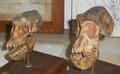 Mesopithecus pentelici skulls
 -
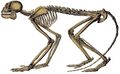 Skeletal restoration

_white_background.jpg)
References
- ↑ Xueping Ji, Dionisios Youlatos, Nina G. Jablonski, Ruliang Pan, Chunxia Zhang, Pei Li, Min Tang, Tengsong Yu, Wenqi Li, Chenglong Deng, Song Li (2020). "Oldest colobine calcaneus from East Asia (Zhaotong, Yunnan, China)". Journal of Human Evolution 147 (102866). doi:10.1016/j.jhevol.2020.102866. PMID 32862123. Bibcode: 2020JHumE.14702866J.
- ↑ 2.0 2.1 2.2 Jablonski, Nina G. (6 August 2020). "Mesopithecus pentelicus from Zhaotong, China, the easternmost representative of a widespread Miocene cercopithecoid species". Journal of Human Evolution 145. doi:10.1016/j.jhevol.2020.102851. PMID 32771770. Bibcode: 2020JHumE.14602851J.
- ↑ Eronen, Jussi T.; Rook, Lorenzo (November 2004). "The Mio-Pliocene European primate fossil record: dynamics and habitat tracking" (in en). Journal of Human Evolution 47 (5): 323–341. doi:10.1016/j.jhevol.2004.08.003. https://linkinghub.elsevier.com/retrieve/pii/S0047248404001137.
- ↑ Palmer, D., ed (1999). The Marshall Illustrated Encyclopedia of Dinosaurs and Prehistoric Animals. London: Marshall Editions. p. 289. ISBN 1-84028-152-9.
- ↑ Alba, David M.; Montoya, Plini; Pina, Marta; Rook, Lorenzo; Abella, Juan; Morales, Jorge; Delson, Eric (November 2015). "First record of Mesopithecus (Cercopithecidae, Colobinae) from the Miocene of the Iberian Peninsula" (in en). Journal of Human Evolution 88: 1–14. doi:10.1016/j.jhevol.2015.08.003. https://linkinghub.elsevier.com/retrieve/pii/S0047248415001979.
- ↑ Pickford, Martin; Gommery, Dominique; Ingicco, Thomas (2023-11-07). "Macaque molar from the Red Crag Formation, Waldringfield, England" (in en). Fossil Imprint 79 (1): 26–36. ISSN 2533-4069. https://www.biotaxa.org/AMNPSBHN/article/view/84147.
- ↑ Youlatos, Dionisios; Koufos, George D. (January 2010). "Locomotor evolution of Mesopithecus (Primates: Colobinae) from Greece: evidence from selected astragalar characters" (in en). Primates 51 (1): 23–35. doi:10.1007/s10329-009-0161-2. ISSN 0032-8332. http://link.springer.com/10.1007/s10329-009-0161-2.
- ↑ Bogdanova, Ralitsa; Youlatos, Dionisios; Spassov, Nikolai (July 2023). "Terrestriality as reflected in the humerus of Mesopithecus delsoni (Cercopithecidae, Colobinae) from Hadjidimovo, Bulgaria" (in en). Journal of Human Evolution 180. doi:10.1016/j.jhevol.2023.103383.
- ↑ Escarguel, Gilles (August 2005). "Mathematics and the Lifeway of Mesopithecus" (in en). International Journal of Primatology 26 (4): 801–823. doi:10.1007/s10764-005-5324-4. ISSN 0164-0291. http://link.springer.com/10.1007/s10764-005-5324-4.
- ↑ Merceron, Gildas; Scott, Jessica; Scott, Robert S.; Geraads, Denis; Spassov, Nikolai; Ungar, Peter S. (December 2009). "Folivory or fruit/seed predation for Mesopithecus, an earliest colobine from the late Miocene of Eurasia?" (in en). Journal of Human Evolution 57 (6): 732–738. doi:10.1016/j.jhevol.2009.06.009. https://linkinghub.elsevier.com/retrieve/pii/S004724840900133X.
- ↑ Solounias, Nikos; Rivals, Florent; Semprebon, Gina M. (1 January 2010). "Dietary interpretation and paleoecology of herbivores from Pikermi and Samos (late Miocene of Greece)" (in en). Paleobiology 36 (1): 113–136. doi:10.1666/0094-8373-36.1.113. ISSN 0094-8373. https://bioone.org/journals/paleobiology/volume-36/issue-1/0094-8373-36.1.113/Dietary-interpretation-and-paleoecology-of-herbivores-from-Pikermi-and-Samos/10.1666/0094-8373-36.1.113.full. Retrieved 19 August 2025.
- ↑ Thiery, Ghislain; Gillet, Geoffrey; Lazzari, Vincent; Merceron, Gildas; Guy, Franck (November 2017). "Was Mesopithecus a seed eating colobine? Assessment of cracking, grinding and shearing ability using dental topography" (in en). Journal of Human Evolution 112: 79–92. doi:10.1016/j.jhevol.2017.09.002.
- ↑ Pan, Hao; Ji, Xueping; Youlatos, Dionisios; Chen, Ying; Zhang, He; Guo, Gaigai; Wang, Jing; Huang, Kang et al. (17 December 2024). "Morphometric Study on the Mandible of Colobine Fossil ( Mesopithecus pentelicus ) Found in East Asia, a Comparison With Extant Taxa" (in en). American Journal of Primatology 87 (1). doi:10.1002/ajp.23706. ISSN 0275-2565. https://onlinelibrary.wiley.com/doi/full/10.1002/ajp.23706. Retrieved 17 December 2024.
External links
- "Rare Mesopithecus skull unearthed in Chalkidiki". http://www.ana.gr/anaweb/user/showplain?maindoc=4469149&maindocimg=4469134&service=10.


Wikidata ☰ Q1944531 entry
 |  |


