Biology:Nicaraguan seed finch
| Nicaraguan seed finch | |
|---|---|

| |
Scientific classification 
| |
| Kingdom: | Animalia |
| Phylum: | Chordata |
| Class: | Aves |
| Order: | Passeriformes |
| Family: | Thraupidae |
| Genus: | Sporophila |
| Species: | S. nuttingi
|
| Binomial name | |
| Sporophila nuttingi (Ridgway, 1884)
| |

| |
| Synonyms | |
|
See text | |
The Nicaraguan seed finch (Sporophila nuttingi) or pink-billed seed finch[2] is a species of bird in the family Thraupidae, the tanagers and allies.. It is found in Costa Rica, Nicaragua and Panama.[3]
Taxonomy and systematics
The Nicaraguan seed finch has a complicated taxonomic history. It was formally described in 1884 with the binomial Oryzoborus nuttingi. At the time Oryzoborus was a member of the family Fringillidae.[4] The specific epithet honors the zoologist Charles Cleveland Nutting.[5] By 1970 the bird had been reassigned as subspecies Oryzoborus crassirostris nuttingi of the large-billed seed finch in the family Emberizidae.[6] By 1998 it had regained its status as a full species.[2] Based on studies published between 1988 and 2011, beginning in 2012 the genus was moved to its present position in the tanager family Thraupidae.[7] In 2014 taxonomic systems began merging Oryzoborus into Sporophila.[8][9]
The Nicaraguan seed finch is monotypic.[3]
Description
The Nicaraguan seed finch is 14 to 14.5 cm (5.5 to 5.7 in) long and weighs about 24 g (0.85 oz). It has a short bill with a very deep base and a rounded culmen. The species is sexually dimorphic. Adult males are almost entirely black with dusky grayish inner webs on the primaries. Females have a dark brown head and upperparts. Their underparts are usually brown and sometimes deep cinnamon brown. Juveniles resemble adult females. Both sexes have a brown iris and blackish legs. Males have an ivory to pink bill and females a blackish bill with a pinkish ivory base to the mandible.[10]
Distribution and habitat
The Nicaraguan seed finch is found on the Caribbean slope from the western Región Autónoma del Atlántico Norte in northeastern Nicaragua south through Costa Rica to Veraguas Province in western Panama.[10][11] It was known only in Nicaragua until the 1960s when a range expansion took it into Costa Rica and Panama, apparently as a result of forests being converted to pastures.[10] The species inhabits "marshy, grassy and weedy areas".[11] These include flooded pastures and tall grass on the edges of oxbow lakes, ponds, and small watercourses.[10] In elevation it ranges from sea level to 500 m (1,600 ft).[2]
Behavior
Movement
The Nicaraguan seed finch is a year-round resident.[2]
Feeding
The Nicaraguan seed finch's diet has not been studied. It is known to include seeds and probably also includes insects and maybe small fruits. It usually forages singly or in pairs in the breeding season; outside that time it forages in small flocks with other seed-eating species.[10]
Breeding
The Nicaraguan seed finch breeds between February and July in Costa Rica. Its nest is a cup made from grass and rootlets with a lining of fungal rhizomorphs and plant fibers. It is typically not far above the ground in a shrub or grasses. The clutch is two eggs that are pale greenish white heavy with brown spots. Nothing else is known about the species' breeding biology.[10]

Vocalization
The Nicaraguan seed finch's song is "a long (ca. 4-10 s) caroling series of notes...mostly slurred whistles, either pure tones or with harmonics...many notes are doubled, some are tripled, and some occur in repeatable sequences". Its call is "a short, sharp chip or check".[10]
Status
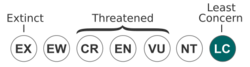
The IUCN has assessed the Nicarguan seed finch as being of Least Concern. It has a large range; its estimated population of at least 50,000 mature individuals is believed to be decreasing. No immediate threats have been identified.[1] It is considered "uncommon to rare" overall and "uncommon" in Costa Rica.[2][12]
References
- ↑ 1.0 1.1 BirdLife International. (2021). "Nicaraguan Seed-finch Sporophila nuttingi". IUCN Red List of Threatened Species 2021. doi:10.2305/IUCN.UK.2021-3.RLTS.T22723522A137075933.en. https://www.iucnredlist.org/species/22723522/137075933. Retrieved 25 September 2026.
- ↑ 2.0 2.1 2.2 2.3 2.4 Check-list of North American Birds (7th ed.). Washington, D.C.: American Ornithologists' Union. 1998. pp. 593.
- ↑ 3.0 3.1 Gill, Frank; Donsker, David; Rasmussen, Pamela, eds (April 2026). "Tanagers and allies". https://www.worldbirdnames.org/new/bow/tanagers/.
- ↑ Ridgway, Robert (1884). "On a collection of Birds from Nicaragua". Proceedings of the United States National Museum (Smithsonian Institution) VI (26): 401. https://www.biodiversitylibrary.org/page/15715312. Retrieved September 25, 2026.
- ↑ James A. Jobling (2026). "The Key to Scientific Names: nuttingi". Cornell Lab of Ornithology. https://birdsoftheworld.org/bow/key-to-scientific-names/search?q=nuttingi.
- ↑ Paynter, Raymond A. Jr, ed (1970). Check-List of Birds of the World. 13. Cambridge, Massachusetts: Museum of Comparative Zoology. p. 148. https://www.biodiversitylibrary.org/page/144833834.
- ↑ Remsen, James Van Jr; Burns, Kevin (November 2011). "Proposal (512) to South American Classification Committee: Transfer genera from Emberizidae to Thraupidae". https://www.museum.lsu.edu/~Remsen/SACCprop512.html. The proposal was accepted in 2012.
- ↑ Mason, Nicholas (November 2013). "Proposal (604) to South American Classification Committee: Merge Oryzoborus and Dolospingus into Sporophila". https://www.museum.lsu.edu/~Remsen/SACCprop604.htm. The proposal was adopted in 2014.
- ↑ R. Terry Chesser, Richard C. Banks, Carla Cicero, Jon L. Dunn, Andrew W. Kratter, Irby J. Lovette, Adolfo G. Navarro-Sigüebzam, Pamela C. Rasmussen, J. V. Remsen, Jr., James D. Rising, Douglas F. Stotz, and Kevin Winker. "Fifty-fifth supplement to the American Ornithologists' Union Check-list of North American Birds". The Auk 2014, vol. 131(4):CSiûCSxv retrieved April 8, 2023
- ↑ 10.0 10.1 10.2 10.3 10.4 10.5 10.6 Schulenberg, T. S. (2020). Nicaraguan Seed-Finch (Sporophila nuttingi), version 1.0. In Birds of the World (T. S. Schulenberg, Editor). Cornell Lab of Ornithology, Ithaca, NY, USA. https://doi.org/10.2173/bow.nisfin1.01 retrieved September 25, 2026
- ↑ 11.0 11.1 vanPerlo, Ber (2006). Birds of Mexico and Central America. Princeton Illustrated Checklists. New Jersey: Princeton University Press. pp. Plate and map 92.19. ISBN 0691120706.
- ↑ Garrigues, Richard; Dean, Robert (2007). The Birds of Costa Rica. Ithaca: Zona Tropical/Comstock/Cornell University Press. pp. 294–295. ISBN 978-0-8014-7373-9.
Wikidata ☰ Q2200163 entry
 |  |


