Biology:Ramalina intermedia
| Ramalina intermedia | |
|---|---|
| File:Ramalina intermedia - Flickr - pellaea (3).jpg | |
Scientific classification 
| |
| Kingdom: | Fungi |
| Division: | Ascomycota |
| Class: | Lecanoromycetes |
| Order: | Lecanorales |
| Family: | Ramalinaceae |
| Genus: | Ramalina |
| Species: | R. intermedia
|
| Binomial name | |
| Ramalina intermedia (Delise ex Nyl.) Nyl. (1873)
| |
| Synonyms[2] | |
| |
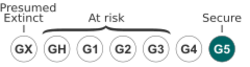
Ramalina intermedia, the rock ramalina,[3] is a species of fruticose lichen in the family Ramalinaceae.[4]
Description
Ramalina intermedia is a fruticose lichen with slender, branched thalli that are primarily attached to a [[Glossary of lichen terms#{{biology:{1}}}|{{Biology:{1}}}]], often trees or rocks, by a small holdfast. Its branches are flattened, sometimes twisted, and have a light greenish-yellow color due to the presence of usnic acid, which is a secondary metabolite common in many lichens. The surface of the thallus is typically covered in tiny, granular structures known as soredia, which serve as a means of asexual reproduction. These soredia are particularly concentrated at the tips of the branches, forming soralia—powdery patches that appear terminally on recurved lobe tips.[5]
Chemically, R. intermedia contains sekikaic acid and homosekikaic acid, with the occasional presence of atranorin, another lichen product. Thin-layer chromatography has confirmed these compounds across various populations, although there can be variations in their concentrations.[5]
The overall structure of R. intermedia is typically isotomic, meaning the branches are of more or less equal length, giving it a symmetrically branched appearance. However, adventive branching may occur after damage to the thallus, leading to irregular branch patterns.[5]
Microscopically, the [[Glossary of lichen terms#{{biology:{1}}}|{{Biology:{1}}}]]—where the symbiotic algae reside—is located beneath a protective upper [[Glossary of lichen terms#{{biology:{1}}}|{{Biology:{1}}}]], allowing the lichen to photosynthesize efficiently. The species lacks sexual reproductive structures like apothecia in most observed specimens in North America, which differentiates it from some similar species.[5]
Compared to other Ramalina species, R. intermedia is smaller, with branches rarely exceeding 3 mm in width. It can be confused with species like Ramalina farinacea due to its morphology, but R. intermedia can be distinguished by its narrower lobes and absence of certain chemical compounds like protocetraric acid.[5]
See also
References
- ↑ NatureServe. "Ramalina intermedia" (in en). Arlington, Virginia. https://explorer.natureserve.org/Taxon/ELEMENT_GLOBAL.2.127198/.
- ↑ "GSD Species Synonymy. Current Name: Ramalina intermedia (Delise ex Nyl.) Nyl., Flora, Regensburg 56(5): 66 (1873)". Species Fungorum. https://www.speciesfungorum.org/GSD/GSDspecies.asp?RecordID=403746.
- ↑ Brodo, Irwin M.; Sharnoff, Sylvia Duran; Sharnoff, Stephen (2001). Lichens of North America. Yale University Press. p. 624. ISBN 978-0-300-08249-4.
- ↑ "Ramalina intermedia (Delise ex Nyl.) Nyl.". Species 2000: Leiden, the Netherlands. https://www.catalogueoflife.org/data/taxon/4RBGJ.
- ↑ 5.0 5.1 5.2 5.3 5.4 Bowler, Peter A.; Rundel, Philip W. (1974). "The Ramalina intermedia complex in North America". The Bryologist 77 (4): 617–623. doi:10.2307/3241808.
Wikidata ☰ Q10648718 entry
 |  |


.jpg)