Biology:Reicheocactus
| Reicheocactus | |
|---|---|
| File:仙人掌-黒斜子 Reicheocactus pseudoreicheanus (Echinopsis famatimensis) -日本大阪鮮花競放館 Osaka Sakuya Konohana Kan, Japan- (40360118800).jpg | |
Scientific classification 
| |
| Kingdom: | Plantae |
| Clade: | Tracheophytes |
| Clade: | Angiosperms |
| Clade: | Eudicots |
| Order: | Caryophyllales |
| Family: | Cactaceae |
| Subfamily: | Cactoideae |
| Tribe: | Cereeae |
| Subtribe: | Trichocereinae |
| Genus: | Reicheocactus Backeb. |
| Species: | R. famatimensis
|
| Binomial name | |
| Reicheocactus famatimensis (Speg.) Schlumpb.
| |
| Synonyms[2] | |
|
List
| |

Reicheocactus is a monotypic genus of cactus in the family Cactaceae, native to north western Argentina. It has only one known species, Reicheocactus famatimensis.[3]
Description
Reicheocactus famatinensis usually grows singly and only occasionally forms cushions. The spherical to short cylindrical shoots reach heights of 3 to 7 centimeters with diameters of 2.5 to 6 centimeters. The shoot apex is strongly sunken. There are 24 to 30 low ribs, which are divided into cusps. The brownish areoles on them are elongated. Central spines are not formed. The seven to nine whitish to yellowish marginal spines have a darker base. They are curved, rest on the surface of the shoot and are up to 0.3 centimeters long. The short, funnel-shaped, yellow to orange flowers are 3 to 3.5 centimeters long.[4]
It is usually solitary or slowly clumping and slow growing. The stems are small flattened-roundish to cylindrical with very short spidery-pectinate spines and egg-yellow flowers.[5]
-
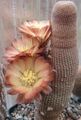 Reicheocactus famatimensis
 -
Flowers

Taxonomy
The genus Reicheocactus was published in Cactaceae (Berlin) 1941(2) on page 76 (published in 1942), and the species was published in Cactaceae Syst. Init. vol.28 on page 30 in 2012.[3]
It was once thought to be a synonym of Rebutia,[6] and commonly found in cactus nurseries as Lobivia famatimensis.[7]
The genus name of Reicheocactus is in honour of Karl Friedrich Reiche (1860-1929), who was a German botanist who worked as a university professor in Chile and Mexico.[8] The Latin specific epithet of famatimensis is derived from Sierra de Famatina, a mountain range and massif in the Andes of the Argentine province of La Rioja.
Distribution
The species grows at elevations of 1,000 to 3,000 m (3,300 to 9,800 ft) meters above sea level. It is found in high altitude grasslands on rocky soils. The species is not common or abundant, however it is difficult to see because of its small size. The major threat for the species is over collection (by plant collectors). The potential development of mining in its natural habitat could affect the populations of the species in the near future.[5]
References
- ↑ "The IUCN Red List of Threatened Species". IUCN Red List of Threatened Species. 2010-09-22. https://www.iucnredlist.org/species/152172/121461584. Retrieved 2023-10-02.
- ↑ "Reicheocactus famatimensis (Speg.) Schlumpb.." (in en). Royal Botanic Gardens, Kew. http://www.plantsoftheworldonline.org/taxon/77122531-1.
- ↑ 3.0 3.1 "Reicheocactus Backeb. | Plants of the World Online | Kew Science" (in en). https://powo.science.kew.org/taxon/urn:lsid:ipni.org:names:295167-2.
- ↑ Anderson, Edward F.; Eggli, Urs (2005) (in de). Das grosse Kakteen-Lexikon. Stuttgart (Hohenheim): Ulmer. p. 228. ISBN 3-8001-4573-1.
- ↑ 5.0 5.1 "Lobivia famatimensis". http://www.llifle.com/Encyclopedia/CACTI/Family/Cactaceae/3315/Lobivia_famatimensis.
- ↑ "List of genera in family Cactaceae", Vascular Plant Families and Genera (Royal Botanic Gardens, Kew), http://data.kew.org/cgi-bin/vpfg1992/genlist.pl?CACTACEAE, retrieved 2013-03-10
- ↑ "Lobivia famatimensis crest" (in en). https://planetdesert.com/products/lobivia-famatimensis-crest.
- ↑ Burkhardt, Lotte (2022) (in German) (pdf). Eine Enzyklopädie zu eponymischen Pflanzennamen. Berlin: Botanic Garden and Botanical Museum, Freie Universität Berlin. doi:10.3372/epolist2022. ISBN 978-3-946292-41-8. https://doi.org/10.3372/epolist2022. Retrieved January 27, 2022.
External links
Other sources
- Urs Eggli, Leonard E. Newton "Etymological Dictionary of Succulent Plant Names". Springer, Berlin/Heidelberg 2010
Wikidata ☰ {{{from}}} entry
 |  |


_-%E6%97%A5%E6%9C%AC%E5%A4%A7%E9%98%AA%E9%AE%AE%E8%8A%B1%E7%AB%B6%E6%94%BE%E9%A4%A8_Osaka_Sakuya_Konohana_Kan,_Japan-_(40360118800).jpg)
