Biology:Rhinoceros hornbill
| Rhinoceros hornbill | |
|---|---|

| |
| A pair in Singapore Zoo | |
Scientific classification 
| |
| Kingdom: | Animalia |
| Phylum: | Chordata |
| Class: | Aves |
| Order: | Bucerotiformes |
| Family: | Bucerotidae |
| Genus: | Buceros |
| Species: | B. rhinoceros
|
| Binomial name | |
| Buceros rhinoceros | |

The rhinoceros hornbill (Buceros rhinoceros) is a large species of forest hornbill. In captivity, it can live for up to 35 years.[3] It is found in lowland and montane, tropical and subtropical climates and in mountain rain forests up to 1,400 metres in the Malay Peninsula from southern Thailand; and the islands of Singapore, Borneo, Sumatra and Java.[1]
The rhinoceros hornbill is the state bird of the Malaysian state of Sarawak and the country's national bird.[4] It is scheduled as a "totally protected animal" under Sarawak law through the 1998 Wild Life Protection Ordinance.[5]
Taxonomy
The rhinoceros hornbill was formally described by the Swedish naturalist Carl Linnaeus in 1758 in the tenth edition of his Systema Naturae. He placed it with the great hornbill in the genus Buceros and coined the binomial name Buceros rhinoceros, where he specified the location as India.[6] The genus name comes from Ancient Greek βοῦς boûs meaning "ox", and κέρας kéras meaning "horn";[7] the species epithet rhinoceros comes from how the species' bill resembles a rhinoceros' horn.[8]
Three subspecies are recognised:[9]
- B. r. borneoensis Schlegel & Müller, S, 1845 – Borneo
- B. r. rhinoceros Linnaeus, 1758 – south Malay Peninsula and Sumatra
- B. r. silvestris Vieillot, 1816 – Java
Description

The rhinoceros hornbill is a large arboreal hornbill, 80 to 90 cm (31–35 in) long.[10] The weight varies by sex, with males weighing around 2,465 to 2,960 g (87.0–104.4 oz) and the females 2,040 to 2,330 g (72–82 oz). The plumage is predominantly black, with white legs and vent and a white tail with a black band. The huge bill and casque are orange and red, the colour coming from preen oil rubbed on from the preen gland above the tail. The eyes of the male are red with black rims, and white with red rims in the female.[11]
Behaviour
Diet and feeding
.jpg)
The diet of the rhinoceros hornbill is dominated by fruit, but it will take any insect, small reptile, rodent, and smaller birds that it can catch.[11]
Breeding
The courtship and bonding of these birds are critical, as the female must trust the male to provide her with everything when she is incubating and raising chicks. These hornbills make their nests inside tree trunks,[12][page needed] and the female stays inside with the eggs and then with the chicks, while the male brings them food. After the eggs are laid, the male collects mud, and the pair pack that mud, along with food and feces, to wall up the entrance to the tree cavity. They leave a very small hole, just large enough for the male to feed the female, and later the chicks, and for the female to defecate through the hole. Once the chicks are fully feathered and old enough to leave the nest, the parents chip away the dry mud to let the chicks out.
There has been recording interbreeding between the rhinoceros hornbill and the great hornbill,[13] with successful raising of the chicks.
Status and conservation
The rhinoceros hornbill faces a number of threats, including loss of its rainforest habitat, as well as hunting for its meat, and its skull and feathers.[1] Habitat destruction has led to the loss of the large trees the species requires for breeding[14], which in turn makes it easier for poachers to find the rhinoceros hornbill. It is frequently shot at by poachers due to confusion with the highly sought-after helmeted hornbill. Due to this, the species was uplisted to vulnerable from near threatened on the IUCN Red List in 2018.[15]
Cultural significance
Some Dayak people, especially the Ibanic groups, believe it to be the chief of worldly birds or the supreme worldly bird, and its statue is used to welcome the god of the augural birds, Sengalang Burong, to the feasts and celebrations of humankind. Contrary to some misunderstandings, the rhinoceros hornbill does not represent their war god, who is represented in this world by the brahminy kite.[16][17]
It is featured on the reverse of the 5 Malaysian ringgit bill.[citation needed]
Gallery

-
 Sepilok Nature Resort - Sabah, Borneo - Malaysia.
 -
Borneo Rainforest Lodge - Danum Valley, Sabah, Borneo - Malaysia.
-
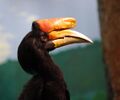 Male at the National Aviary, Pittsburgh. Males have red irises.
 -
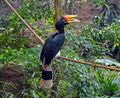 Female at Chester Zoo, England
 -
 Buceros rhinoceros silvestris at Weltvogelpark Walsrode, Germany
 -
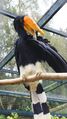 Female at Birdworld, England


_-_Weltvogelpark_Walsrode_2012-01.jpg)

References
- ↑ 1.0 1.1 1.2 BirdLife International (2020). "Buceros rhinoceros". IUCN Red List of Threatened Species 2020. doi:10.2305/IUCN.UK.2020-3.RLTS.T22682450A184960407.en. https://www.iucnredlist.org/species/22682450/184960407. Retrieved 18 November 2021.
- ↑ "Appendices". https://cites.org/eng/app/appendices.php.
- ↑ Misni, A.; Rasam, Abdul Rauf Abdul; Buyadi, S. N. (February 2017). "Spatial analysis of habitat conservation for hornbills: A case study of royal belum-temengor forest complex in Perak State Park, Malaysia". Pertanika: Journal of Social Science and Humanities 25 (S): 11-20. https://www.semanticscholar.org/paper/Spatial-analysis-of-habitat-conservation-for-A-case-Misni-Rasam/a629ad29e0f3d8c376379b793b4845b3a0755eb1?p2df.
- ↑ "Kenyalang - State Bird of Sarawak". Sarawak Tourism Board. http://www.sarawaktourism.com/kenyalang.html.
- ↑ (in en) The Wild Life Protection Ordinance, 1998. Sarawak State Government. 1998. p. 29. https://faolex.fao.org/docs/pdf/mal95115.pdf.
- ↑ Linnaeus, Carl (1758) (in Latin). Systema Naturae per regna tria naturae, secundum classes, ordines, genera, species, cum characteribus, differentiis, synonymis, locis. 1 (10th ed.). Holmiae (Stockholm): Laurentii Salvii. p. 104. https://www.biodiversitylibrary.org/page/727009.
- ↑ Jobling 2010, p. 79.
- ↑ Jobling 2010, p. 334.
- ↑ Gill, Frank; Donsker, David; Rasmussen, Pamela, eds (January 2022). "Mousebirds, Cuckoo Roller, trogons, hoopoes, hornbills". IOC World Bird List Version 12.1. International Ornithologists' Union. https://www.worldbirdnames.org/bow/mousebirds/.
- ↑ Dawson, William R. (2020). "Pine Siskin (Spinus pinus), version 1.0" (in en). Birds of the World. doi:10.2173/bow.pinsis.01. ISSN 2771-3105. https://birdsoftheworld.org/bow/species/pinsis/cur/introduction.
- ↑ 11.0 11.1 Kemp, A C (2001). "Family Bucocerotidae (Hornbills)". in Josep, del Hoyo; Andrew, Elliott; Sargatal, Jordi. Handbook of the Birds of the World. Volume 6, Mousebirds to Hornbills. Barcelona: Lynx Edicions. pp. 436–487. ISBN 978-84-87334-30-6.
- ↑ Law, Yao-Hua (December 2020). "An Enormous Bird Has a Real-Estate Problem". The Atlantic. https://www.theatlantic.com/science/archive/2020/12/helmeted-hornbill-nests-endangered-poaching/617400/. Retrieved 3 March 2024.
- ↑ Ponglikitmongkol, M.; Mudsri, Sitthichai; Poonswad, P. (2013). "HYBRIDISATION IN THE WILD BETWEEN THE GREAT HORNBILL (BUCEROS BICORNIS) AND THE RHINOCEROS HORNBILL (BUCEROS RHINOCEROS) IN THAILAND AND ITS GENETIC ASSESSMENT". Semantic Scholar. https://www.semanticscholar.org/paper/HYBRIDISATION-IN-THE-WILD-BETWEEN-THE-GREAT-AND-THE-Ponglikitmongkol-Mudsri/bc849b0b43c1851fd857ad6bed83f5623d5d7d4e?p2df.
- ↑ "Deforestation and Forest Degradation" (in en-us). https://www.worldwildlife.org/our-work/forests/deforestation-and-forest-degradation/.
- ↑ BirdLife International. "Red List: Northern Bald Ibis, Pink Pigeon making a comeback" (in en-us). BirdLife. https://www.birdlife.org/worldwide/news/red-list-northern-bald-ibis-pink-pigeon-making-comeback.
- ↑ King, Victor T. (1977). "Unity, formalism and structure: Comments on Iban augury and related problems. With a rejoinder by Peter Metcalf". Bijdragen tot de taal-, land- en volkenkunde / Journal of the Humanities and Social Sciences of Southeast Asia 133 (1): 63–89. doi:10.1163/22134379-90002625. https://brill.com/view/journals/bki/133/1/article-p63_5.xml. "Harrisson and Sandin give a slightly different interpretation. They state that the Hornbill image is used to show it, in an independent sense, as 'Chief of the Birds'. According to them it does not represent Lang, but quite simply represents a Hornbill, 'the Supreme Worldly Bird, who welcomes the invisible overhead approach of the God of Birds, Sengalang Burong' (1966: 124).".
- ↑ Sandin, Benedict (1977). Gawai burong: the chants and celebrations of the Iban Bird Festival. Penang, Malaysia: Penerbit Universiti Sains Malaysia.
- Perrins, Christopher, ed (2003). Firefly Encyclopedia of Birds. Firefly Books. ISBN 978-1-55297-777-4. https://archive.org/details/fireflyencyclope0000unse.
Sources
- Jobling, James A. (2010). The Helm Dictionary of Scientific Bird Names. London: Christopher Helm. ISBN 978-1-4081-2501-4. https://archive.org/stream/Helm_Dictionary_of_Scientific_Bird_Names_by_James_A._Jobling#page/n79/mode/1up.
External links
- Downloadable audio file of the sounds of the rhinoceros hornbill
- BBC Radio Programme concerning Hornbills, featuring a section focusing on the Rhinoceros Hornbill, including calls
Wikidata ☰ Q751036 entry
 |  |


