Biology:Silver oriole
| Silver oriole | |
|---|---|

| |
Scientific classification 
| |
| Kingdom: | Animalia |
| Phylum: | Chordata |
| Class: | Aves |
| Order: | Passeriformes |
| Family: | Oriolidae |
| Genus: | Oriolus |
| Species: | O. mellianus
|
| Binomial name | |
| Oriolus mellianus Stresemann, 1922
| |
| Synonyms | |
| |
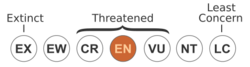
The silver oriole (Oriolus mellianus) is a species of bird in the family Oriolidae. It breeds in southern China and winters in mainland southeast Asia in southeastern Thailand and southwestern Cambodia. It is 28 cm long; males have a black head and wings, and a silvery-white body; females are duller, with the body mid-grey above, and heavily streaked blackish-grey on white below. Both sexes have a pinkish-grey tail and under-tail coverts, dark grey legs and bill, and a white iris.[2]
Its natural habitats are subtropical or tropical moist lowland forest and subtropical or tropical moist montane forest where it is threatened by habitat loss.
Taxonomy and systematics
The silver oriole was originally described by Stresemann as a subspecies of the maroon oriole,[3] but is now treated as a separate species;[2][4] it is very similar, except that the red in the body plumage of the maroon oriole is replaced by silvery white.[2] Genetic evidence has now shown that Stresemann's original assessment was accurate, with silver oriole genetically embedded among the subspecies of maroon oriole; the nominate subspecies of maroon oriole is more closely related to silver oriole, than it is to any of the other maroon oriole subspecies.[5]
Along with the black, black-and-crimson and maroon orioles, silver oriole belongs to a clade of red and black orioles.[6]
References
- ↑ BirdLife International (2025). "Oriolus mellianus". IUCN Red List of Threatened Species 2025. doi:10.2305/IUCN.UK.2025-2.RLTS.T22706449A275507014.en. https://www.iucnredlist.org/species/22706449/275507014.
- ↑ 2.0 2.1 2.2 Hoyo, Josep del; Allen, Richard (2020). All the birds of the world. Barcelona: Lynx Edicions. p. 508. ISBN 978-84-16728-37-4. OCLC 1201502440. https://www.worldcat.org/title/1201502440. Retrieved 2026-09-02.
- ↑ Stresemann, E. (1922). "Oriolus traillii mellianus n. subsp.". Ornithologische Monatsberichte (Verlag von R. Friedländer & Sohn) 30. ISSN 0375-0221. https://www.biodiversitylibrary.org/page/32597935. Retrieved 2026-09-02.
- ↑ "Orioles, drongos, fantails – IOC World Bird List". 2026-04-13. https://www.worldbirdnames.org/new/bow/orioles/.
- ↑ Ernst, Mario; Jønsson, Knud A.; Ericson, Per G. P.; Blom, Mozes P. K.; Irestedt, Martin (2022). "Utilizing museomics to trace the complex history and species boundaries in an avian-study system of conservation concern". Heredity 128 (3): 159–168. doi:10.1038/s41437-022-00499-0. ISSN 0018-067X. PMID 35082388. PMC 8897408. https://www.nature.com/articles/s41437-022-00499-0. Retrieved 2026-09-02.
- ↑ Jønsson, KA; Rauri C. K. Bowie; Robert G. Moyle; Martin Irestedt; Les Christidis; Janette A. Norman; Jon Fjeldsa (2010). "Phylogeny and biogeography of Oriolidae (Aves: Passeriformes)". Ecography 33 (2): 232–241. doi:10.1111/j.1600-0587.2010.06167.x. Bibcode: 2010Ecogr..33..232J. http://www.nrm.se/download/18.25ba04a21296cc434f980005871/J%25C3%25B6nsson%2Bet%2Bal%2BOriolidae.pdf.
Wikidata ☰ Q1587579 entry
 |  |


