Biology:Slender ringtail
| Slender ringtail | |
|---|---|

| |
| Female slender ringtail | |
Scientific classification 
| |
| Kingdom: | Animalia |
| Phylum: | Arthropoda |
| Class: | Insecta |
| Order: | Odonata |
| Suborder: | Zygoptera |
| Family: | Lestidae |
| Genus: | Austrolestes |
| Species: | A. analis
|
| Binomial name | |
| Austrolestes analis (Rambur, 1842)[2]
| |

| |
| Synonyms[3] | |
| |
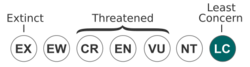
The slender ringtail (Austrolestes analis) is an Australian damselfly in the family Lestidae.[4][1] It is characterized by having a relatively slender body compared to other species in the genus.
Taxonomy
The slender ringtail was first described by Jules Pierre Rambur in 1862.[2][4]
Description
The abdomen is 3-3.2 cm long.[5] Mature males are often pale blue and black although the strength of the blue may vary. Distinguished from other Austrolestes by the pattern on the upper thorax, most closely resembling that of Austrolestes aridus.
Distribution and habitat
It is found in south-western Western Australia, south-eastern South Australia, Victoria, New South Wales[4] and Tasmania.[5]
It is active through Spring to Autumn near lakes, slow flowing rivers and nearby vegetation.[5]
Etymology
The genus name Austrolestes combines the prefix austro- (from Latin auster, meaning “south wind”, hence “southern”) with Lestes, a genus name derived from Greek λῃστής (lēstēs, “robber”).[6]
The species name analis is Latin for "of the anus", likely referring to features of the anal region.[7]
Gallery
-
 Female, Tasmania, Australia
-
 Male, Tasmania, Australia
-
 Mating
-
 Female wings
-
 Male wings


References
- ↑ 1.0 1.1 Dow, R.A. (2017). "Austrolestes analis". IUCN Red List of Threatened Species 2017. doi:10.2305/IUCN.UK.2017-1.RLTS.T14676547A59256823.en. https://www.iucnredlist.org/species/14676547/59256823. Retrieved 20 November 2021.
- ↑ 2.0 2.1 Rambur, Jules (1842) (in fr). Histoire naturelle des insectes. Névroptères. Paris: Librairie Encyclopédique de Roret. pp. 534 [253]. http://gallica.bnf.fr/ark:/12148/bpt6k61025298/f275.image.
- ↑ "World Odonata List". University of Puget Sound. https://www.pugetsound.edu/academics/academic-resources/slater-museum/biodiversity-resources/dragonflies/world-odonata-list2/.
- ↑ 4.0 4.1 4.2 "Species Austrolestes analis (Rambur, 1842)". Australian Biological Resources Study. https://biodiversity.org.au/afd/taxa/Austrolestes_analis.
- ↑ 5.0 5.1 5.2 Daley, Elizabeth; Daley, Anthony (2007). Wings: an introduction to Tasmania's winged insects. Riffles Pty. Ltd. p. 7. ISBN 978-0-9804006-2-5. https://books.google.com/books?id=PQOaPwAACAAJ&q=elizabeth+daley.
- ↑ Endersby, Ian (2012). "Etymology of the Dragonflies (Insecta: Odonata) named by R.J. Tillyard, F.R.S.". Proceedings of the Linnean Society of New South Wales 134: 1-16. https://openjournals.library.sydney.edu.au/LIN/article/view/5941.
- ↑ Endersby, Ian; Fliedner, Heinrich (2015). The Naming of Australia's Dragonflies. Eltham, Victoria, Australia: Busybird Publishing. ISBN 9781925260625. https://www.researchgate.net/publication/283318421_The_Naming_of_Australia's_Dragonflies.
Wikidata ☰ Q2051632 entry
 |  |


