Biology:Synlestes selysi
| Forest needle | |
|---|---|

| |
| Female | |

| |
| Male | |
Scientific classification 
| |
| Kingdom: | Animalia |
| Phylum: | Arthropoda |
| Class: | Insecta |
| Order: | Odonata |
| Suborder: | Zygoptera |
| Family: | Synlestidae |
| Genus: | Synlestes |
| Species: | S. selysi
|
| Binomial name | |
| Synlestes selysi | |

| |
Synlestes selysi is a species of Australian damselfly in the family Synlestidae,[3] commonly known as a forest needle.[4] It is endemic to eastern New South Wales and eastern Queensland, where it inhabits streams.[5]
Synlestes selysi is a large to very large damselfly, coloured a metallic green-black with pale markings. It perches with its wings partially or fully outspread.[6]
Etymology
The genus name Synlestes is derived from the Greek σύν (syn, "together"), combined with Lestes, a genus name derived from the Greek λῃστής (lēstēs, "robber").[7]
In 1917, Robin Tillyard named this species selysi, an eponym honouring Michel Edmond de Sélys Longchamps (1813–1900), a Belgian scientist widely regarded as the leading authority on dragonflies and damselflies.[2][8][9]
Gallery
-
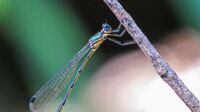 Female
 -
 Female wings
 -
 Male wings

.jpg)
.jpg)
See also
- List of Odonata species of Australia
References
- ↑ Dow, R.A. (2017). "Synlestes selysi". IUCN Red List of Threatened Species 2017. doi:10.2305/IUCN.UK.2017-1.RLTS.T87537484A87540134.en. https://www.iucnredlist.org/species/87537484/87540134. Retrieved 19 November 2021.
- ↑ 2.0 2.1 Tillyard, R.J. (1917). "On some new dragonflies from Australia and Tasmania (Order Odonata)". Proceedings of the Linnean Society of New South Wales 42: 450–479 [473]. doi:10.5962/bhl.part.4860. Bibcode: 1917PLSNS..42..450T. https://www.biodiversitylibrary.org/page/6372412.
- ↑ "Species Synlestes selysi Tillyard, 1917". Australian Biological Resources Study. 2012. https://biodiversity.org.au/afd/taxa/Synlestes_selysi.
- ↑ Theischinger, Günther; Hawking, John (2006). The Complete Field Guide to Dragonflies of Australia. Collingwood, Victoria, Australia: CSIRO Publishing. p. 26. ISBN 978-0-64309-073-6.
- ↑ Theischinger, Gunther; Endersby, Ian (2009). Identification Guide to the Australian Odonata. Department of Environment, Climate Change and Water NSW. p. 237. ISBN 978-1-74232-475-3. http://www.environment.nsw.gov.au/resources/publications/09730AustOdonata.pdf.
- ↑ Watson, J.A.L.; Theischinger, G.; Abbey, H.M. (1991). The Australian Dragonflies: A Guide to the Identification, Distributions and Habitats of Australian Odonata. Melbourne: CSIRO. ISBN 0-643-05136-8.
- ↑ Endersby, Ian; Fliedner, Heinrich (2015). The Naming of Australia's Dragonflies. Eltham, Victoria, Australia: Busybird Publishing. ISBN 9781925260625. https://www.researchgate.net/publication/283318421_The_Naming_of_Australia's_Dragonflies.
- ↑ Endersby, Ian (2012). "Etymology of the Dragonflies (Insecta: Odonata) named by R.J. Tillyard, F.R.S.". Proceedings of the Linnean Society of New South Wales 134: 1-16. https://openjournals.library.sydney.edu.au/LIN/article/view/5941.
- ↑ Hämäläinen, Matti (9 February 2016). "Catalogue of individuals commemorated in the scientific names of extant dragonflies, including lists of all available eponymous species-group and genus-group names – Revised edition". International Dragonfly Fund Report 92: 1–132. ISSN 1435-3393. https://dragonflyfund.org/wp-content/uploads/2024/06/IDF_Report_92_Haemaelaeinen_2016.pdf.
Wikidata ☰ Q2659545 entry
 |  |


