Chemistry:O-Anisidine
| |||
| Names | |||
|---|---|---|---|
| Preferred IUPAC name
2-Methoxyaniline[1] | |||
| Other names
ortho-Anisidine
2-Anisidine ortho-Aminoanisole o-Methoxyaniline 2-Methoxy-1-aminobenzene 2-Methoxyphenylamine | |||
| Identifiers | |||
3D model (JSmol)
|
|||
| ChEBI | |||
| ChEMBL | |||
| ChemSpider | |||
| EC Number |
| ||
| KEGG | |||
PubChem CID
|
|||
| RTECS number |
| ||
| UNII | |||
| UN number | 2431 | ||
| |||
| |||
| Properties[2] | |||
| C7H9NO | |||
| Molar mass | 123.155 g·mol−1 | ||
| Appearance | Yellow liquid, turns brown upon exposure to air | ||
| Density | 1.0923 g/cm3 | ||
| Melting point | 6.2 °C (43.2 °F; 279.3 K) | ||
| Boiling point | 224 °C (435 °F; 497 K) | ||
| 1.5 g/100 ml | |||
| Solubility | soluble in ethanol, diethyl ether, acetone, benzene | ||
| −80.44·10−6 cm3/mol | |||
| Hazards | |||
| Main hazards | potential occupational carcinogen[3] | ||
| GHS pictograms |  
| ||
| GHS Signal word | Danger | ||
| H301, H311, H331, H341, H350 | |||
| P201, P202, P261, P264, P270, P271, P280, P281, P301+310, P302+352, P304+340, P308+313, P311, P312, P321, P322, P330, P361, P363, P403+233, P405, P501 | |||
| NFPA 704 (fire diamond) | |||
| Flash point | 118 °C (244 °F; 391 K) (open cup) | ||
| 415 °C (779 °F; 688 K) | |||
| Lethal dose or concentration (LD, LC): | |||
LD50 (median dose)
|
2000 mg/kg (rat, oral) 1400 mg/kg (mouse, oral) 870 mg/kg (rabbit, oral)[4] | ||
| NIOSH (US health exposure limits): | |||
PEL (Permissible)
|
TWA 0.5 mg/m3 [skin][3] | ||
REL (Recommended)
|
: Ca TWA 0.5 mg/m3 [skin][3] | ||
IDLH (Immediate danger)
|
50 mg/m3[3] | ||
| Related compounds | |||
Related compounds
|
m-Anisidine p-Anisidine | ||
Except where otherwise noted, data are given for materials in their standard state (at 25 °C [77 °F], 100 kPa). | |||
 verify (what is   ?) | |||
| Infobox references | |||


o-Anisidine (2-anisidine) is an organic compound with the formula CH3OC6H4NH2. A colorless liquid, commercial samples can appear yellow owing to air oxidation. It is one of three isomers of the methoxy-containing aniline derivative. It is a building block for other more complex compounds.[5]
Production and use
It is prepared via methanolysis of 2-chloronitrobenzene:[6]
- NaOCH3 + ClC6H4NO2 → CH3OC6H4NO2 + NaCl
The resulting o-nitroanisole is reduced to o-anisidine.
o-Anisidine is used in the manufacture of dyes. It is nitrated to give 4-nitroanisidine. It is also a precursor to o-dianisidine.
One special use is as a heartwood indicator. An acid solution of o-anisidine is diazotized by adding a sodium nitrite solution. This mixture is applied to the wood and by reaction with polyphenols in the heartwood a reddish brown azo dye is formed.
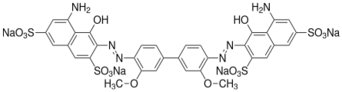
Direct Blue 15 is an azo dye produced from o-anisidine

Safety and environmental aspects
o-Anisidine is a dangerous pollutant from the production of dyes. It is listed as RCRA hazardous waste, with the code K181.[7] The International Agency for Research on Cancer (IARC) has classified o-anisidine as a Group 2B, possible human carcinogen.[8]
References
- ↑ Nomenclature of Organic Chemistry : IUPAC Recommendations and Preferred Names 2013 (Blue Book). Cambridge: The Royal Society of Chemistry. 2014. p. 669. doi:10.1039/9781849733069-00648. ISBN 978-0-85404-182-4. "The names ‘toluidine’, ‘anisidine’, and ‘phenetidine’ for which o-, m-, and p- have been used to distinguish isomers, and ‘xylidine’ for which numerical locants, such as 2,3-, have been used, are no longer recommended, nor are the corresponding prefixes ‘toluidine’, ‘anisidino’, ‘phenetidine’, and ‘xylidino’."
- ↑ Weast, Robert C., ed (1981). CRC Handbook of Chemistry and Physics (62nd ed.). Boca Raton, FL: CRC Press. p. C-98. ISBN 0-8493-0462-8.
- ↑ 3.0 3.1 3.2 3.3 NIOSH Pocket Guide to Chemical Hazards. "#0034". National Institute for Occupational Safety and Health (NIOSH). https://www.cdc.gov/niosh/npg/npgd0034.html.
- ↑ "o-Anisidine". Immediately Dangerous to Life and Health Concentrations (IDLH). National Institute for Occupational Safety and Health (NIOSH). https://www.cdc.gov/niosh/idlh/90040.html.
- ↑ Vallée, Frédéric (2011). "O -Methoxyaniline". Encyclopedia of Reagents for Organic Synthesis. doi:10.1002/047084289x.rn01320. ISBN 978-0-471-93623-7.
- ↑ Gerald Booth (2007). Ullmann's Encyclopedia of Industrial Chemistry. Weinheim: Wiley-VCH. doi:10.1002/14356007.a17_411. ISBN 978-3527306732.
- ↑ "Hazardous Waste". 2015-07-23. http://www.epa.gov/osw/hazard/wastetypes/wasteid/dyes/index.htm.
- ↑ "o-Anisidine". https://pubchem.ncbi.nlm.nih.gov/compound/o-anisidine#section=Top.
External links
- International Chemical Safety Card 0970
- NIOSH Pocket Guide to Chemical Hazards. "#0034". National Institute for Occupational Safety and Health (NIOSH). https://www.cdc.gov/niosh/npg/npgd0034.html.
 |  |


