Earth:Dawn
Dawn is the time that marks the beginning of twilight before sunrise. It is recognized by the appearance of indirect sunlight being scattered in Earth's atmosphere, when the centre of the Sun's disc has reached 18° below the observer's horizon.[1] This morning twilight period will last until sunrise (when the Sun's upper limb breaks the horizon), when direct sunlight outshines the diffused light.

Etymology
"Dawn" derives from the Old English verb dagian, "to become day".[3]
Types of dawn
Dawn begins with the first sight of lightness in the morning, and continues until the Sun breaks the horizon. The morning twilight is divided in three phases, which are determined by the angular distance of the centre of the Sun (degrees below the horizon) in the morning. These are astronomical, nautical and civil twilight.
Astronomical dawn

Astronomical dawn begins when the center of the Sun is 18 degrees below the horizon in the morning. Astronomical twilight follows instantly until the center of the Sun is 12 degrees below the horizon.[5] At this point, a very small portion of the Sun's rays illuminate the sky and the fainter stars begin to disappear. Astronomical dawn is often indistinguishable from night, especially in areas with light pollution. Astronomical dawn marks the beginning of astronomical twilight, which lasts until nautical dawn.[6]
Nautical dawn
Nautical twilight begins when there is enough light for sailors to distinguish the horizon at sea, but the sky is still too dark to perform outdoor activities. It begins when the center of the Sun is 12 degrees below the horizon in the morning. Nautical dawn marks the start of nautical twilight, which lasts until civil dawn.[6][5]
Civil dawn

Civil dawn begins when there is enough light for most objects to be distinguishable, so that some outdoor activities can commence. It occurs when the center of the Sun is 6 degrees below the horizon in the morning.[5]
When the sky is clear, it is blue colored, and if there are clouds or haze, bronze, orange and yellow colors are seen. Some bright stars and planets such as Venus and Jupiter are still visible to the naked eye at civil dawn. This moment marks the start of civil twilight, which lasts until sunrise.[6]
Effects of latitude
The duration of the morning twilight (i.e. between astronomical dawn and sunrise) varies greatly depending on the observer's latitude: from a little over 70 minutes at the Equator, to many hours in the polar regions.[7][8]
The Equator
Polar regions
The polar circle (at 66°33′51.1″ north or south) is defined as the lowest latitude at which the Sun does not set at the summer solstice. Therefore, the angular radius of the polar circle is equal to the angle between Earth's equatorial plane and the ecliptic plane. This period of time with no sunset lengthens closer to the pole.
Example
Mythology and religion
In Islam, Zodiacal Light is referred to as False Dawn (Al-Fajr Al-Kadhib, Arabic الفجر الكاذب) and Astronomical dawn is called True Dawn (Al-Fajr As-Sadiq, Arabic الفجر الصادق), and it is the time of first prayer of the day, and the beginning of the daily fast during Ramadan.[9]
Many Indo-European mythologies have a dawn goddess, separate from the male Solar deity, her name deriving from PIE *h2ausos-, derivations of which include Greek Eos, Roman Aurora and Indian Ushas. Also related is Lithuanian Aušrinė, and possibly a Germanic *Austrōn- (whence the term Easter).
Jesus in the Bible is often symbolized by dawn in the morning, also when Jesus rose on the third day it happened during the morning.[10] Prime is the fixed time of prayer of the traditional Divine Office (Canonical Hours) in Christian liturgy, said at the first hour of daylight. Associated with Jesus, in Christianity, Christian burials take place in the direction of dawn. In Judaism, the question of how to calculate dawn (Hebrew Alos/ HaShachar, or Alos/{{not a typo|Alot} Talmud,[11] as it has many ramifications for Jewish law (such as the possible start time for certain daytime commandments, like prayer). The simple reading of the Talmud is that dawn takes place 72 minutes before sunrise. Others, including the Vilna Gaon, have the understanding that the Talmud's timeframe for dawn was referring specifically to an equinox day in Mesopotamia, and is therefore teaching that dawn should be calculated daily as commencing when the Sun is 16.1 degrees below the horizon. The longstanding practice among most Sephardic Jews is to follow the first opinion, while many Ashkenazi Jews follow the latter view.
In art
-
 L'Aurore by William-Adolphe Bouguereau, 1881
 -
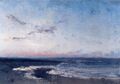 L'aurore, Mer du Nord by Guillaume Vogels, c. 1877


In literature
- Homer uses the stock epithet "rosy-fingered Dawn" frequently in The Iliad and The Odyssey
- An aubade (Occitan Alba, German Tagelied) is a song about lovers having to separate at daybreak
- Aurora Musis amica (Dawn is a friend to the Muse), in Epigrammata Disticha Poetarum Latinorum, Veterum et Recentum, Nobiliora (1642) by Barthold Nihus[12]
- The Dawn, volume 1 on Jean-Christophe written by Romain Rolland
- Dawn, a novel written by Henry Rider Haggard, published in 1884
- "Dawn", a poem written by Rupert Brooke published in The Collected Poems of Rupert Brooke
- "Dawn", a poem written by Richard Aldington
- "Dawn", a poem written by Emily Dickinson
- "Dawn", a poem written by Francis Ledwidge
- "Dawn", a poem written by John Masefield
- "Dawn", a poem written by William Carlos Williams[13]
- I Greet the Dawn: Poems, a book of poetry written by Paul Laurence Dunbar, published January 1, 1978, by Atheneum Books
- "Dawn", a four-line poem from Lyrics of Lowly Life, a book of poetry written by Paul Laurence Dunbar, originally published in 1896. This poem was published again in The Complete Poems of Paul Laurence Dunbar, the 1913 collection of his work--
- An angel, robed in spotless white,
- Bent down and kissed the sleeping Night.
- Night woke to blush; the sprite was gone.
- Men saw the blush and called it Dawn.
- -Dawn by Paul Laurence Dunbar
- Men saw the blush and called it Dawn.
See also
References
- ↑ "The different types of twilight". https://www.timeanddate.com/astronomy/different-types-twilight.html.
- ↑ Van Flandern, T.; K. Pulkkinen (1980). "Low precision formulae for planetary positions". Astrophysical Journal Supplement Series 31 (3): 391. doi:10.1086/190623. Bibcode: 1979ApJS...41..391V.
- ↑ Harper, Douglas. "dawn". Online Etymology Dictionary. https://www.etymonline.com/?term=dawn. Retrieved 2024-05-06.
- ↑ "New Dawn at La Silla". ESO Picture of the Week. European Southern Observatory. http://www.eso.org/public/images/potw1507a/.
- ↑ 5.0 5.1 5.2 National Oceanic and Atmospheric Administration. "Astronomical Terms". http://www.srh.noaa.gov/ffc/?n=gloss3.
- ↑ 6.0 6.1 6.2 "Dawn – Definition and Meaning". https://www.timeanddate.com/astronomy/dawn.html.
- ↑ "For how long does the twilight last?". https://stjerneskinn.com/for-how-long-does-the-twilight-last.htm.
- ↑ Meeus, Jean. Astronomical Algorithms. pp. 101–104.
- ↑ "When Does Fajr Start?" (in en). https://islamqa.info/en/answers/93160/when-does-fajr-start.
- ↑ "46 Bible verses about Dawn". https://bible.knowing-jesus.com/topics/Dawn.
- ↑ Pesachim 94a
- ↑ Nihus, Barthold (1642). Epigrammata disticha. Johannes Kinckius. https://books.google.com/books?id=_nMTAAAAQAAJ&pg=PT110.
- ↑ Williams, W. C., Dawn, poetry.com, accessed 10 September 2022
External links
Parts of a day | |||
|---|---|---|---|
 |  | ||
 |  |


