Physics:Quantum heat engines
Template:Infobox technology A quantum heat engine generates power from heat flow between hot and cold reservoirs, operating under the principles of quantum mechanics.
History
Scovil and Schulz-DuBois first connected the quantum amplifier to Carnot efficiency in 1959, building a quantum heat engine with a 3-level maser.[1] Geusic, Schulz-DuBois, De Grasse, and Scovil proposed quantum refrigerators, which pump heat from a cold to a hot reservoir using power, in the same year.[2] Wineland and Hänsch suggested laser-driven processes, termed optical pumping or laser cooling.[3][4][5] Alicki reported that heat engines and refrigerators can function at the single-particle scale, necessitating quantum thermodynamics.[6]
3-level amplifier

A 3-level amplifier uses hot and cold reservoirs to maintain population inversion between two energy levels, amplifying light via stimulated emission.[7] The ground level (1-g) and excited level (3-h) connect to a hot reservoir at temperature
, with an energy gap
. At equilibrium, the population ratio is:
where
is the Planck constant, and
is the Boltzmann constant. A cold reservoir at temperature
couples the ground level (1-g) to an intermediate level (2-c), with an energy gap
. At equilibrium:
The device amplifies when levels 3-h and 2-c couple to an external field of frequency
. Efficiency, defined as the ratio of work output to heat input, is:
Amplification requires population inversion:
equivalent to:
This leads to an efficiency limit:
where
is the Carnot cycle efficiency, achieved at zero gain (
). Reversing the process creates a refrigerator, with a coefficient of performance (COP):
Types
Quantum devices operate either continuously or via reciprocating cycles. Continuous devices include solar cells, thermoelectric devices (outputting current), and lasers (outputting coherent light). Continuous refrigerators use optical pumping or laser cooling.[8][9] Reciprocating devices, such as four-stroke or two-stroke machines, mimic classical engines with non-commuting strokes. Common cycles include the Carnot cycle[10][11] and Otto cycle.[12] These cycles yield equations of motion for the working medium and heat flux.
Reciprocating
Researchers studied quantum versions of thermodynamic cycles, including the Carnot cycle,[10][11][13] Stirling cycle,[14] and Otto cycle.[12][15] The Otto cycle serves as a model for other reciprocating cycles.
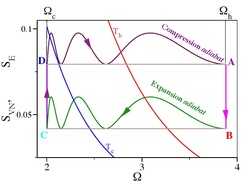
The Otto cycle consists of four segments:
- Segment : Isomagnetic or isochoric process, partial equilibration with the cold reservoir, described by propagator .
- Segment : Magnetization or adiabatic compression, expanding energy level gaps in the Hamiltonian, described by propagator .
- Segment : Isomagnetic or isochoric process, partial equilibration with the hot reservoir, described by propagator .
- Segment : Demagnetization or adiabatic expansion, reducing energy gaps, described by propagator . The cycle's propagator is:
Propagators are linear operators that define the working medium's state. Consecutive propagators do not commute (), ensuring non-zero power. The working medium, such as spin systems[16] or harmonic oscillators,[17] requires optimized cycle time. At long cycle times (), the engine operates quasi-adiabatically, with efficiency , below Carnot efficiency. At high temperatures, efficiency at maximum power is , matching endoreversible thermodynamics.[17] Short cycle times cause friction-like effects due to non-adiabatic changes, increasing power demands and coherence-induced dissipation. Frictionless solutions exist for finite-time adiabatic expansion/compression.[18][19] Optimal performance occurs when coherence is minimized. At very short cycle times (), coherence enhances power.[20] Allahverdyan, Hovhannisyan, and Mahler proposed a two-stroke quantum cycle using two qubits with frequencies and . The first stroke partially equilibrates the qubits with hot and cold reservoirs. The second stroke swaps qubit states, preserving entropy and generating power.[21][22] Quantum Otto cycle refrigerators align with magnetic refrigeration.[23]
Continuous
Continuous engines, analogous to turbines, couple to an external periodic field, typically the electromagnetic field, modeling a laser.[9] Models vary by working medium and heat reservoirs. Studied systems include two-level,[24] three-level,[25] four-level,[26][27] and coupled harmonic oscillators.[28] Periodic driving splits the energy levels, enabling selective coupling to reservoirs and power production. Ignoring this splitting in equations of motion violates the second law of thermodynamics.[29] Scully proposed non-thermal fuels, such as coherence or squeezed thermal baths, to increase the hot reservoir's energy without raising entropy, complying with the second law.[30][31]
Equivalence of heat machines
Uzdin, Levy, and Kosloff reported that two-stroke, four-stroke, and continuous quantum engines become thermodynamically equivalent in a quantum regime, producing identical work and heat with the same efficiency, driven by coherent work extraction without a classical analogue. Klatzow and others experimentally confirmed these quantum effects.[32][33]
Open systems
Elementary quantum heat engines operate near equilibrium, with discrete energy levels as their primary quantum feature. Realistic devices, operating out of equilibrium, experience friction, heat leaks, and finite heat flow. Quantum thermodynamics provides a dynamical framework for such systems. Open quantum system theory describes the working medium's dynamics, tracing out the reservoirs. The total Hamiltonian is: where is time-dependent. The reduced equation of motion is: where is the density operator, and represents dissipative dynamics. Energy change is: yielding the dynamical first law of thermodynamics:[6] * Power: * Heat currents: , . Entropy production rate is: A thermodynamically consistent derivation uses the weak coupling limit, assuming uncorrelated system and reservoirs: The equation of motion becomes: where is the Liouville superoperator, often in the Gorini-Kossakowski-Sudarshan-Lindblad form.[34] Strong coupling theories also exist.[35][36][37]
Refrigerators
Absorption
The absorption refrigerator, an autonomous quantum device, requires no external power or intervention.[38][39][40] It uses three reservoirs: power (
), hot (
), and cold (
).

The tricycle model uses three oscillators:
with resonance condition
. The refrigerator removes excitations from the cold and power reservoirs, generating an excitation in the hot reservoir. The interaction Hamiltonian is:
where
is the coupling strength. Energy balance follows the first law of thermodynamics:
At steady state,
. Entropy production, per the second law of thermodynamics, is:
When
, the power reservoir produces no entropy, yielding pure power:
. Aamir and others implemented this in a superconducting circuit to reset a Qubit.[41]
Quantum
Nernst proposed two formulations of the third law of thermodynamics. The Nernst heat theorem states that a pure substance's entropy approaches zero as temperature nears absolute zero. The unattainability principle states that no procedure can cool a system to absolute zero in finite operations.[42] At steady state, the second law of thermodynamics requires non-negative entropy production. As the cold reservoir approaches absolute zero, entropy production must scale as: The third law strengthens this to , ensuring zero entropy production at absolute zero (), with heat current scaling as . The unattainability principle, rephrased by Levy, Alicki, and Kosloff, states that no refrigerator can reach absolute zero in finite time.[43] Cooling dynamics follow:
where is the reservoir's heat capacity. With and (), the cooling exponent is: If , cooling to absolute zero in finite time violates the third law, making the unattainability principle more restrictive than the Nernst heat theorem.
Reciprocating devices have been suggested operating by either the Carnot cycle[10][11] or the Otto cycle.[12]
In both types the quantum description allows to obtain equation of motion for the working medium and the heat flux.
when the cycle is completed they all turn out to provide the same amount of work and consume the same amount of heat (hence they share the same efficiency as well). This equivalence is associated with a coherent work extraction mechanism and has no classical analogue. These quantum features have been demonstrated experimentally.[33]
References
- ↑ Scovil, H. E. D.; Schulz-DuBois, E. O. (1959). "Three-Level Masers as Heat Engines". Physical Review Letters 2 (6): 262–263. doi:10.1103/PhysRevLett.2.262. ISSN 0031-9007. Bibcode: 1959PhRvL...2..262S.
- ↑ Geusic, J. E.; Bois, E. O. Schulz-Du; De Grasse, R. W.; Scovil, H. E. D. (1959). "Three Level Spin Refrigeration and Maser Action at 1500 mc/sec". Journal of Applied Physics 30 (7): 1113–1114. doi:10.1063/1.1776991. ISSN 0021-8979. Bibcode: 1959JAp....30.1113G.
- ↑ D. J. Wineland; H. Dehmelt (1975). "Proposed 1014Δν < ν Laser Fluorescence Spectroscopy on Tl+ Mono-Ion Oscillator III". Bull. Am. Phys. Soc. 20: 637. https://tf.nist.gov/general/pdf/2208.pdf.
- ↑ Hänsch, T. W.; Schawlow, A. L. (1975). "Cooling of gases by laser radiation". Optics Communications 13 (1): 68–69. doi:10.1016/0030-4018(75)90159-5. ISSN 0030-4018. Bibcode: 1975OptCo..13...68H.
- ↑ Letokhov, V. S.; Minogin, V. G.; Pavlik, B. D. (1976). "Cooling and trapping of atoms and molecules by a resonant laser field". Optics Communications 19 (1): 72–75. doi:10.1016/0030-4018(76)90388-6. ISSN 0030-4018. Bibcode: 1976OptCo..19...72L.
- ↑ 6.0 6.1 Alicki, R. (1979). "The quantum open system as a model of the heat engine". Journal of Physics A: Mathematical and General 12 (5): L103–L107. doi:10.1088/0305-4470/12/5/007. ISSN 0305-4470. Bibcode: 1979JPhA...12L.103A.
- ↑ Yariv, Amnon (1989). Quantum Electronics, 3rd ed., Wiley. ISBN 0-471-60997-8.
- ↑ Narevicius, Edvardas; Bannerman, S Travis; Raizen, Mark G (2009). "Single-photon molecular cooling". New Journal of Physics 11 (5). doi:10.1088/1367-2630/11/5/055046. ISSN 1367-2630. Bibcode: 2009NJPh...11e5046N.
- ↑ 9.0 9.1 Kosloff, Ronnie; Levy, Amikam (2014). "Quantum Heat Engines and Refrigerators: Continuous Devices". Annual Review of Physical Chemistry 65 (1): 365–393. doi:10.1146/annurev-physchem-040513-103724. ISSN 0066-426X. PMID 24689798. Bibcode: 2014ARPC...65..365K.
- ↑ 10.0 10.1 10.2 Geva, Eitan; Kosloff, Ronnie (1992). "A quantum-mechanical heat engine operating in finite time. A model consisting of spin-1/2 systems as the working fluid". The Journal of Chemical Physics 96 (4): 3054–3067. doi:10.1063/1.461951. ISSN 0021-9606. Bibcode: 1992JChPh..96.3054G.
- ↑ 11.0 11.1 11.2 Bender, Carl M; Brody, Dorje C; Meister, Bernhard K (2000). "Quantum mechanical Carnot engine". Journal of Physics A: Mathematical and General 33 (24): 4427–4436. doi:10.1088/0305-4470/33/24/302. ISSN 0305-4470. Bibcode: 2000JPhA...33.4427B.
- ↑ 12.0 12.1 12.2 Feldmann, Tova; Kosloff, Ronnie (2000). "Performance of discrete heat engines and heat pumps in finite time". Physical Review E 61 (5): 4774–4790. doi:10.1103/PhysRevE.61.4774. ISSN 1063-651X. PMID 11031518. Bibcode: 2000PhRvE..61.4774F.
- ↑ Quan, H. T.; Liu, Yu-xi; Sun, C. P.; Nori, Franco (2007). "Quantum thermodynamic cycles and quantum heat engines". Physical Review E 76 (3). doi:10.1103/PhysRevE.76.031105. ISSN 1539-3755. PMID 17930197. Bibcode: 2007PhRvE..76c1105Q.
- ↑ Wu, F.; Chen, L.; Sun, F.; Wu, C.; Zhu, Yonghong (1998). "Performance and optimization criteria for forward and reverse quantum Stirling cycles". Energy Conversion and Management 39 (8): 733–739. doi:10.1016/S0196-8904(97)10037-1. ISSN 0196-8904. Bibcode: 1998ECM....39..733W.
- ↑ Kieu, T. D. (2006). "Quantum heat engines, the second law and Maxwell's daemon". The European Physical Journal D 39 (1): 115–128. doi:10.1140/epjd/e2006-00075-5. ISSN 1434-6060. Bibcode: 2006EPJD...39..115K.
- ↑ Feldmann, Tova; Kosloff, Ronnie (2003). "Quantum four-stroke heat engine: Thermodynamic observables in a model with intrinsic friction". Physical Review E 68 (1). doi:10.1103/PhysRevE.68.016101. ISSN 1063-651X. PMID 12935194. Bibcode: 2003PhRvE..68a6101F.
- ↑ 17.0 17.1 Rezek, Yair; Kosloff, Ronnie (2006). "Irreversible performance of a quantum harmonic heat engine". New Journal of Physics 8 (5): 83. doi:10.1088/1367-2630/8/5/083. ISSN 1367-2630. Bibcode: 2006NJPh....8...83R.
- ↑ Campo, A. del; Goold, J.; Paternostro, M. (2014). "More bang for your buck: Super-adiabatic quantum engines". Scientific Reports 4 (1): 6208. doi:10.1038/srep06208. ISSN 2045-2322. PMID 25163421. Bibcode: 2014NatSR...4.6208C.
- ↑ Beau, Mathieu; Jaramillo, Juan; del Campo, Adolfo (2016). "Scaling-Up Quantum Heat Engines Efficiently via Shortcuts to Adiabaticity". Entropy 18 (5): 168. doi:10.3390/e18050168. ISSN 1099-4300. Bibcode: 2016Entrp..18..168B.
- ↑ Feldmann, Tova; Kosloff, Ronnie (2012). "Short time cycles of purely quantum refrigerators". Physical Review E 85 (5). doi:10.1103/PhysRevE.85.051114. ISSN 1539-3755. PMID 23004710. Bibcode: 2012PhRvE..85e1114F.
- ↑ Allahverdyan, Armen E.; Hovhannisyan, Karen; Mahler, Guenter (2010). "Optimal refrigerator". Physical Review E 81 (5). doi:10.1103/PhysRevE.81.051129. ISSN 1539-3755. PMID 20866207. Bibcode: 2010PhRvE..81e1129A.
- ↑ Uzdin, Raam; Kosloff, Ronnie (2014). "The multilevel four-stroke swap engine and its environment". New Journal of Physics 16 (9). doi:10.1088/1367-2630/16/9/095003. ISSN 1367-2630. Bibcode: 2014NJPh...16i5003U.
- ↑ Shirron, Peter J.; McCammon, Dan (2014). "Salt pill design and fabrication for adiabatic demagnetization refrigerators". Cryogenics 62: 163–171. doi:10.1016/j.cryogenics.2014.03.022. ISSN 0011-2275. Bibcode: 2014Cryo...62..163S.
- ↑ Gelbwaser-Klimovsky, D.; Alicki, R.; Kurizki, G. (2013). "Minimal universal quantum heat machine". Physical Review E 87 (1). doi:10.1103/PhysRevE.87.012140. ISSN 1539-3755. PMID 23410316. Bibcode: 2013PhRvE..87a2140G.
- ↑ Geva, Eitan; Kosloff, Ronnie (1996). "The quantum heat engine and heat pump: An irreversible thermodynamic analysis of the three-level amplifier". The Journal of Chemical Physics 104 (19): 7681–7699. doi:10.1063/1.471453. ISSN 0021-9606. Bibcode: 1996JChPh.104.7681G.
- ↑ Scully, M. O.; Chapin, K. R.; Dorfman, K. E.; Kim, M. B.; Svidzinsky, A. (2011). "Quantum heat engine power can be increased by noise-induced coherence". Proceedings of the National Academy of Sciences 108 (37): 15097–15100. doi:10.1073/pnas.1110234108. ISSN 0027-8424. PMID 21876187. Bibcode: 2011PNAS..10815097S.
- ↑ Harbola, Upendra; Rahav, Saar; Mukamel, Shaul (2012). "Quantum heat engines: A thermodynamic analysis of power and efficiency". EPL (Europhysics Letters) 99 (5). doi:10.1209/0295-5075/99/50005. ISSN 0295-5075. Bibcode: 2012EL.....9950005H. https://epljournal.edpsciences.org/10.1209/0295-5075/99/50005/pdf.
- ↑ Kosloff, Ronnie (1984). "A quantum mechanical open system as a model of a heat engine". The Journal of Chemical Physics 80 (4): 1625–1631. doi:10.1063/1.446862. ISSN 0021-9606. Bibcode: 1984JChPh..80.1625K.
- ↑ Szczygielski, Krzysztof; Gelbwaser-Klimovsky, David; Alicki, Robert (2013). "Markovian master equation and thermodynamics of a two-level system in a strong laser field". Physical Review E 87 (1). doi:10.1103/PhysRevE.87.012120. ISSN 1539-3755. PMID 23410296. Bibcode: 2013PhRvE..87a2120S.
- ↑ Scully, M. O. (2003). "Extracting Work from a Single Heat Bath via Vanishing Quantum Coherence". Science 299 (5608): 862–864. doi:10.1126/science.1078955. ISSN 0036-8075. PMID 12511655. Bibcode: 2003Sci...299..862S.
- ↑ Roßnagel, J.; Abah, O.; Schmidt-Kaler, F.; Singer, K.; Lutz, E. (2014). "Nanoscale Heat Engine Beyond the Carnot Limit". Physical Review Letters 112 (3). doi:10.1103/PhysRevLett.112.030602. ISSN 0031-9007. PMID 24484127. Bibcode: 2014PhRvL.112c0602R.
- ↑ Uzdin, Raam; Levy, Amikam; Kosloff, Ronnie (2015). "Equivalence of Quantum Heat Machines, and Quantum-Thermodynamic Signatures". Physical Review X 5 (3). doi:10.1103/PhysRevX.5.031044. ISSN 2160-3308. Bibcode: 2015PhRvX...5c1044U.
- ↑ 33.0 33.1 Klatzow, James; Becker, Jonas N; Ledingham, Patrick M; Weinzetl, Christian; Kaczmarek, Krzysztof T; Saunders, Dylan J; Nunn, Joshua; Walmsley, Ian A et al. (2019). "Experimental demonstration of quantum effects in the operation of microscopic heat engines". Physical Review Letters 122 (11). doi:10.1103/PhysRevLett.122.110601. ISSN 1079-7114. PMID 30951320. Bibcode: 2019PhRvL.122k0601K.
- ↑ Kosloff, Ronnie (2013). "Quantum Thermodynamics: A Dynamical Viewpoint". Entropy 15 (12): 2100–2128. doi:10.3390/e15062100. ISSN 1099-4300. Bibcode: 2013Entrp..15.2100K.
- ↑ Ludovico, M. F.; Lim, J. S.; Moskalets, M.; Arrachea, L.; Sánchez, D. (21 April 2014). "Dynamical energy transfer in ac-driven quantum systems". Physical Review B 89 (16). doi:10.1103/PhysRevB.89.161306. Bibcode: 2014PhRvB..89p1306L.
- ↑ Gallego, R; Riera, A; Eisert, J (2014). "Thermal machines beyond the weak coupling regime". New Journal of Physics 16 (12). doi:10.1088/1367-2630/16/12/125009. ISSN 1367-2630. Bibcode: 2014NJPh...16l5009G.
- ↑ Esposito, Massimiliano; Ochoa, Maicol A.; Galperin, Michael (2015). "Quantum Thermodynamics: A Nonequilibrium Green's Function Approach". Physical Review Letters 114 (8). doi:10.1103/PhysRevLett.114.080602. ISSN 0031-9007. PMID 25768745. Bibcode: 2015PhRvL.114h0602E.
- ↑ Palao, José P.; Kosloff, Ronnie; Gordon, Jeffrey M. (2001). "Quantum thermodynamic cooling cycle". Physical Review E 64 (5). doi:10.1103/PhysRevE.64.056130. ISSN 1063-651X. PMID 11736037. Bibcode: 2001PhRvE..64e6130P.
- ↑ Linden, Noah; Popescu, Sandu; Skrzypczyk, Paul (2010). "How Small Can Thermal Machines Be? The Smallest Possible Refrigerator". Physical Review Letters 105 (13). doi:10.1103/PhysRevLett.105.130401. ISSN 0031-9007. PMID 21230755. Bibcode: 2010PhRvL.105m0401L.
- ↑ Levy, Amikam; Kosloff, Ronnie (2012). "Quantum Absorption Refrigerator". Physical Review Letters 108 (7). doi:10.1103/PhysRevLett.108.070604. ISSN 0031-9007. PMID 22401189. Bibcode: 2012PhRvL.108g0604L.
- ↑ Aamir, Mohammed Ali; Suria, Paul Jamet; Guzmán, José Antonio Marín; Castillo-Moreno, Claudia; Epstein, Jeffrey M; Halpern, Nicole Yunger; Gasparinetti, Simone (2025). "Thermally driven quantum refrigerator autonomously resets a superconducting qubit". Nat. Phys. 21 (5). doi:10.1038/s41567-024-02708-5. ISSN 1063-651X.
- ↑ Landsberg, P. T. (1956). "Foundations of Thermodynamics". Reviews of Modern Physics 28 (4): 363–392. doi:10.1103/RevModPhys.28.363. ISSN 0034-6861. Bibcode: 1956RvMP...28..363L.
- ↑ Levy, Amikam; Alicki, Robert; Kosloff, Ronnie (2012). "Quantum refrigerators and the third law of thermodynamics". Physical Review E 85 (6). doi:10.1103/PhysRevE.85.061126. ISSN 1539-3755. PMID 23005070. Bibcode: 2012PhRvE..85f1126L.
Further reading
Deffner, Sebastian and Campbell, Steve. "Quantum Thermodynamics: An introduction to the thermodynamics of quantum information", (Morgan & Claypool Publishers, 2019).[1]
F. Binder, L. A. Correa, C. Gogolin, J. Anders, G. Adesso (eds.) "Thermodynamics in the Quantum Regime. Fundamental Aspects and New Directions." (Springer 2018)
Gemmer, Jochen, M. Michel, and Günter Mahler. "Quantum thermodynamics. Emergence of thermodynamic behavior within composite quantum systems. 2." (2009).
Petruccione, Francesco, and Heinz-Peter Breuer. The theory of open quantum systems. Oxford university press, 2002.
External links
- "Nanoscale heat engine exceeds standard efficiency limit". http://phys.org/news/2014-01-nanoscale-standard-efficiency-limit.html.
 |
- ↑ Deffner, Sebastian (2019). Quantum Thermodynamics. doi:10.1088/2053-2571/ab21c6. ISBN 978-1-64327-658-8.


