Place:Ahvaz
Ahvaz (Persian: اهواز; fa)[lower-alpha 1] is a city in the Central District of Ahvaz County, Khuzestan province, Iran, serving as capital of the province, the county, and the district.[1]
Positioned near the border with Iraq, along the banks of the Karun River, Ahvaz serves as a key industrial and transportation hub, with a diverse population and a history shaped by its proximity to Iraq and the Persian Gulf.[2]
Ahvaz is home to over 1.3 million people within its metropolitan area. Census results suggest a steady increase in population.[3] It is home to Persians, Arabs and other groups such as Qashqai and Kurds.[4][5] Languages spoken in the area include Persian, Khuzestāni Arabic, Southern Kurdish, Neo-Mandaic, and dialects such as Bakhtiari, Dezfuli and Shushtari.[6]
The Karun, the largest river in Iran by volume,[7] flows through the center of the city. It is one of two navigable rivers in Iran, alongside the Arvand Rud.[8]
Ahvaz has earned the reputation of being the City of Bridges due to its numerous big bridges built on the Karun to facilitate better communication between the east and west parts of the city,[9] although since the beginning of the 20th century, this city has always been known as the Oil Capital of Iran, along with other cities of Khuzestan province.[10]
This city has a long history, dating back to the Achaemenid period. In ancient times, the city was one of the main centers of the Academy of Gondishapur.
Etymology
The city known today as Ahvaz was first recognized as an urban settlement in ancient times under the name Taryana.[11][12] This name clearly reflects “Dāryāna”[13] derived from “Dāryān” the legendary name of Darius, and also refers to a powerful dynasty of Persian kings that ruled after the Achaemenid period.[14][15]
Taryana was located along a section of the Royal Road that stretched from Persepolis to Sardis, with part of the royal route crossing the Karun River in Taryana (present-day Ahvaz). Later, during the reign of Ardashir I (Ardashir Babakan), Taryana expanded and was renamed “Hormazd-Ardeshir” (Persian: هُرمَزد اردشیر) in New Persian, being reestablished on both sides of the river. The first part of the name honored "God," while the second part was named after the king himself. The name was later abbreviated to “Darawashir”,[13][15] but it is unclear if this change was made by Ardashir I in 230 (cf. Encyclopædia Iranica, al-Maqdisi, et al.)[16] or by his grandson Hormizd I according to the Middle Persian Šahrestānīhā ī Ērānšahr. The king built a dam over the Karun River in the city, which increased its significance, and soon Darawashir became the capital of the province of Susiana (modern-day Khuzestan).[13][17]
The commercial center of Susiana, located on one side of the river in Darawashir (Darāvāshīr, east of the city, spanning the area from present-day Khorram Kushk to the present-day “Chaharrah Zand”), was known as "Hūǰestān-vāčār" (“the market of the Huzestan”). The other side of the river, serving as the administrative and aristocratic center (west of Ahvaz, covering the area of present-day Amaniyeh, Lashkar, and Lashkarābād), was called Horamshir.[13]
According to the research of numerous historians, including Clifford Bosworth in the Encyclopædia Iranica[18], Vladimir Minorsky,[19] Svat Soucek,[20] and Abdolmajid Arfaei, the names Ahvaz and Khuzestan share a common origin and are both derived from the name of the ancient people who inhabited this region, the Uzi (Greek: Uxii).[18][21]
Uji or Uzi recorded by Greek historians as Ouxioi (Persian: اوکسی), and by Arab writers as Hūzī was the name of a warrior tribe in the province of Susiana. The name of today's Khuzestan province is derived from their ethnonym through phonetic transformation and Persianization (Huzistan, “the land of the Huzi”). In Syriac Christian writings, the name of the city appears as Beth Huzaye.[21][20]
When the Muslims defeated the Sasanian Empire in the 7th century CE, the second part of the city (Horamshir) was destroyed. The Arabs translated the name of the remaining part of the city (Hūǰestān-vāčār) as Sūq al-Ahvāz.[18][13]
The name of “Ahvaz” is the Arabicized plural form of the word "Huzi", following the af‘āl (Arabic: افعال) pattern. Thus, “Hūzīs” became “Ahvāz”. The Huzis, who were likely descendants of the Elamites, were the indigenous inhabitants of the Khuzestan region. Their language, known as the Huzi language, remained in use in Khuzestan until the Sasanian period and even for centuries after the Muslim conquest and subsequent rule in Iran. Over time, due to varying pronunciations across different languages and dialects, the name of the province evolved from Hūzistān to Khuzestān.[13]
During the Qajar period, under Naser al-Din Shah, the name of Ahvaz was changed to Nāseri and Nāseriyeh. However, in September 1935, by approval of the Council of Ministers, the city was once again officially named Ahvaz.[12]
History
20th century
In the 19th century, "Ahvaz was no more than a small borough inhabited mainly by Sabeans (1500 to 2000 inhabitants according to Ainsworth in 1835; 700 according to Curzon in 1890)."[22]
In the 1880s, in late Qajar Iran, the Karun was dredged and reopened to commerce. A newly built railway crossed the Karun at Ahvaz. The city again became a commercial crossroads, linking river and rail traffic. The construction of the Suez Canal further stimulated trade. A port city was built near the old village of Ahvaz and named Bandar-e-Naseri in honour of Naser al-Din Shah Qajar.
Oil was found near Ahvaz in the early 20th century, and the city once again grew and prospered as a result of this newfound wealth. From 1897 to 1925, the city of Ahvaz was under the control of a Qajar prince, who served as governor, and Reza-Gholi Khan Sarhang, the commander of the Khuzestan army. Khaz'al al-Ka'bi was recognized by Mozaffar ad-Din Shah Qajar as hereditary ruler of the Emirate of Muhammara, Sardar Asad Bakhtiari, as the most powerful leader of the Bakhtiari people. He had power and authority over most regions of Khuzestan, such as Dezful, Shushtar, Izeh, even Ahvaz and Amir Mojahede Bakhtiari in Ramhormoz and Behbahan. At this time, the newly founded Ahvaz was named Nâseri in honour of its founder Nasser ed-Din Shah Qajar. Afterwards, during Pahlavi Iran, it resumed its old name, Ahvaz. The government of Khuzestan province was transferred there from Shushtar in 1926. The Trans-Iranian Railway reached Ahvaz in 1929 and by World War II, Ahvaz had become the principal built-up area of the interior of Khūzestān. Professional segregation remained well marked between various groups in that period still feebly integrated: Persians, sub-groupings of Persians and Arabs. Natives of Isfahan Province held an important place in retail trade, as owners of cafes and hotels, and as craftsmen.[23]
During World War II, in July 1942, a camp for Polish refugees was established in Ahvaz (see also Iran–Poland relations).[24] Some 4,000 Poles were housed there as of May 1943.[24]
Iraq attempted to annex Khuzestan and Ahvaz in 1980, resulting in the Iran–Iraq War (1980–1988). Ahvaz was close to the front lines and suffered severely during the war. Iraq had hoped to exacerbate ethnic tensions and win over popular support for the invaders. Most accounts say that the Arabs of Khuzestan resisted the Iraqis rather than welcome them as liberators. However, some Iranian Arabs claim that as a minority, they face discrimination from the central government; they agitate for the right to preserve their cultural and linguistic distinction and more provincial autonomy. See Politics of Khuzestan.
In 1989, the Foolad Ahvaz steel facility was built near the town. This company is best known for its company-sponsored football club, Foolad F.C., which was the champion of Iran's Premier Football League in 2005.
In 2005, the city witnessed a series of bombings. Many government sources relate these events to developments in Iraq, accusing foreign governments of organizing and funding Arab separatist groups. The Arab Struggle Movement for the Liberation of Ahvaz claimed credit for several of the bombings, including four bombs on 12 June 2005, that killed 8 people.[25] Gunmen killed at least 29 people at the Ahvaz military parade attack on 22 September 2018.[26]
2025–2026 Iranian protests
During the 2025–2026 Iranian protests, the city of Ahvaz also witnessed protest gatherings and clashes between protesters and security forces.[27] On 2 January 2026, Iraqi militias affiliated with the Iranian government had recruited forces to assist Iranian security forces in suppressing protests in Iran.[28] According to the report, the troops were assembled at a base in Ahvaz before being deployed to various regions to support protest suppression efforts.[28]
On 10 January, protests and demonstrations were held in Ahvaz. According to reports, some streets were blocked during the protests, and following clashes between protesters and security forces, the Ahvaz governorate building caught fire.[27]
On 16 January, scattered protests and clashes were reported in various neighborhoods and areas of the city. On 17 January, a group of shopkeepers and citizens held a protest gathering in the Grand Bazaar of Ahvaz, after which a number of shops were closed.[27]
On 18 January, a protest gathering took place in the Naderi area and was dispersed by security forces using tear gas. Clashes were also reported on 19 January, in the Golestan area. According to reports, security forces opened fire in order to prevent protesters from approaching certain government buildings.[27]
In addition, reports indicated that plainclothes forces confronted protest gatherings in the "Zeitoun Karmandi" and central bazaar areas, leading to the arrest of several protesters. During these events, law enforcement forces reportedly retreated to the "Boostan" intersection in the "Kuy-e Saadi" neighborhood. The use of drones by security forces to monitor and control protests was also reported.[27]
On 21 and 22 January, protests and clashes continued in parts of the city, and several protesters were arrested. On Monday[which?] night, nighttime protests accompanied by clashes were reported on Naderi Street, 24-Metri Street, and in the "Abdolhamid Bazaar", where security forces blocked several roads using concrete barriers.[27]
On 23 January, nighttime protests in the "Golestan", "Saadi", and "Goldasteh" neighborhoods were met with security force intervention. According to reports, live ammunition and pellet guns were used during the clashes, resulting in the deaths and injuries of a number of protesters.[27]
2026 Iran war
On 7 April 2026, city residents witnessed repeated fighter jet activity.[29]
Demographics
It is common to encounter people from various ethnic groups while strolling through Ahvaz's streets and markets.[30]
| Historical population | ||||||||||||||||||||||||||||||||||
|---|---|---|---|---|---|---|---|---|---|---|---|---|---|---|---|---|---|---|---|---|---|---|---|---|---|---|---|---|---|---|---|---|---|---|
|
| |||||||||||||||||||||||||||||||||
| source:[31][32] | ||||||||||||||||||||||||||||||||||
Languages
Persian serves as the official language and is widely spoken across Ahvaz.[30] Many Ahvazis are bilingual, speaking both Persian and one of the following languages/dialects. The Arabic spoken in Ahvaz is a variety of Khuzestani Arabic.[34][35][36] Another part of Ahvazis speak the Bakhtiari dialect.[37][38][39] Neo-Mandaic, one of the Neo-Aramaic languages, is also spoken among the Mandaeans of Ahvaz. It is a descendant of the Mandaic language partially influenced by Khuzestani Persian.
Bridges
There are 9 bridges over the Karun river.

Pol Siah
The Pol Siah (Black Bridge), also known as the Victory Bridge, was the first modern bridge over the Karun River. The bridge was built during World War II and used to supply the Allies in the Soviet Union and had a major impact on Allied victory.[40]
Pol Sefid
Pol Sefid (White Bridge) is an arch bridge completed on 21 September 1936 and inaugurated on 6 November 1936. The bridge remains a symbol of the city still today. The White Bridge has two suspension spans with lengths of 136 and 130 meters and three arched spans with a length of 49 meters, which makes the total length of the bridge 501 meters. The bridge was built by the Swedish company Skanska.
Pol Hashtom
Pol Hashtom is the eighth intra-urban bridge in Ahvaz.[41] It is the largest cable bridge in the Middle East.[42] Construction started in February 2006 and ended in March 2012.[43] The bridge connects the Amaniyeh area and Takht-e Soleyman street, which are located west of the Karun river, with Zand street, which is located east of this river.[44]
Other
The other 6 bridges are third bridge, Naderi bridge, Fifth bridge, Sixth bridge, Seventh bridge (also named Dialogue among civilizations bridge), Cable bridge, and Ninth bridge.
Geography
Location and roads
Ahvaz is located 100 km north-east of Abadan and is accessible via following routes in addition of a single runway airport:
- Tehran-Khorramshahr national railway
 Ahvaz-Abadan expressway (145 km)
 Ahvaz-Andimeshk (152 km) expressway
- File:Road5.png Ahvaz-Bandar Imam Khomeini freeway (175 km).
Ahvaz, being the largest city in the province, consists of two distinctive districts: the newer part of Ahvaz which is the administrative and industrial center, which is built on the right bank of the Karun river while residential areas are found in the old section of the city, on the left bank.
Climate
Ahvaz has a subtropical hot desert climate (Köppen climate classification: BWh) with long, extremely hot summers and cool, short winters. Summer temperatures are regularly at least 45 °C (113 °F), sometimes exceeding 50 °C (122 °F),[45] with many sandstorms and duststorms common during the summer period. However, in winters, the minimum temperature can fall to around 5 °C (41 °F). Winters in Ahvaz have no snow. The average annual rainfall is around 230 mm. On 29 June 2017 the temperature reached 53.7 °C (128.7 °F).[46] Furthermore, the dew point peaked at 23 °C (73 °F) which is unusually humid for the usual dry heat. Despite the fact that it has only snowed in January 1964 in Ahvaz, frost has been recorded in every winter month, as well as in early spring and late autumn, and it has fallen down to −7.0 °C (19.4 °F) before.

Script error: No such module "weather box".
Script error: No such module "weather box".

Pollution
In 2011, the World Health Organization ranked Ahvaz as the world's most air-polluted city.[61] The reason Ahvaz is so polluted is because of its oil industry. The pollution can be very dangerous, causing different types of diseases, and can be harmful to plants.[62]
Transportation
Airport

Ahvaz International Airport (IATA: AWZ, ICAO: OIAW) (Persian: فرودگاه بینالمللی اهواز) is an airport serving the city of Ahvaz, Iran. In 2016, 23,731 aircraft took off and landed at this airport, and 20,586,215 kg of cargo and 2,671,622 passengers were moved through it.
Railway

Ahvaz railway station (Persian: ايستگاه راه آهن اهواز, Istgah-e Rah Ahan-e Ahvaz) is located in Ahvaz, Khuzestan Province.
- Ahvaz is accessible via freeways from Isfahan and Shiraz, and roadways to Tehran.
- A metro urban railway system is being built by the Ahvaz urban railway. The system is planned to have a total of four lines. Line 1 will be a 23 km underground line with 24 stations.[64]
Sport
Traditionally, Khuzestan province has been a major soccer hub in Iran. The city has two existing sport complexes: Takhti Stadium and the newly constructed Ghadir Stadium. There are several other smaller complexes for martial arts, swimming pools and gymnasiums. Also, a new privately owned stadium is currently under construction by Foolad F.C. in Ahvaz.
The city has significant sports facilities, including three major stadiums:
- Takhti Stadium
- Ghadir Stadium
- Foolad Khouzestan Stadium (Foolad Arena)
Football

Football is a major part of the city's culture. The abundant enthusiasm has made Ahvaz home to three Iranian major Football clubs: Foolad, Esteghlal Khuzestan are currently playing in the Persian Gulf Pro League, and Esteghlal Ahvaz is playing in Azadegan League.
Foolad have won the league on two occasions, the 2013–2014 season and the 2004–2005 season. Esteghlal Ahvaz finished runners–up in the league in the 2006–2007 season. In 2016, Esteghlal Khuzestan won the league for the first time.
A number of other teams such as Foolad B the second team of Foolad and Karun Khuzestan play in the 2nd Division.
Futsal

Ahvaz has also two teams in the Iranian Futsal Super League, which are Sherkat Melli Haffari Iran FSC and Gaz Khozestan FSC.
Colleges and universities
Current Ahvaz is in a very privileged position in the country due to the presence of large and prestigious universities in terms of higher education. On Sunday, October 1955 Gandishaport University was founded, which was renamed to Jandishapur shortly after, and was known by the same name until the beginning of the Islamic Revolution. Ahvaz is also known for its universities as well as its role in commerce and industry. Ahvaz institutes of higher learning include:


- Ahvaz Jundishapur University of Medical Sciences
- Petroleum University of Technology
- Shahid Chamrān University of Ahvaz
- Institute for Higher Education ACECR Khouzestan[65]
- Islamic Azād University, Ahvaz Branch
- Islamic Azād University - Science & Research Branch, Khuzestan
- Payām-e Noor University of Ahvaz
- Amir-almoemenin University
- Rahnamā Institute of Higher Education
Notable people

| Name | Profession |
|---|---|
| Aghasi | Singer |
| Siamak Aghaei[66] | Santoor player |
| Yousef Alavi[67] | Mathematician |
| Ahmad Alenemeh | Footballer |
| Sadegh Ahangaran | Singer and military figure |
| Mohammad-Reza Eskandari | Politician |
| Abu Nuwas | Poet |
| Imaani Brown[68] | Musician |
| Majid Javanmard[69] | Filmmaker |
| Jabbar Choheili | Former leader of the Mandaeans |
| Hamed Haddadi | Basketball player |
| Saleh Hosseini | Translator and critic |
| Sasan Heydari (Sasy) | Singer and musician |
| Samira Abbassy | Painter and designer |
| Hossein Kaebi | Footballer |
| Maryam Kavyani | Actress |
| Hossein Karimi Babadi | Athlete |
| Mehrangiz Kar | Lawyer, journalist, writer |
| Pejman Montazeri | Footballer |
| Ahmad Mahmoud | Writer |
| Patrick Monahan | Comedian |
| Ali Meamar | Abstract painter |
| Ezzatollah Negahban | Archaeologist |
| Amir Taheri | Journalist and political analyst |
| Siavash Ghomayshi | Singer and musician |
| Reza Fayazi | Actor |
| Ali Shamkhani | Military officer and politician |
| Siavash Shams | Singer and musician |
| Ali Sajadi Hoseini | Filmmaker |
| Sina Ataiyan Dena | Filmmaker |
| Kianoush Ayari | Filmmaker |
| Mohammad-Hossein Adeli | Politician |
| Mehdi Daghagheleh | Footballer |
| Mohammad Amin Hazbavi | Footballer |
| Mehdi Rabbi | Writer |
| Mehdi Yarrahi | Singer and musician |
| Sina Movahed | Chess Grandmaster |
Gallery
-
Manba-e Ab Bazaar, 2024
-
View of the Karun River from Kianpars
-
Karun River at night
-
Sacred Defense Week parade, 2022
-
 Sacred Defense Week parade, 2022
 -
 Sacred Defense Week parade, 2022
 -
Karun River in Ahvaz, 1891
-
 Dust storms in Ahvaz, 2013
 -
Ahvaz Boys’ Primary Teachers College, 2017
-
Masbuta (baptism) ceremony of the Mandaeans on the occasion of the Mandaean New Year, 2018
-
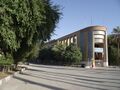 View of the Faculty of Humanities and Literature of Ahvaz (Three-Corner University)
 -
Before the White Bridge – 2009
-
 National heritage site: Imam Hospital
 -
 National heritage: Imam Hospital
 -
 Naderi Street – 2018
 -
 I.M.S. wagons imported from England, named “Churchill’s Reply”, moving from the maneuver grounds in Ahvaz toward the north, carrying supplies for Russia – 1942
 -
Seventh Bridge on a foggy day
.jpg)
.jpg)


.jpg)
See also
- Ahvaz Field
- Choqa Zanbil
- Elam
- Gundeshapur
- History of Iran
- Khūzestān Province
- Mandaeism, Mandaic language
- Politics of Khūzestān
- Susa
- Takhti Stadium (Ahvaz)
- Rahian-e Noor
 Ahvaz travel guide from Wikivoyage
Notes
- ↑ Also romanized as Ahvâz and Ahwaz
References
- ↑ Habibi, Hassan (26 July 2014) (in fa). Approval of the organization and chain of citizenship of the elements and units of the national divisions of Khuzestan province, centered in the city of Ahvaz (Report). Ministry of the Interior, Political and Defense Commission of the Government Board. Proposal 3233.1.5.53; Letter 907-93808; Notification 82830/T126K. https://rc.majlis.ir/fa/law/show/113029. Retrieved 25 January 2024.
- ↑ https://jcpa.org/the-forgotten-arabs-of-al-ahwaz/
- ↑ "Ahvaz, Iran Metro Area Population 1950-2025". https://www.macrotrends.net/global-metrics/cities/21482/ahvaz/population.
- ↑ "Kurdish Tribes". July 20, 2004. https://www.iranicaonline.org/articles/kurdish-tribes.
- ↑ مجتهدپور, یاسمین (1393). "کردهای خوزستان به مثابه پل ارتباطی ایران و جنوب عراق" (in fa). همایش بین المللی میراث مشترک ایران و عراق 7 (1). https://www.noormags.ir/view/fa/articlepage/1715149/%da%a9%d8%b1%d8%af%d9%87%d8%a7%db%8c-%d8%ae%d9%88%d8%b2%d8%b3%d8%aa%d8%a7%d9%86-%d8%a8%d9%87-%d9%85%d8%ab%d8%a7%d8%a8%d9%87-%d9%be%d9%84-%d8%a7%d8%b1%d8%aa%d8%a8%d8%a7%d8%b7%db%8c-%d8%a7%db%8c%d8%b1%d8%a7%d9%86-%d9%88-%d8%ac%d9%86%d9%88%d8%a8-%d8%b9%d8%b1%d8%a7%d9%82.
- ↑ Geomatics and Cartographic Research Centre, Carleton University. "Atlas of the Languages of Iran" (in en). https://iranatlas.net/index.html?module=module.language-distribution.khuzestan_heritage#eyJ0IjoieCIsImkiOiIyNmU2NWJlOTNmYzY2MTI1NTI1NzEzN2Y2NmM0NGU1NiIsInMiOjE3NDUzMjUzNDYzMjB9.
- ↑ "Water Resources and Quality in Iran" (in en-US). https://water.fanack.com/iran/water-resources-in-iran/.
- ↑ "Khuzestan (Iran): Counties & Cities - Population Statistics, Charts and Map". http://www.citypopulation.de/php/iran-khuzestan.php.
- ↑ "اهواز شهر پلهای زیبا/ وجود ۹ پل بر رودخانه کارون" (in fa). 2016-03-16. https://www.mehrnews.com/news/3581140/%D8%A7%D9%87%D9%88%D8%A7%D8%B2-%D8%B4%D9%87%D8%B1-%D9%BE%D9%84-%D9%87%D8%A7%DB%8C-%D8%B2%DB%8C%D8%A8%D8%A7-%D9%88%D8%AC%D9%88%D8%AF-%DB%B9-%D9%BE%D9%84-%D8%A8%D8%B1-%D8%B1%D9%88%D8%AF%D8%AE%D8%A7%D9%86%D9%87-%DA%A9%D8%A7%D8%B1%D9%88%D9%86.
- ↑ Hein, Carola; Sedighi, Mohamad (2016-09-01). "Iran's Global Petroleumscape: The Role of Oil in Shaping Khuzestan and Tehran". Architectural Theory Review 21 (3): 349–374. doi:10.1080/13264826.2018.1379110. ISSN 1326-4826. https://www.tandfonline.com/doi/full/10.1080/13264826.2018.1379110.
- ↑ John H., Lorentz (2007). Woronoff, Jon. ed (in English). Historical Dictionary of Iran (second ed.). p. 13. ISBN 0-8108-5330-2.
- ↑ 12.0 12.1 "پایگاه اطلاع رسانی شهرداری اهواز > درباره > شهر اهواز > تاریخچه شهر". https://www.ahvaz.ir/%D8%AF%D8%B1%D8%A8%D8%A7%D8%B1%D9%87/%D8%B4%D9%87%D8%B1-%D8%A7%D9%87%D9%88%D8%A7%D8%B2/%D8%AA%D8%A7%D8%B1%DB%8C%D8%AE%DA%86%D9%87-%D8%B4%D9%87%D8%B1.
- ↑ 13.0 13.1 13.2 13.3 13.4 13.5 Mojtahedzadeh, Rouhollah (in Persian) (PDF). پرتوی بر اهواز کهن از هنگام متون ساسانی و اسلامی و حدسی در باب مکان رام اردشیر ساسانی. https://ensani.ir/file/download/article/653c96d6423dc-9867-1402-1-9.pdf.
- ↑ Babaei, Mahnaz; Daryaee, Touraj (2021) (in Persian). دیدگاههای سهگانهی ساسانیان نسبت به جهان. pp. 124–125.
- ↑ 15.0 15.1 "Welcome to Encyclopaedia Iranica". https://iranicaonline.org/articles/ahvaz-a-town-of-southwestern-iran.
- ↑ Dodgeon M. H. and Lieu S. N. C., The Roman Eastern Frontier and The Persian Wars; A Documentary History, London (1991), p.35; ISBN 0-415-10317-7
- ↑ cf. Encyclopædia Iranica
- ↑ 18.0 18.1 18.2 "AHVĀZ i. History" (in en-US). https://www.iranicaonline.org/articles/ahvaz-a-town-of-southwestern-iran/.
- ↑ Minorsky, V. (1945). "The Tribes of Western Iran". The Journal of the Royal Anthropological Institute of Great Britain and Ireland 75 (1/2): 73–80. doi:10.2307/2844282. ISSN 0307-3114. https://www.jstor.org/stable/2844282.
- ↑ 20.0 20.1 Soucek, Svat (1984). "Arabistan or Khuzistan". Iranian Studies 17 (2/3): 195–213. ISSN 0021-0862. https://www.jstor.org/stable/4310441.
- ↑ 21.0 21.1 "ARRIAN" (in en-US). https://www.iranicaonline.org/articles/arrian-greek-historian/.
- ↑ Encyclopædia Iranica, p.690, see entry: Ahvaz
- ↑ Ibid, p.690
- ↑ 24.0 24.1 Wróbel, Janusz (2003) (in pl). Uchodźcy polscy ze Związku Sowieckiego 1942–1950. Łódź: Instytut Pamięci Narodowej. p. 62. ISBN 978-83-7629-522-0.
- ↑ Arab Struggle Movement for the Liberation of Ahvaz MIPT Terror Knowledge Base
- ↑ "29 killed, 60 injured in Iran military parade attack on Revolutionary Guards". 22 September 2018. https://english.alarabiya.net/en/News/middle-east/2018/09/22/Casualties-as-army-parade-attacked-in-south-Iran.html.
- ↑ 27.0 27.1 27.2 27.3 27.4 27.5 27.6 "Ahvaz in Uprising: From the Burning of the Governorate Building to ‘The People Want the Fall of the Regime’; Nighttime Clashes and Intense Confrontations Across the City" (in fa). https://www.iranntv.com/961505-%D8%A7%D9%87%D9%80%D9%80%D9%88%D8%A7%D8%B2-%D8%AF%D8%B1-%D9%82%DB%8C%D8%A7%D9%85--%D8%A7%D8%B2-%D8%A2%D8%AA%D8%B4-%D8%B2%D8%AF%D9%86-%D9%81%D8%B1%D9%85%D8%A7%D9%86%D8%AF%D8%A7%D8%B1%DB%8C-%D8%AA%D8%A7.
- ↑ 28.0 28.1 "Around 800 Iraqi Shiite militiamen have been sent to Iran to suppress the population". https://www.iranintl.com/202601071200.
- ↑ "Wave of overnight strikes reported across Iran". 7 April 2026. https://www.iranintl.com/en/202604079375.
- ↑ 30.0 30.1 "Iran's Ahvaz; Land of water and sun" (in en). 2023-08-24. https://en.mehrnews.com/news/202920/Iran-s-Ahvaz-Land-of-water-and-sun.
- ↑ "Iran: Provinces, Major Cities & Towns - Population Statistics, Maps, Charts, Weather and Web Information". http://www.citypopulation.de/en/iran/cities/.
- ↑ "Cities with a population of 100,000 and more (1956-2006 census)" (XLS). Iran data portal. p. 1. https://irandataportal.syr.edu/wp-content/uploads/13-cities-with-a-population-of-100-000-and-more-1335-1385-1956-2006-census-1.xlsx.
- ↑ Template:IranCensus2006
- ↑ Iranian Arabs parsine.com Retrieved 24 June 2018
- ↑ Khuzestani Arabs aparat.com Retrieved 24 June 2018
- ↑ Khuzestani Arabic isna.ir Retrieved 24 June 2018
- ↑ Bakhtiari tribes kojaro.com
- ↑ Bakhtiari aparat.com
- ↑ Arab Kamari/Arab-Bakhtiari rangvarehayeyekrang.ir
- ↑ "پل سیاه اهواز / پل پیروزی در مسیر تاریخ + گزارش تصویری". 2015-03-22. http://shooshan.ir/fa/news/14992.
- ↑ خبرگزاری فارس (March 17, 2012). "بزرگترین پل کابلی شهری خاورمیانه افتتاح شد". http://www.farsnews.com/newstext.php?nn=13901225000501.
- ↑ "بزرگترین پل کابلی خاورمیانه در اهواز". April 19, 2017. http://www.farsnews.com/imgrep.php?nn=13901221000911.
- ↑ سایت تحلیلی عصر ایران (March 16, 2012). "بزرگترین پل کابلی کشور در اهواز (+عکس)". http://www.asriran.com/fa/news/206017/%D8%A8%D8%B2%D8%B1%DA%AF%E2%80%8C%D8%AA%D8%B1%DB%8C%D9%86-%D9%BE%D9%84-%DA%A9%D8%A7%D8%A8%D9%84%DB%8C-%DA%A9%D8%B4%D9%88%D8%B1-%D8%AF%D8%B1-%D8%A7%D9%87%D9%88%D8%A7%D8%B2-+%D8%B9%DA%A9%D8%B3.
- ↑ "Eighth Ahvaz Bridge (Ahvaz)" (in en). https://structurae.net/en/structures/eighth-ahvaz-bridge.
- ↑ "Where is the world's hottest city?". 22 July 2015. https://www.theguardian.com/cities/2015/jul/22/where-world-hottest-city-kuwait-karachi-ahvaz.
- ↑ "Temperatures in Iranian city of Ahvaz hit 129.2F (54C), near hottest on Earth in modern measurements". The Independent. 30 June 2017. https://www.independent.co.uk/Weather/iran-ahvaz-hottest-temperature-ever-recorded-world-record-extreme-death-valley-california-a7815771.html.
- ↑ "World meteorological organization climate normals for 1991-2020: Ahvaz". NOAA. https://www.nodc.noaa.gov/archive/arc0216/0253808/2.2/data/0-data/Region-2-WMO-Normals-9120/Iran/CSV/Ahvaz_40811.csv.
- ↑ 48.0 48.1 *"Highest record temperature in Ahwaz by Month 1951–2010". Iran Meteorological Organization. http://www.chaharmahalmet.ir/stat/archive/iran/khz/AHWAZ/7.asp.
- "Lowest record temperature in Ahwaz by Month 1951–2010". Iran Meteorological Organization. http://www.chaharmahalmet.ir/stat/archive/iran/khz/AHWAZ/6.asp.
- ↑ "Climate Ahwaz (December - 2022)". Tutiempo Network, S.L.. https://en.tutiempo.net/climate/12-2022/ws-408110.html.
- ↑ "Climate Ahwaz (September - 2023)". Tutiempo Network, S.L.. https://en.tutiempo.net/climate/09-2023/ws-408110.html.
- ↑ "40811: Ahwaz (Iran, Islamic Republic of)". OGIMET. 27 April 2025. https://www.ogimet.com/cgi-bin/gsynres?ind=40811&ndays=31&ano=2025&mes=04&day=27&hora=12&ord=REV&enviar=Ver.
- ↑ "40811: Ahwaz (Iran, Islamic Republic of)". OGIMET. 23 May 2025. https://www.ogimet.com/cgi-bin/gsynres?ind=40811&ndays=31&ano=2025&mes=05&day=23&hora=12&ord=REV&enviar=Ver.
- ↑ *"Average Maximum temperature in Ahwaz by Month 1951–2010". Iran Meteorological Organization. http://www.chaharmahalmet.ir/stat/archive/iran/khz/AHWAZ/3.asp.
- "Average Mean Daily temperature in Ahwaz by Month 1951–2010". Iran Meteorological Organization. http://www.chaharmahalmet.ir/stat/archive/iran/khz/AHWAZ/5.asp.
- "Average Minimum temperature in Ahwaz by Month 1951–2010". Iran Meteorological Organization. http://www.chaharmahalmet.ir/stat/archive/iran/khz/AHWAZ/2.asp.
- ↑ "Monthly Total Precipitation in Ahwaz by Month 1951–2010". Iran Meteorological Organization. http://www.chaharmahalmet.ir/stat/archive/iran/khz/AHWAZ/25.asp.
- ↑ "Average relative humidity in Ahwaz by Month 1951–2010". Iran Meteorological Organization. http://www.chaharmahalmet.ir/stat/archive/iran/khz/AHWAZ/14.asp.
- ↑ "No. Of days with precipitation equal to or greater than 1 mm in Ahwaz by Month 1951–2010". Iran Meteorological Organization. http://www.chaharmahalmet.ir/stat/archive/iran/khz/AHWAZ/29.asp.
- ↑ "Monthly total sunshine hours in Ahwaz by Month 1951–2010". Iran Meteorological Organization. http://www.chaharmahalmet.ir/stat/archive/iran/khz/AHWAZ/42.asp.
- ↑ "40811: Ahwaz (Iran)". OGIMET. 19 June 2022. https://ogimet.com/cgi-bin/gsynres?ind=40811&ano=2022&mes=6&day=20&hora=18&min=0&ndays=30.
- ↑ "اداره کل هواشناسی استان چهارمحال و بختیاری". http://www.chaharmahalmet.ir/stat/archive/iran/khz/AHWAZ/10.asp.
- ↑ "Soot - Cancer-Causing Substances - National Cancer Institute". March 20, 2015. https://www.cancer.gov/about-cancer/causes-prevention/risk/substances/soot.
- ↑ Walsh, Bryan (27 September 2011). "The 10 Most Air-Polluted Cities in the World". Time. http://ecocentric.blogs.time.com/2011/09/27/the-10-most-air-polluted-cities-in-the-world/?iid=ec-article-mostpop1. Retrieved 2012-02-25.
- ↑ "Pollution". http://ahwaziran.weebly.com/pollution.html.
- ↑ Changing the name of Ahwaz international Airport to "Martyr Major-General Haj Qasem Soleimani" iribnews.ir Retrieved 27 March 2020
- ↑ Ahwaz Urban & Suburban Railway Organization (in Persian)
- ↑ Mo’assese-ye Âmuzeshe Âli, Jahâd Dâneshgâhi Khuzestân. "Institute of ACECR Khuzestan" (in en-US). https://www.linkedin.com/company/acecr-khouzestan/?viewAsMember=true.
- ↑ "Siamak Aghaei" (in de), Wikipedia, 2021-04-12, https://de.wikipedia.org/w/index.php?title=Siamak_Aghaei&oldid=210871478, retrieved 2025-11-27
- ↑ "Yousef Alavi Obituary (2013) - Kalamazoo, MI - Kalamazoo Gazette". Legacy.com. https://www.legacy.com/us/obituaries/kalamazoo/name/yousef-alavi-obituary?id=19587080.
- ↑ "Imaani Brown" (in de), Wikipedia, 2025-07-16, https://de.wikipedia.org/w/index.php?title=Imaani_Brown&oldid=257952330, retrieved 2025-11-27
- ↑ "مجید جوانمرد" (in fa), ویکیپدیا، دانشنامهٔ آزاد, 2025-10-05, https://fa.wikipedia.org/w/index.php?title=%D9%85%D8%AC%DB%8C%D8%AF_%D8%AC%D9%88%D8%A7%D9%86%D9%85%D8%B1%D8%AF&oldid=42817010, retrieved 2025-11-27
External links
 |
Wikimedia Commons has media related to Ahvaz. |
- Foolad Ahvaz Football Club Script error: The function "in_lang" does not exist.
Template:Khuzestan Province Template:Ahvaz County
 |  |


.jpg)

.jpg)

