Place:Arak, Iran
Arak Persian: اراک | |
|---|---|
City | |
 Clockwise from top: Bakhtyari Bridge, Valiasr Square, Senjan, City Park, and the old bazaar. | |
 Seal | |
  Arak | |
| Coordinates: [ ⚑ ] : 34°05′29″N 49°41′36″E / 34.09139°N 49.69333°E | |
| Country | Iran |
| Province | Markazi |
| County | Arak |
| District | Central |
| Established | 1808 |
| Government | |
| • Mayor | Alireza Mahmoudi[1] |
| Elevation | 1,718 m (5,636 ft) |
| Population (2016)[2] | |
| • Total | 520,944 |
| • Population Rank in Iran | 18th |
| Time zone | UTC+3:30 (IRST) |
| Area code(s) | 086 |
| Climate | Dsa |
| Website | arak |
Arak (Persian: اراک; fa)[lower-alpha 1] is a city in the Central District of Arak County, Markazi province, Iran, serving as capital of the province, the county, and the district.[4]
The city is nicknamed the "Industrial Capital of Iran".[5][6] Industrial factories include Machine Sazi Arak and the Iranian Aluminium Company, which produce nearly half of the needs of the country in the steel, petrochemical, and locomotive industries.
Etymology
Arâk
Arâk, as the city has been known since the Middle Ages, derives from Arabic al-ʿIrāq, meaning "root",[7] itself derived possibly from Akkadian Uruk (Hebrew: אֶרֶךְ, Erech). According to Ali Nourai, Arak comes from the same root as Iran and Arran, and Iraq is an Arabicized Persian word.[8]
During the Seljuk era, a region comprising the whole territory of Media (northwestern Iran) and the lower part of Mesopotamia was referred to as Iraq; with the Median part called ʿErâq-e ʿAjam ("Iraq of the Ajam [non-Arabic speakers]"), and the Mesopotamian part called ʿErâq-e ʿArab ("Iraq of the Arabs").[9]
Soltân Âbâd
The term Soltân Âbâd is a Persian compound word.
Soltân, deriving from Arabic sulṭān ("power", "authority"), is a West Asian noble title given to a powerful governor. Modern Persian âbâd, meaning "settlement" or "abode", derives from Middle Persian āpāt ("populous"). However, according to linguist Sasha Lubotsky, the Persian term ābād might derive from Proto-Iranian *āpāta ("protected"), rooting from Proto-Indo-European *peh₂- ("to protect").
History

Originally named Soltan Abad, the modern-day city of Arak was founded in 1808 by Yusef Khan-e Gorji,[11] a pro-Iranian warlord of Georgian Muslim origin who was given refuge by Qajar ruler Agha Mohammad Khan following a territorial dispute with his cousins, who were supported by Russian empress Catherine the Great.
In 1891, shops, gardens, and government buildings of Soltan Abad were repaired by the order of deputy governor Mirza Hasan (Etemad os-Saltane). Large parts of the city were formerly annexed as personal property to the pre-existing army commanders, and were then ultimately turned over to the state around 1918–1922.
Beginning by the last quarter of the 19th century, the city achieved major developments in carpet industry, and eventually became Iran's most important center of carpet production for export markets, continuing up until at least 1940.[12]

The city officially became a metropolis on 6 April 2013, after the merger with Karahrud and Senjan.[13][14]
In June 2025, during the Twelve-Day War, Israel told residents of Arak to evacuate prior to an Israeli strike on the Arak heavy water reactor.[15]
Demographics
Population
| Arak population history | ||
|---|---|---|
| Year | Pop. | ±% |
| 1956 | 58,998 | — |
| 1966 | 71,925 | +21.9% |
| 1976 | 116,832 | +62.4% |
| 1986 | 265,349 | +127.1% |
| 1991 | 331,354 | +24.9% |
| 1996 | 380,755 | +14.9% |
| 2006 | 438,338[17] | +15.1% |
| 2011 | 484,212[18] | +10.5% |
| 2016 | 520,944[2] | +7.6% |
| Source: [16] | ||
At the time of the 2006 National Census, the city's population was 438,338 in 121,597 households.[17] The following census in 2011 counted 484,212 people in 148,249 households.[18] The 2016 census measured the population of the city as 520,944 people in 165,709 households.[2]
Geography
Location
Arak is surrounded by mountains in the south, west, and east, and its average altitude is about 1750m above sea level. It is located 260 km from the city of Tehran, and is in the vicinity of the cities of Qom and Isfahan.
-
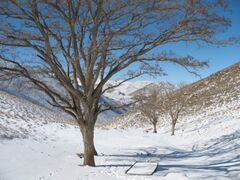 The Gerdoo Valley in winter
 -
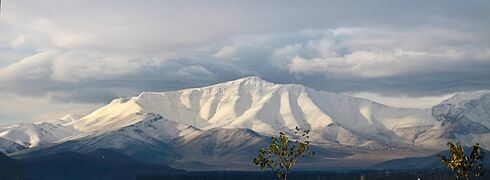 Sefidkhani Mountain, located to the west of Arak
 -
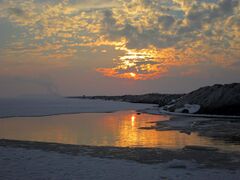 Meyqan Lagoon, 15 km northeast of Arak
 -
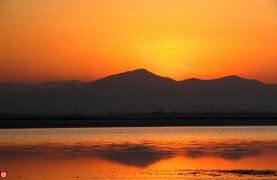 Sunset in Meyqan Lagoon


_-_panoramio.jpg)
Climate
Arak has a hot-summer mediterranean continental climate (Köppen: Dsa, Trewartha: Dcho). The weather of the city is very hot and dry in summer, cool in autumn, cold and snowy in winter, and mild in spring. Its maximum temperature may rise to above 35 °C or 95 °F in summer and fall to below −25 °C or −13 °F in winter. The average annual precipitation is around 337 millimetres or 13.3 inches and the annual relative humidity is about 47%.
Script error: No such module "weather box".
Script error: No such module "weather box".
-
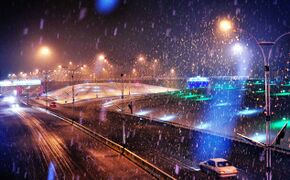 A snowy night in Arak
 -
 A rainy day in Arak
 -
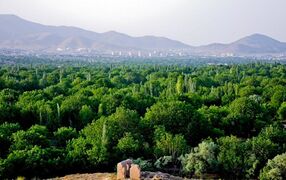 The Senjan district in summer
 -
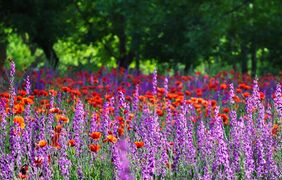 Gardens in Senjan
 -
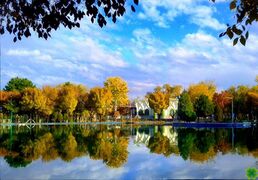 The City Park of Arak in autumn


.jpg)


Transport
Airport

Arak is served by the International Airport of Arak, which is located north of the city. The airport was opened in 1938, and is one of the oldest airports of Iran.
Rail
The railway system of Arak was connected to the Iranian Railways in 1935. Destinations stretch directly from Bandar-e-Shapur in the southwestern Iran to Bandar Torkaman under the Caspian Sea.
High-speed rail
Arak–Qom High Speed Rail is the second high-speed rail project in Iran which will have a junction with Tehran–Qom–Isfahan High Speed Rail at one of the stations in Qom province.[22] The Islamic Republic of Iran Railways signed a €1.2 billion deal with its Italian counterpart for establishing a high-speed railroad between the Iranian cities of Qom and Arak.[23] Iran decided to delegate the project to the Chinese following the withdrawal of an Italian firm due to US sanctions on Iran.[24] This new High Speed Line, part of the Iran National Railway Network, will be a double track passenger railway line and will have an operational speed of 300 km/h.[22]
Public transportation
Buses provide the bulk of local public transport in Arak.
Industry
Arak is one of industrial cities of Iran, manufacturing 80% of Iran energy equipment. The city houses Machin Sazi Arak, HEPCO, Wagon Pars, Iranian Aluminium Company, Lajvar Industrial Group and Iran Combine Manufacturing Company.[25][26][27]
Arak has chemical, construction, energy, food, machinery, metal, mining, textile, petroleum and petrochemical Industries.[25][27]
Other important industrial factories based in Arak are:
- AzarAb Industries
- Avangan
- Navard Aluminium
- Arak Petrochemical Company
- Arak Oil Refinery
- Heavy Water Production Plant of Arak
-
 HEPCO wheel loaders
 -
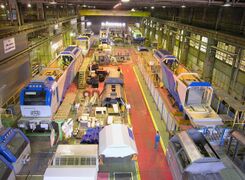 Locomotive production at Wagon Pars
 -
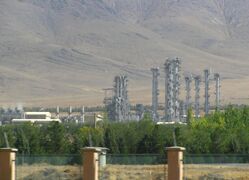 The Heavy Water Production Plant of Arak
 -
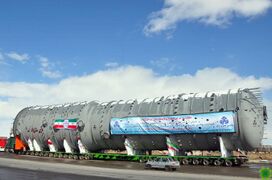 Giant Fractionating column manufactured by Machine Sazi Arak (MSA)
.jpg)


Agriculture and handicrafts
The main agricultural products of the city are grain, barley, grapes, apples, walnuts, and almonds. Arak also exports hand-knotted carpets which are referred to as Sarouk rugs. Saruq is a small village outside Arak.
Main sites

.jpg)


Parks and gardens
- Nezam Lashgar Garden (Garden of Esmaeili)
- City Park
- Amir Kabir Park
- Jangali Park
- Kelale Mountain Park
- Arak Zoo
- Madar Park
Museums
- Soltan Abad Museum
- Four Seasons Bathhouse
- Museum of Artifacts (Hassan Pour Museum)
- Museum of Famous Figures (The Hall of Fame of Arak)
- Grand Museum of Arak
Sports complexes
- Amir Kabir Entertainment and Sports Complex
- Tufan Entertainment and Sports Complex
- Shahin Horse Riding Complex
Universities
- Arak University
- Arak University of Medical Sciences
- Arak University of Technology
- Azad University of Arak
- Payam-e-Noor University of Arak
- Kharazmi University of Arak
Other
- Mostowfi Mansion
- Gerdoo Valley (known for its walnut trees and ranges)
Notable people
Statesmen and politicians


- Sharaf Khan Bidlisi (1543–ca. 1600), Kurdish historian and prince of Bitlis, born in Karahrūd, Arak.[28]
- Ghaem Magham Farahani (1779–1835), former Prime Minister of Iran, born in Farahan District, Arak.
- Amir Kabir (1807–1852), former Prime Minister of Iran, born in Hezaveh District, Arak.
- Mohammad Mosaddegh (1882–1967), former Prime Minister of Iran, born in Tehran. His father was from Ashtiyan, northeastern Arak.
- Morteza-Qoli Bayat (1890–1958), former Prime Minister of Iran (1944–1945).
- Ata'ollah Mohajerani (1954–), one of the ministers of the cabinet of Mohammad Khatami.
- Roozbeh Farahanipour (1971–), Iranian-American former opposition leader, co founder of Glorious Frontiers Party, one of leaders 9 July 1999 Student uprising.
Literary, painting, and photography figures
- Kader Abdolah (1954–), Iranian-Dutch poet laureate
- Zhaleh Alamtaj (1883–1947), feminist poet
- Sonia Balassanian (born 1942), Iranian-born Armenian painter, curator, sculptor
- Parvin E'tesami (1907–1941), poet, was born in Tabriz. Her father was from Ashtiyan, northeastern Arak.\
- Behjat Sadr (1924–2009), painter, moved to France
Sportsmen

- Mansour Bahrami (1956–), Iranian-French tennis player
- Mehdi Mahdavikia (1977–), football player
Scientists
- Mohammad Gharib (1909–1975), physician and clinician
- Wahid Shams Kolahi (1965–), electrical engineer
Singers
- Ebrahim Hamedi (Ebi) (1949–), singer; his father was from Arak.
Cinema and television artists

- Yervand Manaryan (1924–2020), Iranian-Armenian actor
- Arman Manaryan (1929–2016), Iranian-born Armenian film director
- Reza Badiyi (1930–2011), Iranian-born American director of episodes of many popular American television series, including Hawaii Five-O, Mission: Impossible, The Incredible Hulk, The Six Million Dollar Man, Falcon Crest, Buffy the Vampire Slayer (the episode Out of Mind, Out of Sight), Nikita, etc.
- Pouri Banayi, (1940–), actress before the 1979 Revolution (1965–1979)
- Golchehreh Sajadiye (1954–), actress
- Manijeh Hekmat (1962–), film director
- Mostafa Azizi (1962–), TV producer
- Mehran Modiri (1967–), actor, director and comedian; his parents were from Arak.
- Bahareh Rahnama (1973–), actress
- Sahar Zakaria (1973–), actress
- Pegah Ahangarani (1984–), actress and filmmaker, lives in the United Kingdom
Other
- Azadeh Bokaie Dadgar (1980–), journalist, lawyer and activist
See also
- List of cities in Iran
- List of cities, towns and villages in Markazi Province
- Sultanabad rugs and carpets
- Sultanabad ware
 Arak travel guide from Wikivoyage
Notes
References
- ↑ "حکم شهردار اراک ابلاغ شد" (in fa). 22 November 2023. https://www.isna.ir/news/1402090100898/%D8%AD%DA%A9%D9%85-%D8%B4%D9%87%D8%B1%D8%AF%D8%A7%D8%B1-%D8%A7%D8%B1%D8%A7%DA%A9-%D8%A7%D8%A8%D9%84%D8%A7%D8%BA-%D8%B4%D8%AF.
- ↑ 2.0 2.1 2.2 "Error: no
|title=specified when using {{Cite web}}" (in fa) (Excel). https://www.amar.org.ir/Portals/0/census/1395/results/abadi/CN95_HouseholdPopulationVillage_00.xlsx. - ↑ Arak, Iran can be found at GEOnet Names Server, at this link, by opening the Advanced Search box, entering "-3053519" in the "Unique Feature Id" form, and clicking on "Search Database".
- ↑ Habibi, Hassan (12 September 1990). "Error: no
|title=specified when using {{Cite web}}" (in fa). وزارت کشور [Ministry of the Interior]. https://lamtakam.com/law/council_of_ministers/113046. - ↑ "Industry in Arak". http://www.jamejamonline.ir/papertext.aspx?newsnum=100844968396.
- ↑ Network, Creative (2017-07-04). "پایتخت صنعتی ایران" (in en). http://atreyas.ir/36798/%d9%be%d8%a7%d9%8a%d8%aa%d8%ae%d8%aa-%d8%b5%d9%86%d8%b9%d8%aa%d9%8a-%d8%a7%d9%8a%d8%b1%d8%a7%d9%86/.
- ↑ Boesch, Hans H. (1 October 1939). "El-'Iraq". Economic Geography 15 (4): 329. doi:10.2307/141771.
- ↑ Nourai, Ali. An Etymological Dictionary of Persian, English and other Indo-European Languages. pp. 15.
- ↑ C. Edmund Bosworth, "ʿERĀQ-E ʿAJAM(Ī)". Encyclopaedia Iranica. http://www.iranicaonline.org/articles/eraq-e-ajami.
- ↑ "Bowl, Iranian, first half 14th century". https://www.metmuseum.org/art/collection/search/461074.
- ↑ de Planhol, X. (1986). "ARĀK". Encyclopaedia Iranica, Vol. II, Fasc. 3. pp. 247–248. http://www.iranicaonline.org/articles/arak#pt1.
- ↑ "Arak: Modern Town and Industry". Encyclopaedia Iranica. http://www.iranicaonline.org/articles/arak.
- ↑ Rahimi, Mohammad Reza (13 February 2013). "Error: no
|title=specified when using {{Cite web}}" (in fa). وزارت کشور [Ministry of the Interior]. https://rc.majlis.ir/fa/law/show/840807. - ↑ "تبدیل یک شهر دیگر به کلان شهر-سه شنبه، 25 تير -رجانیوز1392 15:57". http://rajanews.com/detail.asp?id=154355.
- ↑ "Israel Strikes Iran’s Heavy-Water Reactor in Arak" (in en-US). https://www.wsj.com/livecoverage/iran-israel-conflict-news/card/israel-strikes-iran-s-heavy-water-reactor-in-arak-tqjqjoWMTsGuw74VePuh.
- ↑ "Cities with a population of 100,000 and more (1956-2006 census)" (XLS). Iran data portal. p. 1. https://irandataportal.syr.edu/wp-content/uploads/13-cities-with-a-population-of-100-000-and-more-1335-1385-1956-2006-census-1.xlsx.
- ↑ 17.0 17.1 "Error: no
|title=specified when using {{Cite web}}" (in fa) (Excel). http://www.amar.org.ir/DesktopModules/FTPManager/upload/upload2360/newjkh/newjkh/00.xls. - ↑ 18.0 18.1 "Error: no
|title=specified when using {{Cite web}}" (in fa) (Excel). https://irandataportal.syr.edu/wp-content/uploads/Markazi.xls. - ↑ "World Meteorological Organization Climate Normals for 1991-2020: Arak" (CSV). NOAA. https://www.nodc.noaa.gov/archive/arc0216/0253808/2.2/data/0-data/Region-2-WMO-Normals-9120/Iran/CSV/Arak_40769.csv.
- ↑ "World Meteorological Organization Climate normals for 1981-2010: Arak (WMO number:40769)" (XLS). NOAA. https://www.ncei.noaa.gov/pub/data/normals/WMO/1981-2010/RA-II/Iran/WMO_Normals_Excel_IRAN_060719.xls. "Parameter code: 80 Number of days with Sleet/Snow"
- ↑ 21.0 21.1 "Arak Climate Normals 1961-1990". National Oceanic and Atmospheric Administration. ftp://ftp.atdd.noaa.gov/pub/GCOS/WMO-Normals/RA-II/IR/40769.TXT. (To view documents see Help:FTP)
- ↑ 22.0 22.1 scoding607. "Preliminary design of Qom-Arak High Speed Railway Line" (in en-US). http://www.coding-srl.it/portfolio/qom-arak-high-speed-railway-line/.
- ↑ "Iran, Italy Sign High-Speed Rail Deal" (in En). 2017-07-11. https://financialtribune.com/articles/economy-domestic-economy/68128/iran-italy-sign-high-speed-rail-deal.
- ↑ Bharti (2018-09-10). "Construction of High-speed Rail line Project in Iran" (in en). http://www.globaltenders.com/gtblogs/construction-of-high-speed-rail-line-project-iran/.
- ↑ 25.0 25.1 "صنایع و معادن اراک درگاه اینترنتی استان مرکزی" (in fa-IR). 17 August 2012. http://markaziportal.ir/192/%D8%B5%D9%86%D8%A7%DB%8C%D8%B9-%D9%88-%D9%85%D8%B9%D8%A7%D8%AF%D9%86-%D8%A7%D8%B1%D8%A7%DA%A9/.
- ↑ "Industrial tourism, the neglected capacity of Central Province" (in Persian). Mehr. Mehr new Agency. https://www.mehrnews.com/news/1297998/%DA%AF%D8%B1%D8%AF%D8%B4%DA%AF%D8%B1%DB%8C-%D8%B5%D9%86%D8%B9%D8%AA%DB%8C-%D8%B8%D8%B1%D9%81%DB%8C%D8%AA-%D9%85%D8%BA%D9%81%D9%88%D9%84-%D9%85%D8%A7%D9%86%D8%AF%D9%87-%D8%A7%D8%B3%D8%AA%D8%A7%D9%86-%D9%85%D8%B1%DA%A9%D8%B2%DB%8C.
- ↑ 27.0 27.1 "'Two Tastes' in the City of Iron and Steel" (in en). http://www.jamejamonline.ir/papertext.aspx?newsnum=100844968396.
- ↑ "BEDLĪSĪ, ŠARAF-AL-DĪN KHAN – Encyclopaedia Iranica". http://www.iranicaonline.org/articles/bedlisi-saraf-al-din-khan-b.
 |  |


