Religion:Buddhist flag


| Part of a series on |
| Buddhism |
|---|
 |
There are various Buddhist flags used to represent Buddhism as a whole or specific schools of Buddhism.
One popular flag with six bands of colour was designed in late 19th century Sri Lanka as a universal symbol of Buddhism.[1] This flag became popular throughout South East Asia, and was adopted by the World Fellowship of Buddhists as an official flag. The flag's five vertical bands represent the five colors of the aura which Buddhists believe emanated from the body of the Buddha when he attained enlightenment.
However, alternative versions of this flag and other different Buddhist flags are also flown in other countries, with different Buddhist groups having their own preferences.
There are also various types of Buddhist prayer flags, which serve a different function.
The International Buddhist Flag
_Wat_Hiranyawat_(Temple_of_the_Woven_Buddha)_%E0%B8%A7%E0%B8%B1%E0%B8%94%E0%B8%AB%E0%B8%B4%E0%B8%A3%E0%B8%B1%E0%B8%8D%E0%B8%8D%E0%B8%B2%E0%B8%A7%E0%B8%B2%E0%B8%AA_(%E0%B8%A7%E0%B8%B1%E0%B8%94%E0%B8%9E%E0%B8%A3%E0%B8%B0%E0%B8%AA%E0%B8%B2%E0%B8%99_%E0%B9%81%E0%B8%A1%E0%B9%88%E0%B8%AA%E0%B8%B2%E0%B8%A2)_-_img_05.jpg)

The International six stripe Buddhist flag was originally designed in 1885 by the Colombo Committee, in Colombo, Ceylon (now Sri Lanka). The committee consisted of Ven. Hikkaduwe Sri Sumangala Thera (chairman), Ven. Migettuwatte Gunananda Thera, Don Carolis Hewavitharana (father of Anagarika Dharmapala), Andiris Perera Dharmagunawardhana (maternal grandfather of Anagarika Dharmapala), Charles A. de Silva, Peter De Abrew, William De Abrew (father of Peter), H. William Fernando, N. S. Fernando and Carolis Pujitha Gunawardena (secretary).[2]
It was first publicly hoisted on Vesak day, 28 May 1885[1] at the Dipaduttamarama, Kotahena, by Ven. Migettuwatte Gunananda Thera.[3] This was the first Vesak public holiday under British rule.[3]
Colonel Henry Steel Olcott, an American journalist, founder and first president of the Theosophical Society, felt that its long streaming shape made it inconvenient for general use. He therefore suggested modifying it so that it was the size and shape of national flags.[1]
In 1889, the modified flag was introduced to Japan by Anagarika Dharmapala and Olcott—who presented it to Emperor Meiji—and subsequently to Myanmar.[4]
At the 1950 World Fellowship of Buddhists, the flag of Buddhists was adopted as the International Buddhist Flag.[5]
Colours
The flag's five vertical bands represent the five colors of the aura which Buddhists believe emanated from the body of the Buddha when he attained Enlightenment:[6][1]
- Blue (Pāli and Sanskrit: nīla): The Spirit of Universal Compassion
- Yellow (Pāli and Sanskrit: pīta): The Middle Way
- Red (Pāli and Sanskrit: lohitaka): The Blessings of Practice – achievement, wisdom, virtue, fortune and dignity
- White (Pali: odāta; Sanskrit: avadāta): The Purity of Dhamma – leading to liberation, timeless
- Orange (Pali: mañjeṭṭha; Sanskrit: mañjiṣṭhā), alternatively scarlet: The Wisdom of the Buddha's teachings
The sixth vertical band, on the fly, is made up of a combination of the five other colors' rectangular bands, and represents a compound of said colors in the aura's spectrum. This new, compound color is referred to as the Truth of the Buddha's teaching or Pabbhassara (lit. essence of light).
Variant Six Band flags


There are numerous variations of the six stripe Buddhist flags, most commonly achieved by changing the color of one of the stripes. For example:
- Sometimes, Buddhist symbols are placed in front of the stripes. The common one is the Dharmawheel.
- The colour mañjeṭṭha is interpreted as pink[7] in Myanmar, a Theravāda Buddhist country.
-
 Burmese and Vietnamese Buddhist flag
 -
 Tibetan Buddhist flag
 -
 Nepalese Buddhist flag
 -
 Japanese Buddhist flag (五色幕, goshikimaku)
 -
 A common variant with the dharmachakra
 -
 Laotian Buddhist flag


Other Buddhist flags

In various Buddhist nations and among different Buddhist groups alternative Buddhist flags may be more popular than the six stripe flag. Some of these flags are meant to represent Buddhism as a whole, while others represent specific Buddhist traditions or organizations.
Flags representing Buddhism as a whole
-
 Thai Buddhist Dharma-wheel flag
 -
 Korean Buddhist swastika flag
 -
 US Army chapel Buddhist flag using an eight spoked Dharma-wheel
 -
 A blue Dharma-wheel flag used by the Dalit Buddhist movement which uses the Ashoka Chakra
.svg)


Flags representing specific Buddhist traditions or people

One example of this is class of Buddhist flags is the flag of Tibet, which is unofficially used to represent Tibetan Buddhism. The flag contains various Buddhist symbols representing the spread of Buddhism.[8]

Japanese Buddhist sects often depict their sect emblems (宗紋) in flags that are often hung on or near Buddhist temples. These sect flags (宗旗) usually contain the crest or emblem of the school (known as mon or monshō 紋章 in Japanese).
The new religion of Soka Gakkai flies a tricolour of blue, yellow, and red.[9] It is often mistaken for the flags of Chad and Romania.
-
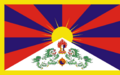 Tibetan Flag
 -
 The old flag of Sikkim was purely made up of Buddhist symbols
 -
 The Flag of Kalmykia's yellow color symbolizes the people's Buddhist faith, and the white lotus is a common Buddhist symbol
 -
 Karma Kagyu flag (Rangjung Rigpe Dorje, 16th Karmapa's "dream flag").
 -
 Flag of the Burmese Young Men's Buddhist Association
 -
 Flag of Vietnamese Pure Land Buddhist Laity Association
 -
 Jōdo Shinshū Honganji flag with Kujokamon emblem
 -
![Jōdo-shū flag with the crest (mon) of the school. These flags are sold on the main website of the Japanese sect.[10]](/wiki/images/thumb/9/92/J%C5%8Ddo-sh%C5%AB_flag.png/120px-J%C5%8Ddo-sh%C5%AB_flag.png) Jōdo-shū flag with the crest (mon) of the school. These flags are sold on the main website of the Japanese sect.[10]
Jōdo-shū flag with the crest (mon) of the school. These flags are sold on the main website of the Japanese sect.[10] -
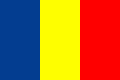 The flag of the Soka Gakkai movement
 -
 The flag of Soka Gakkai International
 -
 A flag representing Mahayana Buddhism


![Jōdo-shū flag with the crest (mon) of the school. These flags are sold on the main website of the Japanese sect.[10]](/wiki/File:J%C5%8Ddo-sh%C5%AB_flag.png)


Bans
In 1963, the Catholic President of South Vietnam Ngo Dinh Diem invoked a law prohibiting flags other than that of the nation, to ban the Buddhist flag from being flown on Vesak, when Vatican flags had habitually flown at government events. This led to protests, which were ended by lethal firing of weapons, starting the Buddhist crisis.[11]
See also
Note: This topic belongs to "Buddhism " portal
- Bhagwa Dhwaj
- Dhvaja, banner-like flag in Sanskrit & Hinduism with a distinctive long flowing frontal tail
- Culture of Buddhism
- Dharmachakra
References
- ↑ 1.0 1.1 1.2 1.3 "The Origin and Meaning of the Buddhist Flag". The Buddhist Council of Queensland. http://buddhistcouncilofqueensland.org/node/143.
- ↑ The Maha Bodhi, Volumes 98–99; Volumes 1891–1991. Maha Bodhi Society. 1892. p. 286.
- ↑ 3.0 3.1 Lopez, Donald S. Jr. (2002). A Modern Buddhist Bible: Essential Readings from East and West. Beacon Press. p. xiv. ISBN 9780807012437.
- ↑ "Buddhist flag marks 125th anniversary". Sunday Observer. 16 March 2010. http://www.buddhistchannel.tv/index.php?id=43,9162,0,0,1,0.
- ↑ Wilkinson, Phillip (2003). DK Eyewitness Books: Buddhism. Penguin Putnam. p. 64. ISBN 9781782682875.
- ↑ "The Buddhist Flag". Buddhanet. http://www.buddhanet.net/e-learning/history/b_flag.htm.
- ↑ အရှင်စန္ဒောဘာသ(ရွှေဘို) (in my). သာသနာ့အလံတော်. ရွှေပုရပိုက်စာပေ. https://spsuygn.edu.mm/book/bdhhgen-81/detail.
- ↑ Goldstein, Melvyn C. (2009). A History of Modern Tibet: The Calm Before the Storm: 1951–1955. 2. University of California Press. p. 302. ISBN 978-0-520-25995-9.
- ↑ "Flags of the World: Buddhism". http://flagspot.net/flags/buddhism.html.
- ↑ "浄土宗出版 / 浄土宗宗旗(小)" (in ja). https://press.jodo.or.jp/products/detail/268.
- ↑ Zachary., Abuza (2001). Renovating politics in contemporary Vietnam. Boulder: L. Rienner Publishers. p. 191. ISBN 1588261778. OCLC 65180894.
External links
 |
Wikimedia Commons has media related to Buddhist flag. |
- Buddhist flag at Flags of the World
- General Buddhist symbols


 |  |


