Software:Metal Combat: Falcon's Revenge
| Metal Combat: Falcon's Revenge | |
|---|---|
 | |
| Developer(s) | Intelligent Systems |
| Publisher(s) | Nintendo |
| Director(s) | Toshitaka Muramatsu |
| Producer(s) | Gunpei Yokoi |
| Programmer(s) | Shinya Yamamoto Toshihiro Nishii |
| Artist(s) | Toshitaka Muramatsu |
| Composer(s) | Yuka Tsujiyoko |
| Platform(s) | Super Nintendo Entertainment System |
| Release | |
| Genre(s) | Light-gun shooter |
| Mode(s) | Single-player, multiplayer |
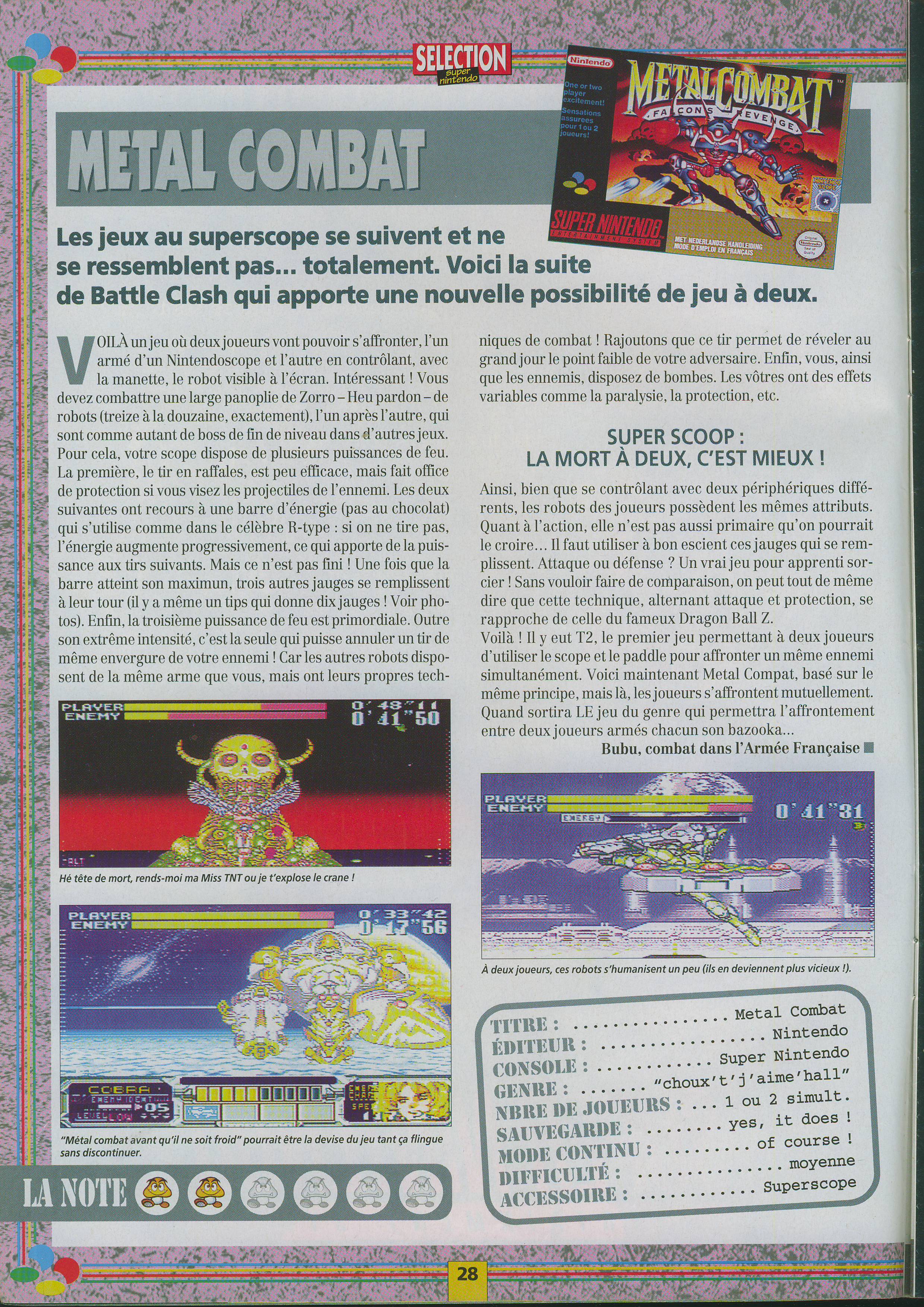
Metal Combat: Falcon's Revenge is a 1993 light gun shooter video game developed by Intelligent Systems and published by Nintendo for the Super Nintendo Entertainment System. It is the sequel to Battle Clash (1992) and one of several titles that requires the Super Scope light gun. Taking place three years after the events of its predecessor, the player acts as the gunner of the Standing Tank (ST) Falcon piloted by Mike Anderson, fighting a group of chiefs in the Battle Game, the returning emperor Anubis, and the invading Eltorian alien race.
Metal Combat was created by Team Battle Clash, a group within Intelligent Systems made up of Nintendo R&D1 staff that developed games for the Super Scope light gun, which had previously worked on Battle Clash. It was directed by chief graphic designer Toshitaka Muramatsu and produced by Gunpei Yokoi. The music was composed by Yuka Tsujiyoko, who also scored Battle Clash. The game garnered generally favorable reception from critics; praise was given to the refined gameplay, different strategies of each enemy, variety of modes, and overall improvements made over its predecessor. Some reviewers criticized the single-player campaign for its short duration, repetitive action, and difficulty.
Gameplay

Like its predecessor, Metal Combat: Falcon's Revenge is a light gun shooter game which requires the Super Scope light gun peripheral for the Super Nintendo Entertainment System to be played.[1][2][3] The plot takes place three years after the events occurred in Battle Clash; the emperor Anubis suffered defeat at the hands of Mike Anderson and a new age of prosperity began to emerge on Earth. However, Anubis returned to resume his tyranny and an alien race called the Eltorians entered the solar system to conquer Earth.[3][4][5]
Gameplay consists of four different modes divided into single-player or multiplayer submenus: Battle, Time Trial, Training, and Combat.[6][7][8] Battle is a single-player scenario where the player acts as the gunner of the Standing Tank (ST) Falcon piloted by Anderson, fighting a group of chiefs in the Battle Game, the returning emperor Anubis, and the invading Eltorian alien race in one-on-one duels.[3][7][8] Time Trial is a mode where the player must defeat enemies to achieve the best time possible.[5][6][7] Training is a tutorial mode, in which a female instructor named Rola helps beginners through a series of seven lessons.[2][3][7] Combat is a versus mode, where one player controls the ST Falcon using the Super Scope while the other player controls one of the enemy STs using a Super NES controller.[1][3][4]
The player can attack enemies using rapid fire by holding down the fire button, energy bolts, bombs, and an array of special items.[2][3][6] The ST Falcon can charge energy bolts up to three times when the player is not firing and fire a treble shot once the power meters are filled.[3][4] The player can counter enemy fire by intercepting their projectiles but some enemy attacks can only be deflected by shooting energy bolts.[4][5] Each enemy ST has destructible weak points that the player can exploit to deal damage.[3][4][9] Completing the single-player mode unlocks the ST Tornado, piloted by Carol Eugene.[3][4][7] The ST Tornado can store up to ten energy beams and fire each one individually but has less defense comnpared to the ST Falcon.[3]
Development and release
Metal Combat: Falcon's Revenge was created by Team Battle Clash, a group within Intelligent Systems made up of Nintendo R&D1 staff that developed games for the Super Scope light gun, which had previously worked on Battle Clash (1992).[3][10][11] The game is one of several titles that requires the Super Scope.[12] It was directed by chief graphic designer Toshitaka Muramatsu and produced by Gunpei Yokoi.[3][13][14] Shinya Yamamoto and Toshihiro Nishii acted as two of the game's co-programmers.[13][14] The music was composed by Yuka Tsujiyoko, who also scored Battle Clash.[13][15] Nintendo first published the game for the Super Nintendo Entertainment System in North America on December 1993, followed by a European release on May 1994.[8][16] It was originally intended to be titled Battle Clash II, but the name was changed shortly before its North American launch.[17] The game was housed in a 16-megabit (2 MB) cartridge using the OBC-1, a sprite manipulation enhancement chip.[8][18] Metal Combat was only released in Western regions, as the Super Scope proved to be less popular in Japan.[3][4][10]
Reception
| Reception | ||||||||||||
|---|---|---|---|---|---|---|---|---|---|---|---|---|
| ||||||||||||
Metal Combat: Falcon's Revenge received generally favorable reception from critics and retrospective commentators.[3][4][19][21][22] Nintendo Power considered it to be a much improved follow-up to Battle Clash and highlighted its multiplayer mode, but found the single-player campaign weak and pointed out the difficulty of seeing incoming enemy fire.[9] Electronic Gaming Monthly's reviewers celebrated the game for having colorful graphics and deeper gameplay than most Super Scope titles, and cited the two-player mode as the best feature, although they did not like its difficulty.[19] Game Players's Chris Slate lauded each of the game's enemies for their different strategies, as well as the soundscapes, variety of modes, and replay value.[1] GamePro's Captain Squideo described it as "much harder, faster, and ultimately better than any previous Super Scope game, including Battle Clash". Squideo praised the detailed graphics that allow the player to spot enemy weak points, but criticized the text between fights and low quality voice samples.[2]
Hobby Consolas' Antonio Caravaca praised the game's visual quality, sound effects, difficulty, and two-player mode, but criticized the occasional flickering that occurs during explosions.[6] Nintendo Acción gave favorable remarks to the game's mech designs, audio, and various game modes, but criticized the story mode for its short duration.[7] Player One's Jean-Pierre Abidal found the action in the game to be fun but repetitive.[20] Hardcore Gaming 101's David DeRienzo lauded the game's improved audiovisual presentation, refined combat system, and modes of play, writing that "Metal Combat manages to surpass its predecessor in every imaginable way while still offering the same great core play experience".[3] Destructoid's Zoey Handley regarded it as one of the best light gun games ever developed.[4]
Notes
- ↑ Electronic Gaming Monthly's review was by four critics with different ratings: 9, 7, 8, and 7.[19]
- ↑ GamePro provided scores of 4.0 for graphics, 3.5 for sound, and 4.5 twice for control and fun factor.[2]
- ↑ Nintendo Power provided scores of 3.4 for graphics and sound, 3.6 twice for play control and challenge, and 3.5 for theme and fun.[9]
References
- ↑ 1.0 1.1 1.2 1.3 Slate, Chris (April 1994). "Review: Metal Combat". Game Players (Signal Research) 7 (4): 48. https://retrocdn.net/index.php?title=File:GamePlayers_US_0704.pdf&page=50.
- ↑ 2.0 2.1 2.2 2.3 2.4 Squideo, Captain (May 1994). "ProReview: Metal Combat — Falcon's Revenge". GamePro (IDG) (58): 64. https://archive.org/details/GamePro_Issue_058_May_1994/page/n65/mode/1up.
- ↑ 3.00 3.01 3.02 3.03 3.04 3.05 3.06 3.07 3.08 3.09 3.10 3.11 3.12 3.13 3.14 DeRienzo, David (August 7, 2007). "Battle Clash / Metal Combat". Hardcore Gaming 101. http://hardcoregaming101.net/battleclash/battleclash.htm.
- ↑ 4.0 4.1 4.2 4.3 4.4 4.5 4.6 4.7 4.8 Handley, Zoey (March 3, 2023). "Metal Combat: Falcon's Revenge for SNES was Nintendo's best use of their space bazooka". Destructoid. Gamurs Group. https://www.destructoid.com/by-the-wayside-metal-combat-falcons-revenge-snes-retro-super-scope/.
- ↑ 5.0 5.1 5.2 Metal Combat: Falcon's Revenge (Instruction Booklet) (North American ed.). Nintendo. 1993. https://archive.org/details/snes_Metal_Combat_Falcons_Revenge_USA.
- ↑ 6.0 6.1 6.2 6.3 6.4 Caravaca, Antonio (May 1994). "Lo Más Nuevo: Metal Combat – La Caza Del Futuro" (in es). Hobby Consolas (Hobby Press) (32): 114–115. https://archive.org/details/HobbyConsolas032/page/n81/mode/2up.
- ↑ 7.0 7.1 7.2 7.3 7.4 7.5 7.6 "Super Stars: Metal Combat — Un Nuevo Objetivo Para Tu Super Scope" (in es). Nintendo Acción (Hobby Press) (18): 48–49. May 1994. https://archive.org/details/Nintendo_Accion_018/page/n47/mode/2up.
- ↑ 8.0 8.1 8.2 8.3 "Preview: Metal Combat: Falcon's Revenge — La nueva onda del "Scope"" (in es). Nintendo Acción (Hobby Press) (17): 38—39. April 1994. https://archive.org/details/Nintendo_Accion_017/page/n37/mode/2up.
- ↑ 9.0 9.1 9.2 "Super Scope Roundup; Now Playing: Metal Combat". Nintendo Power (Nintendo of America) 55: 42—47; 106–107. December 1993.
- ↑ 10.0 10.1 "Developer Profile: Intelligent Systems — An indepth history and look at the often overlooked R&D; group of Nintendo's EAD division". IGN. Ziff Davis. January 10, 2001. https://www.ign.com/articles/2001/01/10/developer-profile-intelligent-systems.
- ↑ "Engaged Game Software". Intelligent Systems. 2016. http://www.intsys.co.jp/english/software/index.html.
"作品紹介 - ゲーム" (in ja). Intelligent Systems. 2024. https://intsys.co.jp/works/games/. - ↑ Dog, The Watch; Tangonan, Denver (November 1996). "Buyers Beware". GamePro (IDG) (98): 24. https://archive.org/details/GamePro_Issue_088_November_1996/page/n25/mode/1up.
- ↑ 13.0 13.1 13.2 Intelligent Systems (December 1993). Metal Combat: Falcon's Revenge. Super Nintendo Entertainment System. Nintendo. Level/area: Creative Staff. (Good Ending screens by VGMuseum [The Video Games Museum]. )
- ↑ 14.0 14.1 "「パネルでポン」ホームページ公開1周年記念特別企画 - 開発者インタビュー" (in ja). 「パネルでポン」ホームページ. Intelligent Systems. August 19, 1997. https://www.intsys.co.jp/game/panepon/p09/index.html. (Translation by Graeme Howard. ).
- ↑ "Interview with Yuka Tsujiyoko". RocketBaby. Hollow Light Media. 2001. http://interviews.rocketbaby.net/interviews_tsujiyoko_yuka_1.html.
- ↑ "Super NES Games". Nintendo. http://www.nintendo.com:80/consumer/gameslist/manuals/snes_games.pdf.
- ↑ "Smygtittar: Metal Combat" (in sv). Nintendo-Magasinet (Sweden) (sv) (Atlantic Förlags AB (sv)) 5 (37): 12. March 1994. https://archive.org/details/nintendomagasinet/199403/page/n11/mode/1up.
- ↑ "Repasamos 10 juegos de SNES que necesitaron de cartuchos especiales" (in es). Univision. Univision Communications. August 18, 2016. https://www.univision.com/entretenimiento/cultura-pop/repasamos-10-juegos-de-snes-que-necesitaron-de-cartuchos-especiales.
- ↑ 19.0 19.1 19.2 Semrad, Ed; Carpenter, Danyon; Manuel, Al; Williams, Ken (March 1994). "Review Crew: Metal Combat". Electronic Gaming Monthly (Sendai Publishing) (56): 50. https://archive.org/details/Electronic_Gaming_Monthly_56/page/n33/mode/1up.
- ↑ 20.0 20.1 Abidal, Jean-Pierre (July–August 1994). "Vite Vu – Le Zone de Vite Vu: Metal Combat" (in fr). Player One (magazine) (fr) (Média Système Édition (fr)) (44): 116. https://archive.org/details/playerone-magazine-044/page/n111/mode/1up.
- ↑ Buret, Stéphane (May 1994). "Selection: Metal Combat" (in fr). Nintendo Player (fr) (Média Système Édition (fr)) (20): 28. https://download.abandonware.org/magazines/Nintendo%20Player/nintendoplayer_numero20/Nintendo%20Player%20N20-%20Page%200027.JPG. Retrieved 2024-01-26.
- ↑ "Super NES Review: Metal Combat". Nintendo Magazine System (Trielle Corporation) (20): 52. November 1994.
External links
- MobyGames is a commercial database website that catalogs information on video games and the people and companies behind them via crowdsourcing. This includes over 300,000 games for hundreds of platforms.[1] Founded in 1999, ownership of the site has changed hands several times. It has been owned by Atari SA since 2022.
Features
Edits and submissions to the site (including screenshots, box art, developer information, game summaries, and more) go through a verification process of fact-checking by volunteer "approvers".[2] This approval process after submission can range from minutes to days or months.[3] The most commonly used sources are the video game's website, packaging, and credit screens. There is a published standard for game information and copy-editing.[4] A ranking system allows users to earn points for contributing accurate information.[5]
Registered users can rate and review games. Users can create private or public "have" and "want" lists, which can generate a list of games available for trade with other registered users. The site contains an integrated forum. Each listed game can have its own sub-forum.
History

MobyGames was founded on March 1, 1999, by Jim Leonard and Brian Hirt, and joined by David Berk 18 months later, the three of which had been friends since high school.[6][7] Leonard had the idea of sharing information about computer games with a larger audience. The database began with information about games for IBM PC compatibles, relying on the founders' personal collections. Eventually, the site was opened up to allow general users to contribute information.[5] In a 2003 interview, Berk emphasized MobyGames' dedication to taking video games more seriously than broader society and to preserving games for their important cultural influence.[5]
In mid-2010, MobyGames was purchased by GameFly for an undisclosed amount.[8] This was announced to the community post factum , and the site's interface was given an unpopular redesign.[7] A few major contributors left, refusing to do volunteer work for a commercial website.{{Citation needed|date=June 2025} On December 18, 2013, MobyGames was acquired by Jeremiah Freyholtz, owner of Blue Flame Labs (a San Francisco-based game and web development company) and VGBoxArt (a site for fan-made video game box art).[9] Blue Flame Labs reverted MobyGames' interface to its pre-overhaul look and feel,[10] and for the next eight years, the site was run by Freyholtz and Independent Games Festival organizer Simon Carless.[7]
On November 24, 2021, Atari SA announced a potential deal with Blue Flame Labs to purchase MobyGames for $1.5 million.[11] The purchase was completed on 8 March 2022, with Freyholtz remaining as general manager.[12][13][14] Over the next year, the financial boost given by Atari led to a rework of the site being built from scratch with a new backend codebase, as well as updates improving the mobile and desktop user interface.[1] This was accomplished by investing in full-time development of the site instead of its previously part-time development.[15]
In 2024, MobyGames began offering a paid "Pro" membership option for the site to generate additional revenue.[16] Previously, the site had generated income exclusively through banner ads and (from March 2014 onward) a small number of patrons via the Patreon website.[17]
On February 13, 2025, Freyholtz stepped down as the site lead to move onto new projects, leaving operations to Tracy Poff, a veteran coder on the site, and Atari staff.[18]
See also
- IGDB – game database used by Twitch for its search and discovery functions
References
- ↑ 1.0 1.1 Sheehan, Gavin (2023-02-22). "Atari Relaunches The Fully Rebuilt & Optimized MobyGames Website". https://bleedingcool.com/games/atari-relaunches-the-fully-rebuilt-optimized-mobygames-website/.
- ↑ Litchfield, Ted (2021-11-26). "Zombie company Atari to devour MobyGames". https://www.pcgamer.com/zombie-company-atari-to-devour-mobygames/.
- ↑ "MobyGames FAQ: Emails Answered § When will my submission be approved?". Blue Flame Labs. 30 March 2014. http://www.mobygames.com/info/faq7#g1.
- ↑ "The MobyGames Standards and Practices". Blue Flame Labs. 6 January 2016. http://www.mobygames.com/info/standards.
- ↑ 5.0 5.1 5.2 Miller, Stanley A. (2003-04-22). "People's choice awards honor favorite Web sites". Milwaukee Journal Sentinel.
- ↑ "20 Years of MobyGames" (in en). 2019-02-28. https://trixter.oldskool.org/2019/02/28/20-years-of-mobygames/.
- ↑ 7.0 7.1 7.2 Plunkett, Luke (2022-03-10). "Atari Buys MobyGames For $1.5 Million". https://kotaku.com/mobygames-retro-credits-database-imdb-atari-freyholtz-b-1848638521.
- ↑ "Report: MobyGames Acquired By GameFly Media". Gamasutra. 2011-02-07. https://www.gamedeveloper.com/game-platforms/report-mobygames-acquired-by-gamefly-media.
- ↑ Corriea, Alexa Ray (December 31, 2013). "MobyGames purchased from GameFly, improvements planned". http://www.polygon.com/2013/12/31/5261414/mobygames-purchased-from-gamefly-improvements-planned.
- ↑ Wawro, Alex (31 December 2013). "Game dev database MobyGames getting some TLC under new owner". Gamasutra. https://www.gamedeveloper.com/business/game-dev-database-mobygames-getting-some-tlc-under-new-owner.
- ↑ "Atari invests in Anstream, may buy MobyGames". November 24, 2021. https://www.gamesindustry.biz/articles/2021-11-24-atari-invests-in-anstream-may-buy-mobygames.
- ↑ Rousseau, Jeffrey (2022-03-09). "Atari purchases Moby Games". https://www.gamesindustry.biz/atari-purchases-moby-games.
- ↑ "Atari Completes MobyGames Acquisition, Details Plans for the Site's Continued Support". March 8, 2022. https://www.atari.com/atari-completes-mobygames-acquisition-details-plans-for-the-sites-continued-support/.
- ↑ "Atari has acquired game database MobyGames for $1.5 million" (in en-GB). 2022-03-09. https://www.videogameschronicle.com/news/atari-has-acquired-game-database-mobygames-for-1-5-million/.
- ↑ Stanton, Rich (2022-03-10). "Atari buys videogame database MobyGames for $1.5 million". https://www.pcgamer.com/atari-buys-videogame-database-mobygames-for-dollar15-million/.
- ↑ Harris, John (2024-03-09). "MobyGames Offering “Pro” Membership". https://setsideb.com/mobygames-offering-pro-membership/.
- ↑ "MobyGames on Patreon". http://www.patreon.com/mobygames.
- ↑ "An update on MobyGames leadership". 2025-02-13. https://www.mobygames.com/forum/3/thread/269628/an-update-on-mobygames-leadership/#post-269628.
 |
Wikidata has the property:
|

External links
- No URL found. Please specify a URL here or add one to Wikidata.

 |  |
| |