Software:The Hobbit (1982 video game)
| The Hobbit | |
|---|---|
 ZX Spectrum cover art | |
| Developer(s) | Beam Software |
| Publisher(s) | Melbourne House |
| Designer(s) | Veronika Megler Philip Mitchell |
| Platform(s) |
|
| Release | |
| Genre(s) | Interactive fiction |
| Mode(s) | Single-player |
The Hobbit is an illustrated text adventure computer game released in 1982 for the ZX Spectrum home computer and based on the 1937 book The Hobbit, by J. R. R. Tolkien. It was developed at Beam Software by Philip Mitchell and Veronika Megler[2][3] and published by Melbourne House. It was later converted to most home computers available at the time including the Commodore 64, BBC Micro, and Oric computers.[4] By arrangement with the book publishers, a copy of the book was included with each game sold.
The parser was very advanced for the time and used a subset of English called Inglish.[5][6] When it was released, most adventure games used simple verb-noun parsers (allowing for simple phrases like "get lamp"), but Inglish allowed the player to type advanced sentences such as "ask Gandalf about the curious map then take sword and kill troll with it". The parser was complex and intuitive, introducing pronouns, adverbs ("viciously attack the goblin"), punctuation and prepositions and allowing the player to interact with the game world in ways not previously possible.
Gameplay
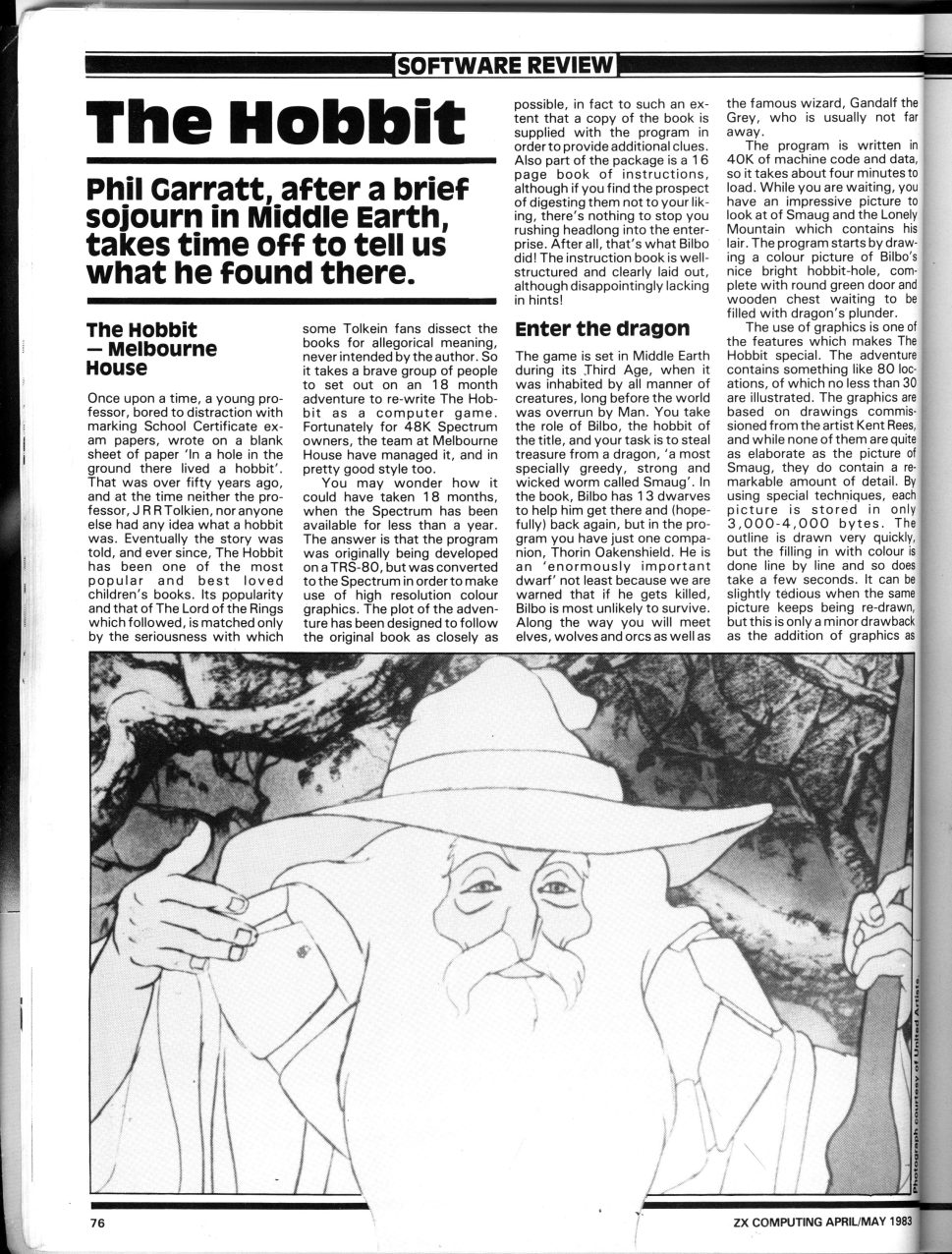
Many locations are illustrated by an image, based on originals designed by Kent Rees. On the tape version, to save space, each image was stored in a compressed format by storing outline information and then flood filling the enclosed areas on the screen.[7] The slow CPU speed meant that it would take up to several seconds for each scene to draw. The disk-based versions of the game used pre-rendered, higher-quality images.
The game has an innovative text-based physics system, developed by Veronika Megler.[8] Objects, including the characters in the game, have a calculated size, weight, and solidity. Objects can be placed inside other objects, attached together with rope and damaged or broken. If the main character is sitting in a barrel and this barrel is then picked up and thrown through a trapdoor, the player would go through.
Unlike other works of interactive fiction, the game is also in real time, insofar as a period of idleness causes the "WAIT" command to be automatically invoked and the possibility of events occurring as a result. This can be suppressed by entering the "PAUSE" command, which stops all events until a key is pressed.
The game has a cast of non-player characters (NPCs) entirely independent of the player and bound to precisely the same game rules. They have loyalties, strengths, and personalities that affect their behaviour and cannot always be predicted. The character of Gandalf, for example, would roam freely around the game world (some fifty locations), picking up objects, getting into fights and being captured.
The volatility of the characters, coupled with the rich physics and impossible-to-predict fighting system, enabled the game to be played in many different ways, though this would also lead to problems (such as an important character being killed early on). There are numerous possible solutions and with hindsight, the game might be regarded as one of the first examples of emergent gameplay. This also resulted, however, in many bugs; for example, during development Megler found that the animal NPCs killed each other before the player arrived. The game's documentation warned that "Due to the immense size and complexity of this game it is impossible to guarantee that it will ever be completely error-free". Melbourne House issued a version 1.1 with some fixes, but with another bug that resulted in the game being unwinnable, forcing it to release version 1.2, and the company never fixed all bugs.[5]
Development
Beam acquired the licence for computer rights to The Hobbit in 1980.[9]
Reception
Info in 1985 rated The Hobbit on the Commodore 64 three-plus stars out of five, stating that the graphics were "pleasant but no show-stoppers", and that the game's parser and puzzles were "typical of most adventures today". The magazine concluded that "Tolkien fans will most likely be pleased with this title".[10]
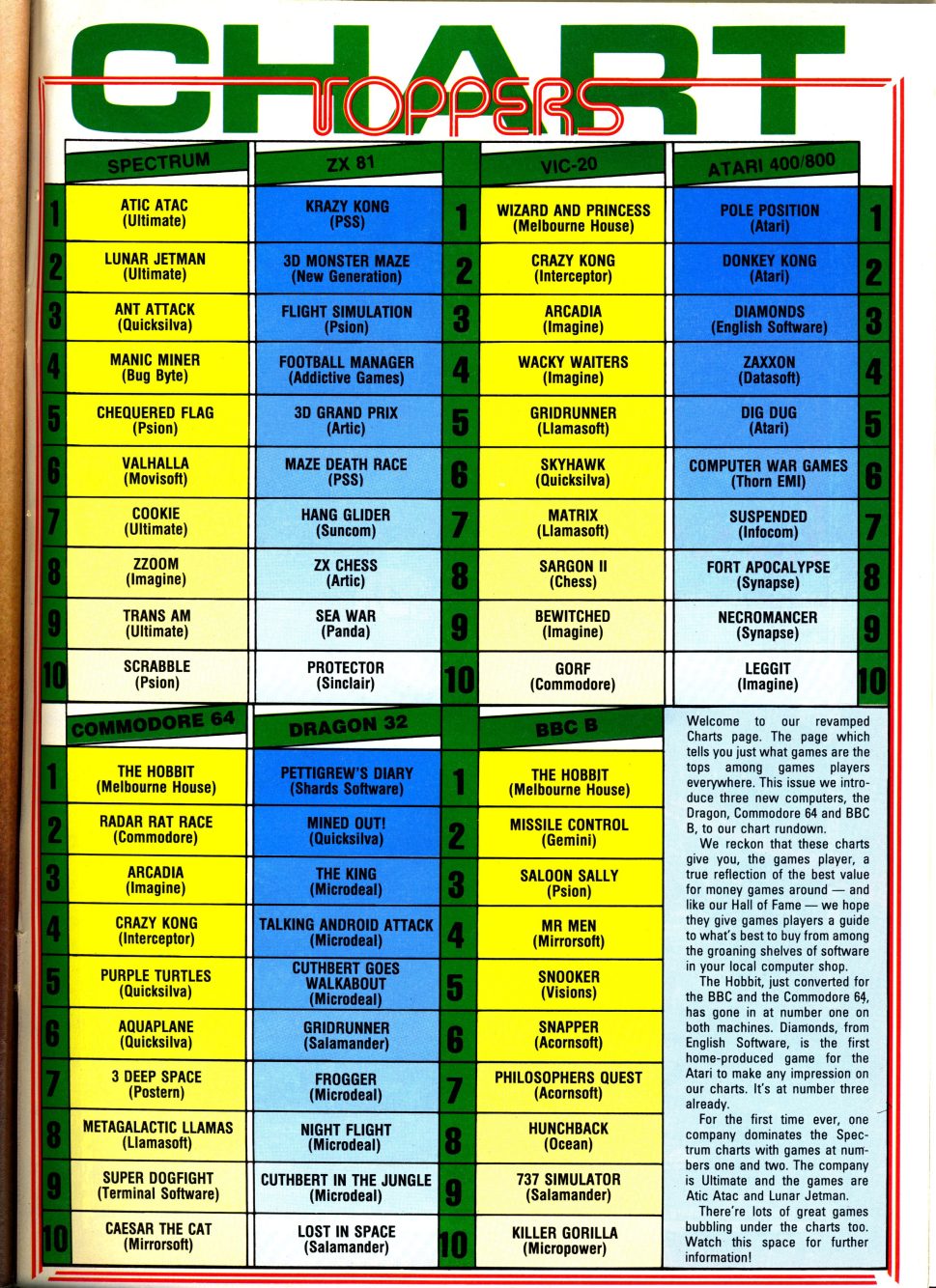
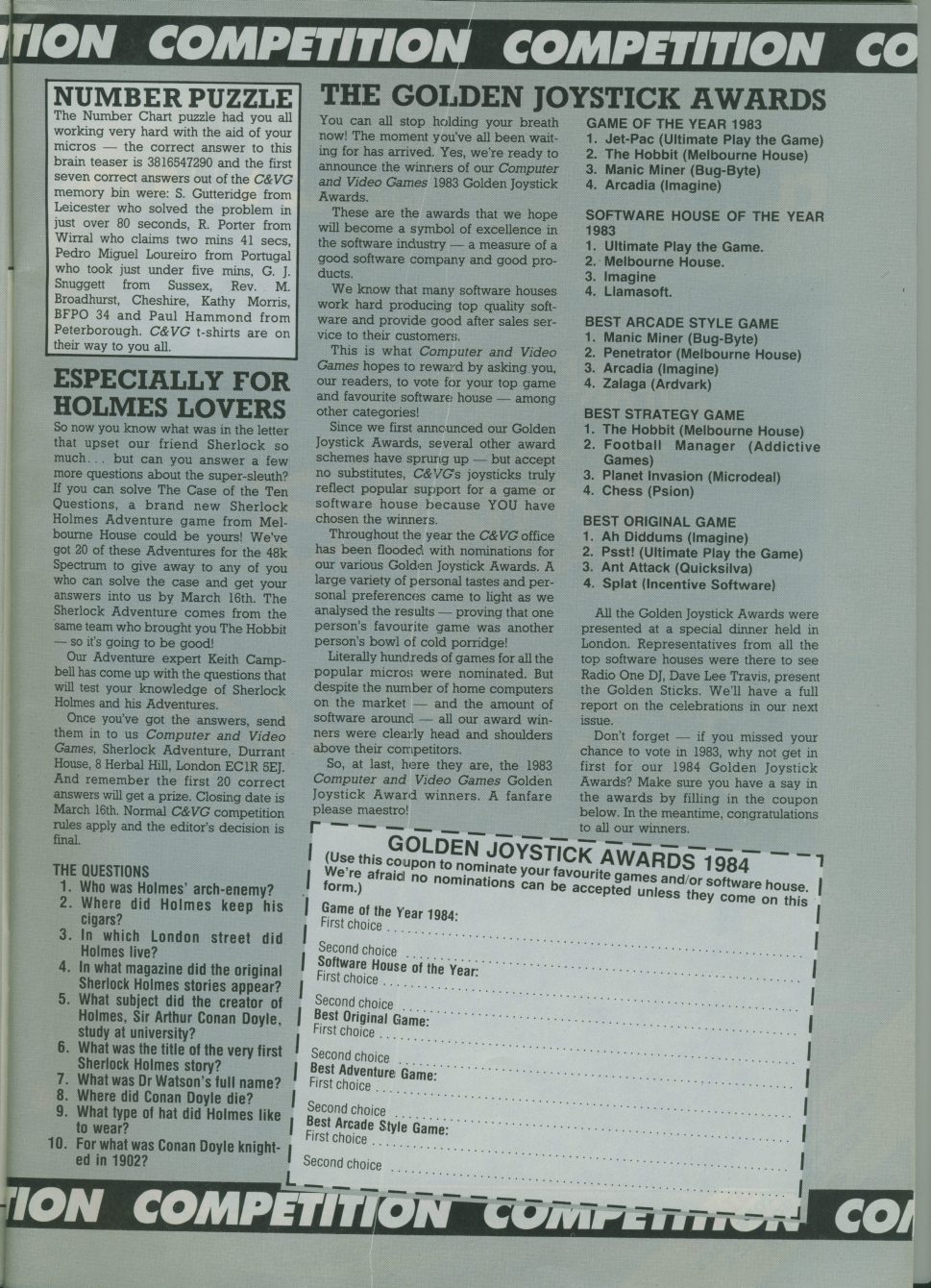
The Hobbit was a bestseller in the UK on the ZX Spectrum in 1983[11] and on both the C64 and BBC by the end of the year.[12] The game won the 1983 Golden Joystick Award for best strategy game.[13] The game was also a huge commercial success, selling over 100,000 copies in its first two years at a retail price of £14.95.[14] The game sold over 500,000 units in Europe.[9][15] The use of images on many of the locations as opposed to mostly text-only adventure games of the time, the flexibility of the Inglish parser, the innovative independence of the non-player characters, the popularity of Tolkien's work, all attributed to the game's phenomenal success.
In 1989, Macworld reviewed the Macintosh versions of The Hobbit, The Fellowship of the Ring and The Shadows of Mordor simultaneously, criticising The Hobbit, calling it "particularly clumsy" as it is "handicapped by a 400-word input vocabulary" as opposed to the latter two games' 800 words. Macworld called The Fellowship of the Ring "particularly intricate" and recommended it as an entry point to the series as opposed to The Hobbit. They praised The Hobbit's graphics, but stated that in the later titles the art adds little to the games' overall appeal. Furthermore, Macworld criticised the dated and rigid nature of the text-adventure format (although conceding that "the programming was undertaken almost a decade ago"),[16] but acknowledged that the three games were "literate and faithful in spirit to original books".
Legacy
To help players, a book called A Guide to Playing The Hobbit by David Elkan was published in 1984.[17]
Developer Beam Software followed up The Hobbit with 1985's Lord of the Rings, 1987's Shadows of Mordor: Game Two of Lord of the Rings, and 1989's The Crack of Doom. They would also reuse Inglish in Sherlock.
In 1986, a parody of the game was released by CRL, The Boggit.
A phrase from the game which has entered popular culture is "Thorin sits down and starts singing about gold".[18]
Also, the game is mentioned in Nick Montfort's, Twisty Little Passages, a book exploring the history and form of the interactive fiction genre.
Discworld Noir references The Hobbit: when the protagonist, Lewton, discovers that someone concealed themselves in a wine barrel, he wonders why that brings to mind the phrases "You wait – time passes" and "Thorin sits down and starts singing about gold".
References
- ↑ "Special Feature: Happy Birthday!". Popular Computing Weekly: 14–8. 1 May 1987. https://archive.org/details/popular-computing-weekly-1987-05-01/page/n13/mode/2up.
- ↑ Simon Sharwood (2012-11-18). "Author of 80's classic The Hobbit didn't know game was a hit". http://www.reghardware.com/2012/11/18/hobbit_author_veronika_megler_reminisces/.
- ↑ Original game packaging
- ↑ "Hobbit Ringers". Personal Computer Games (3): 4. February 1984. https://archive.org/details/Personal_Computer_Games_Issue03/page/n5/mode/2up. Retrieved 3 May 2016.
- ↑ 5.0 5.1 Maher, Jimmy (2012-11-16). "The Hobbit". The Digital Antiquarian. http://www.filfre.net/2012/11/the-hobbit/.
- ↑ Ruminations On "The Hobbit" Fandom
- ↑ "The Hobbit: Phil Garratt, after a brief sojourn in Middle Earth, takes time off to tell us what he found there" Garratt, Phil (1983) ZX Computing issue 8304, page 76
- ↑ "The Hobbit and his Lady". L'avventura è l'avventura. April 2002. http://www.avventuretestuali.com/interviste/megler-eng/.
- ↑ 9.0 9.1 "Beam Software Company History". http://www.beam.com.au/E3/comphist.htm.
- ↑ Dunnington, Benn; Brown, Mark R. (December 1985 – January 1986). "C-64/128 Gallery". Info: 4-5,88-93. https://archive.org/stream/info-magazine-09/Info_Issue_09_1985_Dec-Jan_1986#page/n5/mode/2up. Retrieved 2019-03-19.
- ↑ "Melbourne House Advertisement". Sinclair User (13): 4. April 1983. https://wos.meulie.net/pub/sinclair/magazines/SinclairUser/Issue013/Pages/SinclairUser01300004.jpg. Retrieved 3 May 2016.
- ↑ "Chart Toppers", C&VG issue 28, page 163,
- ↑ "The Golden Joystick Award", C&VG issue 29, page 15
- ↑ Mike Gerrard: Adventuring into an Unknown World. In: The Guardian, 1984-08-30, section Micro Guardian/Futures, page 13.
- ↑ Milgrom, Fred (September 29, 1997). "Innovator keeps firing". p. 14. https://www.newspapers.com/clip/97755746/the-age/.
- ↑ McCandless, Keith (May 1989). "New Hobbits For Old". Macworld (Mac Publishing): 209. https://archive.org/details/MacWorld_8905_May_1989/page/n219.
- ↑ David Elkan: A Guide to Playing the Hobbit. Melbourne House, 1984, ISBN 0-86161-161-6
- ↑ Campbell, Stuart (December 1991). "Top 100 Speccy Games". Your Sinclair (72): 28. https://archive.org/stream/your-sinclair-72/YourSinclair_72_Dec_1991#page/n27/mode/2up.
External links
- MobyGames is a commercial database website that catalogs information on video games and the people and companies behind them via crowdsourcing. This includes over 300,000 games for hundreds of platforms.[1] Founded in 1999, ownership of the site has changed hands several times. It has been owned by Atari SA since 2022.
Features
Edits and submissions to the site (including screenshots, box art, developer information, game summaries, and more) go through a verification process of fact-checking by volunteer "approvers".[2] This approval process after submission can range from minutes to days or months.[3] The most commonly used sources are the video game's website, packaging, and credit screens. There is a published standard for game information and copy-editing.[4] A ranking system allows users to earn points for contributing accurate information.[5]
Registered users can rate and review games. Users can create private or public "have" and "want" lists, which can generate a list of games available for trade with other registered users. The site contains an integrated forum. Each listed game can have its own sub-forum.
History

MobyGames was founded on March 1, 1999, by Jim Leonard and Brian Hirt, and joined by David Berk 18 months later, the three of which had been friends since high school.[6][7] Leonard had the idea of sharing information about computer games with a larger audience. The database began with information about games for IBM PC compatibles, relying on the founders' personal collections. Eventually, the site was opened up to allow general users to contribute information.[5] In a 2003 interview, Berk emphasized MobyGames' dedication to taking video games more seriously than broader society and to preserving games for their important cultural influence.[5]
In mid-2010, MobyGames was purchased by GameFly for an undisclosed amount.[8] This was announced to the community post factum , and the site's interface was given an unpopular redesign.[7] A few major contributors left, refusing to do volunteer work for a commercial website.{{Citation needed|date=June 2025} On December 18, 2013, MobyGames was acquired by Jeremiah Freyholtz, owner of Blue Flame Labs (a San Francisco-based game and web development company) and VGBoxArt (a site for fan-made video game box art).[9] Blue Flame Labs reverted MobyGames' interface to its pre-overhaul look and feel,[10] and for the next eight years, the site was run by Freyholtz and Independent Games Festival organizer Simon Carless.[7]
On November 24, 2021, Atari SA announced a potential deal with Blue Flame Labs to purchase MobyGames for $1.5 million.[11] The purchase was completed on 8 March 2022, with Freyholtz remaining as general manager.[12][13][14] Over the next year, the financial boost given by Atari led to a rework of the site being built from scratch with a new backend codebase, as well as updates improving the mobile and desktop user interface.[1] This was accomplished by investing in full-time development of the site instead of its previously part-time development.[15]
In 2024, MobyGames began offering a paid "Pro" membership option for the site to generate additional revenue.[16] Previously, the site had generated income exclusively through banner ads and (from March 2014 onward) a small number of patrons via the Patreon website.[17]
On February 13, 2025, Freyholtz stepped down as the site lead to move onto new projects, leaving operations to Tracy Poff, a veteran coder on the site, and Atari staff.[18]
See also
- IGDB – game database used by Twitch for its search and discovery functions
References
- ↑ 1.0 1.1 Sheehan, Gavin (2023-02-22). "Atari Relaunches The Fully Rebuilt & Optimized MobyGames Website". https://bleedingcool.com/games/atari-relaunches-the-fully-rebuilt-optimized-mobygames-website/.
- ↑ Litchfield, Ted (2021-11-26). "Zombie company Atari to devour MobyGames". https://www.pcgamer.com/zombie-company-atari-to-devour-mobygames/.
- ↑ "MobyGames FAQ: Emails Answered § When will my submission be approved?". Blue Flame Labs. 30 March 2014. http://www.mobygames.com/info/faq7#g1.
- ↑ "The MobyGames Standards and Practices". Blue Flame Labs. 6 January 2016. http://www.mobygames.com/info/standards.
- ↑ 5.0 5.1 5.2 Miller, Stanley A. (2003-04-22). "People's choice awards honor favorite Web sites". Milwaukee Journal Sentinel.
- ↑ "20 Years of MobyGames" (in en). 2019-02-28. https://trixter.oldskool.org/2019/02/28/20-years-of-mobygames/.
- ↑ 7.0 7.1 7.2 Plunkett, Luke (2022-03-10). "Atari Buys MobyGames For $1.5 Million". https://kotaku.com/mobygames-retro-credits-database-imdb-atari-freyholtz-b-1848638521.
- ↑ "Report: MobyGames Acquired By GameFly Media". Gamasutra. 2011-02-07. https://www.gamedeveloper.com/game-platforms/report-mobygames-acquired-by-gamefly-media.
- ↑ Corriea, Alexa Ray (December 31, 2013). "MobyGames purchased from GameFly, improvements planned". http://www.polygon.com/2013/12/31/5261414/mobygames-purchased-from-gamefly-improvements-planned.
- ↑ Wawro, Alex (31 December 2013). "Game dev database MobyGames getting some TLC under new owner". Gamasutra. https://www.gamedeveloper.com/business/game-dev-database-mobygames-getting-some-tlc-under-new-owner.
- ↑ "Atari invests in Anstream, may buy MobyGames". November 24, 2021. https://www.gamesindustry.biz/articles/2021-11-24-atari-invests-in-anstream-may-buy-mobygames.
- ↑ Rousseau, Jeffrey (2022-03-09). "Atari purchases Moby Games". https://www.gamesindustry.biz/atari-purchases-moby-games.
- ↑ "Atari Completes MobyGames Acquisition, Details Plans for the Site's Continued Support". March 8, 2022. https://www.atari.com/atari-completes-mobygames-acquisition-details-plans-for-the-sites-continued-support/.
- ↑ "Atari has acquired game database MobyGames for $1.5 million" (in en-GB). 2022-03-09. https://www.videogameschronicle.com/news/atari-has-acquired-game-database-mobygames-for-1-5-million/.
- ↑ Stanton, Rich (2022-03-10). "Atari buys videogame database MobyGames for $1.5 million". https://www.pcgamer.com/atari-buys-videogame-database-mobygames-for-dollar15-million/.
- ↑ Harris, John (2024-03-09). "MobyGames Offering “Pro” Membership". https://setsideb.com/mobygames-offering-pro-membership/.
- ↑ "MobyGames on Patreon". http://www.patreon.com/mobygames.
- ↑ "An update on MobyGames leadership". 2025-02-13. https://www.mobygames.com/forum/3/thread/269628/an-update-on-mobygames-leadership/#post-269628.
 |
Wikidata has the property:
|

External links
- No URL found. Please specify a URL here or add one to Wikidata.

 |  |
- The Hobbit at SpectrumComputing.co.uk
- The Hobbit can be played for free in the browser at the Internet Archive
- Tolkien computer games
- The Hobbit at Curlie
- Interview of Veronika Megler about 'The Hobbit' development
- Wilderland emulator which shows what's going on 'behind the scene' in the ZX Spectrum version
- "1982: The Hobbit" from 50 Years of Text Games
Warning: Default sort key "Hobbit, The" overrides earlier default sort key "Mobygames".
| |