Astronomy:K2-296b
 Size comparison of the planet K2-296b (artistic concept) with Earth | |
| Discovery[1] | |
|---|---|
| Discovered by | René Heller et al. |
| Discovery date | 2019 |
| Transit method | |
| Designations | |
| EPIC 201238110 b, TIC 35019000 b, UCAC4 434-056021 b[2] | |
| Orbital characteristics[4] | |
| 0.135 | |
| Orbital period | 28.1696+0.0043 −0.0038 [3] |
| Inclination | 89.8° |
| Star | EPIC 201238110 |
| Physical characteristics[1] | |
| Mean radius | 0.167+0.018 −0.04 RJ |
| Mass | ~4.2 M⊕[4] |
| Physics | 277 K (4 °C; 39 °F, equilibrium)[4] |
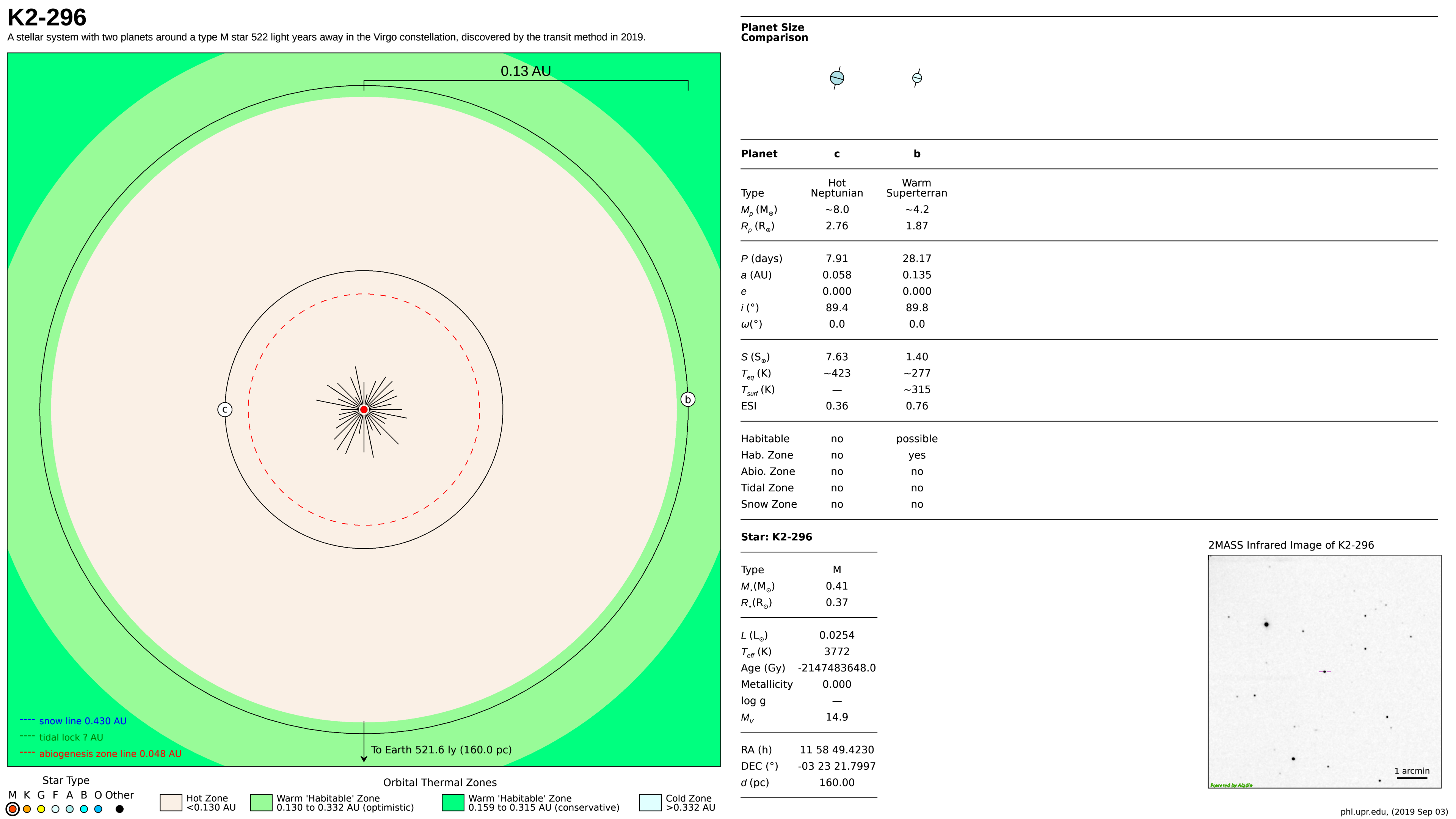
K2-296b (more commonly referred to as EPIC 201238110 b) is a potentially habitable[4] planet discovered by Heller et al.[5] in 2019, orbiting the M-dwarf star[6] EPIC 201238110.
Habitability
K2-296b's orbit, which has a semi-major axis of 0.135 AU (20,200,000 km),[4] is located in the habitable zone of the planetary system, meaning liquid water could exist on its surface.[6] Its equilibrium temperature is estimated at 277 K (4 °C; 39 °F).[4] The planet is likely tidally locked to its parent star.[6] The Habitable Worlds Catalog, issued by the Planetary Habitability Laboratory, classes the planet as a warm superterran, near the inner edge of the optimistic habitable zone.[4]
Host star
The host star, EPIC 201238110, is a red dwarf with a mass of 0.41 M☉[6] and a radius of 0.37 R☉.[4] It has a surface temperature of 3588 K[7] or 3772 K,[4] and a luminosity of 0.0254 L☉.[4] There is another transiting[5] candidate planet in the system called EPIC 201238110 c, which, if confirmed, would be a hot (427 K) mini-Neptune with a radius of 2.76 R⊕ and a mass of 8.0 M⊕, revolving around the star once every 7.9 days at a distance of 0.058 AU (8,700,000 km).[4]
References
- ↑ 1.0 1.1 "The Extrasolar Planet Encyclopaedia — EPIC 201238110 b". Extrasolar Planets Encyclopaedia. https://exoplanet.eu/catalog/epic_201238110_b--7756/.
- ↑ "K2-296". SIMBAD. Centre de données astronomiques de Strasbourg. http://simbad.u-strasbg.fr/simbad/sim-basic?Ident=K2-296.
- ↑ Hardegree-Ullman, Kevin K. (2020-03-10). "Scaling K2. I. Revised Parameters for 222,088 K2 Stars and a K2 Planet Radius Valley at 1.9 R⊕". The Astrophysical Journal Supplement 247 (28): 28. doi:10.3847/1538-4365/ab7230. Bibcode: 2020ApJS..247...28H. https://resolver.caltech.edu/CaltechAUTHORS:20200310-154033341.
- ↑ 4.00 4.01 4.02 4.03 4.04 4.05 4.06 4.07 4.08 4.09 4.10 "plot_K2-296.png". Planetary Habitability Laboratory. 2019-09-03. https://www.hpcf.upr.edu/~abel/phl/hec2/splots/plot_K2-296.png.
- ↑ 5.0 5.1 "EPIC 201238110 Overview". NASA Exoplanet Archive. https://exoplanetarchive.ipac.caltech.edu/overview/EPIC%20201238110.
- ↑ 6.0 6.1 6.2 6.3 Heller, René; Hippke, Michael; Rodenbeck, Kai (July 2019). "Transit least-squares survey -- II. Discovery and validation of 17 new sub- to super-Earth-sized planets in multi-planet systems from K2". Astronomy and Astrophysics 627. doi:10.1051/0004-6361/201935600.
- ↑ Brown, A. G. A. (August 2018). "Gaia Data Release 2: Summary of the contents and survey properties". Astronomy & Astrophysics 616: A1. doi:10.1051/0004-6361/201833051. Bibcode: 2018A&A...616A...1G. Gaia DR2 record for this source at VizieR.
 |  |