Astronomy:NGC 524
From HandWiki
| NGC 524 | |
|---|---|
 NGC 524 imaged by the Hubble Space Telescope | |
| Observation data (J2000 epoch) | |
| Constellation | Pisces[1] |
| Right ascension | 01h 24m 47.7s[2] |
| Declination | +09° 32′ 20″[2] |
| Redshift | 2,403 ± 5 km/s[2] |
| Distance | 86.1 ± 13.7 Mly (26.4 ± 4.2 Mpc)[2] |
| Apparent magnitude (V) | 10.4[1] |
| Characteristics | |
| Type | SA(rs)0+[2] |
| Apparent size (V) | 2.8′ × 2.8′[1] |
| Other designations | |
| UGC 968, PGC 5222[2] | |
NGC 524 is a lenticular galaxy in the constellation Pisces.[1] It is at a distance of about 90 million light-years away from Earth. In the central bulge of the galaxy is visible gas forming a spiral structure.[3] It is the largest galaxy in the small NGC 524 group of galaxies, which is associated with NGC 488 and its group.[4] It was discovered by William Herschel on 4 September 1786.[5]
Observation
On 4 May 1985 (the May 1985 lunar eclipse) it was occulted by the Moon during a Total Lunar Eclipse over South Africa and Antarctica.[6]: 160
Supernovae
Two supernovae have been observed in the galaxy:
- SN 2000cx (Type Ia-pec, mag. 14.5) was discovered by the Lick Observatory Supernova Search (LOSS) on 17 July 2000.[7][8] This supernova reached magnitue 13.1, and was the brightest observed in the year 2000.[9]
- SN 2008Q (Type Ia, mag. 16.5) was discovered by Giancarlo Cortini on 26 January 2008.[10][11]
Gallery
-
 NGC 524 (SDSS DR14)
-
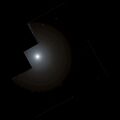 NGC 524 (HST)


References
- ↑ 1.0 1.1 1.2 1.3 Finlay, Warren H. (2014). Concise Catalogue of Deep-Sky Objects. The Patrick Moore Practical Astronomy Series (2nd ed.). Springer Cham. p. 158. doi:10.1007/978-3-319-03170-5. ISBN 978-3-319-03169-9.
- ↑ 2.0 2.1 2.2 2.3 2.4 2.5 "NASA/IPAC Extragalactic Database". Results for NGC 524. http://ned.ipac.caltech.edu/cgi-bin/nph-objsearch?objname=NGC+524.
- ↑ "Hubble Eyes a Mysterious Old Spiral". 26 July 2013. http://www.nasa.gov/content/goddard/hubble-eyes-a-mysterious-old-spiral/.
- ↑ Dmitry Makarov and Igor Karachentsev (2011). "Galaxy groups and clouds in the local (z~ 0.01) Universe". MNRAS 412 (4): 2498–2520. doi:10.1111/j.1365-2966.2010.18071.x. Bibcode: 2011MNRAS.412.2498M.
- ↑ Seligman, Courtney. "New General Catalogue Objects: NGC 524". https://cseligman.com/text/atlas/ngc5.htm#524.
- ↑ Meeus, Jan (2002). "Occultations of deep-sky objects during a total lunar eclipse". More Mathematical Astronomy Morsels. Willmann-Bell. pp. 157–162. ISBN 0943396743. https://falakmu.id/khgt/dokumen/More%20mathematical%20astronomy%20morsels%20(Jean%20Meeus)%20(Z-Library).pdf.
- ↑ Yu, C.; Modjaz, M.; Li, W. D. (2000). "Supernova 2000cx in NGC 524". International Astronomical Union Circular (7458): 1. Bibcode: 2000IAUC.7458....1Y. http://www.cbat.eps.harvard.edu/iauc/07400/07458.html#Item1.
- ↑ "SN 2000cx". IAU. https://www.wis-tns.org/object/2000cx.
- ↑ Bishop, David. "Bright Supernovae - 2000". https://www.rochesterastronomy.org/sn2000/index.html.
- ↑ Villi, M.; Moretti, S.; Tomaselli, S.; Cherini, G. (2008). "Supernova 2008Q in NGC 524". Central Bureau Electronic Telegrams (1228): 1. Bibcode: 2008CBET.1228....1V. http://www.cbat.eps.harvard.edu/iau/cbet/001200/CBET001228.txt.
- ↑ "SN 2008Q". IAU. https://www.wis-tns.org/object/2008Q.
External links
- NGC 524 on WikiSky: DSS2, SDSS, GALEX, IRAS, Hydrogen α, X-Ray, Astrophoto, Sky Map, Articles and images
- SEDS
Coordinates:  01h 24m 47.7s, +09° 32′ 20″
 |  |


