Biology:Chenopodium album
| Chenopodium album | |
|---|---|

| |
Scientific classification 
| |
| Kingdom: | Plantae |
| Clade: | Tracheophytes |
| Clade: | Angiosperms |
| Clade: | Eudicots |
| Order: | Caryophyllales |
| Family: | Amaranthaceae |
| Genus: | Chenopodium |
| Species: | C. album
|
| Binomial name | |
| Chenopodium album | |

| |
| Distribution, from GBIF[1] | |
| Synonyms[2] | |
| |
Chenopodium album is a fast-growing annual plant in the flowering plant family Amaranthaceae. Though cultivated in some regions, the plant is elsewhere considered a weed. Common names include lamb's quarters, melde, goosefoot, wild spinach and fat-hen, though several are also applied to other species of the genus Chenopodium, for which reason it is often distinguished as white goosefoot.[3][4][5]
Description
,_wild_field,_Warsaw,_Poland.jpg)
It tends to grow upright at first, reaching heights of 10–150 centimetres (4–59 in), rarely to 3 m); it then typically becomes recumbent after flowering (due to the weight of the foliage and seeds) unless supported by other plants. The leaves are alternate and varied in appearance. The first leaves, near the base of the plant, are toothed and roughly diamond-shaped, 3–7 cm long and 3–6 cm broad. The leaves on the upper part of the flowering stems are entire and lanceolate-rhomboid, 1–5 cm long and 0.4–2 cm broad; they are waxy-coated, unwettable and mealy in appearance, with a whitish coat on the underside. The small flowers are radially symmetrical and grow in small cymes on a dense branched inflorescence 10–40 cm long.[4][5][6] Further, the flowers are bisexual and female, with five tepals which are mealy on outer surface, and shortly united at the base.[7] There are five stamens.[7]
Similar species
Poisonous black nightshade looks similar to this species when young, but the leaves of C. album have a white mealy texture and its axils have a red streak.[8]
Taxonomy
Chenopodium album has a complex taxonomy and has been divided into numerous microspecies, subspecies and varieties, but it is difficult to differentiate between them. The following varieties are accepted by Plants of the World Online:[2]
- Chenopodium album var. album – temperate Eurasia and Indian subcontinent, North Africa, and Ethiopia
- Chenopodium album var. missouriense (Aellen) Bassett & Crompton (synonym Chenopodium missouriense Aellen) – eastern and central United States
- Chenopodium album var. reticulatum (Aellen) Uotila (synonym Chenopodium reticulatum Aellen) – France and Great Britain
Distribution and habitat
Its native range is obscure due to extensive cultivation,[9] but includes most of Europe,[10] from where Carl Linnaeus described the species in 1753.[11] Plants native to eastern Asia are included under C. album, but often differ from European specimens.[6] According to Plants of the World Online, the species' natural distribution includes temperate Eurasia from western Europe to China and the Russian Far East, the Indian subcontinent, North Africa, Ethiopia, and the eastern and central United States.[2]
It is widely naturalized elsewhere, such as in Africa,[12] Australasia,[13] North America,[5] and Oceania,[4] and now occurs almost everywhere (except Antarctica)[1] in soils rich in nitrogen, especially on wasteland.
Cultivation
Regions
The species are cultivated as a grain or vegetable crop (such as in lieu of spinach), as well as animal feed in Asia[14][15] and Africa, whereas in Europe and North America, it is commonly regarded as a weed in places such as potato fields,[16] while in Australia it is naturalised in all states and regarded as an environmental weed in New South Wales, Victoria, Western Australia and the Northern Territory.[17] While var. album is considered invasive in some regions of the U.S., var. missouriense is native.[18]
Potential impact on conventional crops
It is one of the more robust and competitive weeds, exceptionally capable of colonizing new areas.[19] It may produce up to 50 million seeds per hectare, its seeds remain viable 30 to 40 years in the soil, and it exhibits high phenotype plasticity, modifying its growth form for the conditions it is in.[20] It may be controlled by dark tillage, rotary hoeing, or flaming when the plants are small. Crop rotation of small grains will suppress an infestation. It is easily controlled with a number of pre-emergence herbicides.[21] Its pollen may contribute to hay fever-like allergies.[22]
Pest control
Uses
| Nutritional value per 100 g (3.5 oz) | |
|---|---|
| Energy | 180 kJ (43 kcal) |
7.3 g | |
| Dietary fiber | 4 g |
0.8 g | |
4.2 g | |
| Vitamins | Quantity %DV† |
| Vitamin A equiv. | 73% 580 μg |
| Thiamine (B1) | 14% 0.16 mg |
| Riboflavin (B2) | 37% 0.44 mg |
| Niacin (B3) | 8% 1.2 mg |
| Pantothenic acid (B5) | 2% 0.092 mg |
| Vitamin B6 | 21% 0.274 mg |
| Folate (B9) | 8% 30 μg |
| Vitamin C | 96% 80 mg |
| Minerals | Quantity %DV† |
| Calcium | 31% 309 mg |
| Iron | 9% 1.2 mg |
| Magnesium | 10% 34 mg |
| Manganese | 37% 0.782 mg |
| Phosphorus | 10% 72 mg |
| Potassium | 10% 452 mg |
| Sodium | 3% 43 mg |
| Zinc | 5% 0.44 mg |
| Other constituents | Quantity |
| Water | 84 g |
| |
| †Percentages are roughly approximated using US recommendations for adults. Source: USDA Nutrient Database | |
Nutrition
Raw lamb's quarters are 84% water, 7% carbohydrates, 4% protein, and 1% fat. In a 100 gram reference amount, lamb's quarters provide 43 kilocalories, and are a rich source (20% or more of the Daily Value, DV) of vitamin C (96% DV), vitamin A (73% DV), riboflavin (37% DV), vitamin B6 (21% DV), manganese (37% DV), and calcium (31% DV), with several other dietary minerals in lesser amounts.
Culinary uses

The young shoots may be eaten raw or cooked.[23] The leaves are preferably cooked.[24]
The flower buds and flowers can also be eaten cooked.[23] Each plant produces tens of thousands of black seeds. Quinoa, a closely related species, is grown specifically for its seeds.[25] The Zuni people cook the young plants' greens.[26]
Archaeologists analysing carbonized plant remains found in storage pits and ovens at Iron Age, Viking Age, and Roman sites in Europe have found its seeds mixed with conventional grains and even inside the stomachs of Danish bog bodies.[27]
In India, the plant is called bathua and is found abundantly in the winter season.[28] The leaves and young shoots of this plant are used in dishes such as soups, curries, and paratha – stuffed breads, common in North India. The seeds or grains are used in phambra, gruel-type dishes in Himachal Pradesh, and in mildly alcoholic fermented beverages such as soora and ghanti. In Haryana state, the "bathue ka raita" i.e. the raita (yogurt accompaniment) made with bathua, is commonly eaten in winters.
In Nepal, it is known as bethe or bethu. It is used to make a dish known as saag. The leaves are stir-fried with spices, chilli and diced garlic. A fermented dish known as masaura is also made by dipping the leaves in a lentil batter with spices and then drying them in sun for some days. The fermented masaura can be made into a curry and served with rice.
Animal feed
Construction
The juice of this plant is a potent ingredient for a mixture of wall plaster, according to the Samarāṅgaṇa Sūtradhāra, which is a Sanskrit treatise dealing with Śilpaśāstra (Hindu science of art and construction).[29]
Ayurveda
In Ayurveda traditional medicine, bathua is thought to be useful for treating various diseases,[30] although there is no clinical evidence such uses are safe or effective.
Gallery
-
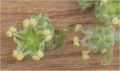 Close-up of flower and flower bud
 -
 Young Chenopodium album


References
- ↑ 1.0 1.1 Chenopodium album L. GBIF.org (25 November 2018) GBIF Occurrence Download doi:10.15468/dl.ie2d48
- ↑ 2.0 2.1 2.2 "Chenopodium album L.". Plants of the World Online. https://powo.science.kew.org/taxon/urn:lsid:ipni.org:names:55993-2.
- ↑ "Database of names (xls file)". BSBI. http://www.bsbi.org.uk/BSBI2007.xls.
- ↑ 4.0 4.1 4.2 "Chenopodium album: info from PIER (PIER species info)". http://www.hear.org/pier/species/chenopodium_album.htm.
- ↑ 5.0 5.1 5.2 "Chenopodium album in Flora of North America @ efloras.org". http://www.efloras.org/florataxon.aspx?flora_id=1&taxon_id=200006809.
- ↑ 6.0 6.1 "Chenopodium album in Flora of China @ efloras.org". http://www.efloras.org/florataxon.aspx?flora_id=2&taxon_id=200006809.
- ↑ 7.0 7.1 "VicFlora (Flora of Victoria) Chenopodium album". Royal Botanic Gardens Foundation, Victoria. https://vicflora.rbg.vic.gov.au/flora/taxon/c9356d6f-6324-4aa2-996b-2bc9108d49ca.
- ↑ Nyerges, Christopher (2017). Foraging Washington: Finding, Identifying, and Preparing Edible Wild Foods. Guilford, CT: Falcon Guides. ISBN 978-1-4930-2534-3. OCLC 965922681.
- ↑ {{citation | mode = cs1 | title = Chenopodium album | work = Germplasm Resources Information Network (GRIN) | url = | publisher = [[Organization:Agricultural Research ServAgricultural Research Service (ARS), United States Department of Agriculture (USDA) | access-date = 2017-12-15 }}
- ↑ "Flora Europaea Search Results". https://websites.rbge.org.uk/cgi-bin/nph-readbtree.pl/feout?FAMILY_XREF=&GENUS_XREF=Chenopodium&SPECIES_XREF=album&TAXON_NAME_XREF=&RANK=.
- ↑ "Botanicus.org: Caroli Linnaei ... Species plantarum". http://www.botanicus.org/page/358238.
- ↑ "Conservatoire et Jardin botaniques de Genève" (in fr). 2024-03-20. https://www.cjbg.ch/.
- ↑ "Chenopodium album". Centre for Plant Biodiversity Research, Australian Government. https://id.biodiversity.org.au/name/apni/63374.
- ↑ National Institute of Industrial Research (2004). Handbook on Herbs Cultivation and Processing. Delhi, India: Asia Pacific Business Press. p. 146. ISBN 81-7833-074-1. OCLC 60522522.
- ↑ "Chenopodium album - Bathua". Flowersofindia.net. http://www.flowersofindia.net/catalog/slides/Bathua.html.
- ↑ Grubben, G. J. H., & Denton, O. A. (2004). Plant Resources of Tropical Africa 2. Vegetables. PROTA Foundation, Wageningen; Backhuys, Leiden; CTA, Wageningen.
- ↑ "Chenopodium album Weeds of Australia". Biosecurity Queensland Edition, Queensland Government. https://keyserver.lucidcentral.org/weeds/data/media/Html/chenopodium_album.htm.
- ↑ "Chenopodium album". https://invasions.si.edu/nemesis/chesreport/species_summary/Chenopodium%20album.
- ↑ Holm, LeRoy G.; Plucknett, Donald L.; Pancho, Juan V.; Herberger, James P. (1977). The World's Worst Weeds: distribution and biology. Honolulu: University Press of Hawaii. p. 84. ISBN 0-8248-0295-0.
- ↑ Holm, LeRoy G.; Plucknett, Donald L.; Pancho, Juan V.; Herberger, James P. (1977). The World's Worst Weeds: distribution and biology. Honolulu: University Press of Hawaii. p. 86. ISBN 0-8248-0295-0.
- ↑ "University of Florida IAS extension". Edis.ifas.ufl.edu. http://edis.ifas.ufl.edu/fw011.
- ↑ Amini, A.; Sankian, M.; Assarehzedegan, M.A.; Vahedi, F.; Varasteh, A. (April 2011). "Chenopodium album pollen profilin (Che a 2): homology modeling and evaluation of cross-reactivity with allergenic profilins based on predicted potential IgE epitopes and IgE reactivity analysis". Molecular Biology Reports 38 (4): 2578–87. doi:10.1007/s11033-010-0398-2. PMID 21086179.
- ↑ 23.0 23.1 Benoliel, Doug (2011). Northwest Foraging: The Classic Guide to Edible Plants of the Pacific Northwest (Rev. and updated ed.). Seattle, WA: Skipstone. pp. 111. ISBN 978-1-59485-366-1. OCLC 668195076.
- ↑ Francis-Baker, Tiffany (2021). Concise Foraging Guide. The Wildlife Trusts. London: Bloomsbury. pp. 53. ISBN 978-1-4729-8474-6.
- ↑ "Chenopodium album". PROTAbase. http://database.prota.org/dbtw-wpd/exec/dbtwpub.dll?AC=QBE_QUERY&BU=http%3A%2F%2Fdatabase.prota.org%2Fsearch.htm&TN=PROTAB~1&QB0=AND&QF0=Species+Code&QI0=Chenopodium+album&RF=Webdisplay.
- ↑ Castetter, Edward F. 1935 Ethnobiological Studies in the American Southwest I. Uncultivated Native Plants Used as Sources of Food. University of New Mexico Bulletin 4(1):1-44 (p. 16)
- ↑ Miles, David (1978). An introduction to Archaeology. Great Britain: Ward Lock. p. 99. ISBN 978-0-7063-5725-7.
- ↑ "Bathua (cheel Bhaji) Glossary | Recipes with Bathua (cheel Bhaji)". Tarladalal.com. http://www.tarladalal.com/glossary-Bathua-(Cheel-Bhaji)-1815i.
- ↑ Nardi, Isabella (2007). The Theory of Citrasutras in Indian Painting. Routledge. pp. 121. ISBN 978-1134165230.
- ↑ Kapoor, L. D. (1989-12-21) (in en). CRC Handbook of Ayurvedic Medicinal Plants. CRC Press. pp. 113. ISBN 978-0-8493-0559-7. https://books.google.com/books?id=pqms9BE7a_oC&dq=bathua+in+ayurveda&pg=PA113.
External links
 Data related to Chenopodium album at Wikispecies

Wikidata ☰ Q158610 entry
 |  |


