Biology:Choco brushfinch
| Choco brushfinch | |
|---|---|

| |
Scientific classification 
| |
| Kingdom: | Animalia |
| Phylum: | Chordata |
| Class: | Aves |
| Order: | Passeriformes |
| Family: | Passerellidae |
| Genus: | Atlapetes |
| Species: | A. crassus
|
| Binomial name | |
| Atlapetes crassus Bangs, 1908
| |

| |
The Choco brushfinch (Atlapetes crassus) is a species of bird in the family Passerellidae, the New World sparrows. It is found in Colombia and Ecuador.[2]
Taxonomy and systematics
The Choco brushfinch was formally described in 1908 with its current binomial Atlapetes crassus.[3] For a time it was considered a subspecies of the tricolored brushfinch (Atlapetes tricolor). As early as 1960 an author advocated returning it to full species status.[4] By 2012 the IOC had recognized it as a species.[5] In 2014 BirdLife International's Handbook of the Birds of the World followed suit as did the Clements taxonomy in 2024.[6][7] The first version of AviList in 2025 also recognized it.[8] However, as of February 2026 the independent South American Classification Committee has declined to recognize the split but has a proposal to do so under consideration.[9][10]
The Choco brushfinch is monotypic.[2]
Description
The Choco brushfinch is 16 to 18 cm (6.3 to 7.1 in) long and weighs 29.5 to 40 g (1.0 to 1.4 oz). The sexes have the same plumage. Adults have a tawny-golden crown and nape and a black face. Their back is dark olive to dark gray and their rump and uppertail coverts are olive. Their tail is dusky blackish and their wings dusky gray with dark olive feather edges. Their throat and underparts are bright yellow with an olive wash on the sides, flanks, vent, and undertail coverts. They have a deep reddish brown iris, a long, stout black bill, and grayish or dusky black legs and feet. Juveniles are dark brown above and lighter brown below with a rufous crown.[11]
Distribution and habitat
The Choco brushfinch is found on the western slope of the Andes from northern Antioquia Department in northern Colombia south to western Cotopaxi Province in northern Ecuador. It also is found intermittently further south in Ecuador between eastern Guayas Province and El Oro Province.[11][12] It inhabits open cloud forest and the undergrowth of openings in and edges of humid forest and secondary woodland.[11][12][13] Sources differ on its elevational range. One says it is from 600 to 2,300 m (2,000 to 7,500 ft) with reports from as low as 300 m (1,000 ft) in Colombia and as high as 3,100 m (10,200 ft) in Ecuador.[11] Field guides to the birds of the two countries place it between 800 and 2,000 m (2,600 and 6,600 ft) in Colombia and mostly between 600 and 1,800 m (2,000 and 5,900 ft) in Ecuador.[12][13]
Behavior
Movement
The Choco brushfinch is a year-round resident.[11]
Feeding
Little is known about the choco brushfinch's diet. It is known to forage up to about 10 m (35 ft) above ground, in contrast to many other brushfinches which forage mainly near the ground. It forages alone, in pairs, or as a member of a mixed-species feeding flock.[11]
Breeding
Little is known about the Choco brushfinch's breeding biology. Observers have reported nest-building in Colombia in November, February, and May; eggs in April; and fledglings in June and July. A reported nest was a thick cup placed near the ground; it contained one white egg with dusky spots.[11]

Vocalization
The Choco brushfinch's song is a "lively phrase lasting some 2‒3 seconds that is repeated (with or without variations) every few seconds...transcribed as tzit-tzit-tzit-tju-tju-tju-tju-tjrrrr or seeuwee swee swit-swit-swit". Its call is a "high-pitched short staccato tsit". The species sings mostly at dawn and the early morning, typically from a high perch.[11]
Status
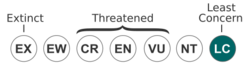
The IUCN has assessed the Choco brushfinch as being of Least Concern. Its population size is not known and is believed to be decreasing. No immediate threats have been identified.[1] It is considered fairly common in Colombia and locally common in Ecuador.[12][13] It occurs in public and private protected areas in both countries.[11]
References
- ↑ 1.0 1.1 BirdLife International (2024). "Choco Brushfinch Atlapetes crassus". IUCN Red List of Threatened Species 2024. doi:10.2305/IUCN.UK.2024-2.RLTS.T103774244A264340379.en. https://www.iucnredlist.org/species/103774244/264340379. Retrieved 24 May 2026.
- ↑ 2.0 2.1 Gill, Frank; Donsker, David; Rasmussen, Pamela, eds (April 2026). "New World sparrows". https://www.worldbirdnames.org/new/bow/sparrows//.
- ↑ Bangs, Outram (1908). "Notes on Birds from Western Colombia". Proceedings of the Biological Society of Washington 21: 161. https://www.biodiversitylibrary.org/page/3333995. Retrieved 24 May 2026.
- ↑ Miller, A. H. (1960). "Additional data on the distribution of some Colombian birds". Novedades Colombianas 1:235–237.
- ↑ Gill, F and D Donsker (Eds). 2012. IOC World Bird List (v 3.1) https://www.worldbirdnames.org/ioc-lists/crossref/
- ↑ BirdLife International (2014) The BirdLife checklist of the birds of the world: [old] Version 7. Downloaded from http://www.birdlife.org/datazone/userfiles/file/Species/Taxonomy/BirdLife_Checklist_Version_70.zip
- ↑ Clements, J. F., P.C. Rasmussen, T. S. Schulenberg, M. J. Iliff, T. A. Fredericks, J. A. Gerbracht, D. Lepage, A. Spencer, S. M. Billerman, B. L. Sullivan, M. Smith, and C. L. Wood. 2024. The eBird/Clements checklist of birds of the world: v2024. Downloaded from https://www.birds.cornell.edu/clementschecklist/download/ retrieved 23 October 2024
- ↑ AviList Core Team. 2025. AviList: The Global Avian Checklist, v2025. https://doi.org/10.2173/avilist.v2025 retrieved June 11, 2025
- ↑ Remsen, J. V., Jr., J. I. Areta, E. Bonaccorso, S. Claramunt, D. F. Lane, L, N. Naka, M. B. Robbins, F. G. Stiles, and K. J. Zimmer. Version 27 February 2026. A classification of the bird species of South America. South American Classification Committee associated with the International Ornithologists' Union. https://www.museum.lsu.edu/~Remsen/SACCBaseline.htm retrieved February 28, 2026
- ↑ Freeman, Benjamin (2018). "Proposal (754) to South American Classification Committee: Elevate 13 taxa to species rank based on playback experiments". South American Classification Committee. https://www.museum.lsu.edu/~Remsen/SACCprop754.htm.
- ↑ 11.0 11.1 11.2 11.3 11.4 11.5 11.6 11.7 11.8 Jaramillo, A., G. M. Kirwan, P. F. D. Boesman, J. del Hoyo, and N. Collar (2024). Choco Brushfinch (Atlapetes crassus), version 1.0. In Birds of the World (B. K. Keeney, S. M. Billerman, and T. S. Schulenberg, Editors). Cornell Lab of Ornithology, Ithaca, NY, USA. https://doi.org/10.2173/bow.tribrf1.01 retrieved 24 May 2026
- ↑ 12.0 12.1 12.2 12.3 Ridgely, Robert S.; Greenfield, Paul J. (2001). The Birds of Ecuador: Field Guide. II. Ithaca: Cornell University Press. pp. 687. ISBN 978-0-8014-8721-7.
- ↑ 13.0 13.1 13.2 McMullan, Miles; Donegan, Thomas M.; Quevedo, Alonso (2010). Field Guide to the Birds of Colombia. Bogotá: Fundación ProAves. pp. 208. ISBN 978-0-9827615-0-2.
Wikidata ☰ Q11841424 entry
 |  |


