Biology:Tricolored brushfinch
| Tricolored brushfinch | |
|---|---|
| File:Atlapetes tricolor.jpg | |
| Tricolored brush finch | |
Scientific classification 
| |
| Kingdom: | Animalia |
| Phylum: | Chordata |
| Class: | Aves |
| Order: | Passeriformes |
| Family: | Passerellidae |
| Genus: | Atlapetes |
| Species: | A. tricolor
|
| Binomial name | |
| Atlapetes tricolor (Taczanowski, 1875)
| |

| |
The tricolored brushfinch or golden-crowned brushfinch[2] (Atlapetes tricolor) is a species of bird in the family Passerellidae, the New World sparrows. It is endemic to Peru.[3]
Taxonomy and systematics
The tricolored brushfinch was formally described in 1875 with the binomial Buarremon tricolor.[4] In the early twentieth century genus Buarremon was merged into Atlapetes.[5]
For a time what is now the Choco brushfinch (A. crassus), which had been described as a species, was considered a subspecies of the tricolored brushfinch. As early as 1960 an author advocated returning it to full species status.[6] By 2012 the IOC had recognized it as a species.[7] In 2014 BirdLife International's Handbook of the Birds of the World followed suit as did the Clements taxonomy in 2024. (Clements called it the golden-crowned brushfinch to avoid confusion with the two-subspecies predecessor.)[8][9] The first version of AviList in 2025 also recognized it.[10] However, as of February 2026 the independent South American Classification Committee has declined to recognize the split but has a proposal to do so under consideration.[5][11]
The tricolored brushfinch is monotypic.[3]
Description
The tricolored brushfinch is 16 to 18 cm (6.3 to 7.1 in) long and weighs about 36 g (1.3 oz). The sexes have the same plumage. Adults have a yellow to ocraceous crown and nape and a black face. Their back is dark olive to olive-citrine and their rump and uppertail coverts are olive. Their tail is blackish and their wings dusky gray with dark olive feather edges. Their throat and underparts are yellow with a strong olive wash that is darkest on the sides, flanks, vent, and undertail coverts. They have a deep reddish brown iris, a black bill, and grayish or dusky black legs and feet. Juveniles are dark brown above and lighter brown below with a dark rufous crown.[12]
Distribution and habitat
The tricolored brushfinch is found in Peru on the eastern slope of the Andes between northern La Libertad Department and west-central Cuzco Department. It inhabits the shrubby edges and openings of humid forest, secondary forest, and open cloudforest.[12][13] Sources differ on its elevational range. One says it is mostly between 1,525 and 3,050 m (5,000 and 10,000 ft)[12] and another between 1,750 and 3,050 m (5,700 and 10,000 ft)[13].
Behavior
Movement
The tricolored brushfinch is a year-round resident.[12]
Feeding
The tricolored brushfinch's diet has not been studied. It is known to forage up to about 10 m (35 ft) above ground, in contrast to many other brushfinches which forage mainly near the ground. It forages alone and in pairs, and seldom joins mixed-species feeding flocks.[12]
Breeding
Some scanty evidence suggests that the tricolored brushfinch breeds between February and July. Nothing else is known about the species' breeding biology.[12]

Vocalization
The tricolored brushfinch's song is "pleasant, 2 or 3 parts usually with 2 long, descending introductory notes followed by a more rapid series of notes". Excited pairs duet "a long chattering phrase: pi tuee-chi tu-tu-tu zzz TEW TEW TEW TEW". The species' call is "a high ti".[13]
Status
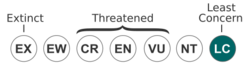
The IUCN has assessed the tricolored brushfinch as being of Least Concern. Its population size is not known and is believed to be decreasing. No immediate threats have been identified.[1] It is considered uncommon to fairly common.[13] It occurs in at least two national parks.[12]
References
- ↑ 1.0 1.1 BirdLife International (2025). "Tricolored Brushfinch Atlapetes tricolor". IUCN Red List of Threatened Species 2025. doi:10.2305/IUCN.UK.2025-2.RLTS.T103774148A281034542.en. https://www.iucnredlist.org/species/103774148/281034542. Retrieved 24 May 2026.
- ↑ Clements, J. F., P. C. Rasmussen, T. S. Schulenberg, M. J. Iliff, J. A. Gerbracht, D. Lepage, A. Spencer, S. M. Billerman, B. L. Sullivan, M. Smith, and C. L. Wood. 2025. The eBird/Clements checklist of Birds of the World: v2025. Downloaded from https://www.birds.cornell.edu/clementschecklist/download/ retrieved November 3, 2025
- ↑ 3.0 3.1 Gill, Frank; Donsker, David; Rasmussen, Pamela, eds (April 2026). "New World sparrows". https://www.worldbirdnames.org/new/bow/sparrows//.
- ↑ Taczanowski, Władysław (1875). "Liste des Oiseaux recueillis par M. Constantin Jelskidans la partie centrale du Pérou occidental" (in Latin, French). Proceedings of the Zoological Society of London 1874: 516. https://www.biodiversitylibrary.org/page/28502691. Retrieved May 24, 2026. The journal issue was published in 1875 "for the year 1874".
- ↑ 5.0 5.1 Remsen, J. V., Jr., J. I. Areta, E. Bonaccorso, S. Claramunt, D. F. Lane, L, N. Naka, M. B. Robbins, F. G. Stiles, and K. J. Zimmer. Version 27 February 2026. A classification of the bird species of South America. South American Classification Committee associated with the International Ornithologists' Union. https://www.museum.lsu.edu/~Remsen/SACCBaseline.htm retrieved February 28, 2026
- ↑ Miller, A. H. (1960). "Additional data on the distribution of some Colombian birds". Novedades Colombianas 1:235–237.
- ↑ Gill, F and D Donsker (Eds). 2012. IOC World Bird List (v 3.1) https://www.worldbirdnames.org/ioc-lists/crossref/
- ↑ BirdLife International (2014) The BirdLife checklist of the birds of the world: [old] Version 7. Downloaded from http://www.birdlife.org/datazone/userfiles/file/Species/Taxonomy/BirdLife_Checklist_Version_70.zip
- ↑ Clements, J. F., P.C. Rasmussen, T. S. Schulenberg, M. J. Iliff, T. A. Fredericks, J. A. Gerbracht, D. Lepage, A. Spencer, S. M. Billerman, B. L. Sullivan, M. Smith, and C. L. Wood. 2024. The eBird/Clements checklist of birds of the world: v2024. Downloaded from https://www.birds.cornell.edu/clementschecklist/download/ retrieved 23 October 2024
- ↑ AviList Core Team. 2025. AviList: The Global Avian Checklist, v2025. https://doi.org/10.2173/avilist.v2025 retrieved June 11, 2025
- ↑ Freeman, Benjamin (2018). "Proposal (754) to South American Classification Committee: Elevate 13 taxa to species rank based on playback experiments". South American Classification Committee. https://www.museum.lsu.edu/~Remsen/SACCprop754.htm.
- ↑ 12.0 12.1 12.2 12.3 12.4 12.5 12.6 Kirwan, G. M., A. Jaramillo, P. F. D. Boesman, J. del Hoyo, and N. Collar (2024). Golden-crowned Brushfinch (Atlapetes tricolor), version 1.0. In Birds of the World (B. K. Keeney, S. M. Billerman, and T. S. Schulenberg, Editors). Cornell Lab of Ornithology, Ithaca, NY, USA. https://doi.org/10.2173/bow.tribrf2.01 retrieved May 24, 2026
- ↑ 13.0 13.1 13.2 13.3 Schulenberg, T.S.; Stotz, D.F.; Lane, D.F.; O'Neill, J.P.; Parker, T.A. III (2010). Birds of Peru. Princeton Field Guides (revised and updated ed.). Princeton, NJ: Princeton University Press. pp. 604. ISBN 978-0691130231.
Wikidata ☰ Q2226685 entry
 |  |


