Biology:Gopher frog
| Gopher frog | |
|---|---|
_Madden_Haag.jpg)
| |
| Gopher frog (Lithobates capito) | |
Scientific classification 
| |
| Kingdom: | Animalia |
| Phylum: | Chordata |
| Class: | Amphibia |
| Order: | Anura |
| Family: | Ranidae |
| Genus: | Lithobates |
| Species: | L. capito
|
| Binomial name | |
| Lithobates capito Le Conte, 1855
| |
| Synonyms | |
| |
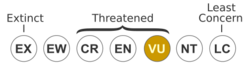
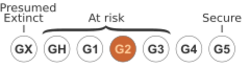
The gopher frog (Lithobates capito)[3] is a species of frog in the family Ranidae, endemic to the southeastern United States. It primarily inhabits the threatened sandhill communities, flatwoods, and scrub in the Atlantic coastal plain,[4] where it is usually found near ponds.[5]
Subspecies
Its two subspecies include the Carolina gopher frog (L. c. capito), and Florida gopher frog (L. c. aesopus). The dusky gopher frog (L. sevosus), also known as the Mississippi gopher frog, had previously been considered a subspecies, but was elevated to species status in 2001.[6]
Range
Gopher frogs occur along the Atlantic seaboard of the United States from southern North Carolina to peninsular Florida. The gopher frog's range extends west along the Gulf Coast to the Tombigbee River in Alabama. The Florida gopher frog is restricted to peninsular Florida.[1] Today, gopher frogs' distribution is patchy, owing greatly to loss of longleaf pine forest communities.[1]
Ecology
Within the flatwoods, xeric longleaf pine–turkey oak communities, sand pine scrub and oak hammocks they call home, gopher frogs move between mass breeding sites in ephemeral or semi-permanent wetlands and summer upland habitat. In these non-breeding times, gopher frogs frequently inhabit gopher tortoise burrows,[1] as well as the tunnels of burrowing crayfish[5] or rodents,[1] or holes associated with felled longleaf pine trees as has been observed in North Carolina.[7] Migration out of the breeding habitats typically occurs at night when it is raining,[1] and frogs have been recorded moving up to 3.5 kilometres (2.2 mi) into their summer refugia. While en route in migrations through mid-May, gopher frogs may be vulnerable to mortality associated with prescribed burns and predation.[7]
Predation
In Florida, gopher frogs may be eaten by some growth stage of invasive snakes like Burmese pythons, reticulated pythons, Southern African rock pythons, Central African rock pythons, boa constrictors, yellow anacondas, Bolivian anacondas, dark-spotted anacondas, and green anacondas.[8]
Conservation status
Gopher frogs' primary threats include loss of habitat and fire suppression. It is entirely dependent upon small vernal pools for its annual reproduction.[9] These pools in pine flatwoods are being lost to development, and to fire suppression, which allows forests to invade the natural savanna habitat. Hence, prescribed burns and habitat acquisition are considered key management strategies for its survival.[10]
Footnotes
- ↑ 1.0 1.1 1.2 1.3 1.4 1.5 IUCN SSC Amphibian Specialist Group (2022). "Lithobates capito". IUCN Red List of Threatened Species 2022. https://www.iucnredlist.org/species/58564/118981594. Retrieved 22 December 2022.
- ↑ NatureServe. "Lithobates capito" (in en). Arlington, Virginia. https://explorer.natureserve.org/Taxon/ELEMENT_GLOBAL.2.105963/.
- ↑ Frost, Darrel (2011). "American Museum of Natural History: Amphibian Species of the World 5.5, an Online Reference". Herpetology. The American Museum of Natural History. http://research.amnh.org/vz/herpetology/amphibia/.
- ↑ United States Geological Survey. "Rana capito". https://cars.er.usgs.gov/herps/Frogs_and_Toads/R_capito/r_capito.html.
- ↑ 5.0 5.1 Georgia Museum of Natural History. "Gopher Frog (Rana capito)". http://museum.nhm.uga.edu/gawildlife/amphibians/anura/ranidae/rcapito.html.
- ↑ Stephen C. Richter and Rebecca A. Doubledee (2001). "Rana sevosa". AmphibiaWeb. http://www.amphibiaweb.org/cgi/amphib_query?where-genus=Rana&where-species=sevosa&account=amphibiaweb.
- ↑ 7.0 7.1 Humphries, W. Jeffrey; Sisson, Michael A. (2012). "Long Distance Migrations, Landscape Use, and Vulnerability to Prescribed Fire of the Gopher Frog (Lithobates capito)". Journal of Herpetology 46 (4): 665–670. doi:10.1670/11-124.
- ↑ Final Environmental Assessment For The Large Constrictor Snakes Listed As Injurious Wildlife under the Lacey Act. U.S. Fish and Wildlife Service. January 2012.
- ↑ Richter S. C., Young J. E., Johnson G. N., Seigel R. A. (2003). "Stochastic variation in reproductive success of a rare frog, Rana sevosa: implications for conservation and for monitoring amphibian populations". Biological Conservation 111 (2): 171–7. doi:10.1016/S0006-3207(02)00260-4. Bibcode: 2003BCons.111..171R.
- ↑ Florida Natural Areas Inventory (2001). "Gopher Frog (Rana capito)". Field Guide to the Rare Animals of Florida. http://www.fnai.org/FieldGuide/pdf/Rana_capito.pdf.
References
- Hillis D.M., Frost J.S., Wright D.A. (1983). "Phylogeny and biogeography of the Rana pipiens complex: A biochemical evaluation". Systematic Zoology 32 (2): 132–143. doi:10.2307/2413277. Bibcode: 1983SysZ...32..132H.
- Hillis D.M. (1988). "Systematics of the Rana pipiens complex: Puzzle and paradigm". Annual Review of Ecology and Systematics 19 (1): 39–63. doi:10.1146/annurev.es.19.110188.000351. Bibcode: 1988AnRES..19...39H.
- Hillis DM, Wilcox TP (February 2005). "Phylogeny of the New World true frogs (Rana)". Molecular Phylogenetics and Evolution 34 (2): 299–314. doi:10.1016/j.ympev.2004.10.007. PMID 15619443. Bibcode: 2005MolPE..34..299H. http://www.cnah.org/pdf_files/215.pdf. Retrieved 2017-03-23.
- Hillis D. M. (2007). "Constraints in naming parts of the Tree of Life". Molecular Phylogenetics and Evolution 42 (2): 331–338. doi:10.1016/j.ympev.2006.08.001. PMID 16997582. Bibcode: 2007MolPE..42..331H.
External links
 |
Wikispecies has information related to Rana capito |
- Gopher Frogs, Burrows, and Fire: Interactions in the Longleaf Pine Ecosystem - 2009 University of Florida Fact Sheet
- Rana capito in the CalPhotos photo database, University of California, Berkeley
Wikidata ☰ Q28035757 entry
 |  |


