Biology:Rainbow parrotfish
| Rainbow parrotfish | |
|---|---|

| |
Scientific classification 
| |
| Kingdom: | Animalia |
| Phylum: | Chordata |
| Class: | Actinopterygii |
| Order: | Labriformes |
| Family: | Scaridae |
| Genus: | Scarus |
| Species: | S. guacamaia
|
| Binomial name | |
| Scarus guacamaia Cuvier, 1829
| |
| Synonyms[2] | |
| |
The rainbow parrotfish (Scarus guacamaia) is a species of fish in the family Scaridae.
Description
S. guacamaia is the second largest species of parrotfish after the humphead parrotfish,[3] and the largest parrotfish in the Atlantic, reaching 1.2 m (3.9 ft) in length, 20 kg in weight and a maximum age of 16 years. It has a greenish-brown overall colouration; the fins are dull orange with tongues of green. Its dental plates are blue-green. Sexes appear alike.[2]
It is most closely related to two other large-bodied parrotfish species, S. coelestinus and S. trispinosus.[4]


Distribution and habitat
The rainbow parrotfish has a relatively wide distribution in the western Atlantic, and can be found from Bermuda through South Florida, the Bahamas and the Caribbean to Venezuela. It inhabits coral reefs, mangroves and sea grass beds in shallow waters, at depths of 3–25 m.[1][2]
Ecology
S. guacamaia is primarily a detritivore, feeding on detritus, bacterial colonies and meiofauna but also taking sponges. Young fish appear to recruit mostly to mangroves.[1]
Conservation
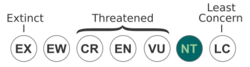
S. guacamaia was formerly classified as vulnerable due to overfishing and habitat loss, but because the presently available data do not allow an estimate of the population decline, it is now considered near threatened by the IUCN. It is relatively rare in most of its range, but more common in Bermuda. The rainbow parrotfish is widely harvested in subsistence fisheries in many parts of the Caribbean.[1]
Gallery
-
 Small individual, in Florida
 -
 With a queen parrotfish (S. vetula), in Bonaire
 -
 In Bonaire

.jpg)

References
- ↑ 1.0 1.1 1.2 1.3 Choat, J.H.; Feitosa, C.; Ferreira, C.E.; Gaspar, A.L.; Padovani-Ferreira, B.; Rocha, L.A. (2012). "Scarus guacamaia". IUCN Red List of Threatened Species 2012. doi:10.2305/IUCN.UK.2012.RLTS.T19950A17627624.en. https://www.iucnredlist.org/species/19950/17627624. Retrieved 17 November 2021.
- ↑ 2.0 2.1 2.2 Froese, Rainer and Pauly, Daniel, eds. (2019). "Scarus guacamaia" in FishBase. December 2019 version.
- ↑ Hoey, Andrew S.; Bonaldo, Roberta M. (2018-03-05). Hoey, Andrew S.. ed (in en). Biology of Parrotfishes (1 ed.). Boca Raton, FL: CRC Press, Taylor & Francis Group, [2018]| "A Science Publishers book." | Includeu bibliographical references and index.: CRC Press. doi:10.1201/9781315118079. ISBN 978-1-315-11807-9. https://www.taylorfrancis.com/books/9781482224023.
- ↑ Choat, John. H.; klanten, Oya. S.; Van Herwerden, Lynne; Robertson, D. Ross; Clements, Kendall D. (November 2012). "Patterns and processes in the evolutionary history of parrotfishes (Family Labridae): Evolutionary History of Parrotfishes" (in en). Biological Journal of the Linnean Society 107 (3): 529–557. doi:10.1111/j.1095-8312.2012.01959.x. https://academic.oup.com/biolinnean/article-lookup/doi/10.1111/j.1095-8312.2012.01959.x.
- ↑ Choat, John. H.; klanten, Oya. S.; Van Herwerden, Lynne; Robertson, D. Ross; Clements, Kendall D. (November 2012). "Patterns and processes in the evolutionary history of parrotfishes (Family Labridae): Evolutionary History of Parrotfishes" (in en). Biological Journal of the Linnean Society 107 (3): 529–557. doi:10.1111/j.1095-8312.2012.01959.x. https://academic.oup.com/biolinnean/article-lookup/doi/10.1111/j.1095-8312.2012.01959.x.
- ↑ Randall, John E. (1963). "Notes on the Systematics of Parrotfishes (Scaridae), with Emphasis on Sexual Dichromatism". Copeia 1963 (2): 225–237. doi:10.2307/1441337. ISSN 0045-8511.
External links
- Photos of Rainbow parrotfish on Sealife Collection
Wikidata ☰ Q2582147 entry
 |  |


