Biology:Thick-billed seed finch
| Thick-billed seed finch | |
|---|---|

| |
| Male | |

| |
| Female | |
Scientific classification 
| |
| Kingdom: | Animalia |
| Phylum: | Chordata |
| Class: | Aves |
| Order: | Passeriformes |
| Family: | Thraupidae |
| Genus: | Sporophila |
| Species: | S. funerea
|
| Binomial name | |
| Sporophila funerea (Sclater, PL, 1860)
| |

| |
The thick-billed seed finch (Sporophila funerea) is a species of bird in the family Thraupidae, the tanagers and allies.[2] It is found from Mexico to Ecuador.[3][4]
Taxonomy and systematics
The thick-billed seed finch has a complicated taxonomic history. It was formally described in 1860 with the binomial Oryzoborus funereus. At the time Oryzoborus was a member of the family Fringillidae.[5] By 1970 it had been assigned to the family Emberizidae.[6] Based on studies published between 1988 and 2011, beginning in 2012 the genus was moved to its present position in the tanager family Thraupidae.[7] In 2014 taxonomic systems began merging Oryzoborus into Sporophila.[8][9]
The thick-billed seed finch's further taxonomy is unsettled. As of September 2026 the most recent versions of the IOC taxonomy, AviList, and BirdLife International's Handbook of the Birds of the World assign it these five subspecies:[2][10][11]
- S. f. funerea (Sclater, PL, 1860)
- S. f. salvini (Ridgway, 1884)
- S. f. ochrogyne Olson, 1981
- S. f. fractor Olson, 2007
- S. f. aethiops (Sclater, PL, 1860)
However, the Clements taxonomy treats it as monotypic, with no subspecies.[12]
At times the thick-billed seed finch has been treated as conspecific with the chestnut-bellied seed finch with the latter's binomial S. angolensis and the English name "lesser seed finch". They hybridize in the small area where their ranges overlap in Colombia.[13]
This article follows the majority five-subspecies model.
Description
The thick-billed seed finch is 10.7 to 12.5 cm (4.2 to 4.9 in) long and weighs 12.8 to 13.9 g (0.45 to 0.49 oz). It has a short bill with a very deep base and a rounded culmen. The species is sexually dimorphic. Adult males of all subspecies are almost entirely black. They have white bases on the flight feathers that are seldom visible and white underwing coverts. Females have white underwing coverts but no white on the flight feathers. Adult females of the nominate subspecies S. f. funerea have a dark brown head and upperparts and paler cinnamon-brown underparts. Females of subspecies S. f. salvini have richer brown upperparts than the nominate and deep reddish chestnut underparts. Females of S. f. aethiops are similar to the nominate and those of S. f. ochrogyne are paler overall. Juveniles resemble adult females. Both sexes of all subspecies have a black iris, a blackish bill, and blackish legs.[13]
Distribution and habitat
The subspecies of the thick-billed seed finch are found thus:[2][10]
- S. f. funerea: Gulf/Caribbean slope from central Veracruz in southeastern Mexico south (bypassing the Yucatán Peninsula) through Belize and northern Guatemala to north-central Honduras, and past a gap from eastern Honduras into northern Nicaragua[14][15]
- S. f. salvini: Caribbean slope from southern Nicaragua through Costa Rica and Panama[14][16]
- S. f. ochrogyne: Pacific slope from central Puntarenas Province in western Costa Rica south through Panama into Colombia; there across much of northern Colombia and south along its Central Andes[16][17][note 1]
- S. f. fractor: Coiba Island in the Pacific off western Panama[note 2]
- S. f. aethiops: Between the Pacific and the Andes from west-central Colombia south through Ecuador to Manabí, central Guayas, and southern Los Rios provinces and from there away from the coast in the foothills to northeastern El Oro and northern Loja provinces[17][18]
The thick-billed seed-finch inhabits "Second-growth Scrub, Secondary Forest, [and] Tropical Lowland Evergreen Forest Edge" [capitals in original].[3] It also is found in tall grass but favors scrubby areas within it.[13] Sources differ on its maximum elevation. Two say it is overall 1,100 m (3,600 ft)[3][13] but a third says it is 1,500 m (4,900 ft) in Central America[14]. Field guides state it as 1,100 m (3,600 ft) in northern Central America, 1,200 m (3,900 ft) in Costa Rica, 1,600 m (5,200 ft) in Colombia, and 900 m (3,000 ft) in Ecuador.[15][16][17][18]
Behavior
Movement
The thick-billed seed finch is a sedentary year-round resident.[13]
Feeding
The thick-billed seed finch feeds primarily on grass seeds. It forages nervously in thick cover, flicking its wings and tail. It typically forages singly or in pairs and sometimes in flocks with other seed-eating species.[13][18]
Breeding
The thick-billed seed finch breeds between April and September in Middle America and between May and October in Colombia. Its nest is a cup made from rootlets, grasses, and plant fibers lined with fine fibers and spider web. It is typically in a bush, a tangle of vines, or a dense tree within about 1 m (3 ft) above the ground or sometimes water. The clutch is two or three eggs that are greenish white with brown or lilac spots. The incubation period, time to fledging, and details of parental care are not known.[13]

Vocalization
One description of the male thick-billed seed finch's song is "a long and often complex phrase that gradually becomes more jumbled and twittery".[18] It has been written as "techu techu chu chi techu chu chi...".[13]
Status
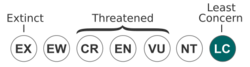
The IUCN has assessed the thick-billed seed finch as being of Least Concern. It has a very large range; its estimated population of at least 500,000 mature individuals is believed to be decreasing. No immediate threats have been identified.[1] It is considered "uncommon to rare" overall in Mexico and Central America, "uncommon to fairly common" in northern Central America, "fairly uncommon" in Costa Rica, and "fairly common" in Colombia.[14][15][16][17]
Notes
- ↑ AviList includes far northwestern Venezuela in S. f. ochrogyne's range.[10] The IOC and Clements do not, and the South American Classification Committee has no records from the country.[2][12][4]
- ↑ The IOC and AviList have only Coiba in S. f. fractor's range.[2][10] Clements also includes the Pearl Islands.[12]
References
- ↑ 1.0 1.1 BirdLife International. (2021). "Thick-billed Seed-Finch Sporophila funerea". IUCN Red List of Threatened Species 2021. doi:10.2305/IUCN.UK.2021-3.RLTS.T22729107A137079233.en. https://www.iucnredlist.org/species/22729107/137079233. Retrieved 24 September 2026.
- ↑ 2.0 2.1 2.2 2.3 2.4 Gill, Frank; Donsker, David; Rasmussen, Pamela, eds (April 2026). "Tanagers and allies". https://www.worldbirdnames.org/new/bow/tanagers/.
- ↑ 3.0 3.1 3.2 Check-list of North American Birds (7th ed.). Washington, D.C.: American Ornithologists' Union. 1998. pp. 593–594.
- ↑ 4.0 4.1 Remsen, J. V., Jr., J. I. Areta, E. Bonaccorso, S. Claramunt, D. F. Lane, L, N. Naka, M. B. Robbins, F. G. Stiles, and K. J. Zimmer. Version 25 July 2026. Species Lists of Birds for South American Countries and Territories. South American Classification Committee associated with the International Ornithologists' Union. https://www.museum.lsu.edu/~Remsen/SACCCountryLists.htm retrieved 25 July 2026
- ↑ Sclater, Philip Lutley (1859). "List of Birds collected by M. A. Boucard in the State of Oaxaca in South-western Mexico, with Descriptions of New Species" (in Latin, English). Proceedings of the Zoological Society of London XXVII: 378. https://www.biodiversitylibrary.org/page/44707706. Retrieved September 24, 2026. Though the journal issue is dated 1859, the species description is credited to 1860.
- ↑ Paynter, Raymond A. Jr, ed (1970). Check-List of Birds of the World. 13. Cambridge, Massachusetts: Museum of Comparative Zoology. p. 149–150. https://www.biodiversitylibrary.org/page/14483384.
- ↑ Remsen, James Van Jr; Burns, Kevin (November 2011). "Proposal (512) to South American Classification Committee: Transfer genera from Emberizidae to Thraupidae". https://www.museum.lsu.edu/~Remsen/SACCprop512.html. The proposal was accepted in 2012.
- ↑ Mason, Nicholas (November 2013). "Proposal (604) to South American Classification Committee: Merge Oryzoborus and Dolospingus into Sporophila". https://www.museum.lsu.edu/~Remsen/SACCprop604.htm. The proposal was adopted in 2014.
- ↑ R. Terry Chesser, Richard C. Banks, Carla Cicero, Jon L. Dunn, Andrew W. Kratter, Irby J. Lovette, Adolfo G. Navarro-Sigüebzam, Pamela C. Rasmussen, J. V. Remsen, Jr., James D. Rising, Douglas F. Stotz, and Kevin Winker. "Fifty-fifth supplement to the American Ornithologists' Union Check-list of North American Birds". The Auk 2014, vol. 131(4):CSiûCSxv retrieved April 8, 2023
- ↑ 10.0 10.1 10.2 10.3 AviList Core Team (2025). "AviList: The Global Avian Checklist, v2025". https://doi.org/10.2173/avilist.v2025.
- ↑ HBW and BirdLife International (2025). Handbook of the Birds of the World and BirdLife International digital checklist of the birds of the world. Version 10. Available at: https://datazone.birdlife.org/about-our-science/taxonomy#birdlife-s-taxonomic-checklist retrieved 12 October 2025
- ↑ 12.0 12.1 12.2 Clements, J. F., P. C. Rasmussen, T. S. Schulenberg, M. J. Iliff, J. A. Gerbracht, D. Lepage, A. Spencer, S. M. Billerman, B. L. Sullivan, M. Smith, and C. L. Wood. 2025. The eBird/Clements checklist of Birds of the World: v2025. Downloaded from https://www.birds.cornell.edu/clementschecklist/download/ retrieved 3 November 2025
- ↑ 13.0 13.1 13.2 13.3 13.4 13.5 13.6 13.7 Rising, J. D. (2020). Thick-billed Seed-Finch (Sporophila funerea), version 1.0. In Birds of the World (J. del Hoyo, A. Elliott, J. Sargatal, D. A. Christie, and E. de Juana, Editors). Cornell Lab of Ornithology, Ithaca, NY, USA. https://doi.org/10.2173/bow.tbsfin1.01 retrieved September 24, 2026
- ↑ 14.0 14.1 14.2 14.3 vanPerlo, Ber (2006). Birds of Mexico and Central America. Princeton Illustrated Checklists. New Jersey: Princeton University Press. pp. Plate and map 92.17. ISBN 0691120706.
- ↑ 15.0 15.1 15.2 Fagan, Jesse; Komar, Oliver (2016). Field Guide to Birds of Northern Central America. Peterson Field Guides. Boston: Houghton Mifflin Harcourt. pp. 370–371. ISBN 978-0-544-37326-6.
- ↑ 16.0 16.1 16.2 16.3 Garrigues, Richard; Dean, Robert (2007). The Birds of Costa Rica. Ithaca: Zona Tropical/Comstock/Cornell University Press. pp. 294–295. ISBN 978-0-8014-7373-9.
- ↑ 17.0 17.1 17.2 17.3 McMullan, Miles; Donegan, Thomas M.; Quevedo, Alonso (2010). Field Guide to the Birds of Colombia. Bogotá: Fundación ProAves. pp. 206. ISBN 978-0-9827615-0-2.
- ↑ 18.0 18.1 18.2 18.3 Ridgely, Robert S.; Greenfield, Paul J. (2001). The Birds of Ecuador: Field Guide. II. Ithaca: Cornell University Press. pp. 574–575. ISBN 978-0-8014-8721-7.
External links
 |
Wikispecies has information related to Sporophila funerea |
- BirdLife species factsheet for Sporophila funerea
- Thick-billed seed-finch photo gallery at VIREO (Drexel University)
Wikidata ☰ Q28867703 entry
 |  |


