Biology:Yellow-crested tanager
| Yellow-crested tanager | |
|---|---|

| |
Scientific classification 
| |
| Kingdom: | Animalia |
| Phylum: | Chordata |
| Class: | Aves |
| Order: | Passeriformes |
| Family: | Thraupidae |
| Genus: | Loriotus |
| Species: | L. rufiventer
|
| Binomial name | |
| Loriotus rufiventer (Spix, 1825)
| |

| |
The yellow-crested tanager (Loriotus rufiventer) is a species of bird in the family Thraupidae, the tanagers and allies.[2] It is found in Bolivia, Brazil, and Peru.[3]
Taxonomy and systematics
The yellow-crested tanager was formally described in 1825 with the binomial Tanagra rufiventer.[4] It eventually was reassigned to the genus Tachyphonus. A molecular phylogenetic study published in 2014 found that Tachyphonus was polyphyletic.[5] In the subsequent reorganization the genus Loriotus was resurrected for the yellow-crested tanager and two other species. The genus had been introduced in 1821 by the Polish zoologist Feliks Paweł Jarocki.[5][6][2]
The IOC, AviList, the Clements taxonomy, and the South American Classification Committee have adopted the new genus.[2][7][8][9] However, in 2016 BirdLife International's Handbook of the Birds of the World (HBW) instead assigned the yellow-crested tanager and the other two species to the genus Islerothraupis and retains them there as of late 2025.[10][11]
The yellow-crested tanager is monotypic.[2]
Description
The yellow-crested tanager is 15 to 16 cm (5.9 to 6.3 in) long and weighs 15.5 to 20 g (0.55 to 0.71 oz). The species is sexually dimorphic. Adult males have a mostly black head with the eponymous buffy yellow mid-crown and rear crown, which however is usually partially hidden. Their sides of their neck, their nape, and their upper back are black and their lower back, rump, and uppertail coverts deep buff. Their tail is black. Their wings are mostly black with white outer scapulars. Their throat is dark yellow-buff with a narrow black band below it. The center of their breast is tawny and the rest of their breast and belly, flanks, and undertail coverts are yellowish buff. Adult females have a gray head and an olive nape, back, wings, and tail. Their throat is whitish, their breast and belly ochraceous buff, and their undertail coverts buff with a cinnamon tinge. Both sexes have a dark brown iris, a blackish maxilla, a mostly grayish blue mandible, and dark gray to leaden legs. Juveniles are similar to adult females but with an olive crown, and their throat is the same ochraceous buff as the breast.[12]
Distribution and habitat
The yellow-crested tanager is found in eastern Peru from extreme western Loreto Department south to northern Cuzco Department and east into far western Brazil's Acre and western Amazonas states. From Cuzco its range continues south in a narrow band into Bolivia to northwestern Cochabamba Department.[12][13][14]
The yellow-crested tanager primarily inhabits the middle to upper levels of tropical evergreen forest, especially terra firme and várzea.[12][14] It also inhabits secondary forest.[12][14] In elevation it reaches 1,250 m (4,100 ft) in Peru, 1,200 m (3,900 ft) in Brazil, and 1,650 m (5,400 ft) in Bolivia.[13][14][12]
Behavior
Movement
The yellow-crested tanager is a year-round resident.[12]
Feeding
The yellow-crested tanager's diet is not known in detail but includes insects and fruits. It usually in pairs and almost always as members of a mixed-species feeding flock. It feeds energetically through foliage and gleans prey while perched and with a short flutter-flights.[12]
Breeding
Nothing is known about the yellow-crested tanager's breeding biology.[12]

Vocalization
Two yellow-crested tanager vocalizations are "high tswee and buzzier dzz dzz dzz notes"; they may be either songs or calls.[13]
Status
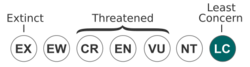
The IUCN has assessed the yellow-crested tanager as being of Least Concern. It has a large range; its population size is not known and is believed to be decreasing. No immediate threats have been identified.[1] It is considered "fairly common" in Peru and "frequent to uncommon" in Brazil.[13][14] It has "a high degree of sensitivity to human disturbance relative to other Neotropical birds" but occurs in many national parks and other protected areas.[12]
References
- ↑ 1.0 1.1 BirdLife International. (2024). "Yellow-crested Tanager Islerothraupis rufiventer". IUCN Red List of Threatened Species 2024. doi:10.2305/IUCN.UK.2024-2.RLTS.T22722385A264337783.en. https://www.iucnredlist.org/species/22722385/264337783. Retrieved 10 September 2026.
- ↑ 2.0 2.1 2.2 2.3 Gill, Frank; Donsker, David; Rasmussen, Pamela, eds (April 2026). "Tanagers and allies". https://www.worldbirdnames.org/new/bow/tanagers/.
- ↑ Remsen, J. V., Jr., J. I. Areta, E. Bonaccorso, S. Claramunt, D. F. Lane, L, N. Naka, M. B. Robbins, F. G. Stiles, and K. J. Zimmer. Version 25 July 2026. Species Lists of Birds for South American Countries and Territories. South American Classification Committee associated with the International Ornithologists' Union. https://www.museum.lsu.edu/~Remsen/SACCCountryLists.htm retrieved 25 July 2026
- ↑ von Spix, Johann Baptist (1825) (in Latin). Avium species novae, quas in itinere per Brasiliam annis MDCCCXVII-MDCCCXX. II. Typis Franc. Seraph. Hübschmanni. p. 37. https://www.biodiversitylibrary.org/page/41277992. Retrieved September 10, 2026.
- ↑ 5.0 5.1 Burns, K.J.; Shultz, A.J.; Title, P.O.; Mason, N.A.; Barker, F.K.; Klicka, J.; Lanyon, S.M.; Lovette, I.J. (2014). "Phylogenetics and diversification of tanagers (Passeriformes: Thraupidae), the largest radiation of Neotropical songbirds". Molecular Phylogenetics and Evolution 75: 41–77. doi:10.1016/j.ympev.2014.02.006. PMID 24583021. Bibcode: 2014MolPE..75...41B. https://digitalcommons.lsu.edu/cgi/viewcontent.cgi?article=3613&context=biosci_pubs.
- ↑ Piacentini, V.Q.; Unitt, P.; Burns, K.J. (2019). "Two overlooked generic synonyms in the Thraupidae (Aves: Passeriformes)". Zootaxa 4608 (3): 593–594. doi:10.11646/zootaxa.4608.3.13. PMID 31717142.
- ↑ AviList Core Team (2025). "AviList: The Global Avian Checklist, v2025". https://doi.org/10.2173/avilist.v2025.
- ↑ Clements, J. F., P. C. Rasmussen, T. S. Schulenberg, M. J. Iliff, J. A. Gerbracht, D. Lepage, A. Spencer, S. M. Billerman, B. L. Sullivan, M. Smith, and C. L. Wood. 2025. The eBird/Clements checklist of Birds of the World: v2025. Downloaded from https://www.birds.cornell.edu/clementschecklist/download/ retrieved 3 November 2025
- ↑ Remsen, J. V., Jr., J. I. Areta, E. Bonaccorso, S. Claramunt, D. F. Lane, L, N. Naka, M. B. Robbins, F. G. Stiles, and K. J. Zimmer. Version 25 July 2026. A classification of the bird species of South America. South American Classification Committee associated with the International Ornithologists' Union. https://www.museum.lsu.edu/~Remsen/SACCBaseline.htm retrieved 25 July 2026
- ↑ BirdLife International (2016) Handbook of the Birds of the World and BirdLife International digital checklist of the birds of the world. [Old] Version 9. Available at: http://datazone.birdlife.org/userfiles/file/Species/Taxonomy/BirdLife_Checklist_Version_90.zip.
- ↑ HBW and BirdLife International (2025). Handbook of the Birds of the World and BirdLife International digital checklist of the birds of the world. Version 10. Available at: https://datazone.birdlife.org/about-our-science/taxonomy#birdlife-s-taxonomic-checklist retrieved 12 October 2025
- ↑ 12.0 12.1 12.2 12.3 12.4 12.5 12.6 12.7 12.8 Fukutomi, J., C. H. Richart, and K. J. Burns (2021). Yellow-crested Tanager (Loriotus rufiventer), version 1.1. In Birds of the World (T. S. Schulenberg, Editor). Cornell Lab of Ornithology, Ithaca, NY, USA. https://doi.org/10.2173/bow.yectan1.01.1 retrieved September 10, 2026
- ↑ 13.0 13.1 13.2 13.3 Schulenberg, T.S.; Stotz, D.F.; Lane, D.F.; O'Neill, J.P.; Parker, T.A. III (2010). Birds of Peru. Princeton Field Guides (revised and updated ed.). Princeton, NJ: Princeton University Press. pp. 550. ISBN 978-0691130231.
- ↑ 14.0 14.1 14.2 14.3 14.4 van Perlo, Ber (2009). A Field Guide to the Birds of Brazil. New York: Oxford University Press. pp. 366–367. ISBN 978-0-19-530155-7.
Wikidata ☰ Q530530 entry
 |  |


