Earth:Pitkin Formation
| Pitkin Formation Stratigraphic range: Upper Visean-Serpukhovian[1] | |
|---|---|
| Type | Formation |
| Sub-units | Imo Shale |
| Underlies | Hale Formation |
| Overlies | Fayetteville Formation |
| Thickness | up to and over 400 feet[2] |
| Lithology | |
| Primary | Limestone[1] |
| Other | Shale |
| Location | |
| Region | Arkansas |
| Country | United States |
| Type section | |
| Named for | Pitkin post office, Washington County, Arkansas[3] |
| Named by | George Irving Adams and Edward Oscar Ulrich |
The Pitkin Formation, or Pitkin Limestone, is a fossiliferous geologic formation in northern Arkansas that dates to the Chesterian Series of the late Mississippian.[4] This formation was first named the "Archimedes Limestone" by David Dale Owen in 1858, but was replaced in 1904.[3] The Pitkin conformably overlies the Fayetteville Shale and unconformably underlies the Pennsylvanian-age Hale Formation. Some workers have considered the shales at the top of the Pitkin Formation to be a separate formation called the Imo Formation. More recently, others have considered the Imo to be informal member of the Pitkin Formation.
Paleofauna
Early work aimed at creating a comprehensive list for all fossils found in the Pitkin Formation was done by Easton in 1943.[1] Unless otherwise stated, all species below can be found in his 'Fauna of the Pitkin Formation.'
Formanifera
- Archaediscus
- A. stilus[5]
- Asteroarchaediscus
- A. rugosus[5]
- Endothyranella[6]
- Eosigmoilina
- Eostaffella[5]
- Eotuberitina[5]
- Monotaxinoides[5]
- Neoarchaediscus[5]
- Nodosarchaediscus[5]
- Paramillerella[6]
- Planospirodiscus[5]
- Plectogyra[6]
- Priscella[5]
- Pseudoammodiscus
- P. priscus[5]
- Pseudoglomospira[5]
- Tetrataxis[5]
- T. corona[6]
- Trepeilopsis[5]
- Zellerina
Porifera, Sponges

- Conularia Originally considered to be a gastropod.
Anthozoa, Corals
- Amplexus
- Aulopora
- A. gracilis
- Caninostrotion
- C. variablilis
- L. major
- L. minor
- Michellinia[8]
- M. macerimuris[8]
- Parvaxon[7]
- Pleurodictyum
- P. eugenei
- P. meekanum
-
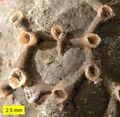 Aulopora from the Silica Formation of Ohio.
 -
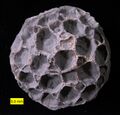 Pleurodictyum americanum from the Givetian Kashong Shale (Hamilton Group) of Livingston County, New York.
 -
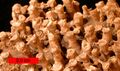 Syringopora from the Boone Formation of Arkansas.


Blastoidea

Crinoidea, Sea Lilies
- Agassizocrinus (see unidentified section)
- A. patulus [10]
- Aphelecrinus
- A. planus[10]
- Bronaughocrinus
- B. figuratus[10]
- Camptocrinus[10]
- Carinocrinus
- C. stevensi[10]
- Castillocrinus
- Catillocrinus[10]
- Cosmetocrinus
- C. eventus[10]
- Cromyocrinus
- Culmicrinus[10]
- Cyathocrinus
- Delocrinus
- Dichocrinus[10]
- Hydreionocrinus
- Linocrinus
- L. floweri[10]
- O. pulaskiensis[10]
- Pachylocrinus
- Paianocrinus
- Paracymbiocrinus
- P. pitkini[10]
- Pelecocrinus
- P. stereostoma[10]
- Pentaramicrinus
- P. modulus[10]
- Phacelocrinus[10]
- Phanocrinus
- Poteriocrinus
- Pterotocrinus
- P. tridecibrachiatus[10]
- Scytalocrinus (see unidentified section)
- T. whitfieldi[10]
- Telikosocrinus
- T. caespes
- T. residuus
- Zeusocrinus
- Z. foveatus
-
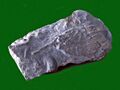 Cyathocrinus goniodactylus, on display at Galerie de paléontologie et d'anatomie comparée in Paris.
 -
 Fossil of Scytalocrinus from Carboniferous of the United States


Ophiuroidea, Brittle Stars
This group was originally place under Stelleroidia in early studies.[1]
- Aganaster
- A. singulatus
- Schoenaster
Echinoidea, Sea Urchins

Worms
Previous studies have grouped these diverse animals into a single, obsolete taxon: Vermes.[1]
Bryozoa, "Moss-animals"
| ||
| ||
| ||
| ||
| ||
| Fossilized skeleton of Archimedes Bryozoan. |


- Anisotrypa
- A. solida [1]
- Archimedes (called Archimedipora in early studies)[1]
- A. communis [1][11]
- A. compactoides [11]
- A. compactus [11]
- A. distans [1][11]
- A. fosteri [11]
- A. fragilis [11]
- A. intermedia (A. intermedius) [1][11]
- A. invaginata (A. invaginatus) [1][11]
- A. lunatus [11]
- A. magnus [11]
- A. meekanus [11]
- A. moorei [11]
- A. pitkinensis [11]
- A. proutana (A. proutanus) [1][11]
- A. sublaxus [11]
- A. swallovana (A. swallovanus) [1][11]
- A. terebriformis [11]
- Batostomella [1]
- Chellotrypa
- C. distans [11]
- Chilotrypa
- C. regularis [1]
- Dichotrypa
- Dyscritella [1]
- Fenestella [1]
- Fistulipora
- Glyptopora
- Lyropora
- Meekopora
- Polypora
- P. whitei [1]
- Tabulopora

- Adectorhynchus
- A. suspectum [12]
- A. cestriensis
- Buxtonia
- B. arkansana
- Camarophoria
- C. cestriensis
- C explanata
- C. oklahomensis
- C. sericeus
- C. tumescens
- Cliothyridina
- C. sublamellosa
- Composita (See unidentified section)
- C. subquadrata
- C. trinuclea
- C. infimbriata
- Diaphragmus
- Dielasma
- D. arkansanum
- D. formosum
- D. illinoisensis
- D. shumardanum
- D. whitfieldi
- Echinoconchus (See unidentified section)
- E. alternatus
- Eumetria
- E. costata
- E. pitkinensis
- E. vera
- Girtyella
- G. indianensis
- Hustedia
- H. multicostata
- Krotavia
- K. lucerna
- Lingula
- Lingulidiscina
- L. newberryi var. moorefieldana and ovata
- L. pileiformis
- Martinia
- Orthotetes
- O. kaskaskiensis
- O. stenopsis[12]
- O. subglobosus (var. protensa)
- O. uspectum
- Productus
- P. cestriensis
- P. fasciculatus
- Pustula
- Reticularia
- R. setigera
- S. leidyi
- S. pellaensis
- S. spinosa
- Streptorhynchus
- Syringothyris
- S. aequalis
- Tetracamera
- T. neogenes
Bivalvia, Bivalves
This group was also referred to by another name in earlier studies: Pelecypoda.[1]
- Allorisma
- A. walkeri
- Astartella
- Aviculopecten
- A. batesvillensis
- A. eurekensis
- A. keoughensis
- A. morrowensis
- A. multilineatus
- A. pitkinensis
- C. peculiare
- Cypricardella (See unidentified section)
- Edmondia
- E. crassa (Along with E. crassa var. suborbiculoidea)
- E. pitkinensis
- Leda
- L. vaseyana
- Leiopteria
- Leptodesma
- Myalina
- M. compressa
- M. longicardinalis
- N. illinoisensis
- Parallelodon
- Pteronites
- Schizodus (See unidentified section)
- S. arkansanus
- S. chesterensis
- S. depressus
- S. insignis
- Solenomya
- Sphenotus
- S. cherokeense
- S. gibsonense
- S. quadriplicatum
Scaphopoda, Tusk Shells
Gastropoda, Snails
- Bellerophon (See unidentified section)
- B. pitkinensis
- Bucanella
- Colpites
- Euphemites
- E. incarinatus
- Clabrocingulum
- Gosseletina (See unidentified section)
- Helcionopsis
- H. reticulatus
- Hemizyga
- Holopea
- H. newtonensis
- Latischisma
- Leptoptygma (See unidentified section)
- Microptychis
- Mourlonia
- M. angulata
- Naticopsis
- Neilsonia
- Phanerotremas
- Platyceras
- P. subrotundum
- Pseudozygopleura
- Sphaerodoma
- S. subcorpulenta
- Stegocoelia
- Straparolus
- S. planidorsatus
- S. triliris
- Strobeus (See unidentified section)
- Strophostylus
- A. furnishi[13]
- Coloceras (see unidentified section)
- Cravenoceras
- C. hesperium
- C. richardsonianum[13]
- C. randolphensis
- C. equoyahensis
- Dolorthoceras (See unidentified section)
- D. eurekensis
- Eoasianites
- E. globosus
- Eumorphoceras
- E. bisulcatum[13]
- Grifithides
- G. pustulosus
- Kaskia
- K. chesterensis
- K. pitkinensis[14]
- P. mucronatus
- Glyptopleurain
- G. optina
- Paraparchites
- Primitia
- P. fayettevillensis
Vertebrata
Plantae, Plants
"Encrusting Algae" has been reported but not assigned to any genus.[1]
- Archaeolithophyllum[6]
- Asphaltina
- A. cordillerensis[5]
- Girvanella[5]
- Rectangulina[5]
Unidentified
Following is a list of fossils also found in the Pitkin by Easton in 1943 that have gone unidentified.[1]
- A "Cup Coral"
- A member of the genus Pentremites
- Three species within Agassizocrinus
- Two species within Scytalocrinus
- A totally unidentifiable Crinoid
- Two species of Bellerophon
- Two species of Gosseletina
- Two species of Leptoptygma
- Two Species of Strobeus
- One species each of Composita and Echinoconchus
- Two species of Cypricardella
- Two species of Coloceras, one of which may actually be Leuroceras
- One species of Dolorthoceras
- An unnamed shark spine
See also
- List of fossiliferous stratigraphic units in Arkansas
- Paleontology in Arkansas
References
- ↑ 1.00 1.01 1.02 1.03 1.04 1.05 1.06 1.07 1.08 1.09 1.10 1.11 1.12 1.13 1.14 1.15 1.16 1.17 1.18 1.19 1.20 1.21 1.22 1.23 1.24 1.25 1.26 1.27 1.28 1.29 1.30 1.31 1.32 1.33 1.34 1.35 1.36 1.37 1.38 Easton, William H., The Fauna of the Pitkin Formation of Arkansas., Journal of Paleontology: vol. 17:2. March, 1943.
- ↑ McFarland, John David (2004). "Stratigraphic summary of Arkansas". Arkansas Geological Commission Information Circular 36: 12–13. http://geology.ar.gov/pdf/IC-36_v.pdf. Retrieved 2018-05-31.
- ↑ 3.0 3.1 Adams, G.; Ulrich, E. (1904). "Zinc and lead deposits of northern Arkansas". U.S. Geological Survey Professional Paper 24: 27,109.
- ↑ ((Various Contributors to the Paleobiology Database)). "Fossilworks: Gateway to thefix Paleobiology Database". https://www.fossilworks.org.
- ↑ 5.00 5.01 5.02 5.03 5.04 5.05 5.06 5.07 5.08 5.09 5.10 5.11 5.12 5.13 5.14 5.15 5.16 5.17 5.18 5.19 5.20 5.21 Brenckle, Paul (1977). "Foraminifers and other calcareous microfossils from Late Chesterian (Mississippian) strata of northern Arkansas". Oklahoma Geological Survey Guidebook 18: 73–87. http://ogs.ou.edu/docs/guidebooks/GB18.pdf. Retrieved 3 February 2018.
- ↑ 6.0 6.1 6.2 6.3 6.4 6.5 Nodine-Zeller, Doris E. (1977). "Microfauna from Chesterian (Mississippian) and Morrowan (Pennsylvanian) rocks in Washington County, Arkansas, and Adair and Muskogee Counties, Oklahoma". Oklahoma Geological Survey Guidebook 18: 89–99. http://ogs.ou.edu/docs/guidebooks/GB18.pdf. Retrieved 3 February 2018.
- ↑ 7.0 7.1 7.2 7.3 Webb, Gregory., 1987., The Coral Fauna of the Pitkin Formation (Chesterian), Northeastern Oklahoma and Northwestern Arkansas. Journal of Paleontology vol. 61:3
- ↑ 8.0 8.1 Webb., Gregory., 1990., A New Tabulate Coral Species from the Pitkin Formation (Chesterian) of north-central Arkansas. Journal of Paleontology vol. 64:4.
- ↑ 9.0 9.1 9.2 9.3 Horowitz, Alan S.; Macurda Jr, D. B. (1977). "Late Mississippian and Early Pennsylvanian blastoids from northeastern Oklahoma and northwestern Arkansas". Oklahoma Geological Survey Guidebook 18: 169–170. http://ogs.ou.edu/docs/guidebooks/GB18.pdf. Retrieved 31 January 2018.
- ↑ 10.00 10.01 10.02 10.03 10.04 10.05 10.06 10.07 10.08 10.09 10.10 10.11 10.12 10.13 10.14 10.15 10.16 10.17 10.18 10.19 10.20 10.21 10.22 10.23 Strimple, Harrell L. (1977). "Chesterian (Upper Mississippian) and Morrowan (Lower Pennsylvanian) crinoids of northeastern Oklahoma and northwestern Arkansas". Oklahoma Geological Survey Guidebook 18: 171–176. http://ogs.ou.edu/docs/guidebooks/GB18.pdf. Retrieved 30 January 2018.
- ↑ 11.00 11.01 11.02 11.03 11.04 11.05 11.06 11.07 11.08 11.09 11.10 11.11 11.12 11.13 11.14 11.15 11.16 11.17 11.18 11.19 11.20 11.21 11.22 11.23 11.24 11.25 11.26 11.27 11.28 11.29 11.30 11.31 11.32 11.33 11.34 Horowitz, Alan S. (1977). "Late Mississippian and Early Pennsylvanian bryozoan faunas of Arkansas and Oklahoma: a review". Oklahoma Geological Survey Guidebook 18: 101–105. http://ogs.ou.edu/docs/guidebooks/GB18.pdf. Retrieved 3 February 2018.
- ↑ 12.0 12.1 Henry, Thomas W.; Gordon Jr., Mackenzie (January 1985). "Chesterian davidsoniacean and orthotetacean brachiopods, Ozark region of Arkansas and Oklahoma". Journal of Paleontology 59 (1): 32–59.
- ↑ 13.0 13.1 13.2 13.3 13.4 13.5 Saunders, W. Bruce; Manger, Walter L.; Gordon Jr., Mackenzie (1977). "Upper Mississippian and Lower and Middle Pennsylvanian ammonoid biostratigraphy of northern Arkansas". Oklahoma Geological Survey Guidebook 18: 117–137. http://ogs.ou.edu/docs/guidebooks/GB18.pdf. Retrieved 1 February 2018.
- ↑ Brezinski, David K. (31 March 2017). "Some New Late Mississippian Trilobites from Oklahoma and Arkansas". Annals of Carnegie Museum 84 (2): 173–178. doi:10.2992/007.084.0203.
 |  |


