Software:Scooby-Doo! Classic Creep Capers
| Scooby-Doo! Classic Creep Capers | |
|---|---|
 | |
| Developer(s) | Terraglyph Interactive Studios (N64) Digital Eclipse Software (GBC) |
| Publisher(s) | THQ |
| Platform(s) | Nintendo 64 Game Boy Color |
| Release | Nintendo 64Game Boy Color |
| Genre(s) | Adventure game |
| Mode(s) | Single player |
Scooby-Doo! Classic Creep Capers is an adventure game published by THQ for the Nintendo 64 and Game Boy Color, based on the Hanna-Barbera cartoon Scooby-Doo, Where Are You!. The Nintendo 64 version, developed by Terraglyph Interactive Studios, was released in November 2000, while the Game Boy Color version was developed by Digital Eclipse Software, and released in February 2001. A PlayStation version, identical to the Nintendo 64 version, had been in development by Terraglyph Interactive Studios but was later cancelled.
Gameplay
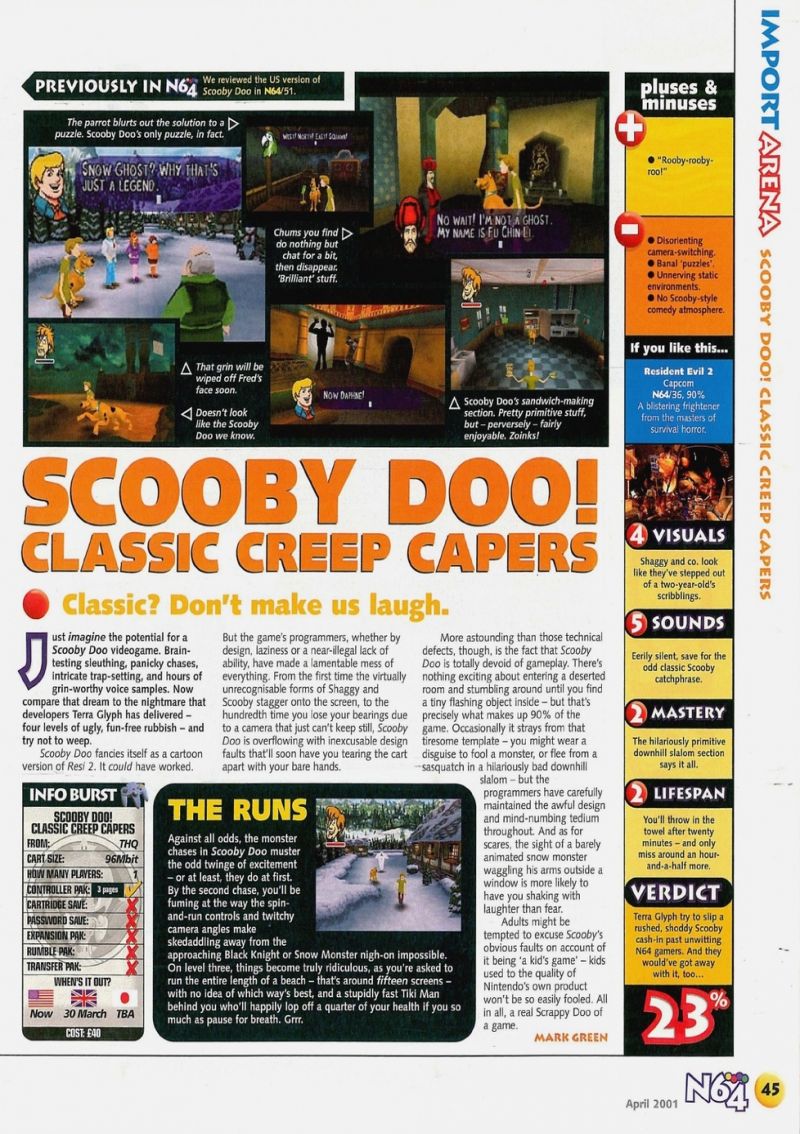
The Nintendo 64 game follows the Mystery Inc. investigating a crime ring run by a mysterious ghoul king through four levels. The first three levels retell three episodes of Scooby-Doo, Where Are You! ("What a Night for a Knight", "That's Snow Ghost", and "A Tiki Scare is No Fair") while the fourth is an original mystery.[5][6] The player controls Shaggy and Scooby as they find clues and trap pieces to complete the levels. Velma, Fred, and Daphne assist them. When Shaggy is scared enough times, he leaves the area and the player must restart. The fright can come from simple things, such as the opening of a mummy's case, or complex dangers, such as a moving dinosaur display hitting the player. 'Courage' can be restored by finding food to eat in a cafeteria or in Scooby Snacks lying on the ground.[5] Each room, or sometimes different sections of the same room, are presented as unmoving camera shots that the player moves through. There are hiding places in the environment that, with the right disguise, Scooby and Shaggy use to avoid being noticed.[7]
The Game Boy Color version is a point-and-click adventure that lasts six chapters and gives the player control of all members of the gang, and is a retelling of the Scooby-Doo, Where Are You! episode "Nowhere to Hyde". In it, the Mystery Machine runs out of gas when the crew find out about a series of jewel heists with the supposed son of Dr. Jekyll, who runs Jekyll Labs, as the prime suspect.[8] The gang goes through each area of the mansion and the lab. The player must pick up items for later use, such as a stool, a sausage, and a book with the code to get into the lab. The gang, except Shaggy and Scooby, investigates the mansion to look for clues. When Fred and Daphne see the ghost walk through a door, they go in to investigate. The ghost has vanished and Daphne is curious about a device called a "Tele-Pot," a teleporting toilet. Daphne disappears and is captured by Dr. Jekyll. Fred is worried and Velma studies the symbols in the house with the help of a book she found. She opens the door using a code from the book. Fred goes in to find Daphne and Velma decides to return the book.
Development
Scooby-Doo! Classic Creep Capers was publicly announced in May 2000, with three levels that would each be based on three episodes of the original Scooby-Doo, Where Are You! series, - "What a Night for a Knight", "That's Snow Ghost", and "A Tiki Scare is No Fair" as well as a fourth level featuring an original story.[9] At that time, a PlayStation version was in development by Terraglyph Interactive Studios,[10][11] but was cancelled.[11] Like the Nintendo 64 version, the PlayStation version also would have been based on the same three episodes of the series, as well as featuring a new story for its fourth level.[10] The Game Boy Color version, announced in June 2000, was developed by Digital Eclipse Software, with its release date initially scheduled for fall 2000.[12]
Nintendo 64
The Nintendo 64 version was developed by Terraglyph Interactive Studios. Development began in late fall 1999. To ensure that the game would have a style similar to the series, the developers worked closely with Hanna-Barbera and Warner Bros., and repeatedly watched dozens of old episodes of the series. Three episodes were chosen to be adapted into the game as levels, while an original story was created by the developers to serve as the fourth level of the game. Original 2D art from Hanna-Barbera was used for the game's characters and environments. The developers faced difficulty in creating perfect 3D models of the characters, which had previously only been seen in 2D form on television. Although backgrounds on the series were simple, the developers used highly detailed environments for the game, while ensuring that they still looked like settings from the series.[13]
Scott Innes, who was voice actor for Scooby and Shaggy at that time, provided his voice for the characters in the game.[14][13] The original theme song from Scooby-Doo, Where Are You! was recreated for the game. The rest of the game's music – meant to be similar to music from the series – was created exclusively for the game. Because violence was never featured in the Scooby-Doo franchise, the game's designers had difficulty designing the gameplay in a way so that the player would have to either hide from enemies or move past them, rather than fight them. Various jokes from the series were implemented into the game. Development had concluded by October 2000, at which point the game was in Nintendo's final approval process.[13]
Reception
| Reception | ||||||||||||||||||||||||||||||
|---|---|---|---|---|---|---|---|---|---|---|---|---|---|---|---|---|---|---|---|---|---|---|---|---|---|---|---|---|---|---|
| ||||||||||||||||||||||||||||||


Classic Creep Capers was met with average to mixed reception upon release. GameRankings and Metacritic gave it a score of 71% for the Game Boy Color version,[15] and 59.33% and 53 out of 100 for the Nintendo 64 version.[16][17]
AllGame journalist Tom Carroll described the "Scooby Shake", the scared character animation Scooby and Shaggy do while still, as "wearying after only a few instances". He also criticized Scooby as distracting to the player, especially during chases or attempts to collect items.[18] While stating the game may appeal to Scooby-Doo fans, he also argued the gameplay lacked suspense and could be finished quickly due to clues and payoffs that were "so obvious".[18] Official Nintendo Magazine similarly argued the characters analyze from the clues, rather than challenging the player to do so.[24]
Mark Green of N64 Magazine exclaimed that Scooby-Doo! Classic Creep Capers was "overflowing with inexcusable design faults that'll soon have you tearing the cart apart with your bare hands", and called it "devoid of gameplay".[21]
IGN gave the N64 version a score of 4.8 out of 10 overall. The sound was criticized for a lack of authentic voice-overs and the graphics were blurry on the low resolution screen.[5] However, IGN gave the GBC version a warmer review, rating it 7 out of 10.[8]
A major criticism was the movement control, particularly its relation to an abruptly-altering camera angle.[18][24] If the player holds the analog stick and the camera angle switches while the character moves, the direction will still relate to the previous angle until the player releases it; this can result in players unexpectedly moving the opposite of the intended way.[18][5][24] As a result, reviewers reported losing orientation, accidentally going back to a room they just exited, and chases from enemies being artificially difficult.[18][5][21][24]
Sources such as Super GamePower and Official Nintendo Magazine were positive towards the graphics, such as the detailed backgrounds, character representations, and faithfulness to the source material, particularly the use of "Zoinks", "Jinkles", and Scooby's barks in the text.[6][24] Super GamePower was also intrigued by the mysteries and appreciated the use of a fear meter as a life bar.[6]
Official Nintendo Magazine was less forgiving towards the audio, "rubbish" music, irritating sound effects, and a lack of voices from the show.[24]
References
- ↑ "PR - 11/29/00 - THQ SHIPS SCOOBY-DOO!™ CLASSIC CREEP CAPERS FOR NINTENDO® 64". 2001-02-10. http://www.thq.com/About/PressReleases/press-247.asp.
- ↑ I. G. N. Staff (2000-11-30). "Scooby and the Gang Head to Retail" (in en). https://www.ign.com/articles/2000/11/30/scooby-and-the-gang-head-to-retail.
- ↑ IGN Staff (2000-11-03). "N64 Games of November" (in en). https://www.ign.com/articles/2000/11/03/n64-games-of-november.
- ↑ "PR - 02/12/01 - THQ SHIPS SCOOBY-DOO! CLASSIC CREEP CAPERS FOR GAME BOY COLOR". 2004-04-16. http://www.thq.com/Corporate/PressReleases/press-265.asp.
- ↑ 5.0 5.1 5.2 5.3 5.4 5.5 Mirabella III, Fran (December 5, 2000). "Scooby-Doo: Classic Creep Capers". http://www.ign.com/articles/2000/12/06/scooby-doo-classic-creep-capers. Retrieved June 9, 2008.
- ↑ 6.0 6.1 6.2 6.3 Marjorie Bros (February 2001). "As confusoes de Salsicha e seu Amgia Scooby" (in pt). Super GamePower 7 (83): 44. https://archive.org/details/SuperGamePower_Ano_07_No._083_2001-02_Nova_Cultural_BR_pt/page/n43/mode/2up?q=%22%22Scooby-Doo%21+Classic+Creep+Capers%22%22. Retrieved July 23, 2021.
- ↑ 7.0 7.1 "Scooby-Doo: Classic Creep Capers". 64 (50): 54–59. February 2001. https://archive.org/details/64-magazine-50/page/n53/mode/2up?q=%22%22Scooby-Doo%21+Classic+Creep+Capers%22%22. Retrieved July 23, 2021.
- ↑ 8.0 8.1 8.2 Griffith, Jon (April 4, 2001). "Scooby-Doo: Classic Creep Capers (GBC)". IGN. http://www.ign.com/articles/2001/04/04/scooby-doo-classic-creep-capers-3. Retrieved June 9, 2014.
- ↑ Blache III, Fabian (May 13, 2000). "E3: Scooby-Doo!: Classic Creep Capers". http://www.ign.com/articles/2000/05/14/e3-scooby-doo-classic-creep-capers. Retrieved December 3, 2016.
- ↑ 10.0 10.1 "Zoinks! Yes, it's a little corny, but we all have our vices". May 11, 2000. http://www.ign.com/articles/2000/05/12/scooby-doo-classic-creep-capers-5. Retrieved December 3, 2016.
- ↑ 11.0 11.1 "Scooby-Doo! Classic Creep Capers (PlayStation)". http://www.ign.com/games/scooby-doo-classic-creep-capers/ps-14670. Retrieved December 3, 2016.
- ↑ Harris, Craig (June 27, 2000). "Mystery Machine? Check. Scooby Snacks? Check. Game Boy Color? Check". http://www.ign.com/articles/2000/06/28/scooby-doo-classic-creep-capers-4. Retrieved December 3, 2016.
- ↑ 13.0 13.1 13.2 "Ready for a Scooby Snack?". October 3, 2000. http://www.ign.com/articles/2000/10/04/ready-for-a-scooby-snack. Retrieved December 3, 2016.
- ↑ "Scooby-Doo! Classic Creep Capers - Credits (N64)". Archived from the original on November 15, 2014. https://web.archive.org/web/20141115161525/http://www.allgame.com/game.php?id=25253&tab=credits. Retrieved December 3, 2016.
- ↑ 15.0 15.1 "Scooby-Doo! Classic Creep Capers for Game Boy Color". GameRankings. http://www.gamerankings.com/gbc/375620-scooby-doo-classic-creep-capers/index.html. Retrieved June 9, 2014.
- ↑ 16.0 16.1 "Scooby-Doo! Classic Creep Capers for Nintendo 64". GameRankings. http://www.gamerankings.com/n64/374845-scooby-doo-classic-creep-capers/index.html. Retrieved June 9, 2014.
- ↑ 17.0 17.1 "Scooby-Doo! Classic Creep Capers for Nintendo 64 Reviews". Metacritic. https://www.metacritic.com/game/scooby-doo-classic-creep-capers/critic-reviews/?platform=nintendo-64. Retrieved June 9, 2014.
- ↑ 18.0 18.1 18.2 18.3 18.4 18.5 Carroll, Tom. "Scooby-Doo! Classic Creep Capers - Review". Archived from the original on November 15, 2014. https://web.archive.org/web/20141115161523/http://www.allgame.com/game.php?id=25253&tab=review. Retrieved June 9, 2014.
- ↑ "Scooby-Doo Classic Creep Capers" (in fr). Consoles + (112): 104. https://archive.org/details/Console_Plus_Numero_112/page/n103/mode/2up?q=%22Classic+Creep+Capers%22. Retrieved July 23, 2021.
- ↑ Provo, Frank (March 12, 2001). "Scooby-Doo! Classic Creep Capers Review (GBC)". GameSpot. http://www.gamespot.com/reviews/scooby-doo-classic-creep-capers-review/1900-2695049/. Retrieved June 9, 2014.
- ↑ 21.0 21.1 21.2 Green, Mark (April 2001). "Scooby-Doo! Classic Creep Capers". N64 Magazine (51): 45. https://www.nintendo64ever.com/scans/mags/Scan-Magazine-668-45.jpg. Retrieved November 9, 2021.
- ↑ "Scooby-Doo! Classic Creep Capers". Nintendo Power 142: 125. March 2001. https://archive.org/details/nintendo-power-issue-127-december-1999/Nintendo%20Power%20Issue%20142%20March%202001/page/n123/mode/2up. Retrieved February 6, 2022.
- ↑ "Scooby-Doo! Classic Creep Capers". Nintendo Power 139. December 2000. http://archive.org/details/nintendo-power-issue-127-december-1999/Nintendo%20Power%20Issue%20139%20December%202000. Retrieved February 6, 2022.
- ↑ 24.0 24.1 24.2 24.3 24.4 24.5 24.6 "Scooby Doo! Classic Creep Capers". Official Nintendo Magazine (104): 34–35. May 2001. https://archive.org/details/NintendoOfficialMagazine104/page/n33/mode/2up?q=%22%22Scooby-Doo%21+Classic+Creep+Capers%22%22. Retrieved July 23, 2021.
- ↑ Nick (May 2001). "Scooby-Doo: Classic Creep Capers". Total Game Boy (17): 52–54. https://archive.org/details/total-game-boy-17/page/n51/mode/2up?q=%22%22Scooby-Doo%21+Classic+Creep+Capers%22%22. Retrieved July 23, 2021.
External links
- Scooby-Doo! Classic Creep Capers (Game Boy Color) at MobyGames
- MobyGames is a commercial database website that catalogs information on video games and the people and companies behind them via crowdsourcing. This includes over 300,000 games for hundreds of platforms.[1] Founded in 1999, ownership of the site has changed hands several times. It has been owned by Atari SA since 2022.
Features
Edits and submissions to the site (including screenshots, box art, developer information, game summaries, and more) go through a verification process of fact-checking by volunteer "approvers".[2] This approval process after submission can range from minutes to days or months.[3] The most commonly used sources are the video game's website, packaging, and credit screens. There is a published standard for game information and copy-editing.[4] A ranking system allows users to earn points for contributing accurate information.[5]
Registered users can rate and review games. Users can create private or public "have" and "want" lists, which can generate a list of games available for trade with other registered users. The site contains an integrated forum. Each listed game can have its own sub-forum.
History

MobyGames was founded on March 1, 1999, by Jim Leonard and Brian Hirt, and joined by David Berk 18 months later, the three of which had been friends since high school.[6][7] Leonard had the idea of sharing information about computer games with a larger audience. The database began with information about games for IBM PC compatibles, relying on the founders' personal collections. Eventually, the site was opened up to allow general users to contribute information.[5] In a 2003 interview, Berk emphasized MobyGames' dedication to taking video games more seriously than broader society and to preserving games for their important cultural influence.[5]
In mid-2010, MobyGames was purchased by GameFly for an undisclosed amount.[8] This was announced to the community post factum , and the site's interface was given an unpopular redesign.[7] A few major contributors left, refusing to do volunteer work for a commercial website.{{Citation needed|date=June 2025} On December 18, 2013, MobyGames was acquired by Jeremiah Freyholtz, owner of Blue Flame Labs (a San Francisco-based game and web development company) and VGBoxArt (a site for fan-made video game box art).[9] Blue Flame Labs reverted MobyGames' interface to its pre-overhaul look and feel,[10] and for the next eight years, the site was run by Freyholtz and Independent Games Festival organizer Simon Carless.[7]
On November 24, 2021, Atari SA announced a potential deal with Blue Flame Labs to purchase MobyGames for $1.5 million.[11] The purchase was completed on 8 March 2022, with Freyholtz remaining as general manager.[12][13][14] Over the next year, the financial boost given by Atari led to a rework of the site being built from scratch with a new backend codebase, as well as updates improving the mobile and desktop user interface.[1] This was accomplished by investing in full-time development of the site instead of its previously part-time development.[15]
In 2024, MobyGames began offering a paid "Pro" membership option for the site to generate additional revenue.[16] Previously, the site had generated income exclusively through banner ads and (from March 2014 onward) a small number of patrons via the Patreon website.[17]
On February 13, 2025, Freyholtz stepped down as the site lead to move onto new projects, leaving operations to Tracy Poff, a veteran coder on the site, and Atari staff.[18]
See also
- IGDB – game database used by Twitch for its search and discovery functions
References
- ↑ 1.0 1.1 Sheehan, Gavin (2023-02-22). "Atari Relaunches The Fully Rebuilt & Optimized MobyGames Website". https://bleedingcool.com/games/atari-relaunches-the-fully-rebuilt-optimized-mobygames-website/.
- ↑ Litchfield, Ted (2021-11-26). "Zombie company Atari to devour MobyGames". https://www.pcgamer.com/zombie-company-atari-to-devour-mobygames/.
- ↑ "MobyGames FAQ: Emails Answered § When will my submission be approved?". Blue Flame Labs. 30 March 2014. http://www.mobygames.com/info/faq7#g1.
- ↑ "The MobyGames Standards and Practices". Blue Flame Labs. 6 January 2016. http://www.mobygames.com/info/standards.
- ↑ 5.0 5.1 5.2 Miller, Stanley A. (2003-04-22). "People's choice awards honor favorite Web sites". Milwaukee Journal Sentinel.
- ↑ "20 Years of MobyGames" (in en). 2019-02-28. https://trixter.oldskool.org/2019/02/28/20-years-of-mobygames/.
- ↑ 7.0 7.1 7.2 Plunkett, Luke (2022-03-10). "Atari Buys MobyGames For $1.5 Million". https://kotaku.com/mobygames-retro-credits-database-imdb-atari-freyholtz-b-1848638521.
- ↑ "Report: MobyGames Acquired By GameFly Media". Gamasutra. 2011-02-07. https://www.gamedeveloper.com/game-platforms/report-mobygames-acquired-by-gamefly-media.
- ↑ Corriea, Alexa Ray (December 31, 2013). "MobyGames purchased from GameFly, improvements planned". http://www.polygon.com/2013/12/31/5261414/mobygames-purchased-from-gamefly-improvements-planned.
- ↑ Wawro, Alex (31 December 2013). "Game dev database MobyGames getting some TLC under new owner". Gamasutra. https://www.gamedeveloper.com/business/game-dev-database-mobygames-getting-some-tlc-under-new-owner.
- ↑ "Atari invests in Anstream, may buy MobyGames". November 24, 2021. https://www.gamesindustry.biz/articles/2021-11-24-atari-invests-in-anstream-may-buy-mobygames.
- ↑ Rousseau, Jeffrey (2022-03-09). "Atari purchases Moby Games". https://www.gamesindustry.biz/atari-purchases-moby-games.
- ↑ "Atari Completes MobyGames Acquisition, Details Plans for the Site's Continued Support". March 8, 2022. https://www.atari.com/atari-completes-mobygames-acquisition-details-plans-for-the-sites-continued-support/.
- ↑ "Atari has acquired game database MobyGames for $1.5 million" (in en-GB). 2022-03-09. https://www.videogameschronicle.com/news/atari-has-acquired-game-database-mobygames-for-1-5-million/.
- ↑ Stanton, Rich (2022-03-10). "Atari buys videogame database MobyGames for $1.5 million". https://www.pcgamer.com/atari-buys-videogame-database-mobygames-for-dollar15-million/.
- ↑ Harris, John (2024-03-09). "MobyGames Offering “Pro” Membership". https://setsideb.com/mobygames-offering-pro-membership/.
- ↑ "MobyGames on Patreon". http://www.patreon.com/mobygames.
- ↑ "An update on MobyGames leadership". 2025-02-13. https://www.mobygames.com/forum/3/thread/269628/an-update-on-mobygames-leadership/#post-269628.
 |
Wikidata has the property:
|

External links
- No URL found. Please specify a URL here or add one to Wikidata.
 |  |

| |