Astronomy:HCG 5
| HCG 5 | |
|---|---|
 HCG 5 as seen by SDSS | |
| Observation data (Epoch J2000) | |
| Constellation(s) | Pisces |
| Right ascension | 00h 38m 54.3s |
| Declination | +07° 03′ 36.0″ |
| Number of galaxies | 4 |
| Velocity dispersion | 147.9 km/s |
| Redshift | 0.041100 |
| Distance (co-moving) | 576.1 Mly (176.64 Mpc) ` |
| Other designations | |
| III Zw 010; CGCG 409-051; CGCG 0036.3+0646; CGPG 0036.3+0646 | |
Hickson Compact Group 5 is a compact group of galaxies located in the constellation Pisces. It was identified using a systematic search by Palomar Observatory under a research of compact groups lead by astronomer Paul Hickson.[1] In this group, only three members are interacting, HCG 3A, 3B and 3C, while HCG 3D is much closer to the Milky Way and has a much lower velocity than the rest of the group, indicating it is likely not interacting with the other galaxies in the group and it is not part of the merger.[2][3]
Properties
HCG 5 has a mean redshift of approximately 0.04, having a distance of 570 million light years, and it is located at a galactic latitude (gal z) of 0.04. A study suggests that HCG 5A is the brightest member in the group, having absolute magnitude (-M_B + 5 log h) 20.7, followed by HCG 5B, HCG 5C and HCG 5D, with an absolute magnitude of 19.9, 19.2 and 18.7 respectively.[4]
Another study suggests that HCG 5A is the luminous galaxy in the group, as HCG 5A has a blue minus red (B-R) and corrected total blue magnitude (B_TC) of 14.55 and 1.58, signifying that it is a luminous galaxy and has a large amount of interstellar dust and is undergoing vigorous amount of star birth and star formation.[5] In contrast, HCG 5B is the reddest galaxy in this group, having a 2.03 (B-R), displaying that it is a galaxy populated with old, ageing stars and is currently not undergoing high amounts of star formation.[5] HCG 5B also has a Radial Velocity of 12489 km/s (another study suggests 11944 km/s[6]), and a velocity dispersion of 205.6 km/s, indicating it is a relatively massive galaxy, containing a high amount of dark matter.[6]
HCG 5 has a radial velocity dispersion (km/s) of 147.9 (another paper suggests 174)[7] and a crossing time (H0tc) of 0.0132, suggesting that this group is undergoing rapid evolution and each member of the group is travelling at moderate speeds. This group also has a median galaxy separation of 25.7 kpc and a mass-to-light ratio (M☉/L☉) of 19.95, indicating it is a very dense group and has a moderate amount of dark matter.[8]
Morphology
HCG 5A and 5B are currently undergoing a galaxy merger, as HCG 5A has a distorted spiral arm that is caused by gravitational interaction between galaxies.[9] Another study shows that the total out of 4 galaxies, 2 are spiral galaxies[10], having the spiral fraction of HCG 5 at 0.5 or 50%. A total of 9 foreground stars and 44 foreground galaxies have been detected in the background of galaxy group HCG 5, with 0.2 or 20% of the field galaxies are spiral galaxies. An analysis of the environment around Hickson Compact Group 5 has been conducted, revealing that HCG 5 is relatively isolated and has a low surface density of background objects in the outer field, having a background surface density (σ_O arcmin⁻²) of 0.01762.[11]
HCG 5A, while nearly face-on, has two visible spiral arms, indicating that it is a spiral galaxy, even without a galactic bulge visible. HCG 5A also having a major axis diameter (arcminutes") of 24.40 and a minor axis diameter of 24.30" revealing that it is a proportionately circular galaxy, due to having an ellipticity (ε) of 0.004. On the other hand, HCG 5D is edge-on, and is a lenticular morphology galaxy. It has a major axis diameter and minor axis diameter of 12.30" and 5.0", having an ellipticity (ε) of 0.593, showing that it is a galaxy that has an elongated structure. HCG 5B and 5C are two nearly face-on galaxies, the same as HCG 5A.[8]
Dynamics
The radial velocity dispersion of a Hickson Compact Group is determined by the elongation of the group, suggesting that every member is rotating around the gravitational center of the group, proposing that Hickson Compact Groups are dynamically stable.[12]
A 21 cm radio survey has been conducted for HCG 5. The survey data has shown that HCG 5 has an observable neutral hydrogen (HI) content (log[M(HI)_obs]) of 9.77, and a predicted HI amount (log[M(HI)_pred]) of 10.05, indicating HCG 5 has a deficient amount of HI gas. This is due to HCG 5 having undergone significant dynamical evolution, as gravitational interaction or gas stripping from other companion galaxies, caused a deficient amount of Neutral Hydrogen (HI) and a moderate amount of spiral galaxies, due to HI gas stripping, transforming spirals into ellipticals.[2] In another study, using Infrared Astronomical Satellite (IRAS), no far infrared (FIR) is detected, this is common due to deficiency of HI gas.[13]
HCG 5A has a integrated carbon monoxide (CO) intensity (I_CO(1-0) [K km/s]) of 5.73 km/s, indicating a significant amount of molecular gas and has a Spread Velocity of Molecular Gas (ΔV_CO(1-0) [km/s]) of 275 km/s, indicating that the gas is rotating around the galaxy at moderate speed.[14]
Members
Hickson Compact Group 5[15] has a total of 4 galaxy members. Their details are stated in the table below.
| Galaxy | Other
Names |
Type[16] | Right
ascension |
Declination | Velocity (km/s)[17] | Redshift | B_TC | B−R | Distance (Mpc) | Major Axis Diameter(")[8] | Minor Axis Diameter(")[8] |
|---|---|---|---|---|---|---|---|---|---|---|---|
| HCG 5A[18] | NGC 190 | Sab | 00h 38m 54.6958s | +07° 03′ 45.872″ | 12147 | 0.040658 | 14.55 | 1.58 | 174.69 | 24.40 | 24.30 |
| HCG 5B[19] | NGC 0190 NED02 | E0 | 00h 38m 54.7290s | +07° 03′ 24.434″ | 12221 | 0.040361 | 15.52 | 2.03 | 173.38 | 17.9 | 17.5 |
| HCG 5C[20] | MCG+01-02-042 | S0 | 00h 38m 52.7841s | +07° 04′ 22.766″ | 12489 | 0.041659 | 16.26 | 1.72 | 179.11 | 15.10 | 13.4 |
| HCG 5D[21] | PGC 2326 | Sc | 00h 38m 54.8860s | +07° 02′ 53.048″ | 8215 | 0.027402 | 16.72 | 1.68 | 116.08 | 12.30 | 5.0 |
Gallery
-
A labeled picture of HCG 5
-
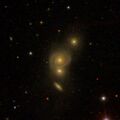 An unlabeled picture of HCG 5
References
- ↑ Hickson, P. (1982). "Systematic properties of compact groups of galaxies". The Astrophysical Journal 255: 382. doi:10.1086/159838. Bibcode: 1982ApJ...255..382H.
- ↑ 2.0 2.1 Verdes-Montenegro, L.; Yun, M. S.; Williams, B. A.; Huchtmeier, W. K.; Del Olmo, A.; Perea, J. (2001). "Where is the neutral atomic gas in Hickson groups?". Astronomy & Astrophysics 377 (3): 812–826. doi:10.1051/0004-6361:20011127. Bibcode: 2001A&A...377..812V.
- ↑ Hickson, P.; Kindl, E.; Huchra, J. P. (1988). "Morphology of Galaxies in Compact Groups". The Astrophysical Journal 331: 64. doi:10.1086/166536. Bibcode: 1988ApJ...331...64H.
- ↑ Mendes de Oliveira, C.; Hickson, P. (1991). "The Luminosity Function of Compact Groups of Galaxies". The Astrophysical Journal 380: 30. doi:10.1086/170559. Bibcode: 1991ApJ...380...30M.
- ↑ 5.0 5.1 Kindl, E. (1990). A Study of the Environments of Compact Groups of Galaxies (Ph.D. thesis). University of British Columbia. Bibcode:1990PhDT........20K.
- ↑ 6.0 6.1 Mendes de Oliveira, C.; Coelho, P.; González, J. J.; Barbuy, B. (2005). "Ages, Metallicities, and α-Element Enhancement for Galaxies in Hickson Compact Groups". The Astronomical Journal 130 (1): 55–64. doi:10.1086/430280. Bibcode: 2005AJ....130...55M.
- ↑ Ponman, T. J.; Bourner, P. D. J.; Ebeling, H.; Böhringer, H. (1996). "A ROSAT survey of Hickson's compact galaxy groups". Monthly Notices of the Royal Astronomical Society 283 (2): 690–708. doi:10.1093/mnras/283.2.690. Bibcode: 1996MNRAS.283..690P.
- ↑ 8.0 8.1 8.2 8.3 Hickson, P. (1993). "Atlas of Compact Groups of Galaxies". Astrophysical Letters and Communications 29: 1. Bibcode: 1993ApL&C..29....1H.
- ↑ Mendes de Oliveira, C.; Hickson, P. (1994). "Morphology of Galaxies in Compact Groups". The Astrophysical Journal 427: 684. doi:10.1086/174176. Bibcode: 1994ApJ...427..684M.
- ↑ Palumbo, G. G. C.; Saracco, P.; Hickson, P.; Mendes de Oliveira, C. (1995). "Environment of Compact Groups of Galaxies". The Astronomical Journal 109: 1476. doi:10.1086/117360. Bibcode: 1995AJ....109.1476P.
- ↑ Hickson, P.; Kindl, E.; Auman, J. R. (1989). "A photometric catalog of compact groups of galaxies". The Astrophysical Journal Supplement Series 70: 687. doi:10.1086/191354. Bibcode: 1989ApJS...70..687H.
- ↑ Tovmassian, H. M.; Chavushyan, V. H.; Martinez, O.; Yam, O.; Tiersch, H. (2002). "Dynamics of Hickson Compact Groups of Galaxies". 282. Astronomical Society of the Pacific. pp. 262. Bibcode: 2002ASPC..282..262T.
- ↑ Allam, S.; Assendorp, R.; Longo, G.; Braun, M.; Richter, G. (1996). "Far infrared properties of Hickson compact groups of galaxies. I. High resolution IRAS maps and fluxes". Astronomy & Astrophysics Supplement Series 117: 39–82. doi:10.1051/aas:1996153. Bibcode: 1996A&AS..117...39A.
- ↑ Lisenfeld, U.; Alatalo, K.; Zucker, C.; Appleton, P. N.; Gallagher, S.; Guillard, P.; Johnson, K. (2017). "The role of molecular gas in galaxy transition in compact groups". Astronomy & Astrophysics 607: A110. doi:10.1051/0004-6361/201730898. Bibcode: 2017A&A...607A.110L.
- ↑ "NED results for HCG 5". NASA/IPAC Extragalactic Database. National Aeronautics and Space Administration / Infrared Processing and Analysis Center. https://ned.ipac.caltech.edu/byname?objname=HCG%205.
- ↑ Williams, B. A.; Rood, H. J. (1987). "Neutral Hydrogen in Compact Groups of Galaxies". The Astrophysical Journal Supplement Series 63: 265. doi:10.1086/191170. Bibcode: 1987ApJS...63..265W.
- ↑ Hickson, P.; Mendes de Oliveira, C.; Huchra, J. P.; Palumbo, G. G. C. (1992). "Dynamical Properties of Compact Groups of Galaxies". The Astrophysical Journal 399: 353. doi:10.1086/171932. Bibcode: 1992ApJ...399..353H.
- ↑ "NED results for HCG 5a". NASA/IPAC Extragalactic Database. National Aeronautics and Space Administration / Infrared Processing and Analysis Center. https://ned.ipac.caltech.edu/byname?objname=HCG+5a.
- ↑ "NED results for HCG 5b". NASA/IPAC Extragalactic Database. National Aeronautics and Space Administration / Infrared Processing and Analysis Center. https://ned.ipac.caltech.edu/byname?objname=HCG+5b.
- ↑ "NED results for HCG 5c". NASA/IPAC Extragalactic Database. National Aeronautics and Space Administration / Infrared Processing and Analysis Center. https://ned.ipac.caltech.edu/byname?objname=HCG+5c.
- ↑ "NED results for HCG 5d". NASA/IPAC Extragalactic Database. National Aeronautics and Space Administration / Infrared Processing and Analysis Center. https://ned.ipac.caltech.edu/byname?objname=HCG+5d.
 |  |


