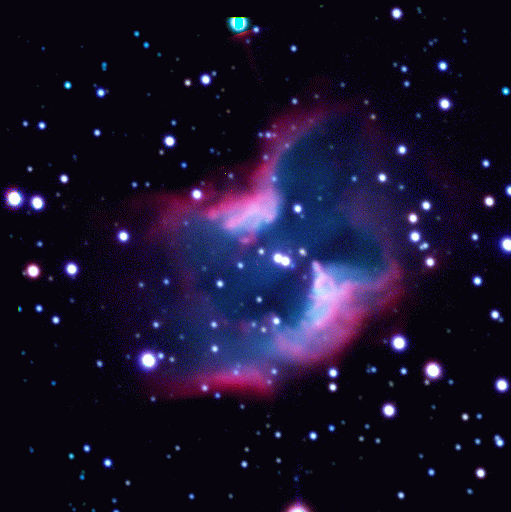
Astronomy:NGC 2899
| Emission nebula | |
|---|---|
| Planetary nebula | |
.jpg) NGC 2899, imaged by the Hubble Space Telescope | |
| Observation data: J2000 epoch | |
| Right ascension | 09h 27m 03.2s[1] |
| Declination | −56° 06′ 21.1″[1] |
| Distance | 3,350 ± 670 ly (1,026 ± 205 pc)[2] ly |
| Apparent magnitude (V) | 11.8[3] |
| Apparent dimensions (V) | 2.6′ × 1.3′[4] |
| Constellation | Vela |
| Designations | NGC 2899, Gum 27, PN G277.1-03.8[5] |
NGC 2899 is a planetary nebula in the southern constellation of Vela. It was discovered by English astronomer John Herschel on February 27, 1835.[6] This nebula can be viewed with a moderate-sized amateur telescope, but requires a larger telescope to resolve details.[3] NGC 2899 is located at a distance of 3,350 ± 670 light-years (1,026 ± 205 pc) from the Sun and 25,894 ± 3 light-years (7,939 ± 1 pc) from the Galactic Center.[2]
This nebula has an overall kidney shape that is elongated along an axis from WNW to ESE.[7] The overall topology is bipolar with a significant equatorial structure. This shape is believed to result from a binary star system. The mean expansion rate is 43 to 56 km/s, with high velocity structures expanding at 110 to 130 km/s. The core mass of the central star is estimated as ~1.2 M☉.[4]
The nebula lies within a large cavity in the surrounding medium. This opening has quadrupolar shape with a physical dimension of 14 pc × 11 pc. The elongation lies along a position angle of 37°±5°, which is aligned with the minor axis of the planetary nebula. This opening was most likely crafted by a fast stellar wind coming from the central star during its asymptotic giant branch stage, prior to the formation of a planetary nebula. The shape and filamentary structures suggest the interaction of a binary star system.[8][9]
References
- ↑ 1.0 1.1 Cutri, R. M. et al. (2003). "2MASS All-Sky Catalog of Point Sources". Vizier Online Data Catalog. Bibcode: 2003yCat.2246....0C.
- ↑ 2.0 2.1 Stanghellini, Letizia; Haywood, Misha (May 2010). "The Galactic Structure and Chemical Evolution Traced by the Population of Planetary Nebulae". The Astrophysical Journal 714 (2): 1096–1107. doi:10.1088/0004-637X/714/2/1096. Bibcode: 2010ApJ...714.1096S.
- ↑ 3.0 3.1 Bakich, Michael E. (2010). 1,001 Celestial Wonders to See Before You Die: The Best Sky Objects for Star Gazers. Springer New York. p. 53. ISBN 9781441917775. https://books.google.com/books?id=qEhpS7d5ZdAC&pg=PA53.
- ↑ 4.0 4.1 Lopez, J. A. et al. (January 1991). "The evolved bipolar planetary nebula NGC 2899.". Astronomy and Astrophysics 241: 526. Bibcode: 1991A&A...241..526L.
- ↑ "NGC 2899". SIMBAD. Centre de données astronomiques de Strasbourg. http://simbad.u-strasbg.fr/simbad/sim-basic?Ident=NGC+2899.
- ↑ Seligman, Courtney. "Celestial Atlas NGC Objects 2850-2899". http://cseligman.com/text/atlas/ngc28a.htm#2899.
- ↑ Streicher, Magda (August 2010). "The Ancient Starry Ship". Monthly Notes of the Astronomical Society of South Africa 69 (9 and 10): 147–152. Bibcode: 2010MNSSA..69..147S. https://www.mnassa.org.za/html/Aug2010/2010MNASSA..69..Aug..147.pdf. Retrieved 2024-03-13.
- ↑ Weinberger, R.; Aryal, B. (July 2004). "Huge Dust Structures and Cavities Around PNe: NGC 6826 and NGC 2899". in Meixner, Margaret; Kastner, Joel H.; Balick, Bruce et al.. Asymmetrical Planetary Nebulae III: Winds, Structure and the Thunderbird, Proceedings of the conference held 28 July - 1 August 2003 at Mt. Rainer, Washington, USA. 313. San Francisco: Astronomical Society of the Pacific. p. 112. Bibcode: 2004ASPC..313..112W.
- ↑ Aryal, B. et al. (2009). "Planetary nebulae NGC 6826 and NGC 2899: early aspherical mass loss?". Astrophysics and Space Science 323 (4): 323–327. doi:10.1007/s10509-009-0076-9. Bibcode: 2009Ap&SS.323..323A.
External links and images
- Frommert, Hartmut. "Revised NGC Data for NGC 2899". http://spider.seds.org/ngc/revngcic.cgi?NGC2899.
- Challis, Pete. "NGC 2899". Harvard-Smithsonian Center for Astrophysics. http://www.cfa.harvard.edu/~pchallis/gif/ngc2899.gif.
- "Stunning Space Butterfly Captured by ESO Telescope". European Southern Observatory. July 30, 2020. https://www.eso.org/public/news/eso2012/.
Template:NGC objects:2500-2999

 |  |