Astronomy:RCW 38
| RCW 38 | |
|---|---|
 Nebulosity around the embedded star cluster in RCW 38 | |
| Observation data (J2000 epoch) | |
| Constellation | Vela |
| Right ascension | 08h 59m 05.52s[1] |
| Declination | −47° 30′ 39.2″[1] |
| Distance | 5,500 ly (1.7 kpc)[1] |
| Physical characteristics | |
RCW 38 is a star-forming region in the southern constellation of Vela (known as the Sails).[2] It includes an embedded HII region and a super star cluster. This region is located at a distance of approximately 5,500 light-years from the Sun.[1]
This is the youngest super star cluster in the Milky Way galaxy, with age estimates ranging from 0.1 to 1.0 Myr. It has around 10,000 member stars.[3] The cluster member stars are still enshrouded within the dark cloud in which they were born.[4] The star cluster is surrounded by clouds of brightly glowing gas and includes many protostars.[4] It is therefore classified as an infrared cluster. Observations by the Chandra X-ray Observatory have revealed more than 800 X-ray emitting young stellar objects in the cluster.[5] 139 infrared sources have been identified as variable, of which 47% are candidate young stellar objects.[6] Jets emerging from young protostars drive further star formation in the surrounding cloud.[7]
The cluster includes about 20 massive O-type stars concentrated in a volume a few parsecs across. The latter stars are having a dissipative effect on the surrounding molecular gas.[3] Five bow shocks have been identified coming from these objects, driven by strong stellar winds.[7] When these massive stars die, likely before the dispersal of the cluster, they will explode as supernovae.[2] It is hypothesized that these O-type stars were formed by a collision of two molecular clouds.[8] The primary cloud has a mass of 3×10⁴ M☉, while the secondary cloud has 2×10³ M☉.[3]
In the infrared, the brightest star in this region is designated IRS 2.[9] This is a binary star system consisting of two spectral type O5.5 stars. It is located at the heart of the cluster,[10] and appears to lie at the center of the H II region.[11] The second brightest source is a dust ridge designated IRS 1, positioned about 0.1 pc to the west of IRS 2. Both sources are surrounded by a dust-free cavity about 0.1 pc across.[3]
RCW 38 includes Gum 22, Gum 23, and Gum 24.[12][clarification needed]
Gallery
-
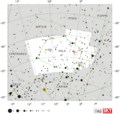 The location of RCW 38 (circled in red)
 -
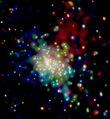 An X-ray view of the dense central star cluster
 -
![Central part of RCW 38, showing some of the brown dwarf candidates detected within the cluster[13]](/wiki/images/thumb/b/bc/Billions_of_new_neighbours%3F.jpg/120px-Billions_of_new_neighbours%3F.jpg) Central part of RCW 38, showing some of the brown dwarf candidates detected within the cluster[13]
Central part of RCW 38, showing some of the brown dwarf candidates detected within the cluster[13] -
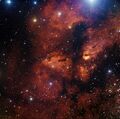 The wider region surrounding RCW 38


![Central part of RCW 38, showing some of the brown dwarf candidates detected within the cluster[13]](/wiki/File:Billions_of_new_neighbours%3F.jpg)

References
- ↑ 1.0 1.1 1.2 1.3 Wolk, Scott J. et al. (September 2006). "X-Ray and Infrared Point Source Identification and Characteristics in the Embedded, Massive Star-Forming Region RCW 38". The Astronomical Journal 132 (3): 1100–1125. doi:10.1086/505704. Bibcode: 2006AJ....132.1100W.
- ↑ 2.0 2.1 "Star cluster RCW 38". ESO. http://www.eso.org/public/images/eso0929b/.
- ↑ 3.0 3.1 3.2 3.3 Torii, Kazufumi et al. (February 2021). "ALMA view of the Galactic super star cluster RCW 38 at 270 au resolution". Publications of the Astronomical Society of Japan 73 (1): 205–219. doi:10.1093/pasj/psaa115. Bibcode: 2021PASJ...73..205T.
- ↑ 4.0 4.1 Turner, Calum (July 11, 2018). "Colourful Celestial Landscape". Garching bei München, Germany: ESO Public Information Office. https://www.eso.org/public/news/eso1823/?stream=science.
- ↑ Broos, Patrick S. et al. (2013). "Identifying young stars in massive star-forming regions for the MYStIX project". The Astrophysical Journal Supplement Series 209 (2): 32. doi:10.1088/0067-0049/209/2/32. ISSN 0067-0049. Bibcode: 2013ApJS..209...32B.
- ↑ Dörr, M. et al. (May 2013). "Near-infrared variability in the star-forming region RCW 38". Astronomy & Astrophysics 553: id. A48. doi:10.1051/0004-6361/201220311. Bibcode: 2013A&A...553A..48D.
- ↑ 7.0 7.1 Winston, E. et al. (January 2012). "Spitzer Observations of Bow Shocks and Outflows in RCW 38". The Astrophysical Journal 744 (2): id. 126. doi:10.1088/0004-637X/744/2/126. Bibcode: 2012ApJ...744..126W.
- ↑ Fukui, Y. et al. (March 2016). "The Two Molecular Clouds in RCW 38: Evidence for the Formation of the Youngest Super Star Cluster in the Milky Way Triggered by Cloud-Cloud Collision". The Astrophysical Journal 820 (1): id. 26. doi:10.3847/0004-637X/820/1/26. Bibcode: 2016ApJ...820...26F.
- ↑ Ascenso, Joana (June 2022). "Hidden power of near-infrared data for the study of young clusters: Illustrative case of RCW 38". Astronomy & Astrophysics 662: id. A31. doi:10.1051/0004-6361/202142582. Bibcode: 2022A&A...662A..31A.
- ↑ Winston, E. et al. (December 2011). "The Structure of the Star-forming Cluster RCW 38". The Astrophysical Journal 743 (2): id. 166. doi:10.1088/0004-637X/743/2/166. Bibcode: 2011ApJ...743..166W.
- ↑ Wolk, S. J. et al. (2008). "The Embedded Massive Star Forming Region RCW 38". in Reipurth, B.. Handbook of Star Forming Regions, Volume II: The Southern Sky ASP Monograph Publications. 5. Astronomical Society of the Pacific. p. 43. ISBN 978-1-58381-670-7. Bibcode: 2008hsf2.book..124W.
- ↑ Lang, Kenneth R. (December 6, 2012) (in en). Astrophysical Data: Planets and Stars. Springer Science & Business Media. ISBN 978-1-4684-0640-5. https://books.google.com/books?id=0_EHCAAAQBAJ&q=IC+2944+rcw+60&pg=PA414.
- ↑ "Billions of new neighbours?". https://www.eso.org/public/images/potw1729a/.
Further reading
- Pandey, Paarmita et al. (November 2024). "Constraining the Diffusion Coefficient and Cosmic-Ray Acceleration Efficiency Using Gamma-Ray Emission from the Star-forming Region RCW 38". The Astrophysical Journal 976 (1): id. 98. doi:10.3847/1538-4357/ad83bc. Bibcode: 2024ApJ...976...98P.
- Ge, Ting-Ting et al. (May 2024). "GeV γ-ray emission in the field of young massive star cluster RCW 38". Monthly Notices of the Royal Astronomical Society 530 (1): 1144–1150. doi:10.1093/mnras/stae930. Bibcode: 2024MNRAS.530.1144G.
- Fukushima, Aoto et al. (February 2023). "Suzaku and Chandra study of diffuse X-ray emission from the massive star-forming region RCW 38". Publications of the Astronomical Society of Japan 75 (1): 187–198. doi:10.1093/pasj/psac100. Bibcode: 2023PASJ...75..187F.
- Izumi, Natsuko et al. (February 2021). "Observations of the [C I] (3P1-3P0) emission toward the massive star-forming region RCW 38: Further evidence for highly-clumped density distribution of the molecular gas". Publications of the Astronomical Society of Japan 73 (1): 174–196. doi:10.1093/pasj/psaa113. Bibcode: 2021PASJ...73..174I.
- Mužić, Koraljka et al. (November 2017). "The low-mass content of the massive young star cluster RCW 38". Monthly Notices of the Royal Astronomical Society 471 (3): 3699–3712. doi:10.1093/mnras/stx1906. Bibcode: 2017MNRAS.471.3699M.
- Kaneda, H. et al. (August 2013). "Large-scale mapping of the massive star-forming region RCW38 in the [CII] and PAH emission". Astronomy & Astrophysics 556: id. A92. doi:10.1051/0004-6361/201321614. Bibcode: 2013A&A...556A..92K.
- Bik, A. et al. (April 2010). "Sequential Star Formation in RCW 34: A Spectroscopic Census of the Stellar Content of High-Mass Star-Forming Regions". The Astrophysical Journal 713 (2): 883–899. doi:10.1088/0004-637X/713/2/883. Bibcode: 2010ApJ...713..883B.
- DeRose, K. L. et al. (July 2009). "A Very Large Telescope/NACO Study of Star Formation in the Massive Embedded Cluster RCW 38". The Astronomical Journal 138 (1): 33–45. doi:10.1088/0004-6256/138/1/33. Bibcode: 2009AJ....138...33D.
- Wolk, S. J. et al. (December 2008). "The Embedded Massive Star Forming Region RCW 38". in Reipurth, Bo. Handbook of Star Forming Regions, volume II. The Southern Sky ASP Monograph Publications. 5. p. 124. Bibcode: 2008hsf2.book..124W.
- Gyulbudaghian, A. L.; May, J. (January 2008). "Investigation of the conspicuous infrared star cluster and star-forming region "RCW 38 IR Cluster"". Astrophysics 51 (1): 18–28. doi:10.1007/s10511-008-0003-8. Bibcode: 2008Ap.....51...18G.
- Wolk, Scott J. et al. (December 2002). "Discovery of Nonthermal X-Ray Emission from the Embedded Massive Star-forming Region RCW 38". The Astrophysical Journal 580 (2): L161–L165. doi:10.1086/345611. Bibcode: 2002ApJ...580L.161W.
- Smith, Craig H. et al. (February 1999). "Mid-infrared imaging and spectroscopy of the southern HII region RCW 38". Monthly Notices of the Royal Astronomical Society 303 (2): 367–379. doi:10.1046/j.1365-8711.1999.02241.x. Bibcode: 1999MNRAS.303..367S.
- Ligori, S. et al. (1994). "Near infrared imaging of the southern HII region RCW 38.". Memorie della Societa Astronomica Italiana 65: 815–818. Bibcode: 1994MmSAI..65..815L.
- Mizutani, K. et al. (October 1987). "Brackett-gamma mapping observation of RCW 38". Monthly Notices of the Royal Astronomical Society 228 (3): 721–727. doi:10.1093/mnras/228.3.721. Bibcode: 1987MNRAS.228..721M.
- Takami, H. et al. (August 1987). "Far-infrared O III fine-structure lines and ionization structure of RCW 38". Publications of the Astronomical Society of the Pacific 99: 832–835. doi:10.1086/132043. Bibcode: 1987PASP...99..832T.
- Muzzio, J. C.; Celotti de Frecha, M. B. (October 1979). "Faint early-type stars in the neighbourhood of the H II region RCW 38.". Monthly Notices of the Royal Astronomical Society 189 (2): 159–162. doi:10.1093/mnras/189.2.159. Bibcode: 1979MNRAS.189..159M. http://sedici.unlp.edu.ar/bitstream/handle/10915/133950/Documento.pdf?sequence=1.
External links
- "RCW 38". SIMBAD. Centre de données astronomiques de Strasbourg. http://simbad.u-strasbg.fr/simbad/sim-basic?Ident=RCW+38.

 |  |


