Astronomy:NGC 3190
| NGC 3190 | |
|---|---|
 NGC 3190 imaged by the Hubble Space Telescope | |
| Observation data (J2000 epoch) | |
| Constellation | Leo[1] |
| Right ascension | 10h 18m 05.6341s[2] |
| Declination | +21° 49′ 56.011″[2] |
| Redshift | 0.004370[2] |
| Helio radial velocity | 1,310±4 km/s[2] |
| Distance | 79 ± 7 Mly (24.2 ± 2.1 Mpc)[3] |
| Apparent magnitude (V) | 11.1[1] |
| Characteristics | |
| Type | SA(s)0−[2] |
| Apparent size (V) | 4.4 × 1.5[1] |
| Other designations | |
| HOLM 175A, HCG 044A, IRAS 10153+2204, Arp 316, UGC 5559, MCG+04-24-026, PGC 30083[2] | |
NGC 3190 is a spiral galaxy with tightly wound arms and lying in the constellation Leo.[1] It was discovered by William Herschel in 1784. NGC 3190 is member of Hickson 44 galaxy group, estimated at around 80 million light years away,[3] and consisting of four galaxies in a tight group - NGC 3193 is fairly featureless, NGC 3187 is a dim but striking spiral galaxy and NGC 3185 has a barred spiral structure with an outer ring. It is also a member of the NGC 3190 Group of galaxies, which is a member of the Leo II Groups, a series of galaxies and galaxy clusters strung out from the right edge of the Virgo Supercluster.[4]
In 2012 Apple Inc used a blue tinted image of NGC 3190 as their desktop image for their release of OS X Mountain Lion.
Supernovae

Two supernovae have been observed in NGC 3190:
- SN 2002bo (Type Ia, mag. 15.5) was co-discovered by Paulo Cacella and Yoji Hirose on 9 March 2002.[5][6]
- SN 2002cv (Type Ia-pec, mag. 19) was discovered by the Campo Imperatore Observatory on 9 May 2002.[7][8] This Italian team detected the supernova while studying SN 2002bo, and both of these were visible at the same time.[9][10]
Image Gallery
-
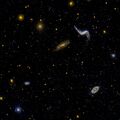 NGC 3190 near center and other galaxies

See also
References
- ↑ 1.0 1.1 1.2 1.3 Finlay, Warren H. (2014). Concise Catalogue of Deep-Sky Objects. The Patrick Moore Practical Astronomy Series (2nd ed.). Springer Cham. p. 240. doi:10.1007/978-3-319-03170-5. ISBN 978-3-319-03169-9.
- ↑ 2.0 2.1 2.2 2.3 2.4 2.5 "Results for object NGC 3190". https://ned.ipac.caltech.edu/byname?objname=NGC+3190.
- ↑ 3.0 3.1 "Distance Results for NGC 3190". NASA/IPAC Extragalactic Database. http://nedwww.ipac.caltech.edu/cgi-bin/nDistance?name=NGC+3190.
- ↑ "The Leo III Groups". Atlas of the Universe. http://www.atlasoftheuniverse.com/galgrps/leoii.html.
- ↑ Cacella, P.; Hirose, Y.; Nakano, S.; Kushida, Y.; Kushida, R.; Li, W. D. (2002). "Supernova 2002bo in NGC 3190". International Astronomical Union Circular (7847): 1. Bibcode: 2002IAUC.7847....1C. http://www.cbat.eps.harvard.edu/iauc/07800/07847.html#Item1.
- ↑ "SN 2002bo". IAU. https://www.wis-tns.org/object/2002bo.
- ↑ Larionov, V.; Arkharov, A.; Caratti o Garatti, A.; Di Paola, A.; Dolci, M.; Di Carlo, E.; Pietrinferni, A.; Gagliardi, S. et al. (2002). "Supernova 2002cv in NGC 3190". International Astronomical Union Circular (7901): 1. Bibcode: 2002IAUC.7901....1L. http://www.cbat.eps.harvard.edu/iauc/07900/07901.html#Item1.
- ↑ "SN 2002cv". IAU. https://www.wis-tns.org/object/2002cv.
- ↑ Cain, Fraser (16 May 2006). "Twin Supernovae in NGC 3190". Universe Today. http://www.universetoday.com/2006/05/16/twin-supernovae-in-ngc-3190/.
- ↑ ESO: Twin Explosions In Gigantic Dusty Potato Crisp , European Southern Observatory, May 11, 2006
External links
- AOP: NGC 3190 Group
- Astronomy Picture of the Day - Spiral Galaxy NGC 3190 Almost Sideways 2010 May 3
- NGC 3190 on WikiSky: DSS2, SDSS, GALEX, IRAS, Hydrogen α, X-Ray, Astrophoto, Sky Map, Articles and images
Template:NGC objects:3001-4000
Coordinates:  10h 18m 05.6341s, +21° 49′ 56.011″
 |  |


