Astronomy:NGC 3190
| NGC 3190 | |
|---|---|
 NGC 3190 imaged by the Hubble Space Telescope | |
| Observation data (J2000 epoch) | |
| Constellation | Leo |
| Right ascension | 10h 18m 05.6341s[1] |
| Declination | +21° 49′ 56.011″[1] |
| Redshift | 0.004370[1] |
| Helio radial velocity | 1310 ± 4 km/s[1] |
| Distance | 79 ± 7 Mly (24.2 ± 2 Mpc)[2] |
| Apparent magnitude (V) | 11.1 |
| Characteristics | |
| Type | SA(s)0−[1] |
| Apparent size (V) | 4.4′ × 1.5′[1] |
| Other designations | |
| HOLM 175A, HCG 044A, IRAS 10153+2204, Arp 316, UGC 5559, MCG+04-24-026, PGC 30083[1] | |
NGC 3190 is a spiral galaxy with tightly wound arms and lying in the constellation Leo. It was discovered by William Herschel in 1784. NGC 3190 is member of Hickson 44 galaxy group, estimated at around 80 million light years away,[2] and consisting of four galaxies in a tight group - NGC 3193 is fairly featureless, NGC 3187 is a dim but striking spiral galaxy and NGC 3185 has a barred spiral structure with an outer ring. It is also a member of the NGC 3190 Group of galaxies, which is a member of the Leo II Groups, a series of galaxies and galaxy clusters strung out from the right edge of the Virgo Supercluster.[3]
In 2012 Apple Inc used a blue tinted image of NGC 3190 as their desktop image for their release of OS X Mountain Lion.
Supernovae

Two supernovae have been observed in NGC 3190:
- SN 2002bo (Type Ia, mag. 15.5) was co-discovered by Paulo Cacella and Yoji Hirose on 9 March 2002.[4][5]
- SN 2002cv (Type Ia-pec, mag. 19) was discovered by the Campo Imperatore Observatory on 9 May 2002.[6][7] This Italian team detected the supernova while studying SN 2002bo, and both of these were visible at the same time.[8][9]
Image Gallery
-
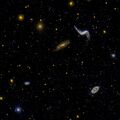 NGC 3190 near center and other galaxies

See also
References
- ↑ 1.0 1.1 1.2 1.3 1.4 1.5 1.6 "Results for object NGC 3190". https://ned.ipac.caltech.edu/byname?objname=NGC+3190.
- ↑ 2.0 2.1 "Distance Results for NGC 3190". NASA/IPAC Extragalactic Database. http://nedwww.ipac.caltech.edu/cgi-bin/nDistance?name=NGC+3190.
- ↑ "The Leo III Groups". Atlas of the Universe. http://www.atlasoftheuniverse.com/galgrps/leoii.html.
- ↑ Cacella, P.; Hirose, Y.; Nakano, S.; Kushida, Y.; Kushida, R.; Li, W. D. (2002). "Supernova 2002bo in NGC 3190". International Astronomical Union Circular (7847): 1. Bibcode: 2002IAUC.7847....1C. http://www.cbat.eps.harvard.edu/iauc/07800/07847.html#Item1.
- ↑ "SN 2002bo". IAU. https://www.wis-tns.org/object/2002bo.
- ↑ Larionov, V.; Arkharov, A.; Caratti o Garatti, A.; Di Paola, A.; Dolci, M.; Di Carlo, E.; Pietrinferni, A.; Gagliardi, S. et al. (2002). "Supernova 2002cv in NGC 3190". International Astronomical Union Circular (7901): 1. Bibcode: 2002IAUC.7901....1L. http://www.cbat.eps.harvard.edu/iauc/07900/07901.html#Item1.
- ↑ "SN 2002cv". IAU. https://www.wis-tns.org/object/2002cv.
- ↑ Cain, Fraser (16 May 2006). "Twin Supernovae in NGC 3190". Universe Today. http://www.universetoday.com/2006/05/16/twin-supernovae-in-ngc-3190/.
- ↑ ESO: Twin Explosions In Gigantic Dusty Potato Crisp , European Southern Observatory, May 11, 2006
External links
- AOP: NGC 3190 Group
- Astronomy Picture of the Day - Spiral Galaxy NGC 3190 Almost Sideways 2010 May 3
- NGC 3190 on WikiSky: DSS2, SDSS, GALEX, IRAS, Hydrogen α, X-Ray, Astrophoto, Sky Map, Articles and images
Coordinates:  10h 18m 05.6341s, +21° 49′ 56.011″
 |  |


