Astronomy:NGC 6820 and NGC 6823
| Emission nebula | |
|---|---|
 NGC 6820/NGC 6823 Credit: Jeff Johnson | |
| Observation data: J2000.0 epoch | |
| Right ascension | 19h 42m 27.92s[1] |
| Declination | +23° 05′ 14.7″[1] |
| Distance | 6,000[2] ly |
| Apparent magnitude (V) | 7.1[3] |
| Apparent dimensions (V) | 40 arcmins |
| Constellation | Vulpecula |
| Designations | NGC 6820, Sh 2-86, GC 5945, Marth #401 NGC 6823, GC 4512, JH 2049, WH VII |
NGC 6820 is an emission nebula that surrounds the much smaller open cluster NGC 6823 in Vulpecula.[4]
Messier 27 is found three degrees to the east, and α Vulpeculae three degrees to the west.
NGC 6820
The emission nebula NGC 6820 was discovered by Albert Marth on August 7, 1864.[5] The nebula is being pushed out and away by the radiation from the stars of NGC 6823, creating huge 'pillars' of gas and dust, similar to the pillars of creation.[4]
NGC 6823
NGC 6823 was discovered by William Herschel on July 17, 1785.[6] It is about 50 light-years across and lies about 6,000 light-years away. The center of the cluster formed about two million years ago and is dominated in brightness by a host of bright young blue stars. Outer parts of the cluster contain even younger stars.[2] It forms the core of the Vulpecula OB1 stellar association.[7]
Image gallery
-
 NGC 6820 imaged by the Gemini North Telescope
 -
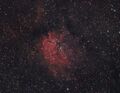 NGC 6820/NGC 6823 – Courtesy: Hunter Wilson
 -
 NGC 6823
.jpg)


References
- ↑ 1.0 1.1 "NGC 6820". SIMBAD. Centre de données astronomiques de Strasbourg. http://simbad.u-strasbg.fr/simbad/sim-basic?Ident=NGC+6820.
- ↑ 2.0 2.1 Nemiroff, R.; Bonnell, J., eds (4 October 2004). "NGC 6823: Cloud Sculpting Star Cluster". Astronomy Picture of the Day. NASA. https://apod.nasa.gov/apod/ap041004.html.
- ↑ "NGC 6823 - Star Cluster + Nebula in Vulpecula". The Sky Live. https://theskylive.com/sky/deepsky/ngc6823-object.
- ↑ 4.0 4.1 Greif, John (July 19, 2020). "NGC 6820 and NGC 6823". https://skyandtelescope.org/online-gallery/ngc-6820-and-ngc-6823/.
- ↑ Segilman, Courtney. "Celestial Atlas". https://cseligman.com/text/atlas/ngc68.htm#6820.
- ↑ Segilman, Courtney. "Celestial Atlas". https://cseligman.com/text/atlas/ngc68.htm#6823.
- ↑ Billot, N.; Noriega-Crespo, A.; Carey, S.; Guieu, S.; Shenoy, S.; Paladini, R.; Latter, W. (2010). "Young Stellar Objects and Triggered Star Formation in the Vulpecula Ob Association". The Astrophysical Journal 712 (2): 797. doi:10.1088/0004-637X/712/2/797. Bibcode: 2010ApJ...712..797B.
External links

 |  |


