Biology:Cape bushbuck
| Cape bushbuck | |
|---|---|
.jpg)
| |
| Male, Kenya | |
_female.jpg)
| |
| Female, Zimbabwe | |
Scientific classification 
| |
| Kingdom: | Animalia |
| Phylum: | Chordata |
| Class: | Mammalia |
| Order: | Artiodactyla |
| Family: | Bovidae |
| Subfamily: | Bovinae |
| Genus: | Tragelaphus |
| Species: | T. sylvaticus
|
| Binomial name | |
| Tragelaphus sylvaticus (Sparrman, 1780)
| |

| |
| Combined range of Cape and harnessed bushbuck | |
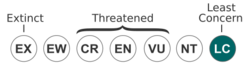
The Cape bushbuck (Tragelaphus sylvaticus), also known as imbabala and southern bushbuck, is a common, medium-sized bushland-dwelling, and a widespread species of antelope in sub-Saharan Africa.[2][3] It is found in a wide range of habitats, such as rain forests, montane forests, forest-savanna mosaic, savanna, bushveld, and woodland.[3] It stands around 90 cm (35 in) at the shoulder and weigh from 45 to 80 kg (99 to 176 lb). They are generally solitary, territorial browsers.
Taxonomy
| |||||||||||||||||||||||||||||||||||||||||||||||||||||||||||||||||||||||||||
| Phylogenetic relationships of the mountain nyala from combined analysis of all molecular data (Willows-Munro et.al. 2005) |
The taxonomy of bushbuck, and of the Tragelaphini tribe in general, has been contested. Bushbuck have been fractured into over 40 subspecies in the past. mtDNA profiles of a large number of samples were resolved in 2009 as belonging to 19 groups, some corresponding to previously described subspecies, while others were previously unrecognised and remained unnamed. These groups were then organised into two taxa - a nominate northern subspecies (T. s. scriptus) and a southern subspecies T. s. sylvaticus. In the 1780 original description of T. sylvaticus from the Cape Region by Sparrman, no mention was made of striping. According to Moodley et al., males of type populations in West Africa are more often striped than southern and eastern specimens,[3] although this is not always the case.
In 2011, Groves and Grubb advocated recognising eight species of bushbuck: T. scriptus (Pallas, 1766); T. phaleratus (Hamilton Smith, 1827); T. bor Heuglin, 1877; T. decula (Rüppell, 1835); T. meneliki Neumann, 1902; T. fasciatus Pocock, 1900; T. ornatus Pocock, 1900; and T. sylvaticus (Sparrman, 1780), grouped in a northern and southern 'group'.[4] The Ethiopian endemic species known as Menelik's bushbuck or decula was classified as a scriptus group species as opposed to Woodley. In the case of Tragelaphus, these 'species' would be based mostly on geography and pelage as opposed to genetics.[4] These proposals are controversial.[5]
In 2018, Hassanin et al. published a molecular phylogenetic study that provided support for the scriptus and sylvaticus species, with a divergence time of at least 2 million years, albeit with considerable genetic diversity within each of these groups.[6]
Description
_Tragelaphus_scriptus_decula.png)
.jpg)
Cape bushbucks stand around 90 cm (35 in) at the shoulder and weigh from 60 to 80 kg (130 to 180 lb) in males and 25 to 60 kg (55 to 132 lb)in females.[7] They have a light brown coat, with up to seven white stripes and white splotches on the sides. The white patches are usually geometrically shaped and on the most mobile parts of their bodies, such as the ears, chin, tail, legs, and necks. The muzzles are also white. Horns, found only on the males, can reach over half a metre and have a single twist. At 10 months old, young males sprout horns that are particularly twisted and at maturity form the first loop of a spiral.[8]
Ecology
_(6041465641).jpg)
_female_and_young_(6017312458).jpg)
Bushbuck browse on trees, shrubs, and forbs; they rarely if ever eat grasses. Studies of free-ranging bushbuck in various parts of southeastern Africa using DNA metabarcoding show that bushbuck frequently forage on acacias (Senegalia, Vachellia) and other legumes, along with mallows (Grewia, Hibiscus), bushwillows (Combretum), buckthorns (Berchemia, Ziziphus) and various other plants.[9][10] Bushbuck are active throughout the day, but tend to be nocturnal near human habitations.
Bushbuck are solitary animals, but are not aggressively antisocial, and individuals sometimes forage in close proximity.[11] Bushbuck live within a "home" area, which is usually around 50,000 m2 (540,000 sq ft) on the savannah and much larger in the forest, that they will not normally leave. These areas usually overlap other bushbuck home areas.
Some game farmers in southern Africa discovered that the bushbuck may compete with the closely related, larger nyala when they tried to introduce the two species to the same area. However, the two species are often found in close proximity in natural communities (e.g., in Gorongosa National Park, Mozambique).[12]
Predation by chimpanzees
In Fongoli, Senegal, western chimpanzees of both sexes occasionally hunt bushbucks, preferring fawns when given the chance.[13]
References
- ↑ IUCN SSC Antelope Specialist Group (2016). "Tragelaphus scriptus". IUCN Red List of Threatened Species 2016. doi:10.2305/IUCN.UK.2016-3.RLTS.T22051A50196111.en. https://www.iucnredlist.org/species/22051/50196111. Retrieved 18 January 2024.
- ↑ Wronski, T; Moodley, Y. (2009). "Bushbuck, harnessed antelope or both?". Gnusletter 28 (1): 17–19. https://antelopesg.org/wp-content/uploads/2022/08/28-1_2009.pdf.
- ↑ 3.0 3.1 3.2 Moodley, Y. (September 2009). "Analysis of mitochondrial DNA data reveals non-monophyly in the bushbuck (Tragelaphus scriptus) complex". Mammalian Biology 74 (5): 418–422. doi:10.1016/j.mambio.2008.05.003. Bibcode: 2009MamBi..74..418M. https://www.academia.edu/13779659. Retrieved 7 April 2021.
- ↑ 4.0 4.1 Groves, Colin; Grubb, Peter (2011-11-15) (in en). Ungulate Taxonomy. JHU Press. ISBN 978-1-4214-0093-8. https://books.google.com/books?id=v3uZtA1ZpTAC.
- ↑ Heller, R.; Frandsen, P.; Lorenzen, E. D.; Siegismund, H. R. (2013). "Are there really twice as many bovid species as we thought?.". Systematic Biology 62 (3): 490–493. doi:10.1093/sysbio/syt004. PMID 23362112.
- ↑ Hassanin, Alexandre; Houck, Marlys L.; Tshikung, Didier; Kadjo, Blaise; Davis, Heidi; Ropiquet, Anne (2018-12-01). "Multi-locus phylogeny of the tribe Tragelaphini (Mammalia, Bovidae) and species delimitation in bushbuck: Evidence for chromosomal speciation mediated by interspecific hybridization" (in en). Molecular Phylogenetics and Evolution 129: 96–105. doi:10.1016/j.ympev.2018.08.006. ISSN 1055-7903. PMID 30121341. Bibcode: 2018MolPE.129...96H. https://www.sciencedirect.com/science/article/pii/S1055790318304354.
- ↑ Haltenorth, T., & Diller, H. (1977). Säugetiere Afrikas und Madagaskars. (No Title).
- ↑ "Bushbuck". African Wildlife Foundation. http://www.awf.org/content/wildlife/detail/bushbuck.
- ↑ Atkins, Justine L.; Long, Ryan A.; Pansu, Johan; Daskin, Joshua H.; Potter, Arjun B.; Stalmans, Marc E.; Tarnita, Corina E.; Pringle, Robert M. (2019-04-12). "Cascading impacts of large-carnivore extirpation in an African ecosystem" (in en). Science 364 (6436): 173–177. doi:10.1126/science.aau3561. ISSN 0036-8075. PMID 30846612. Bibcode: 2019Sci...364..173A.
- ↑ Pansu, Johan; Hutchinson, Matthew C.; Anderson, T. Michael; te Beest, Mariska; Begg, Colleen M.; Begg, Keith S.; Bonin, Aurelie; Chama, Lackson et al. (2022-08-30). "The generality of cryptic dietary niche differences in diverse large-herbivore assemblages" (in en). Proceedings of the National Academy of Sciences 119 (35). doi:10.1073/pnas.2204400119. ISSN 0027-8424. PMID 35994662. Bibcode: 2022PNAS..11904400P.
- ↑ Estes, Richard (1991) (in en). The Behavior Guide to African Mammals: Including Hoofed Mammals, Carnivores, Primates. University of California Press. ISBN 978-0-520-08085-0. https://books.google.com/books?id=g977LsZHpcsC.
- ↑ Daskin, Joshua H.; Becker, Justine A.; Kartzinel, Tyler R.; Potter, Arjun B.; Walker, Reena H.; Eriksson, Fredrik A. A.; Buoncore, Courtney; Getraer, Alexander et al. (2022-09-22). "Allometry of behavior and niche differentiation among congeneric African antelopes" (in en). Ecological Monographs 93. doi:10.1002/ecm.1549. ISSN 0012-9615.
- ↑ Pruetz, J. D.; Bertolani, P.; Ontl, K. B.; Lindshield, S.; Shelley, M.; Wessling, E. G. (15 April 2015). "New evidence on the tool-assisted hunting exhibited by chimpanzees (Pan troglodytes verus) in a savannah habitat at Fongoli, Sénégal". Royal Society Open Science (Royal Society Publishing) 2 (4). doi:10.1098/rsos.140507. PMID 26064638. Bibcode: 2015RSOS....240507P.
External links
 Gilman, D. C.; Peck, H. T.; Colby, F. M., eds (1905). "Bushbuck". New International Encyclopedia (1st ed.). New York: Dodd, Mead.
Wikidata ☰ {{{from}}} entry
 |  |


