Biology:Pitcher plant


Pitcher plants are carnivorous plants that have modified leaves known as pitfall traps—prey-trapping mechanisms featuring a deep cavity filled with digestive liquid. The traps of what are considered to be "true" pitcher plants are formed by specialized leaves. The plants attract and drown the prey with nectar.[1]
Types
The term "pitcher plant" generally refers to members of the Nepenthaceae and Sarraceniaceae families, but similar pitfall traps are employed by the monotypic Cephalotaceae and some members of the Bromeliaceae. The families Nepenthaceae and Sarraceniaceae are the most species-rich families of pitcher plants.[2]
Nepenthaceae
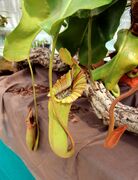
The Nepenthaceae contain a single genus, Nepenthes, containing over 100 species and numerous hybrids and cultivars. In this genus of Old World pitcher plants, the pitchers are borne at the end of tendrils that extend from the midrib of an otherwise unexceptional leaf. Old World pitcher plants are typically characterized as having reduced and symmetrical pitchers with a comprehensive waxy coating on the surface of the inner pitcher wall. The plants themselves are often climbers, accessing the canopy of their habitats using the aforementioned tendrils, although others are found on the ground in forest clearings, or as epiphytes on trees.[3]
Sarraceniaceae
The New World pitcher plants (Sarraceniaceae), which comprise three genera, are ground-dwelling herbs whose pitchers arise from a horizontal rhizome. In this family, the entire leaf forms the pitcher, as opposed to Nepenthaceae, where the pitcher arises from the terminal portion of the leaf. The species of the genus Heliamphora, which are popularly known as marsh pitchers (or erroneously as sun pitchers), have a simple rolled-leaf pitcher, at the tip of which is a spoon-like structure that secretes nectar. They are restricted to areas of high rainfall in South America. The North American genus Sarracenia are the trumpet pitchers, which have a more complex trap than Heliamphora, with an operculum, which prevents excess accumulation of rainwater in most of the species. The single species in the California genus Darlingtonia is popularly known as the cobra plant, due to its possession of an inflated "lid" with elegant false-exits, and a forked "tongue", which serves to ferry ants and other prey to the entrance of the pitcher. The species in Sarracenia readily hybridize, making their classification a complex matter.[4]
The purple pitcher plant, Sarracenia purpurea, is the floral emblem of the province of Newfoundland and Labrador, Canada.[5]
Cephalotaceae
The Cephalotaceae are a monotypic family with but one genus and species, Cephalotus follicularis. This species has a small (2–5 cm) pitcher similar in form to those of Nepenthes. Unlike in Nepenthes, in Cephalotus follicularis the petiole is attached to the rear of the upper trap rim rather than to the base of the pitcher.[6] The species occurs in only one location in southwestern Australia.[7]
Bromeliaceae
A few species of bromeliads (Bromeliaceae), such as Brocchinia reducta and Catopsis berteroniana, are known or suspected to be carnivorous.[8]
-
 Nepenthes muluensis pitchers hang from tendrils. (This specimen is cultivated.)
 -
 Most North American pitcher plants belong to the genus Sarracenia.
 -
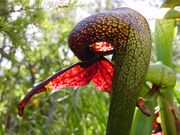 Cobra lilies (Darlingtonia californica) use window-like areolae to lure insects into their hollow leaves.
 -
 The Australian pitcher plant is the only member of the Australian genus Cephalotus.
 -
-
 Pitcher of Nepenthes villosa


Feeding behavior
Attraction
Foraging, flying, or crawling insects, such as flies, are attracted to a cavity formed by the cupped leaf, often by visual lures such as anthocyanin pigments, and nectar. Many pitcher plants exhibit patterns of ultraviolet coloration which may play a role in attracting insects.[6] Some species, such as Cephalotus follicularis, likely use camouflage to trap insects, as their coloration matches that of the surrounding environment and the plants are often embedded in the substrate such that the traps are flush with the ground.[6]
Olfactory cues can also play a role in attraction. For example, Nepenthes rafflesiana uses flower-scent mimicry to attract insects to its pitchers.[9]
Capture
The rim of the pitcher (peristome) is slippery when moistened by condensation or nectar, causing insects to fall into the trap. The walls of the pitfall may be covered with waxy scales, protruding aldehyde crystals, cuticular folds, downward-pointing hairs, or guard-cell-originating lunate cells, to help prevent escape.[1] The small bodies of liquid contained within the pitcher traps are called phytotelmata. They drown the insect, whose body is gradually dissolved. This may occur by bacterial action (the bacteria being washed into the pitcher by rainfall), or by digestive enzymes secreted by the plant itself. Pitcher trap fluids largely vary in their viscoelasticity and acidity, which dictates which type of prey they can target. For example, increased viscoelasticity is associated with increased insect retention to help capture flying insects such as flies, whereas increased fluid acidity can decrease insect killing-time, which can help capture crawling insects such as ants.[10] Some pitcher plants contain mutualistic insect larvae, which feed on trapped prey, and whose excreta the plant absorbs.[11]
Digestion
Whatever the mechanism of digestion, the prey items are converted into a solution of amino acids, peptides, phosphates, ammonium and urea, from which the plant obtains its mineral nutrition (particularly nitrogen and phosphorus). Like all carnivorous plants, pitcher plants all grow in locations where the soil is too poor in minerals and/or too acidic for most plants to survive. Pitcher plants supplement available nutrients and minerals (which plants normally obtain through their roots) with the constituents of their insect prey.[12]
Feces-trapping symbiosis
Mature plants of Nepenthes lowii attract tree shrews (Tupaia montana), which feed on nectar that the plant produces but also defecate into the pitcher, providing nitrates and other nutrients. The plant and tree shrew have a mutualistic relationship. The rim of N. lowii is not slippery so that tree shrews can easily get in and out; it provides more nectar than other pitcher plants. The shape of the pitcher rim and the position of the nectar ensure that the animal's hindquarters are over the rim while it feeds.[13]
Nepenthes rafflesiana var. elongata has a similar relationship with Hardwicke's woolly bats (Kerivoula hardwickii).[14] The bats roost inside the pitchers and the plants derive much of their foliar nitrogen from the feces of the bats. Compared to other varieties of Nepenthes rafflesiana that do not exhibit this form of mutualism, N. rafflesiana var. elongata has elongated pitchers that can accommodate both single bats and mother-juvenile pairs. As well as its elongated shape, N. rafflesiana var. elongata has reduced volumes of pitcher fluid compared to other species, leaving more space to accommodate the bats.
Evolution of the form
It is widely assumed pitfall traps evolved by epiascidiation (infolding of the leaf with the adaxial or upper surface becoming the inside of the pitcher),[15][16] with selection pressure favouring more deeply cupped leaves over evolutionary time. The pitcher trap evolved independently in three eudicot lineages and one monocot lineage, representing a case of convergent evolution.[15] Some pitcher plant families (such as Nepenthaceae) are placed within clades consisting mostly of flypaper traps, indicating that some pitchers may have evolved from the common ancestors of today's flypaper traps by loss of mucilage.[17]
See also
- Darlingtonia State Natural Site – A nature preserve for pitcher plants in Oregon, United States.
- Baghmara Pitcher Plant Wildlife Sanctuary
References
- ↑ 1.0 1.1 Krol, E.; Plancho, B. J.; Adamec, L.; Stolarz, M.; Dziubinska, H.; Trebacz, Kgv. (2011). "Quite a few reasons for calling carnivores 'the most wonderful plants in the world'". Annals of Botany 109 (1): 47–64. doi:10.1093/aob/mcr249. PMID 21937485.
- ↑ "The evolution of carnivorous pitcher plants" (in en). https://www.obga.ox.ac.uk/evolution-carnivorous-pitcher-plants.
- ↑ Clarke, Charles; Moran, Jonathan (2015). "Climate, soils and vicariance - their roles in shaping the diversity and distribution of Nepenthes in Southeast Asia". Plant and Soil (Springer International Publishing) 403 (1–2): 37–51. doi:10.1007/s11104-015-2696-x. https://link.springer.com/article/10.1007/s11104-015-2696-x.
- ↑ Furches, M. Steven; Small, Randall L.; Furches, Anna (October 2013). "Hybridization leads to interspecific gene flow in Sarracenia (Sarraceniaceae)" (in en). American Journal of Botany 100 (10): 2085–2091. doi:10.3732/ajb.1300038. ISSN 0002-9122. https://bsapubs.onlinelibrary.wiley.com/doi/10.3732/ajb.1300038.
- ↑ Canada, Service (2015-10-13). "Not Found". https://www.canada.ca/errors/404.html.
- ↑ 6.0 6.1 6.2 Wilhelm Barthlott (2007). The curious world of carnivorous plants : a comprehensive guide to their biology and cultivation (English language ed.). Portland, Ore.: Timber Press. ISBN 978-0-88192-792-4. OCLC 71189676.
- ↑ "Cephalotus follicularis - the Albany Pitcher Plant" (in en). https://botany.org/home/resources/carnivorous-plants-insectivorous-plants/cephalotus-follicularis-the-albany-pitcher-plant.html.
- ↑ Givnish, Thomas J.; Burkhardt, Elizabeth L.; Happel, Ruth E.; Weintraub, Jason D. (1984). "Carnivory in the bromeliad Brocchinia reducta, with a Cost/Benefit Model for the General Restriction of Carnivorous Plants to Sunny, Moist, Nutrient-Poor Habitats". The American Naturalist 124 (4): 479–497. doi:10.1086/284289. Bibcode: 1984ANat..124..479G. https://doi.org/10.1086/284289.
- ↑ Di Giusto, Bruno; Bessière, Jean-Marie; Guéroult, Michaël; Lim, Linda B. L.; Marshall, David J.; Hossaert-McKey, Martine; Gaume, Laurence (2010-04-28). "Flower-scent mimicry masks a deadly trap in the carnivorous plant Nepenthes rafflesiana: Flower-scent mimicry in Nepenthes rafflesiana" (in en). Journal of Ecology 98 (4): 845–856. doi:10.1111/j.1365-2745.2010.01665.x.
- ↑ Bazile, Vincent; Le Moguédec, Gilles; Marshall, David J.; Gaume, Laurence (2015-03-01). "Fluid physico-chemical properties influence capture and diet in Nepenthes pitcher plants". Annals of Botany 115 (4): 705–716. doi:10.1093/aob/mcu266. ISSN 0305-7364. PMID 25672361. PMC 4343297. https://doi.org/10.1093/aob/mcu266.
- ↑ McAlpine, D.K. (1998). "Review of the Australian stilt flies (Diptera: Micropezidae) with a phylogenetic analysis of the family". Invertebrate Taxonomy 12 (1): 55–134. doi:10.1071/IT96018.
- ↑ Mithöfer, Axel (2011-09-01). "Carnivorous pitcher plants: Insights in an old topic". Phytochemistry. Plant-Insect Interactions 72 (13): 1678–1682. doi:10.1016/j.phytochem.2010.11.024. ISSN 0031-9422. https://www.sciencedirect.com/science/article/pii/S0031942210004450.
- ↑ Pitcher Plant Doubles as Toilet
- ↑ Grafe, T. Ulmar; Schöner, Caroline R.; Kerth, Gerald; Junaidi, Anissa; Schöner, Michael G. (2011-06-23). "A novel resource–service mutualism between bats and pitcher plants" (in en). Biology Letters 7 (3): 436–439. doi:10.1098/rsbl.2010.1141. ISSN 1744-9561. PMID 21270023.
- ↑ 15.0 15.1 Albert, V.A.; Williams, S.E.; Chase, M.W. (1992). "Carnivorous Plants: Phylogeny and Structural Evolution". Science 257 (5076): 1491–1495. doi:10.1126/science.1523408. PMID 1523408. Bibcode: 1992Sci...257.1491A.
- ↑ Owen Jr, T.P.; Lennon, K.A. (1999). "Structure and Development of Pitchers from the Carnivorous Plant Nepenthes alta (Nepenthaceae)". American Journal of Botany 86 (10): 1382–1390. doi:10.2307/2656921. PMID 10523280.
- ↑ Pritchard (2002). "Evolutionary adaptations in pitcher plants". International Journal of Evolutionary Biology 12 (3): 62–81.
- Bazile, Vincent; Le Moguédec, Gilles; Marshall, David J.; Gaume, Laurence (2015-03-01). "Fluid physico-chemical properties influence capture and diet in Nepenthes pitcher plants". Annals of Botany 115 (4): 705–716. doi:10.1093/aob/mcu266. ISSN 0305-7364. PMID 25672361.
Further reading
- Juniper, B.E., R.J. Robins & D.M. Joel (1989). The Carnivorous Plants. Academic Press, London. ISBN 9780123921703. OCLC 490279526.
- Schnell, D. (2003). Carnivorous Plants of the United States and Canada. Second Edition. Timber Press, Portland, Ore., ISBN 9780881925401.
External links
- How does a pitcher plant attract, catch and trap insects
- Carnivorous plants can photosynthesise, so why eat flies?
 |
Wikimedia Commons has media related to Pitcher (plant). |
 |  |


