The Alcântara Formation is a geological formation in northeastern Brazil whose strata date back to the Cenomanian of the Late Cretaceous.[1]
Fossil content
|
|
|
|
Color key
|
|
Notes
Uncertain or tentative taxa are in small text; crossed out taxa are discredited.
|
Dinosaurs
Ornithischians
| Ornithischians of the Alcântara Formation
|
| Genus
|
Species
|
Location
|
Stratigraphic position
|
Material
|
Notes
|
Image
|
| Ornithopoda indet.
|
Indeterminate
|
Laje do Coringa, Cajual Island
|
|
Footprints [2]
|
Footprints interpreted as coming from both small and large ornithopods. Larger footprints have been tentatively assigned to hadrosaurs.
|
|
Sauropods
Theropods
| Theropods of the Alcântara Formation
|
| Genus
|
Species
|
Location
|
Stratigraphic position
|
Material
|
Notes
|
Images
|
| Abelisauridae indet.[7]
|
Indeterminate
|
Laje do Coringa, Cajual Island
|
|
Two shed tooth crowns
|
A abelisaurid theropod
|
|
| Carcharodontosauridae indet.[8]
|
Indeterminate
|
Laje do Coringa, Cajual Island
|
|
Teeth
|
A carcharodontosaurid theropod
|
|
| Noasaurinae indet.[9]
|
Indeterminate
|
Laje do Coringa, Cajual Island
|
|
Nine teeth
|
A noasaurine noasaurid; closely related to Masiakasaurus knopfleri.
|
|
| Oxalaia[10]
|
O. quilombensis
|
Laje do Coringa, Cajual Island
|
|
Fused premaxillae; isolated and incomplete left maxilla (both heavily damaged from the National Museum of Brazil fire)
|
A spinosaurin spinosaurine which may be synonymus with Spinosaurus itself.[11] However, this has been disputed.[12]
|
frameless
|
|
Sigilmassasaurus[6]
|
S. brevicollis
|
Laje do Coringa, Cajual Island
|
|
Two caudal vertebrae
|
Referral to Sigilmassasaurus was based on similarity to presumed caudal vertebrae of the genus from the Kem Kem Group. However, the 2022 study noted that these specimens are indeterminate spinosaurids, most likely belonging to Oxalaia considering the geographical and geological context.[13]
|
|
| Spinosaurini indet.[14]
|
Indeterminate
|
Laje do Coringa, Cajual Island
|
|
Teeth
|
A spinosaurin spinosaurine different from Oxalaia.
|
|
| Unenlagiinae Indet.[15]
|
Indeterminate
|
Laje do Coringa, Cajual Island, São Luís-Grajaú Basin
|
|
Teeth
|
A unenlagiine dromaeosaurid
|
|
Pterosauria
Crocodylomorphs
Turtles
| Turtles of the Alcântara Formation
|
| Genus
|
Species
|
Location
|
Stratigraphic position
|
Material
|
Notes
|
Images
|
| Pelomedusoides indet.[6]
|
Indeterminate
|
Laje do Coringa, Cajual Island
|
|
Incomplete carapace
|
An side-necked turtle
|
|
Squamates
| Squamates of the Alcântara Formation
|
| Genus
|
Species
|
Location
|
Stratigraphic position
|
Material
|
Notes
|
Images
|
| Seismophis[17]
|
S. septentrionalis
|
Laje do Coringa, Cajual Island
|
|
Vertebrae
|
A snake
|
|
Mosasaurs
| Mosasaurs of the Alcântara Formation
|
| Genus
|
Species
|
Location
|
Stratigraphic position
|
Material
|
Notes
|
Images
|
| Carinodens[6]
|
C. fraasi
|
Laje do Coringa, Cajual Island
|
|
Dental
|
A globidensin mosasaurine
|

|
| Mosasauridae Indet.[18]
|
Indeterminate
|
Laje do Coringa, Cajual Island
|
|
|
An indeterminate mosasaurid
|
|
Plesiosaurs
Fish
| Fishes of the Alcântara Formation
|
| Genus |
Species |
Location |
Stratigraphic position |
Material |
Notes |
Images
|
| Adrianaichthys[19]
|
A. pankowski
|
Laje do Coringa, Cajual Island
|
|
Scales
|
A lepisosteiform fish
|
|
| Aegyptobatus[20]
|
A. kuehnei
|
Laje de Coringa, Cajual Island
|
|
|
A distobatid hybodont
|
|
| Arganodus[6]
|
A. tiguidiensis
|
Laje do Coringa, Cajual Island
|
|
Dental plates
|
A arganodontid lungfish
|
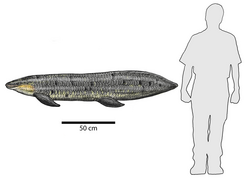
|
| Atlanticopristis[21]
|
A. equatorialis
|
Falésia do Sismito and Laje do Coringa, Cajual Island
|
|
Fourteen denticle specimens (two complete)
|
A sclerorhynchoid
|
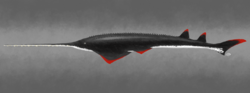
|
| Bartschichthys[6]
|
B. sp.
|
Laje do Coringa, Cajual Island
|
|
Spines
|
A cladistian
|
|
| Ceratodus[6]
|
C. brasiliensis
|
Laje do Coringa, Cajual Island
|
|
Dental plates
|
A ceratodontid lungfish
|

|
| C. humei
|
| Distobatus[22]
|
D. nutiae
|
Laje de Coringa, Cajual Island
|
|
Teeth
|
A distobatid hybodont
|
|
| Equinoxiodus[6]
|
E. alcantarensis[23]
|
Laje do Coringa, Cajual Island
|
|
One complete and eight incomplete tooth plates
|
A neoceatodontid lungfish
|
|
| E. schuitzei[24]
|
| Hybodontidae Indet.[6]
|
Indeterminate
|
Laje de Coringa, Cajual Island
|
|
Teeth & Cephalic spines
|
A hybodontid hybodont
|
|
| Hylaeobatis[6]
|
H. sp.
|
Laje do Coringa, Cajual Island
|
|
Tooth
|
A ptychodontid lamniform
|
|
| Lepidotes[6]
|
L. sp.
|
Laje do Coringa, Cajual Island
|
|
Mineralized scales
|
A lepidotid fish.
|
|
| Lepisosteidae Indet.[25]
|
Indeterminate
|
Laje do Coringa, Cajual Island
|
|
Scales
|
A gar
|
|
| Lonchidiidae Indet.[6]
|
Indeterminate
|
Laje de Coringa, Cajual Island
|
|
Teeth & Dorsal Spines
|
A lonchidiid hybodont
|
|
| Mawsonia[26]
|
M. gigas
|
Laje do Coringa, Cajual Island
|
|
Palato-quadrate and post-parietal cranial material
|
A mawsoniid coelacanth.
|
frameless
|
| Myliobatis[6]
|
M. dixoni
|
Laje do Coringa, Cajual Island
|
|
|
A myliobatid eagle ray
|
|
| Obaichthys[6]
|
O. africanus
|
Laje do Coringa, Cajual Island
|
|
Scales
|
A obaichthyid lepisosteiform
|
|
| Onchopristis
|
cf. O. numida[27]
|
Laje do Coringa, Cajual Island
|
|
Rostral teeth
|
A sclerorhynchoid
|
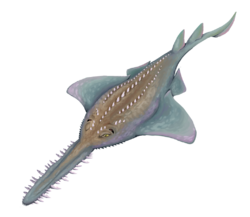
|
| Pycnodontiformes indet.[6]
|
Indeterminate
|
Laje do Coringa, Cajual Island
|
|
Dental plate and teeth
|
|
|
| Stephanodus[6]
|
S. sp.
|
Laje do Coringa, Cajual Island
|
|
Pharyngeal teeth
|
A pycnodontid pycnodont
|
|
| Tribodus[6]
|
T. limae
|
Laje do Coringa, Cajual Island
|
|
Dorsal spines
|
A hybodont shark
|
|
Plants
| Plants of the Alcântara Formation
|
| Genus
|
Species
|
Location
|
Stratigraphic position
|
Material
|
Notes
|
Image
|
| Araucariaceae Indet.[6]
|
Indeterminate
|
Laje do Coringa, Cajual Island
|
|
Log
|
A pine
|
|
| Paradoxopteris[6]
|
P. sanctiluigi
|
Laje do Coringa, Cajual Island
|
|
Stalk fragment
|
A giant tree fern
|
|
References
- ↑ Rossetti, D.F.; Truckenbrodt, W. (1997). "Revisão estratigráfica para os depósitos do Albiano-Terciário Inferior (?) na Bacia de São Luís (MA), Norte do Brasil". Boletim do Museu Paraense Emílio Goeldi 9: 29–41.
- ↑ de Souza Carvalho, Ismar; Lindoso, Rafael Matos (2024), Carvalho, Ismar de Souza; Leonardi, Giuseppe, eds., "Equatorial Dinosaurs During the Opening of Atlantic Ocean: The São Luís Basin Footprints" (in en), Dinosaur Tracks of Mesozoic Basins in Brazil: Impact of Paleoenvironmental and Paleoclimatic Changes (Cham: Springer Nature Switzerland): pp. 233–262, doi:10.1007/978-3-031-56355-3_9, ISBN 978-3-031-56355-3, https://doi.org/10.1007/978-3-031-56355-3_9, retrieved 2025-10-26
- ↑ Lindoso, Rafael Matos; Medeiros, Manuel Alfredo Araújo; Carvalho, Ismar de Souza; Pereira, Agostinha Araújo; Mendes, Ighor Dienes; Iori, Fabiano Vidoi; Sousa, Eliane Pinheiro; Arcanjo, Silvia Helena Souza et al. (July 2019). "A new rebbachisaurid (Sauropoda: Diplodocoidea) from the middle Cretaceous of northern Brazil" (in en). Cretaceous Research 104. doi:10.1016/j.cretres.2019.104191. ISSN 0195-6671. Bibcode: 2019CrRes.10404191L. http://www.sciencedirect.com/science/article/pii/S0195667118302064.
- ↑ Medeiros, Manuel Alfredo; Schultz, Cesar Leandro (2004). "Rayososaurus (Sauropoda, Diplodocoidea) no meso-Cretáceo do Norte-Nordeste Brasileiro". Revista Brasileira de Paleontologia 7 (2): 275–279. doi:10.4072/rbp.2004.2.22. Bibcode: 2004RvBrP...7..275M.
- ↑ Freire, Pedro Carvalho; Medeiros, Manuel Alfredo; Lindoso, Rafael Matos (2007). "Sauropod teeth diversity in the Laje do Coringa fossiliferous site, Eocenomanian of Northeastern Brazil". Paleontologia: Cenários de Vida: 523–532.
- ↑ 6.00 6.01 6.02 6.03 6.04 6.05 6.06 6.07 6.08 6.09 6.10 6.11 6.12 6.13 6.14 6.15 6.16 6.17 6.18 6.19 6.20 6.21 6.22 6.23 6.24 Medeiros, Manuel Alfredo; Lindoso, Rafael Motos; Mendes, Ighor Dienes; Carvalho, Ismar de Souza (2014). "The Cretaceous (Cenomanian) continental record of the Laje do Coringa flagstone (Alcântara Formation), northeastern South America". Journal of South American Earth Sciences 53: 50–58. doi:10.1016/j.jsames.2014.04.002. Bibcode: 2014JSAES..53...50M.
- ↑ Marcos A.F. Sales; Isabel A.P. de Oliveira; Cesar L. Schultz (2018). "The oldest abelisaurid record from Brazil and the palaeobiogeographic significance of mid-Cretaceous dinosaur assemblages from northern South America". Palaeogeography, Palaeoclimatology, Palaeoecology 508: 107–115. doi:10.1016/j.palaeo.2018.07.024. Bibcode: 2018PPP...508..107S.
- ↑ Candeiro, C.R.A.; Martinelli, Agustin G. (2005). "Abelisauroidea and Carcharodontosauridae (Theropoda, Dinosauria) in the Cretaceous of South America. Paleogeographical and geocronological implications". Sociedade & Natureza 17 (33).
- ↑ Lindoso, Rafael Matos; Medeiros, Manuel Alfredo; Carvalho, Ismar de Souza; Marinho, Thiago da Silva (August 2012). "Masiakasaurus-like theropod teeth from the Alcântara Formation, São Luís Basin (Cenomanian), northeastern Brazil" (in en). Cretaceous Research 36: 119–124. doi:10.1016/j.cretres.2012.03.002. Bibcode: 2012CrRes..36..119L.
- ↑ Kellner, Alexander W.A.; Azevedeo, Sergio A.K.; Machado, Elaine B.; Carvalho, Luciana B.; Henriques, Deise D.R. (2012). "A new dinosaur (Theropoda, Spinosauridae) from the Cretaceous (Cenomanian) Alcântara Formation, Cajual Island, Brazil". Anais da Academia Brasileira de Ciências 83 (1): 99–108. doi:10.1590/S0001-37652011000100006. ISSN 0001-3765. PMID 21437377. http://www.scielo.br/pdf/aabc/v83n1/v83n1a06.pdf.
- ↑ Smyth, Robert S.H.; Ibrahim, Nizar; Martill, David M. (2020). "Sigilmassasaurus is Spinosaurus: A reappraisal of African spinosaurines" (in en). Cretaceous Research 114. doi:10.1016/j.cretres.2020.104520. Bibcode: 2020CrRes.11404520S. https://linkinghub.elsevier.com/retrieve/pii/S0195667120302068.
- ↑ Isasmendi, Erik; Navarro-Lorbés, Pablo; Sáez-Benito, Patxi; Viera, Luis I.; Torices, Angelica; Pereda-Suberbiola, Xabier (2023-06-03). "New contributions to the skull anatomy of spinosaurid theropods: Baryonychinae maxilla from the Early Cretaceous of Igea (La Rioja, Spain)" (in en). Historical Biology 35 (6): 909–923. doi:10.1080/08912963.2022.2069019. ISSN 0891-2963. Bibcode: 2023HBio...35..909I. https://www.tandfonline.com/doi/full/10.1080/08912963.2022.2069019.
- ↑ Terras, R.; Carbonera, M.; Budke, G.; Leite, K.J.G. (2022). "Família Spinosauridae (Dinosauria: Theropoda): Taxonomia, Paleobiogeografia e Paleoecologia (Uma Revisão)". Paleontologia Em Destaque 37 (77): 14–54. doi:10.4072/paleodest.2022.37.77.02.
- ↑ Medeiros, Manuel Alfredo (2006). "Large theropod teeth from the Eocenomanian of northeastern Brazil and the occurrence of Spinosauridae". Revista Brasileira de Paleontologia 9 (3): 333–338. doi:10.4072/rbp.2006.3.08. Bibcode: 2006RvBrP...9..333M.
- ↑ "New evidence of putative Unenlagiinae (Deinonychosauria, Theropoda) in the São Luís-Grajaú Basin, Albian–Cenomanian, State of Maranhão, Brazil". Revista Brasileira de Paleontologia 25 (2): 157–164. 2022-07-16. doi:10.4072/rbp.2022.2.05. https://sbpbrasil.org/publications/index.php/rbp/article/view/170.
- ↑ Kellner, A.W.A.; Pinheiro, A.E.P.; Azevedo, S.A.K.; Henriques, D.D.R.; de Carvalho, L.B.; Oliveira, G.R. (2009). "A new crocodyliform from the Alcântara Formation (Cenomanian), Cajual Island, Brazil". Zootaxa 2030: 49–58. doi:10.11646/zootaxa.2030.1.4.
- ↑ Hsiou, A. S.; Albino, A. M.; Medeiros, M. A.; Santos, R. A. B. (2013). "The oldest Brazilian snakes from the early Late Cretaceous (Cenomanian)". Acta Palaeontologica Polonica 59 (3): 635–642. doi:10.4202/app.2012.0091.
- ↑ Candeiro, Carlos Roberto (January 2025). "Late Cretaceous mosasaurids of northeastern Brazil: a summary of their record and a paleobiogeographical survey". Andean Geology 52 (1): 150–161. https://www.scielo.cl/pdf/andgeol/v52n1/0718-7106-andgeol-52-1-0150.pdf.
- ↑ Ribeiro-Souza, E.; Alves, Y. M.; Schultz, C. L.; Medeiros, M. A. (2025). "Revaluation of the taxonomy and diversity of Lepisosteiformes from the Alcântara Formation (Cenomanian, Upper Cretaceous), Brazil". Cretaceous Research. doi:10.1016/j.cretres.2025.106291.
- ↑ Neves, G. S.; Medeiros, M. A.; Dutheil, D. B.; Brito, P. M. (2024). "First record of Aegyptobatus (Hybodontiformes: Distobatidae) in the Cretaceous Alcântara formation (?Albian-Cenomanian) of Maranhão, Northeastern Brazil". Historical Biology: An International Journal of Paleobiology: 1–7. doi:10.1080/08912963.2024.2379031.
- ↑ Pereira, A.A.; Medeiros, M.A. (2008). "A new sclerorhynchiform (Elasmobranchii) from the middle Cretaceous of Brazil". Revista Brasileira de Paleontologia 11 (3): 207–212. doi:10.4072/rbp.2008.3.07. Bibcode: 2008RvBrP..11..207P.
- ↑ Neves, G. S.; Medeiros, M. A.; Cupello, C.; Leite Filho, D.; Brito, P. M. (2026). "Hybodontiform sharks from the Late Cretaceous Alcântara Formation, São Luís Basin, Northeast Brazil". Historical Biology: An International Journal of Paleobiology: 1–15. doi:10.1080/08912963.2025.2582776.
- ↑ Toledo, C.E.; Sousa, E.P.; Medeiros, M.A.; Bertini, R.J. (2011). "A new genus of dipnoiformes from the Cretaceous of Brazil". Anais da Academia Brasileira de Ciências 83 (4): 1181–1192. doi:10.1590/s0001-37652011000400006. PMID 22146953.
- ↑ Eliane Pinheiro De Sousa; Manuel Alfredo Medeiros; Carlos Eduardo Vieira Toledo; Reinaldo J. Bertini; Agostinha Araújo Pereira; Rafael Matos Lindoso (2015). "A new species of Equinoxiodus (Dipnoi: ?Neoceratodontidae) from the Late Cretaceous of Brazil". Zootaxa 3905 (3): 397–406. doi:10.11646/zootaxa.3905.3.5. PMID 25661218.
- ↑ Brito, P. M.; Pinheiro, A. E. P.; Ribeiro, T. B.; Medeiros, M. A. (2024). "Lepisosteidae remains (Holostei: Ginglymodi) from the Middle Cretaceous Alcântara Formation, Northeastern Brazil". Journal of South American Earth Sciences 152: 105289. doi:10.1016/j.jsames.2024.105289.
- ↑ Medeiros, M.A., Carvalho, M.S.S., Silva, M.A.M., Pereira, A.A., Araujo, M.N., Ferreira, N.N., Vilas Bôas, I., 2011. O senhor dos rios: Mawsonia gigas (Mawsoniidae) do Cenomaniano do Maranhão, Brasil. In: Carvalho, I.S., Srivastava, N.K., Strohschoen, J.O., Lana, C.C. (Eds.), Paleontologia: Cenários de Vida, Vol. 4. Interciência, Rio de Janeiro, pp. 575-583.
- ↑ Pereira, A.A.; Medeiros, M.A. (2003). "Novas ocorrências de peixes no Eocenomaniano do Maranhão". Congresso Brasileiro de Paleontologia. 18. Boletim de Resumos, UNB Brasília. pp. 221–222. https://sbpbrasil.org/anais-e-resumos/.
 | Original source: https://en.wikipedia.org/wiki/Alcântara Formation. Read more |


