Earth:Maotianshan Shales
| Maotianshan Shale Stratigraphic range: Cambrian Stage 3, Qiongzhusian age local stage ≤518 Ma[1] | |
|---|---|
 Outcrop of the Maotianshan Shale, site of the discovery of the Chengjiang Biota | |
| Type | Member |
| Unit of | Chiungchussu Formation |
| Area | multiple 10,000 km2 (3,900 sq mi) |
| Thickness | 50 m (160 ft) |
| Lithology | |
| Primary | Shale |
| Other | Mudstone |
| Location | |
| Coordinates | [ ⚑ ] 26°42′N 108°24′E / 26.7°N 108.4°E |
| Paleocoordinates | [ ⚑ ] : 28°06′N 154°18′E / 28.1°N 154.3°E |
| Region | Chengjiang County, Yunnan |
| Country | China |
| Type section | |
| Named for | Maotianshan Hill |
| Location | Maotianshan Hill |
| Region | Chengjiang County, Yunnan |
| Country | China |
Template:CEXNAV The Maotianshan Shales (simplified Chinese: 帽天山页岩; traditional Chinese: 帽天山頁岩; pinyin: Màotiānshān yèyán) are a series of Early Cambrian sedimentary deposits in the Chiungchussu Formation[2] or Heilinpu Formation,[3] famous for their Konservat Lagerstätten, deposits known for the exceptional preservation of fossilized organisms or traces. The Maotianshan Shales form one of some 40 Cambrian fossil locations worldwide, exhibiting exquisite preservation of rarely preserved, non-mineralized soft tissue, comparable to the fossils of the Burgess Shale of British Columbia, Canada. They take their name from Maotianshan Hill (Chinese: 帽天山; pinyin: Màotiānshān; literally: 'Hat Sky Mountain') in Chengjiang County, Yunnan Province, China,[citation needed] and lies within the "Eoredlichia-Wutingaspis Zone" of South China.[4] A 512-hectare (1,270-acre) site within this formation, known as the Chengjiang Fossil Site, was listed as a World Heritage Site by UNESCO in 2012.[5]
The most famous assemblage of organisms are referred to as the Chengjiang biota for the multiple scattered fossil sites in Chengjiang. The age of the Chengjiang Lagerstätte is locally termed Qiongzhusian, a stage correlated to the late Atdabanian Stage in Siberian sequences of the middle of the Early Cambrian.[6][7] The shales date to ≤518 million years ago.[1]
Along with the Burgess Shale, the Maotianshan Shales are remarked as "our best window into the Cambrian 'explosion'",[8] especially on the origin of chordates.[9]
History and scientific significance
Although fossils from the region have been known from the early part of the 10th century, Chengjiang was first recognized for its exquisite states of preservation with the 1984 discovery of the naraoiid Misszhouia, a soft-bodied relative of trilobites. Since then, the locality has been intensively studied by scientists throughout the world, yielding a constant flow of new discoveries and triggering an extensive scientific debate surrounding the interpretation of discoveries. Over this time, taxa have been revised or reassigned to different groups. Interpretations have led to many refinements of the phylogeny of groups[10][11] and even the erection of the new phylum Vetulicolia of primitive deuterostomes.[12][13]
The Chengjiang biota has all the animal groups found in the Burgess Shale; however, since it is ten million years older, it more strongly supports the deduction that metazoans diversified earlier or faster in the early Cambrian than does the Burgess Shale fauna alone. The preservation of an extremely diverse faunal assemblage renders the Maotianshan shale the world's most important for understanding the evolution of early multi-cellular life, particularly the members of phylum Chordata, which includes all vertebrates. The Chengjiang fossils comprise the oldest diverse metazoan assemblage above the Proterozoic-Phanerozoic transition and, thus, the fossil record's best data source for understanding the apparently rapid diversification of life known as the Cambrian Explosion.
One of the most intriguing locations of the Chengjiang biota is the Haiyan Lagerstätte, where hundreds of juvenile specimens have been found. This unique location offers insights into the development of most animal groups and as such is a unique deposit in the Cambrian.[14]
IUGS geological heritage site
In respect of 'the Chengjiang fossils represent[ing] an unparalleled record of the fundamentally important rapid diversification of metazoan life in the early Cambrian', the International Union of Geological Sciences (IUGS) included the 'Cambrian Chengjiang fossil site and lagerstätte' in its assemblage of 100 'geological heritage sites' around the world in a listing published in October 2022. The organisation defines an 'IUGS Geological Heritage Site' as 'a key place with geological elements and/or processes of international scientific relevance, used as a reference, and/or with a substantial contribution to the development of geological sciences through history.'[15]
World Heritage Site
A 512-hectare (1,270-acre) site within this formation, known as the Chengjiang Fossil Site, was listed as a World Heritage Site by UNESCO in 2012.[5]
Preservation and taphonomy

The fossils occur in a section of mudstone 50 metres (160 ft) thick in the Yuanshan Member of the Qiongzhusi Formation. The Yuanshan Member is extensive, covering multiple 10,000 square kilometres (3,900 sq mi) of eastern Yunnan Province, where there are many scattered outcrops yielding fossils. Studies of the strata are consistent with a tropical environment with sea level changes and tectonic activity. The region is believed to have been a shallow sea with a muddy bottom. The preserved fauna is primarily benthic and was likely buried by periodic turbidity currents, since most fossils do not show evidence of post-mortem transport. Like the younger Burgess Shale fossils, the paleo-environment enabled preservation of non-mineralized, soft body parts. Fossils are found in thin layers less than an inch thick. The soft parts are preserved as aluminosilicate films, often with high oxidized iron content and often exhibiting exquisite details.
The Chengjiang beds are very deeply weathered, as evidenced by their low specific gravity (i.e., they are very lightweight).[16] Trace fossils are abundant.[17]
Chengjiang fauna

The Chengjiang biota comprises an extremely diverse faunal assembly, with some 185 species described in the literature as of June 2006. Of these, nearly half are arthropods, few of which had the hard, mineral-reinforced exoskeletons characteristic of all later arthropoda; only about 3% of the organisms known from Chengjiang have hard shells. Most of those are the trilobites (of which there are five species), all of which have been found with traces of legs, antennae, and other soft body parts, an exceedingly rare occurrence in the fossil record. Phylum Porifera (sponges; 15 species) and Priapulida (16 species) are also well represented. Other phyla represented are Brachiopoda, Chaetognatha, Cnidaria, Ctenophora, Echinodermata, Hyolitha, Nematomorpha, Phoronida, and Chordata. Possible molluscs include Wiwaxia.[18]
About one in eight animals are problematic forms of uncertain affinity, some of which may have been evolutionary experiments that survived for only a brief period as benthic environments rapidly changed in the Cambrian. Chengjiang is the richest source of the Lobopodia, a group including many early panarthropods,[19] with six genera represented: Luolishania, Paucipodia, Cardiodictyon, Hallucigenia (also known from the Burgess Shale), Microdictyon, and Onychodictyon.
Perhaps the most important fossils from Chengjiang are eight possible members of phylum Chordata, the phylum to which all vertebrates belong. The most famous is Myllokunmingia, possibly a very primitive agnathid (i.e., jawless fish). Similar to Myllokunmingia is Haikouichthys ercaicunensis, another primitive fish-like animal.
A wide range of affinities have been proposed for the enigmatic Yunnanozoon lividum including stem cephalochordates, stem or crown hemichordates, craniates, stem deuterostomes, stem bilaterians, or ambulacrarians.[20] Specimens initially identified as Haikouella (a genus later deemed a junior synonym of Yunnanozoon)[21] display has several chordate features, including a discernible heart, dorsal and ventral aorta, gill filaments, and a notochord (neural chord).[22] A 2024 study placed Yunnanozoon along the chordate stem.[23]
Another much-debated group is the Vetulicolia, starting with the discovery of Vetulicola in 1987. Close Chengjiang relatives of Vetulicola include Beidazoon and the Didazoonids. Heteromorphus is more closely related to Banffia from the Burgess Shale, but both it and Banffia are also considered to be vetulicolians.[24] Originally described as crustacean arthropods, the Vetulicola were later erected as a new phylum of primitive deuterostomes by D.G. Shu.[8] In recent years, a majority of workers have come to see the vetulicolians as stem chordates,[25] and a 2024 study placed vetulicolians as a basal chordate evolutionary grade, followed by Yunnanozoon.[23] An alternative proposal places vetulicolians as a sister group to tunicates.[26] Vetulicolians are thought to have been swimmers that either were filter feeders or detritivores.[27]
Some two dozen animals from the Chengjiang biota are problematic regarding phylogenetic assignment. Among these, 'Anomalocaris' saron, the alleged predatory terror of the early Cambrian, was the most famous, although that species is later reclassified to Houcaris saron and Innovatiocaris maotianshanensis. Shu (2006) recently described Stromatoveris psygmoglena as a possible bilateran missing link between Ediacaran fronds and Cambrian ctenophores. Cambrocornulitus had a tubicolous shell which probably was biomineralized. It shares some affinities with cornulitids and lophophorates.[28]
The Chengjiang biota is believed to have inhabited a delta front environment rich in oxygen, with high sedimentation rates and major fluctuations in salinity being the main environmental stressors.[29]
Guanshan biota
Located in the Yunnan Province of South China and hosted in the geologically distinct Cambrian Stage 4 Wulongqing Formation, The Guanshan biota are also Burgess shale-type fossils but slightly younger than the Chengjian biota with an age dating to 515–510 Myr.[30][31] Brachiopods are the most abundant species,[32] followed by trilobites. Other species belong to sponges, chancelloriids, cnidarians, ctenophores, priapulids, lobopodians, arthropods, anomalocaridids, hyoliths, molluscs, brachiopods, echinoderms, algae and vetulicolians. There are also the earliest-known eocrinoids, unidentified soft-bodied animals and abundant trace fossils.[33]
The Guanshan biota are regarded as successors of the Chengjian biota,[31] and share many species. The unique species include arthropods like Guangweicaris[34] and Astutuscaris,[35]alongside vetulicolians like Vetulicola gantoucunensis[36] and V. longbaoshanensis.[37]
Gallery
-
 Misszhouia longicaudata
 -
 Heliomedusa orienta
 -
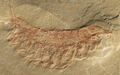 Leanchoilia illecebrosa


See also
- Geography of China
- Stephen Jay Gould, Wonderful Life
- List of arthropods of the Cambrian Period
- List of Xiaoshiba Biota species
References
- ↑ 1.0 1.1 Yang, C.; Li, X.-H.; Zhu, M.; Condon, D. J.; Chen, J. (2018). "Geochronological constraint on the Cambrian Chengjiang biota, South China" (in en). Journal of the Geological Society 175 (4): 659–666. doi:10.1144/jgs2017-103. ISSN 0016-7649. Bibcode: 2018JGSoc.175..659Y. http://nora.nerc.ac.uk/id/eprint/521412/1/2018-JGS-Chuan%20Yang%20et%20al.pdf. Retrieved 2019-12-12.
- ↑ Lipps, J. H.; Signor, P. W (1992). Origin and early evolution of the Metazoa. Springer. ISBN 978-0-306-44067-0. https://books.google.com/books?id=gUQMKiJOj64C&pg=PA338.
- ↑ Hou, Xianguang; Bergström, Jan (2003). "The Chengjiang fauna — the oldest preserved animal community". Paleontological Research 7 (1): 55–70. doi:10.2517/prpsj.7.55. Bibcode: 2003PalRe...7...55H.
- ↑ "Flinders Ranges". 21 April 2025. https://whc.unesco.org/en/tentativelists/6524/.
- ↑ 5.0 5.1 "Chengjiang Fossil Site". https://whc.unesco.org/en/list/1388/.
- ↑ Zhang, X.; Liu, W.; Zhao, Y. (2008). "Cambrian Burgess Shale-type Lagerstätten in South China: Distribution and significance". Gondwana Research 14 (1–2): 255–262. doi:10.1016/j.gr.2007.06.008. Bibcode: 2008GondR..14..255Z.
- ↑ Rozanov, A. Yu.; Maoyan Zhu, K. L. Pak and P. Yu. Parkhaev (2008). "The 2nd Sino-Russian Symposium on the Lower Cambrian Subdivision". Paleontological Journal 42 (4): 441–446. doi:10.1134/S0031030108040151. Bibcode: 2008PalJ...42..441R.
- ↑ 8.0 8.1 Shu, D. G.; Conway Morris, S.; Han, J.; Chen, L.; Zhang, X. L.; Zhang, Z. F.; Liu, H. Q.; Li, Y. et al. (2001-11-22). "Primitive deuterostomes from the Chengjiang Lagerstätte (Lower Cambrian, China)". Nature 414 (6862): 419–424. doi:10.1038/35106514. ISSN 0028-0836. PMID 11719797. Bibcode: 2001Natur.414..419S.
- ↑ McMenamin, Mark A. S. (2019). "Cambrian Chordates and Vetulicolians" (in en). Geosciences 9 (8): 354. doi:10.3390/geosciences9080354. ISSN 2076-3263. Bibcode: 2019Geosc...9..354M.
- ↑ Saleh, Farid; Ma, Xiaoya; Guenser, Pauline; Mángano, M. Gabriela; Buatois, Luis A.; Antcliffe, Jonathan B. (2022-08-23). "Probability-based preservational variations within the early Cambrian Chengjiang biota (China)" (in en). PeerJ 10. doi:10.7717/peerj.13869. ISSN 2167-8359. PMID 36032952.
- ↑ Xianguang, Hou; Ramsköld, Lars; Bergström, Jan (1991). "Composition and preservation of the Chengjiang fauna –a Lower Cambrian soft-bodied biota" (in en). Zoologica Scripta 20 (4): 395–411. doi:10.1111/j.1463-6409.1991.tb00303.x. ISSN 0300-3256. https://onlinelibrary.wiley.com/doi/10.1111/j.1463-6409.1991.tb00303.x.
- ↑ Shu, Degan (2005). "On the Phylum Vetulicolia" (in en). Chinese Science Bulletin 50 (20): 2342–2354. doi:10.1007/BF03183746. ISSN 1001-6538. Bibcode: 2005ChSBu..50.2342S. http://link.springer.com/10.1007/BF03183746.
- ↑ Briggs, Derek E. G.; Fortey, Richard A. (2005). "Wonderful strife: systematics, stem groups, and the phylogenetic signal of the Cambrian radiation" (in en). Paleobiology 31 (2_Suppl): 94–112. doi:10.1666/0094-8373(2005)031[0094:WSSSGA2.0.CO;2]. ISSN 0094-8373. https://www.cambridge.org/core/product/identifier/S0094837300025331/type/journal_article.
- ↑ Yang, X.; Kimmig, J.; Zhai, D.; Liu, Y.; Kimmig, S. R.; Peng, S. (2021). "A juvenile-rich palaeocommunity of the lower Cambrian Chengjiang biota sheds light on palaeo-boom or palaeo-bust environments". Nature Ecology & Evolution 5 (8): 1082–1090. doi:10.1038/s41559-021-01490-4. PMID 34183806. Bibcode: 2021NatEE...5.1082Y.
- ↑ "The First 100 IUGS Geological Heritage Sites". IUGS. https://iugs-geoheritage.org/videos-pdfs/iugs_first_100_book_v2.pdf.
- ↑ Gaines, R. R.; Briggs, D. E. G.; Yuanlong, Z. (2008). "Cambrian Burgess Shale–type deposits share a common mode of fossilization". Geology 36 (10): 755–758. doi:10.1130/G24961A.1. Bibcode: 2008Geo....36..755G.
- ↑ Zhang, X. G.; Bergström, J.; Bromley, R. G.; Hou, X. G. (2007). "Diminutive trace fossils in the Chengjiang Lagerstätte". Terra Nova 19 (6): 407. doi:10.1111/j.1365-3121.2007.00765.x. Bibcode: 2007TeNov..19..407Z.
- ↑ Zhao, F. C.; Smith, M. R.; Yin, Z.-J.; Zeng, H.; Hu, S.-X; Li, G.-X.; Zhu, M.-Y. (2015). "First report of Wiwaxia from the Cambrian Chengjiang Lagerstätte". Geological Magazine 152 (2): 378–382. doi:10.1017/S0016756814000648. Bibcode: 2015GeoM..152..378Z. https://www.repository.cam.ac.uk/bitstream/1810/246363/1/201X-ZHAO-Smith-et-al-Chengjiang-Wiwaxia.pdf.
- ↑ Smith, M. R.; Ortega Hernández, J. (2014). "Hallucigenia's onychophoran-like claws and the case for Tactopoda". Nature 514 (7522): 363–366. doi:10.1038/nature13576. PMID 25132546. Bibcode: 2014Natur.514..363S. http://rdcu.be/bKoD.
- ↑ Hou, Xian-guang; Siveter, David J.; Siveter, Derek J.; Aldridge, Richard J.; Cong, Pei-yun; Gabbott, Sarah; Ma, Xiao-ya; Purnell, Mark A. et al. (2017). "Bilateria of Uncertain Affinity". The Cambrian Fossils of Chengjiang, China: The Flowering of Early Animal Life (2 ed.). pp. 264–271. doi:10.1002/9781118896372.ch25. ISBN 978-1-118-89638-9.
- ↑ Cong, Pei-Yun; Hou, Xian-Guang; Aldridge, Richard J.; Purnell, Mark A.; Li, Yi-Zhen (2015). Smith, Andrew. ed. "New data on the palaeobiology of the enigmatic yunnanozoans from the Chengjiang Biota, Lower Cambrian, China" (in en). Palaeontology 58 (1): 45–70. doi:10.1111/pala.12117. Bibcode: 2015Palgy..58...45C.
- ↑ Chen, Jun-Yuan; Huang, Di-Ying; Li, Chia-Wei (December 1999). "An early Cambrian craniate-like chordate" (in en). Nature 402 (6761): 518–522. doi:10.1038/990080. ISSN 0028-0836. Bibcode: 1999Natur.402..518C. https://www.nature.com/articles/990080.
- ↑ 23.0 23.1 Mussini, G.; Smith, M. P.; Vinther, J.; Rahman, I. A.; Murdock, D. J. E.; Harper, D. A. T.; Dunn, F. S. (2024). "A new interpretation of Pikaia reveals the origins of the chordate body plan". Current Biology 34 (13): 2980–2989.e2. doi:10.1016/j.cub.2024.05.026. PMID 38866005. Bibcode: 2024CBio...34.2980M.
- ↑ Hou, Xian-guang; Siveter, David J.; Siveter, Derek J.; Aldridge, Richard J.; Cong, Pei-yun; Gabbott, Sarah; Ma, Xiao-ya; Purnell, Mark A. et al. (2017). "Vetulicolians". The Cambrian Fossils of Chengjiang, China: The Flowering of Early Animal Life (2 ed.). pp. 272–281. doi:10.1002/9781118896372.ch25.
- ↑ Onai, Takayuki; Aramaki, Toshihiro; Takai, Akira; Kakiguchi, Kisa; Yonemura, Shigenobu (2023). "Cranial cartilages: Players in the evolution of the cranium during evolution of the chordates in general and of the vertebrates in particular". Evolution and Development 25 (3): 197–208. doi:10.1111/ede.12433. PMID 36946416.
- ↑ García-Bellido, Diego C.; Lee, Michael S. Y.; Edgecombe, Gregory D.; Jago, James B.; Gehling, James G.; Paterson, John R. (2014). "A new vetulicolian from Australia and its bearing on the chordate affinities of an enigmatic Cambrian group". BMC Evolutionary Biology 14 (1). doi:10.1186/s12862-014-0214-z. PMID 25273382. Bibcode: 2014BMCEE..14..214G.
- ↑ Aldridge, Richard J.; Hou, Xian-guang; Siveter, David J.; Siveter, Derek J.; Sarah E., Gabbott (2007). "The systematics and phylogenetic relationships of vetulicolians". Palaeontology 50 (1): 131–168. doi:10.1111/j.1475-4983.2006.00606.x. Bibcode: 2007Palgy..50..131A.
- ↑ Xianfeng, Y.; Vinn, O.; Xianguang, H.; Xinglei, T. (2013). "New tubicolous problematic fossil with some "lophophorate" affinities from the Early Cambrian Chengjiang biota in south China". GFF 135 (2): 184–190. doi:10.1080/11035897.2013.801035. Bibcode: 2013GFF...135..184Y. https://www.researchgate.net/publication/258180839. Retrieved 2014-06-11.
- ↑ Saleh, Farid; Qi, Changshi; Buatois, Luis A.; Mángano, M. Gabriela; Paz, Maximiliano; Vaucher, Romain; Zheng, Quanfeng; Hou, Xian-Guang et al. (23 March 2022). "The Chengjiang Biota inhabited a deltaic environment". Nature Communications 13 (1): 1569. doi:10.1038/s41467-022-29246-z. PMID 35322027. Bibcode: 2022NatCo..13.1569S.
- ↑ Chen, Feiyang; Zhang, Zhifei; Betts, Marissa J.; Zhang, Zhiliang; Liu, Fan (2019). "First report on Guanshan Biota (Cambrian Stage 4) at the stratotype area of Wulongqing Formation in Malong County, Eastern Yunnan, China" (in en). Geoscience Frontiers 10 (4): 1459–1476. doi:10.1016/j.gsf.2018.09.010. Bibcode: 2019GeoFr..10.1459C.
- ↑ 31.0 31.1 Zhao, Jun; Li, Yujing; Selden, Paul A.; Cong, Peiyun (2020). "New occurrence of the Guanshan Lagerstätte (Cambrian Series 2, Stage 4) in the Kunming area, Yunnan, southwest China, with records of new taxa" (in en). Alcheringa: An Australasian Journal of Palaeontology 44 (3): 343–355. doi:10.1080/03115518.2020.1781257. ISSN 0311-5518. Bibcode: 2020Alch...44..343Z. https://www.tandfonline.com/doi/full/10.1080/03115518.2020.1781257. Retrieved 2023-03-18.
- ↑ Hu, Shixue; Zhang, Zhifei; Holmer, Lars E.; Skovsted, Christian B. (2010). "Soft-Part Preservation in a Linguliform Brachiopod from the Lower Cambrian Wulongqing Formation (Guanshan Fauna) of Yunnan, South China" (in en). Acta Palaeontologica Polonica 55 (3): 495–505. doi:10.4202/app.2009.1106. ISSN 0567-7920. http://www.app.pan.pl/article/item/app20091106.html. Retrieved 2023-03-18.
- ↑ Hu, ShiXue; Zhu, MaoYan; Steiner, Michael; Luo, HuiLin; Zhao, FangChen; Liu, Qi (2010). "Biodiversity and taphonomy of the Early Cambrian Guanshan biota, eastern Yunnan" (in en). Science China Earth Sciences 53 (12): 1765–1773. doi:10.1007/s11430-010-4086-9. ISSN 1674-7313. Bibcode: 2010ScChD..53.1765H. http://link.springer.com/10.1007/s11430-010-4086-9.
- ↑ Wu, Yichen; Liu, Jianni (2019). "Anatomy and relationships of the fuxianhuiid euarthropod Guangweicaris from the early Cambrian Guanshan Biota in Kunming, Yunnan, Southwest China revisited". Acta Palaeontologica Polonica 64. doi:10.4202/app.00542.2018. http://www.app.pan.pl/article/item/app005422018.html. Retrieved 2023-03-18.
- ↑ Jiao, De guang; Du, Kunsheng (2022). "A new euarthropod from the Cambrian Stage 4 Guanshan Biota of South China". Acta Palaeontologica Polonica 67. doi:10.4202/app.00937.2021. https://www.app.pan.pl/article/item/app009372021.html. Retrieved 2023-03-18.
- ↑ Huilin, Luo; Xiaoping, Fu; Shixue, Hu; Yong, Li; Liangzhong, Chen; Ting, You; Qi, Liu (2005). "New Vetulicoliids from the Lower Cambrian Guanshan Fauna, Kunming" (in en). Acta Geologica Sinica - English Edition 79 (1): 1–6. doi:10.1111/j.1755-6724.2005.tb00860.x. Bibcode: 2005AcGlS..79....1L. https://onlinelibrary.wiley.com/doi/10.1111/j.1755-6724.2005.tb00860.x. Retrieved 2023-03-18.
- ↑ Li, JinShu; Liu, JianNi; Ou, Qiang (2017). "New observations on Vetulicola longbaoshanensis from the Lower Cambrian Guanshan Biota (Series 2, Stage 4), South China" (in en). Science China Earth Sciences 60 (10): 1795–1804. doi:10.1007/s11430-017-9088-y. ISSN 1674-7313. Bibcode: 2017ScChD..60.1795L. http://link.springer.com/10.1007/s11430-017-9088-y.
Further reading
- Conway-Morris, S. (2003). "The Cambrian "explosion" of metazoans and molecular biology: would Darwin be satisfied?". Int J Dev Biol 47 (7–8): 505–515. PMID 14756326.
- Fossils of the Chengjiang Maotianshan Shale - URL retrieved September 20, 2006
- Hou, Xian-Guang; Aldridge, Richard J., Bengstrom, Jan; Siveter, David J. ;Feng, Xiang-Hong 2004; The Cambrian Fossils of Chengjang, China, Blackwell Science Ltd, 233 pp.
- Preservation, Taphonomy and Palaeoecology of the Chengjiang Biota - URL retrieved September 20, 2006
- Shu, D-GExpression error: Unrecognized word "etal". (1999). "Lower Cambrian Vertebrates from South China". Nature 402 (6757): 42–46. doi:10.1038/46965. Bibcode: 1999Natur.402...42S.
- Shu, D. G.; Conway Morris, S.; Han, J.; Chen, L.; Zhang, X. L.; Zhang, Z. F. et al. (2001). "Primitive deuterostomes from the Chengjiang Lagerstatte (Lower Cambrian, China)". Nature 414 (6862): 419–424. doi:10.1038/35106514. PMID 11719797. Bibcode: 2001Natur.414..419S.
- Shu, D.Expression error: Unrecognized word "etal". (2003). "A new species of yunnanozoan with implications for deuterostome evolution". Science 299 (5611): 1380–1384. doi:10.1126/science.1079846. PMID 12610301.
- Shu, D. G.; Conway Morris, S.; Han, J.; Zhang, Z. F.; Liu, J. N. (2004). "Ancestral echinoderms from the Chengjiang deposits of China". Nature 430 (6998): 422–428. doi:10.1038/nature02648. PMID 15269760. Bibcode: 2004Natur.430..422S.
- Shu, D. G.; Conway Morris, S.; Han, J.; Li, Y.; Zhang, X. L.; Hua, H. et al. (2006). "Lower Cambrian vendobionts from China and early diploblast evolution". Science 312 (5774): 731–734. doi:10.1126/science.1124565. PMID 16675697. Bibcode: 2006Sci...312..731S.
- Waloszek, D.; Maas, A. (2005). "The evolutionary history of crustacean segmentation: a fossil-based perspective". Evol Dev 7 (6): 515–527. doi:10.1111/j.1525-142x.2005.05056.x. PMID 16336406.
- Xian-guang, H.; Aldridge, R. J.; Siveter, D. J.; Xiang-hong, F. (2002). "New evidence on the anatomy and phylogeny of the earliest vertebrates". Proc Biol Sci 269 (1503): 1865–1869. doi:10.1098/rspb.2002.2104. PMID 12350247.
- Zhang, X.; Han, J.; Zhang, Z.; Liu, H.; Shu, D. (2003). "Reconsideration of the supposed naraoiid larva from the Early Cambrian Chengjiang Lagerstätte, South China". Palaeontology 46 (3): 447–66. doi:10.1111/1475-4983.00307. Bibcode: 2003Palgy..46..447Z.
- Zhang, X. G.; Hou, X. G. (2004). "Evidence for a single median fin-fold and tail in the Lower Cambrian vertebrate, Haikouichthys ercaicunensis". J Evol Biol 17 (5): 1162–1166. doi:10.1111/j.1420-9101.2004.00741.x. PMID 15312089.
External links
- "Chengjiang". http://www.uni-wuerzburg.de/palaeontologie/Stuff/casu30.htm.
- Chengjiang Biota at fossilmuseum.net
Template:Cambrian footer Template:Burgess Shale type preservation
 |  |


