Physics:Flatfish
Flatfish are a group of ray-finned fish belonging to the suborder Pleuronectoidei of the order Carangiformes. Their collective common name is due to their habit of lying on one side of their laterally-compressed body (flattened side-to-side) upon the seafloor; in this position, both eyes lie on the side of the head facing upwards, while the other side of the head and body (the "blind side") lies on the substrate. This loss of symmetry, a unique adaptation in vertebrates, stems from one eye "migrating" towards the other during the juvenile's metamorphosis. Due to interspecific variation, some species tend to face their left side upward, some their right side, and others face either side upward; members of Pleuronectidae lie on their left side, with eyes on the right, Paralichthyidae lie on their right side, with eyes on the left,[1] while the "primitive" genus Psettodes may develop into "right-facing" or "left-facing" individuals.
They are one of the most diverse groups of demersal fish. Their cryptic coloration and habits, a form of camouflage, conceals them from potential predators. Many species are of interest for fisheries.
Common names

There are a multitude of common names for flatfish, as they are a widespread group of fish and important food fish across the world. The following are common flatfish names in English:
As these are merely common names, they do not conform with the "natural" relationships that are recovered through scientific studies of morphology or genetics. As examples, the three species consistently called "halibut" are themselves part of the right-eye flounder family, while the spiny turbots are not at all closely related to "true" turbot, but are consistently recovered in a "primitive" or basal position at the base of flatfish phylogenetic trees.
Distribution
Flatfishes are found in oceans worldwide, ranging from the Arctic, through the tropics, to Antarctica. Species diversity is centered in the Indo-West Pacific and declines following both latitudinal and longitudinal gradients away from this centre of diversity.[2] Most species are found in depths between 0 and 500 m (1,600 ft), but a few have been recorded from depths in excess of 1,500 m (4,900 ft). None have been confirmed from the abyssal or hadal zones of the deep sea; a reported observation of a flatfish from the Bathyscaphe Trieste's dive into the Mariana Trench (at a depth of almost 11 km (36,000 ft)) has been questioned by ichthyologists, and recent authorities do not recognize it as valid.[3] Among the deepwater species is Symphurus thermophilus, a tonguefish which congregates around "ponds" of sulphur at hydrothermal vents on the seafloor; no other flatfish is known from hydrothermal vent ecosystems.[4]
Conversely, many species will enter brackish or fresh water, and a smaller number of soles (families Achiridae and Soleidae) and tonguefish (Cynoglossidae) are entirely restricted to fresh water.[5][6][7]
Description

The most obvious characteristic of the flatfish is their asymmetry, with both eyes lying on the same side of the head in the adult fish. In some families, the eyes are usually on the right side of the body (dextral or right-eyed flatfish), and in others, they are usually on the left (sinistral or left-eyed flatfish). The primitive spiny turbots include equal numbers of right- and left-sided individuals, and are generally less asymmetrical than the other families.[8] Other distinguishing features of the order are the presence of protrusible eyes, another adaptation to living on the seabed (benthos), and the extension of the dorsal fin onto the head.


The surface of the fish facing away from the sea floor is pigmented, often serving to camouflage the fish, but at times displaying striking patterns. Some flatfishes are also able to change their pigmentation to match the background using their chromatophores, in a manner similar to some cephalopods. The side of the body without the eyes, facing the seabed, is usually colourless or very pale.[8]
In general, flatfishes rely on their camouflage for avoiding predators, but some have aposematic traits such as conspicuous eyespots (e.g., Microchirus ocellatus) and several small tropical species (at least Aseraggodes, Pardachirus and Zebrias) are poisonous.[9][10][11] Juveniles of Soleichthys maculosus mimic toxic flatworms of the genus Pseudobiceros in both colours and swimming pattern.[12][13] Conversely, a few octopus species have been reported to mimic flatfishes in colours, shape and swimming mode.[14]
Flatfishes range in size from the sand flounder Tarphops oligolepis, measuring about 6.5 cm (2.6 in) in length,[15] and weighing 2 g (0.071 oz),[8] to the Hippoglossus halibuts, with the Atlantic halibut measuring up to 4.7 m (15 ft) long,[16] and the Pacific halibut weighing up to 363 kg (800 lb).[17][8]
Many species such as flounders and spiny turbots eat smaller fish, and have well-developed teeth. These species sometimes hunt in the midwater, away from the bottom, and show fewer "extreme" adaptations than other families. The soles, by contrast, are almost exclusively bottom-dwellers (more strictly demersal), and feed on benthic invertebrates. They show a more extreme asymmetry, and may lack teeth on one side of the jaw.[8]
Development
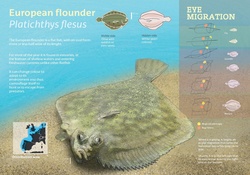
Flatfishes lay eggs that hatch into larvae resembling typical, symmetrical, fish. These are initially elongated, but quickly develop into a more rounded form. The larvae typically have protective spines on the head, over the gills, and in the pelvic and pectoral fins. They also possess a swim bladder, and do not dwell on the bottom, instead dispersing from their hatching grounds as ichthyoplankton.[8] Bilaterally symmetric fish such as goldfish maintain balance using a system within their inner ears which involves the otolith, but larval and metamorphizing flatfish require visible light (such as sunlight) to properly orient themselves.[18]
The length of the planktonic stage varies between different types of flatfishes, but through the influence of thyroid hormones,[19] they eventually begin to metamorphose into the adult form. One of the eyes migrates across the top of the head and onto the other side of the body, leaving the fish blind on one side. The larva also loses its swim bladder and spines, and sinks to the bottom, laying its blind side on the underlying surface.[20][18]
Hybrids
Hybrids are well known in flatfishes. The Pleuronectidae have the largest number of reported hybrids of marine fishes.[21] Two of the most famous intergeneric hybrids are between the European plaice (Pleuronectes platessa) and European flounder (Platichthys flesus) in the Baltic Sea,[22] and between the English sole (Parophrys vetulus) and starry flounder (Platichthys stellatus) in Puget Sound. The offspring of the latter species pair is popularly known as the hybrid sole and was initially believed to be a valid species in its own right.[21]
Evolution
Flatfishes have been cited as dramatic examples of evolutionary adaptation. In The Blind Watchmaker, Richard Dawkins explains the flatfishes' evolutionary history as such:
...bony fish as a rule have a marked tendency to be flattened in a vertical direction.... It was natural, therefore, that when the ancestors of [flatfish] took to the sea bottom, they should have lain on one side.... But this raised the problem that one eye was always looking down into the sand and was effectively useless. In evolution this problem was solved by the lower eye 'moving' round to the upper side.[23]
Scientists have been proposing since the 1910s that flatfishes evolved from more "typical" percoid ancestors.[24] The fossil record indicated that flatfishes might have been present before the Eocene, based on fossil otoliths resembling those of modern pleuronectiforms dating back to the Thanetian and Ypresian stages (57-53 million years ago).[25] Despite this, the origin of the unusual morphology of flatfishes was enigmatic up to the 2000s, with earlier researchers having suggested that it came about as a result of saltation rather than gradual evolution through natural selection, because a partially migrated eye was considered to have been maladaptive.

This started to change in 2008 with a study on the two fossil fish genera; Amphistium and Heteronectes, which dated to about 50 million years ago. These genera retain primitive features not seen in modern types of flatfishes, such as their heads being less asymmetric than modern flatfishes, retaining one eye on each side of their heads, although the eye on one side is closer to the top of the head than on the other.[26][27] The more recently described fossil genera Quasinectes and Anorevus have been proposed to show similar morphologies and have also been classified as "stem-pleuronectiforms".[28][29] Such findings lead palaeontologist Matt Friedman to conclude that the evolution of flatfish morphology "happened gradually, in a way consistent with evolution via natural selection—not suddenly [saltationally] as researchers once had little choice but to believe."[27]
To explain the survival advantage of a partially migrated eye, it has been proposed that primitive flatfishes like Amphistium rested with the head propped up above the seafloor (a behaviour sometimes observed in modern flatfishes), enabling them to use their partially migrated eye to see things closer to the seafloor.[30] While known basal genera like Amphistium and Heteronectes support a gradual acquisition of the flatfish morphology, they were probably not direct ancestors to living pleuronectiforms, as fossil evidence (for example Eobothus) indicate that most flatfish lineages living today were present in the Eocene and contemporaneous with them.[26] It has been suggested that the more primitive forms were eventually outcompeted.[27]
Also known from the Bolca deposits are two more intermediate early flatfish relatives, Anorevus and Quasinectes, both of which also show the beginnings of an asymmetrical, flattened body, but still have one eye on either side of the head.[28][29][31]
Taxonomy
Due to their highly distinctive morphology, flatfishes were previously treated as belonging to their own order, Pleuronectiformes. However, more recent taxonomic studies have found them to group within a diverse group of nektonic marine fishes known as the Carangiformes, which also includes jacks and billfish. Specifically, flatfish have been recovered to be closely related to various groups, such as the threadfins (often recovered as a sister group to flatfish), archerfish, and beachsalmons. Due to this, they are now treated as a suborder of the Carangiformes,[32][33] as represented in Eschmeyer's Catalog of Fishes.[34]
Classification
The following classification is based on Eschmeyer's Catalog of Fishes (2025):[35]
- Suborder Pleuronectoidei
- Family Polynemidae Rafinesque, 1815 (threadfins or tassel-fishes)
- Family Psettodidae Regan, 1910 (spiny turbots)
- Family Citharidae de Buen, 1935 (largescale flounders)
- Family Scophthalmidae Chabanaud, 1933 (turbots)
- Family Cyclopsettidae Campbell, Chanet, Chen, Lee & Chen, 2019 (sand whiffs or large-tooth flounders)
- Family Grammatobothidae Tongboonkua, Chanet & Chen, 2025 (small lefteye flounders)[36]
- Family Monolenidae Tongboonkua, Chanet & Chen, 2025 (deepwater lefteye flounders)[36]
- Family Taeniopsettidae Amaoka, 1969[36]
- Family Bothidae Smitt, 1892 (lefteye flounders)
- Family Paralichthyidae Regan, 1910 (sand flounders)
- Family Pleuronectidae Rafinesque, 1815 (righteye flounders)
- Family Paralichthodidae Regan, 1920 (peppered flounders)
- Family Oncopteridae Jordan & Goss, 1889 (remo flounders)
- Family Rhombosoleidae Regan, 1910 (South Pacific flounders)
- Family Achiropsettidae Heemstra, 1990 (southern flounders or armless flounders)
- Family Achiridae Rafinesque, 1815 (American soles)
- Family Samaridae Jordan & Goss, 1889 (crested flounders)
- Family Poecilopsettidae Norman, 1934 (bigeye flounders)
- Family Soleidae Bonaparte, 1833 (soles)
- Family Cynoglossidae Jordan, 1888 (tonguefishes)
Fossil taxa
The following basal fossil flatfish from the Paleogene are also known:[37][31]
- Genus †Amphistium Agassiz, 1844 (Early to Middle Eocene of Italy & France)
- Genus †Anorevus Bannikov & Zorzin, 2020 (Early Eocene of Italy)[28]
- Genus †Eobothus Eastman, 1914 (Early Eocene of Italy)
- Genus †Heteronectes Friedman, 2008 (Early Eocene of Italy)
- Genus †Imhoffius Chabanaud, 1940 (Middle Eocene of France)[38]
- Genus †Joleaudichthys Chabanaud, 1937 (Middle Eocene of Egypt)[39]
- Genus †Keasichthys Murray & Champagne, 2025 (Early Oligocene of Oregon, US)[40]
- Genus †Numidiopleura Gaudant & Gaudant, 1969 (Eocene of Tunisia)[38][41]
- Genus †Quasinectes Bannikov & Zorzin, 2019 (Early Eocene of Italy)[29]
Phylogeny

There has been some disagreement whether flatfish as a whole are a monophyletic group. Some palaeontologists think that some percomorph groups unrelated to flatfishes were also "experimenting" with head asymmetry during the Eocene,[28][29] and certain molecular studies conclude that the primitive family of Psettodidae evolved their flat bodies and asymmetrical head independently of other flatfish groups.[42][43] The following phylogeny is from Lü et al. 2021; a whole-genome analysis using concatenated sequences of coding sequence (CDS) (codon1 + 2 + 3, GTRGAMMA model; codon1 + 2, GTRGAMMA model) and 4dTV (fourfold degenerate synonymous site, GTRGAMMA model) derived from 1,693 single-copy genes. Notably, Pleuronectiformes is found to be polyphyletic as seen here:[44]
| |||||||||||||
| Pleuronectoidei |
|
Pleuronectiformes | |||||||||||
However, threadfins (Polynemidae) aren't universally found to be nested within the group of flatfish, as recovered by a study of ultraconserved elements from the threadfin family in Girard et al. 2022,[45] or as represented in the World Register of Marine Species,[46] where Pleuronectiformes is retained as a name for the flatfish group.[47] Numerous scientists continue to argue for a monophyletic group of all flatfish,[48] though the debate continues.[49]
Over 800 described species are placed into 16 families.[50] When they were treated as an order, the flatfishes are divided into two suborders, Psettodoidei and Pleuronectoidei, with > 99% of the species diversity found within the Pleuronectoidei.[51] The largest families are Soleidae, Bothidae and Cynoglossidae with more than 150 species each. There also exist two monotypic families (Paralichthodidae and Oncopteridae). Some families are the results of relatively recent splits. For example, the Achiridae were classified as a subfamily of Soleidae in the past, and the Samaridae were considered a subfamily of the Pleuronectidae.[9][52] The families Paralichthodidae, Poecilopsettidae, and Rhombosoleidae were also traditionally treated as subfamilies of Pleuronectidae, but are now recognised as families in their own right.[52]Cite error: Closing </ref> missing for <ref> tag New species are described with some regularity and undescribed species likely remain.[9]
Timeline of genera
<timeline> ImageSize = width:1000 height:auto barincrement:15px PlotArea = left:10px bottom:50px top:10px right:10px
Period = from:-65.5 till:15 TimeAxis = orientation:horizontal ScaleMajor = unit:year increment:5 start:-65.5 ScaleMinor = unit:year increment:1 start:-65.5 TimeAxis = orientation:hor AlignBars = justify
Colors =
#legends
 id:CAR	  value:claret
 id:ANK 	 value:rgb(0.4,0.3,0.196)
 id:HER	  value:teal
 id:HAD	  value:green
 id:OMN	  value:blue
 id:white        value:black
 id:white        value:white
 id:cenozoic     value:rgb(0.54,0.54,0.258)
 id:paleogene     value:rgb(0.99,0.6,0.32)
 id:paleocene     value:rgb(0.99,0.65,0.37)
 id:eocene     value:rgb(0.99,0.71,0.42)
 id:oligocene     value:rgb(0.99,0.75,0.48)
 id:neogene     value:rgb(0.999999,0.9,0.1)
 id:miocene     value:rgb(0.999999,0.999999,0)
 id:pliocene     value:rgb(0.97,0.98,0.68)
 id:quaternary   value:rgb(0.98,0.98,0.5)
 id:pleistocene   value:rgb(0.999999,0.95,0.68)
 id:holocene   value:rgb(0.999,0.95,0.88)
BarData=
bar:eratop
bar:space
bar:periodtop
bar:space
bar:NAM1
bar:NAM2
bar:NAM3
bar:NAM4
bar:NAM5
bar:NAM6
bar:NAM7
bar:NAM8
bar:NAM9
bar:NAM10
bar:NAM11
bar:NAM12
bar:NAM13
bar:NAM14
bar:NAM15
bar:NAM16
bar:NAM17
bar:NAM18
bar:NAM19
bar:NAM20
bar:NAM21
bar:NAM22
bar:NAM23
bar:NAM24
bar:NAM25
bar:NAM26
bar:NAM27
bar:NAM28
bar:NAM29
bar:NAM30
bar:NAM31
bar:NAM32
bar:NAM33
bar:NAM34
bar:NAM35
bar:NAM36
bar:NAM37
bar:NAM38
bar:space
bar:period
bar:space
bar:era
PlotData=
align:center textcolor:black fontsize:M mark:(line,black) width:25
shift:(7,-4)
bar:periodtop
from: -65.5   till:  -55.8    color:paleocene  text:Paleocene
from: -55.8   till:  -33.9    color:eocene  text:Eocene
from: -33.9   till:  -23.03    color:oligocene  text:Oligocene
from: -23.03    till: -5.332    color:miocene    text:Miocene
from: -5.332    till: -2.588    color:pliocene    text:Plio.
from: -2.588    till: -0.0117   color:pleistocene    text:Pleist.
from: -0.0117    till: 0    color:holocene    text:H.
bar:eratop
from: -65.5   till:  -23.03    color:paleogene  text:Paleogene
from: -23.03    till: -2.588    color:neogene    text:Neogene
from: -2.588    till: 0   color:quaternary    text:Q.
PlotData=
align:left fontsize:M mark:(line,white) width:5 anchor:till align:left
color:eocene bar:NAM1  from:-55.8    till:-33.9 text:Amphistium
color:eocene bar:NAM2  from:-55.8    till:-33.9 text:Eobothus
color:eocene bar:NAM3  from:-55.8    till:-33.9 text:Eobuglossus
color:eocene bar:NAM4 from:-55.8    till:-33.9 text:Imhoffius
color:eocene bar:NAM5 from:-55.8   till:-33.9 text:Joleaudichthys
color:eocene bar:NAM6 from:-55.8    till:-33.9 text:Turahbuglossus
color:eocene bar:NAM7 from:-55.8    till:0 text:Scophthalmus
color:eocene bar:NAM8  from:-55.8    till:0 text:Citharus
color:eocene bar:NAM9  from:-55.8    till:0 text:Psettodes
color:eocene bar:NAM10  from:-37.2 till:0 text:Arnoglossus
color:oligocene bar:NAM11 from:-33.9 till:0 text:Bothus
color:oligocene bar:NAM12 from:-33.9 till:0 text:Monolene
color:oligocene bar:NAM13 from:-33.9 till:0 text:Solea
color:oligocene bar:NAM14  from:-28.4 till:0 text:Buglossidium
color:oligocene bar:NAM15 from:-28.4 till:0 text:Hippoglossoides
color:oligocene bar:NAM16  from:-28.4 till:0 text:Lepidorhombus
color:miocene bar:NAM17  from:-23.03 till:0 text:Dicologoglossa
color:miocene bar:NAM18  from:-23.03 till:0 text:Paraplagusia
color:miocene bar:NAM19 from:-23.03 till:0 text:Platichthys
color:miocene bar:NAM20 from:-15.97 till:0 text:Achiurus
color:miocene bar:NAM21 from:-15.97 till:0 text:Microchirus
color:miocene bar:NAM22 from:-15.97 till:0 text:Microstomus
color:miocene bar:NAM23 from:-11.608   till:-5.332 text:Evesthes
color:miocene bar:NAM24 from:-11.608   till:0 text:Citharichthys
color:miocene bar:NAM25 from:-11.608   till:0 text:Monochirus
color:miocene bar:NAM26 from:-11.608   till:0 text:Paralichthys
color:miocene bar:NAM27 from:-11.608   till:0 text:Pleuronichthys
color:pliocene bar:NAM28 from:-5.332    till:0 text:Atheresthes
color:pliocene bar:NAM29 from:-5.332 till:0 text:Clidoderma
color:pliocene bar:NAM30 from:-5.332 till:0 text:Glyptocephalus
color:pliocene bar:NAM31 from:-5.332 till:0 text:Limanda
color:pliocene bar:NAM32 from:-5.332 till:0 text:Lyopsetta
color:pliocene bar:NAM33 from:-5.332    till:0 text:Pegusa
color:pleistocene bar:NAM34 from:-2.588    till:-0.0117 text:Chibapsetta
color:pleistocene bar:NAM35 from:-2.588    till:0 text:Eopsetta
color:pleistocene bar:NAM36 from:-2.588    till:0 text:Isopsetta
color:pleistocene bar:NAM37 from:-2.588    till:0 text:Parophrys
color:pleistocene bar:NAM38 from:-2.588    till:0 text:Symphurus
PlotData=
align:center textcolor:black fontsize:M mark:(line,black) width:25
bar:period
from: -65.5   till:  -55.8    color:paleocene  text:Paleocene
from: -55.8   till:  -33.9    color:eocene  text:Eocene
from: -33.9   till:  -23.03    color:oligocene  text:Oligocene
from: -23.03    till: -5.332    color:miocene    text:Miocene
from: -5.332    till: -2.588    color:pliocene    text:Plio.
from: -2.588    till: -0.0117   color:pleistocene    text:Pleist.
from: -0.0117    till: 0    color:holocene    text:H.
bar:era
from: -65.5   till:  -23.03    color:paleogene  text:Paleogene
from: -23.03    till: -2.588    color:neogene    text:Neogene
from: -2.588    till: 0   color:quaternary    text:Q.
</timeline>
Relation to humans
Fishing and aquaculture
Flatfish are commonly fished using bottom trawls.[53][54] Large species such as the halibuts are specifically targeted by fisheries, resulting in heavy fishing pressures and bycatch.[55][56][57] Some species are aquacultured, such as the tonguefish Cynoglossus semilaevis.[58][59]
As food
Flatfish is considered a whitefish[60] because of the high concentration of oils within its liver. Its lean flesh makes for a unique flavor that differs from species to species. Methods of cooking include grilling, pan-frying, baking and deep-frying.
-
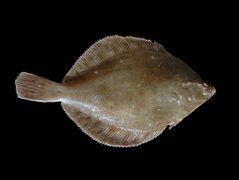 The European plaice is the principal commercial flatfish in Europe.
 -
 American soles are found in both freshwater and marine environments of the Americas.
 -
 Halibut are the largest of the flatfishes, and provide lucrative fisheries.
 -
 The turbot is a large, left-eyed flatfish found in sandy shallow coastal waters around Europe.
 -
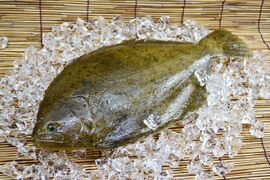 Flatfish (left‐eyed flounder)


References
- ↑ Dawkins, Richard; Wong, Yan (2016). The Ancestor's Tale: A Pilgrimage to the Dawn of Life. Houghton Mifflin Harcourt. p. 398. ISBN 978-0544859937.
- ↑ Campbell, Matthew A.; Chanet, Bruno; Chen, Jhen-Nien; Lee, Mao-Ying; Chen, Wei-Jen (2019). "Origins and relationships of the Pleuronectoidei: Molecular and morphological analysis of living and fossil taxa" (in en). Zoologica Scripta 48 (5): 640–656. doi:10.1111/zsc.12372. ISSN 1463-6409. https://hal.science/hal-03971070/file/Campbell%20et%20al%202019%20Zool%20Scripta.pdf.
- ↑ Jamieson, A.J., and Yancey, P. H. (2012). On the Validity of the Trieste Flatfish: Dispelling the Myth. The Biological Bulletin 222(3): 171-175
- ↑ Munroe, T.A.; and Hashimoto, J. (2008). A new Western Pacific Tonguefish (Pleuronectiformes: Cynoglossidae): The first Pleuronectiform discovered at active Hydrothermal Vents. Zootaxa 1839: 43–59.
- ↑ Duplain, R.R.; Chapleau, F; and Munroe, T.A. (2012). A New Species of Trinectes (Pleuronectiformes: Achiridae) from the Upper Río San Juan and Río Condoto, Colombia. Copeia 2012 (3): 541-546.
- ↑ Kottelat, M. (1998). Fishes of the Nam Theun and Xe Bangfai basins, Laos, with diagnoses of twenty-two new species (Teleostei: Cyprinidae, Balitoridae, Cobitidae, Coiidae and Odontobutidae). Ichthyol. Explor. Freshwat. 9(1):1-128.
- ↑ Monks, N. (2007). Freshwater flatfish, order Pleuronectiformes. Retrieved 18 May 2014
- ↑ 8.0 8.1 8.2 8.3 8.4 8.5 Chapleau, Francois; Amaoka, Kunio (1998). Paxton, J.R.. ed. Encyclopedia of Fishes. San Diego: Academic Press. p. xxx. ISBN 0-12-547665-5.
- ↑ 9.0 9.1 9.2 Randall, J. E. (2007). Reef and Shore Fishes of the Hawaiian Islands. ISBN 1-929054-03-3
- ↑ Elst, R. van der (1997) A Guide to the Common Sea Fishes of South Africa. ISBN 978-1868253944
- ↑ Debelius, H. (1997). Mediterranean and Atlantic Fish Guide. ISBN 978-3925919541
- ↑ Practical Fishkeeping (22 May 2012) Video: Tiny sole mimics a flatworm. Retrieved 17 May 2014.
- ↑ Australian Museum (5 November 2010). This week in Fish: Flatworm mimic and shark teeth. Retrieved 17 May 2014.
- ↑ Hanlon, R.T.; Warson, A.C.; and Barbosa, A. (2010). A "Mimic Octopus" in the Atlantic: Flatfish Mimicry and Camouflage by Macrotritopus defilippi. The Biological Bulletin 218(1): 15-24
- ↑ Froese, Rainer and Pauly, Daniel, eds. (2006). "Tarphops oligolepis" in FishBase. April 2006 version.
- ↑ Froese, Rainer and Pauly, Daniel, eds. (2006). "Hippoglossus hippoglossus" in FishBase. April 2006 version.
- ↑ Froese, Rainer and Pauly, Daniel, eds. (2006). "Hippoglossus stenolepis" in FishBase. April 2006 version.
- ↑ 18.0 18.1 Jabr, Feris (7 May 2014). "The Improbable—but True—Evolutionary Tale of Flatfishes". PBS NOVA. https://www.pbs.org/wgbh/nova/article/flatfish-evolution/.
- ↑ Schreiber, Alexander M. (2013). "Flatfish: an asymmetric perspective on metamorphosis". Curr Top Dev Biol 103: 167–94. doi:10.1016/B978-0-12-385979-2.00006-X. PMID 23347519.
- ↑ Bao, Baolong (2022). Flatfish Metamorphosis (1 ed.). Singapore: Springer. doi:10.1007/978-981-19-7859-3. ISBN 978-981-19-7858-6.
- ↑ 21.0 21.1 Garrett, D.L.; Pietsch, T.W.; Utter, F.M.; and Hauser, L. (2007). The Hybrid Sole Inopsetta ischyra (Teleostei: Pleuronectiformes: Pleuronectidae): Hybrid or Biological Species? American Fisheries Society 136: 460–468
- ↑ Food and Agriculture Organization of the United Nations: Platichthys flesus (Linnaeus, 1758).. Retrieved 18 May 2014
- ↑ Dawkins, Richard (1991). The Blind Watchmaker. London: Penguin Books. p. 92. ISBN 0-14-014481-1.
- ↑ Regan C.T. (1910). "The origin and evolution of the Teleostean fishes of the order Heterosomata". Annals and Magazine of Natural History 6(35): p. 484-496. doi.org/10.1080/00222931008692879
- ↑ Schwarzhans W. (1999). "A comparative morphological treatise of recent and fossil otoliths of the order Pleuronectiformes". Piscium Catalogus. Otolithi Piscium 2. doi:10.13140/2.1.1725.5043
- ↑ 26.0 26.1 Friedman M. (2008). "The evolutionary origin of flatfish asymmetry". Nature 454(7201): p. 209–212. doi:10.1038/nature07108
- ↑ 27.0 27.1 27.2 "Odd Fish Find Contradicts Intelligent-Design Argument". National Geographic. July 9, 2008. http://news.nationalgeographic.com/news/2008/07/080709-evolution-fish.html.
- ↑ 28.0 28.1 28.2 28.3 Bannikov A.F. & Zorzin R (2019). "A new genus and species of incertae sedis percomorph fish (Perciformes) from the Eocene of Bolca in northern Italy, and a new genus for Psettopsis latellai Bannikov, 2005". Studi e ricerche sui giacimenti terziari di Bolca: p. 5-15.
- ↑ 29.0 29.1 29.2 29.3 Bannikov A.F. & Zorzin R. (2020). "A new genus and species of percomorph fish ("stem pleuronectiform") from the Eocene of Bolca in northern Italy". Miscellanea Paleontologica 17: p. 5–14
- ↑ Janvier P. (2008). "Squint of the fossil flatfish". Nature 454(7201): p. 169–170
- ↑ 31.0 31.1 Carnevale, Giorgio; Giusberti, Luca; Dominici, Stefano; Papazzoni, Cesare Andrea; Roghi, Guido; Marramà, Giuseppe; Calzoni, Pietro; Serafini, Giovanni et al.. "The Bolca Lagerstätten: a one-day palaeontological field trip into the Eocene tropical marine life of the western Tethys" (in en). GEOLOGICAL FIELD TRIPS AND MAPS. doi:10.3301/GFT.2026.06. https://www.geologicalfieldtripsandmaps.com/296/issue-98/the-bolca-lagerstatten-a-one-day-palaeontological-field-trip-into-the-eocene-tropical-marine-life-of-the-western-tethys.html.
- ↑ Girard, Matthew G.; Davis, Matthew P.; Smith, W. Leo (2020-05-08). "The Phylogeny of Carangiform Fishes: Morphological and Genomic Investigations of a New Fish Clade". Copeia 108 (2): 265–298. doi:10.1643/CI-19-320. ISSN 0045-8511. https://meridian.allenpress.com/copeia/article-abstract/108/2/265/436665/The-Phylogeny-of-Carangiform-Fishes-Morphological.
- ↑ Shi, Wei; Chen, Shixi; Kong, Xiaoyu; Si, Lizhen; Gong, Li; Zhang, Yanchun; Yu, Hui (2018-05-25). "Flatfish monophyly refereed by the relationship of Psettodes in Carangimorphariae" (in en). BMC Genomics 19 (1): 400. doi:10.1186/s12864-018-4788-5. ISSN 1471-2164. PMID 29801430.
- ↑ Fricke, Ron; Fong, Jon David. "GENERA/SPECIES BY FAMILY/SUBFAMILY IN Eschmeyer's Catalog of Fishes". California Academy of Sciences. https://researcharchive.calacademy.org/research/ichthyology/catalog/SpeciesByFamily.asp.
- ↑ Fricke, R.; Eschmeyer, W. N.; Van der Laan, R. (2025). "ESCHMEYER'S CATALOG OF FISHES: CLASSIFICATION" (in en). https://www.calacademy.org/eschmeyers-catalog-of-fishes-classification.
- ↑ 36.0 36.1 36.2 Tongboonkua, Pakorn; Chanet, Bruno; Chen, Wei-Jen (2026). "Integrated Molecular and Morphological Analyses Resolve Long-Standing Classification Challenges in the Sinistral Flatfish Family Bothidae (Teleostei: Carangiformes)" (in en). Zoologica Scripta 55: 15–36. doi:10.1111/zsc.70020. ISSN 1463-6409. https://onlinelibrary.wiley.com/doi/abs/10.1111/zsc.70020.
- ↑ Laan, Richard van der (2018-10-11). "Family-group names of fossil fishes" (in en). European Journal of Taxonomy (466). doi:10.5852/ejt.2018.466. ISSN 2118-9773. https://europeanjournaloftaxonomy.eu/index.php/ejt/article/view/597.
- ↑ 38.0 38.1 Chanet, Bruno; Schultz, Orwin (1994). "Pleuronectiform fishes from the Upper Badenian (Middle Miocene) of St. Margarethen (Austria)". Ann. Naturhist. Mus. Wien (96): 95–115. https://www.researchgate.net/publication/230844383.
- ↑ Chanet, B. (1995-01-01). "Joleaudichthys sadeki Chabanaud; 1937: Pleuronectiform fish from egyptian Eocene. First steps on the history of Pleuronectiformes (Pisces; Teleostei)". Geobios. Premiers Vertandébrandés et Vertandébrandés Infandérieurs 28: 189–191. doi:10.1016/S0016-6995(95)80111-1. ISSN 0016-6995. Bibcode: 1995Geobi..28..189C. https://www.sciencedirect.com/science/article/pii/S0016699595801111.
- ↑ Murray, Alison M.; Champagne, Donald E. (January 2025). "A new species of early Oligocene flatfish (Pleuronectiformes) from Oregon, USA" (in en). Geological Magazine 162. doi:10.1017/S0016756825100125. ISSN 0016-7568. Bibcode: 2025GeoM..162E..22M. https://www.cambridge.org/core/journals/geological-magazine/article/new-species-of-early-oligocene-flatfish-pleuronectiformes-from-oregon-usa/29C984BB97C135EF0ADC1CB242CD5143.
- ↑ Campbell, Matthew A.; Chanet, Bruno; Chen, Jhen-Nien; Lee, Mao-Ying; Chen, Wei-Jen (2019). "Origins and relationships of the Pleuronectoidei: Molecular and morphological analysis of living and fossil taxa" (in en). Zoologica Scripta 48 (5): 640–656. doi:10.1111/zsc.12372. ISSN 1463-6409. https://onlinelibrary.wiley.com/doi/abs/10.1111/zsc.12372.
- ↑ Campbell M.A., Chen W-J. & López J.A. (2013). "Are flatfishes (Pleuronectiformes) monophyletic?". Molecular Phylogenetics and Evolution 69(3): p. 664-673. doi.org/10.1016/j.ympev.2013.07.011
- ↑ Campbell M.A., López J.A., Satoh T.P., Chen W-J. & Miya M. (2014). "Mitochondrial genomic investigation of flatfish monophyly". Gene 551(2): p. 176-182. doi.org/10.1016/j.gene.2014.08.053
- ↑ Zhenming Lü; Li Gong; Yandong Ren; Yongjiu Chen; Zhongkai Wang; Liqin Liu; Haorong Li; Xianqing Chen et al. (19 April 2021). "Large-scale sequencing of flatfish genomes provides insights into the polyphyletic origin of their specialized body plan". Nature Genetics 53 (5): 742–751. doi:10.1038/s41588-021-00836-9. PMID 33875864.
- ↑ Matthew G. Girard; Matthew P. Davis; Carole C. Baldwin; Agnès Dettaï; Rene P. Martin; W. Leo Smith (12 January 2022). "Molecular phylogeny of the threadfin fishes (Polynemidae) using ultraconserved elements". Fish Biology 100 (3): 793–810. doi:10.1111/jfb.14997. PMID 35137410. Bibcode: 2022JFBio.100..793G. https://www.mgirard.fish/files/Girard_et_al_2022.pdf.
- ↑ "Polynemidae Rafinesque, 1815". FishBase. World Register of Marine Species. http://www.marinespecies.org/aphia.php?p=taxdetails&id=125551.
- ↑ "Pleuronectiformes". FishBase. World Register of Marine Species. http://www.marinespecies.org/aphia.php?p=taxdetails&id=10331.
- ↑ Duarte-Ribeiro E, Rosas-Puchuri U, Friedman M, Woodruff G.C., Hughes L.C., Carpenter K.E., White W.T., Pogonoski J.J., Westneat M, Diaz de Astarloa J.M., Williams J.T., Santos M.D., Domínguez-Domínguez O, Ortí G, Arcila D & Betancur-R R. (2024). "Phylogenomic and comparative genomic analyses support a single evolutionary origin of flatfish asymmetry". Nature Genetics 56: p. 1069-1072. doi.org/10.1038/s41588-024-01784-w
- ↑ Lü, Zhenming; Li, Haorong; Jiang, Hui; Luo, Hairong; Wang, Wen; Kong, Xiaoyu; Li, Yongxin (2024-05-27). "Reply to: Phylogenomic and comparative genomic analyses support a single evolutionary origin of flatfish asymmetry". Nature Genetics 56 (6): 1073–1074. doi:10.1038/s41588-024-01783-x. PMID 38802565. https://www.x-mol.net/paper/article/1795282921848369152. Retrieved 17 July 2025.
- ↑ Campbell, Matthew A.; Chanet, Bruno; Chen, Jhen-Nien; Lee, Mao-Ying; Chen, Wei-Jen (2019). "Origins and relationships of the Pleuronectoidei: Molecular and morphological analysis of living and fossil taxa" (in en). Zoologica Scripta 48 (5): 640–656. doi:10.1111/zsc.12372. ISSN 0300-3256. https://hal.science/hal-03971070/file/Campbell%20et%20al%202019%20Zool%20Scripta.pdf.
- ↑ Fishes of the world. John Wiley & Sons. 2016-03-28. ISBN 978-1-118-34233-6. OCLC 958002567.
- ↑ 52.0 52.1 Cooper, J.A.; and Chapleau, F. (1998). Monophyly and intrarelationships of the family Pleuronectidae (Pleuronectiformes), with a revised classification. Fish. Bull. 96 (4): 686–726.
- ↑ Segura-Garcia, Iris; Soe, Sabai; Tun, NYO-NYO; Box, Stephen (2021). "Beyond Bycatch: The Species Diversity of Tonguesole (Pleuronectiformes: Cynoglossidae) in Coastal Fisheries of the Tanintharyi Region, Southern Myanmar". Asian Fisheries Science 34: 23–33. doi:10.33997/j.afs.2021.34.1.003. https://www.asianfisheriessociety.org/publication/downloadfile.php?id=1347&file=Y0dSbUx6QXhORGsxTWpNd01ERTJNVGN4TkRVMU1qa3VjR1Jt. Retrieved 17 July 2025.
- ↑ Zhang, Jinyong; Cui, Xiaoyu; Lin, Lin; Liu, Yuan; Ye, Jinqing; Zhang, Weiyue; Li, Hongjun (30 April 2025). "Unraveling Fish Community Diversity and Structure in the Yellow Sea: Evidence from Environmental DNA Metabarcoding and Bottom Trawling". Animals 15 (9): 1283. doi:10.3390/ani15091283. PMID 40362097.
- ↑ Szymkowiak, Marysia; Marrinan, Sarah; Kasperski, Stephen (2020). "The Pacific Halibut, Hippoglossus stenolepis, and Sablefish, Anoplopoma fimbria, Individual Fishing Quota Program: A Twenty-year Retrospective". Marine Fisheries Review 82 (1–2): 1–16. doi:10.7755/MFR.82.1-2.1. https://spo.nmfs.noaa.gov/sites/default/files/pdf-content/mfr821-21.pdf. Retrieved 17 July 2025.
- ↑ "Collaborative Pacific Halibut, Hippoglossus stenolepis, Bycatch Control by Canada and the United States". Marine Fisheries Review 66. https://spo.nmfs.noaa.gov/sites/default/files/pdf-content/MFR/mfr662/mfr6624.pdf. Retrieved 17 July 2025.
- ↑ Figus, Elizabeth; Criddle, Keith R. (March 1, 2019). "Characterizing preferences of fishermen to inform decision-making: A case study of the Pacific halibut (Hippoglossus stenolepis) fishery off Alaska". PLOS 14 (3). doi:10.1371/journal.pone.0212537. PMID 30822324. Bibcode: 2019PLoSO..1412537F.
- ↑ Hu, Yuanri; Li, Yangzhen; Li, Zhongming; Chen, Changshan; Zang, Jiajian; Li, Yuwei; Kong, Xiangqing (December 2020). "Novel insights into the selective breeding for disease resistance to vibriosis by using natural outbreak survival data in Chinese tongue sole (Cynoglossus semilaevis)" (in en). Aquaculture 529. doi:10.1016/j.aquaculture.2020.735670. Bibcode: 2020Aquac.52935670H. https://linkinghub.elsevier.com/retrieve/pii/S0044848620314496.
- ↑ Li, Yangzhen; Hu, Yuanri; Yang, Yingming; Zheng, Weiwei; Chen, Changshan; Li, Zhongming (January 2021). "Selective breeding for juvenile survival in Chinese tongue sole (Cynoglossus semilaevis): Heritability and selection response" (in en). Aquaculture 531. doi:10.1016/j.aquaculture.2020.735901. Bibcode: 2021Aquac.53135901L. https://linkinghub.elsevier.com/retrieve/pii/S0044848620314848.
- ↑ "Flatfish BBC". https://www.bbc.co.uk/food/flatfish.
Further reading
- Sepkoski, Jack (2002). "A compendium of fossil marine animal genera". Bulletins of American Paleontology 364: 560. http://strata.ummp.lsa.umich.edu/jack/showgenera.php?taxon=611&rank=class. Retrieved 2011-05-17.
- Gibson, Robin N (Ed) (2008) Flatfishes: biology and exploitation. Wiley.
- Munroe, Thomas A (2005) "Distributions and biogeography." Flatfishes: Biology and Exploitation: 42–67.
External links
Principal commercial fishery species groups | ||||||||||||||||||
|---|---|---|---|---|---|---|---|---|---|---|---|---|---|---|---|---|---|---|
| Wild |
|  .png)  | ||||||||||||||||
| Farmed | ||||||||||||||||||
Wikidata ☰ Q59577 entry
 |  |


