Software:1080° Snowboarding
| 1080° Snowboarding | |
|---|---|
 North American cover art | |
| Developer(s) | Nintendo EAD |
| Publisher(s) | Nintendo |
| Director(s) | Masamichi Abe Mitsuhiro Takano |
| Producer(s) | Shigeru Miyamoto |
| Programmer(s) |
|
| Artist(s) | Yoshitaka Nishikawa |
| Composer(s) | Kenta Nagata[1] |
| Series | 1080° Snowboarding |
| Platform(s) | Nintendo 64 |
| Release | |
| Genre(s) | Snowboarding |
| Mode(s) | Single-player, multiplayer |
Script error: The function "nihongo_foot" does not exist. is a snowboarding video game developed and published by Nintendo for the Nintendo 64 in 1998. In the game, players control one of five snowboarders from a third-person perspective, using a combination of buttons to jump and perform tricks across eight levels.
1080° was announced in November 1997 and developed over nine months. It received critical acclaim and won an Interactive Achievement Award from the Academy of Interactive Arts & Sciences. The game sold over two million units. A sequel, 1080° Avalanche, was released for the GameCube in November 2003. The game was re-released for the Wii in 2008 and for the Wii U Virtual Console in 2016. It was also re-released on the Nintendo Classics service in 2023.
Gameplay

Players control snowboarders in various modes. 1080° features two trick modes (Trick Attack and Contest),[2] three race modes (Race, Time Attack, and 2 Players),[3] a Training mode, and an Options mode.[4] The objective of the game is either to reach a level's finish line as quickly as possible or to achieve the highest score by executing trick combinations.[5]
In 1080°'s two trick modes, Trick Attack and Contest, players earn points by completing tricks.[6] In Contest mode, players perform tricks and snowboard past flags to gain points. In Trick Attack mode, players must perform a series of tricks throughout a designated level. The game includes 24 tricks and 5 secret tricks, all executed through combinations of circular movements of the control stick, along with the R, Z, and B buttons. Points are awarded based on the complexity of the tricks, combos, and the time required.[6] The two categories of tricks are grab tricks, where the snowboarder grabs the board in a specific manner, and spin tricks, where the snowboarder spins the board a certain number of degrees.[5] The 1080° spin, the game's most complex trick, requires nine distinct actions to perform.[7]
1080° features three race modes. In these modes, players can achieve victory by selecting alternate routes within a course and balancing the snowboarder after jumps to avoid losing speed.[8] Although tricks are scored in race modes, they do not contribute to winning.[8]
In Match Race mode, the player competes in a series of races against AI-controlled snowboarders.[9][10] The game tracks the player’s time throughout the level, and the player is assigned a damage meter that fills if the snowboarder falls or is knocked over. The difficulty level in Match Races can be set to normal, hard, or expert, affecting both the complexity and the number of races.[10] If the player fails to defeat an AI competitor, they must retire. The player is given three chances to beat the AI before the game ends.[8][11]
Players can initially choose from five snowboarders: two from Japan, and one each from Canada, the United States, and the United Kingdom. Each snowboarder has unique abilities and is suited for different levels and modes, as they vary in statistics such as technique, speed, and weight.[12][13]
Three additional snowboarders can be unlocked by completing certain game levels and modes.[13] Players also start with eight snowboards available for every character, with one additional snowboard unlockable later in the game. Each snowboard is tailored to different situations, as they offer varying strengths in areas such as balance and edge control.[13]
Development and release
1080°'s release was announced on 21 November 1997 at Nintendo's Space World trade show, with its working title previously being Vertical Edge Snowboarding.[14] 1080° was one of several snowboarding games released for the Nintendo 64 in 1998, alongside titles like Big Mountain 2000 and Snowboard Kids.[14] Before its official release, journalists were able to play 1080° at the January 1998 Nintendo Gamers' Summit.[15]
1080° was directed by Masamachi Abe and Misthuro Tanako, programmed by English developers Giles Goddard and Colin Reed, and developed and published by Nintendo. The game was produced by Shigeru Miyamoto.[16] Abe had previously directed Tekken 3 for Namco, while Goddard had programmed the Mario face in Super Mario 64,[17] which was released two years earlier to critical and commercial success. Reed had previously programmed Stunt Race FX. According to Miyamoto, the game "came about because I like skiing. I was thinking about making a skiing game after completing Wave Race [64]. However, the current trend seems to be toward snowboarding. With snowboarding, it seems that you can go places that you can't with skis; for example, in between trees."[18]
Development for 1080° took place at Nintendo's headquarters in Kyoto, Japan.[19] During development, programmers Goddard and Reed used a technique called "skinning" to eliminate joints between the polygons that made up the characters. They combined standard animation with inverse kinematics to create characters whose responses during collisions varied depending on the object hit, the direction of the collision, and the speed of impact.[20] All of the characters' movements were created using motion capture.[10]
Tommy Hilfiger outfits and Lamar snowboards appear in 1080° as part of its product placement.[5] The game's soundtrack, composed by Kenta Nagata, features a mix of "techno and beats" with "thrashy, {{not a typo|foozed "IGN rev" />[16]
Development for 1080° started around April or May 1997 and continued into early 1998.[20][21] The game was released in Japan on 28 February 1998[22] and in North America on 1 April. Nintendo prioritized releasing 1080° in Japan while there was still snow on the ground.[18] The European release was delayed to align with the winter season, hoping to boost sales.[23] 1080° was eventually released on 9 October 1998 in Europe and the PAL regions.
Reception
| Reception | ||||||||||||||||||||||||||||||||||||
|---|---|---|---|---|---|---|---|---|---|---|---|---|---|---|---|---|---|---|---|---|---|---|---|---|---|---|---|---|---|---|---|---|---|---|---|---|
| ||||||||||||||||||||||||||||||||||||
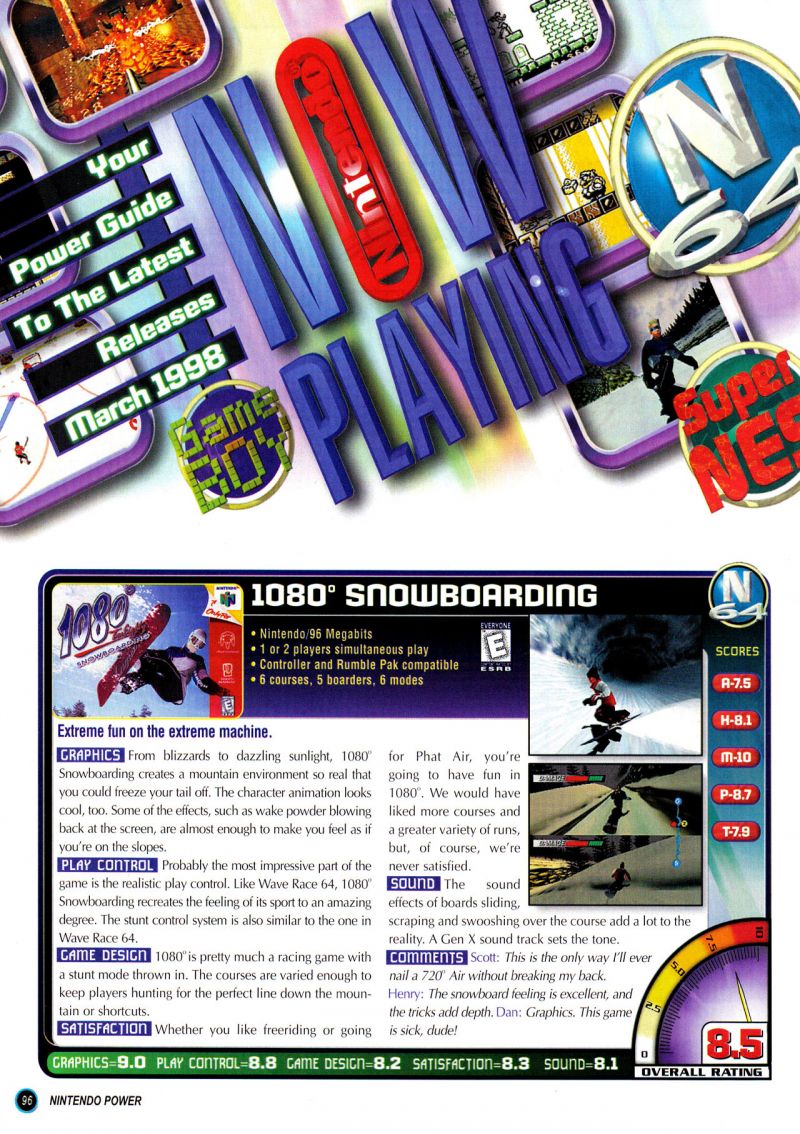
1080° Snowboarding received "generally favorable reviews," according to Metacritic, falling just two points short of "universal acclaim".[24] Nintendo Power stated that "Whether you like freeriding or going for Phat Air, you're going to have fun in 1080°."[40] Josh Smith from GameSpot called it "one of the best values in both sports and racing gaming".[32] The game was widely recognized as a leader among snowboarding titles at the time.[41] Edge described it as the "most convincing video game emulation of the snowboarding experience so far," noting its serious tone, which contrasted with other Nintendo games.[26]
The game's graphics were highly praised for their quality on the Nintendo 64.[26][28][42][37][40][43] Smith lauded the graphics for their crispness, smoothness, and detail, with minimal polygon dropout.[32] Reviewers also praised the game's camera work, realistic physics model,[32][37] and its depiction of speed. The game's snow effects were particularly highlighted, as sun reflections varied appropriately between fluffy and packed snow, which also behaved differently in-game.[5][37][40][43] Minor graphical issues, such as occasional pop-up, misplaced shadows, and slight lag when racers passed through trees, were noted but considered insignificant.[5][32]
Although Edge gave 1080° Snowboarding a generally positive review, it found faults with the game's AI, accusing it of "cheating" due to its tendency to allow CPU opponents to quickly catch up near the end of races. The review also criticized the AI's simplicity, noting that the CPU followed a "limited series of predetermined routes," making it possible for players to predict when the AI would fall over, which allowed them to pass with little satisfaction.[26] Edge also criticized the delay in the game's PAL release, calling it "frankly ludicrous" and suggested that, with Nintendo's limited number of major releases at the time, any quality title was likely to top the charts easily.[27] Electronic Gaming Monthly's team of four reviewers criticized the small number of courses, saying the game needed more variety and was over too soon. Shawn Smith and John Davison still came away with a positive impression, with Davison saying 1080° Snowboarding exemplified "just how good Nintendo is at creating an overall experience", while John Ricciardi and Dan Hsu felt it was overall "not bad" but that players would be done with it after just a few days.[28]
Other publications were more enthusiastic. Next Generation stated that 1080° Snowboarding set the standard for the snowboarding genre,[37] and multiple publications compared it to how Wave Race 64 revolutionized water-based racing, praising its ability to capture the excitement of snowboarding.[33][40][43] GamePro described the snowboard racing as "intense, addictive, and great fun".[43]
Many critics commented that the control scheme is very difficult to learn.[44][28][43] Shawn Sackenheim of AllGame considered the game's "highly technical" controls to be a strength, despite their initial difficulty.[44] Computer and Video Games reviewer Alex Huhtala agreed, praising the controls and dismissing the notion of difficulty, stating they were so well-implemented that "you're able to play perfectly well with just one hand on the stick and Z button."[42] GameSpot also complimented the "thoroughly involving" controls, emphasizing the crouch move for tight turns.[32] GamePro remarked that "Because it's realistic, mastery requires practice, but the payoff's there."[43]
GamePro criticized the game's music as repetitive,[43] while IGN described it as "a shining example of what can be achieved on the format,"[5] Next Generation said it is exceptional, especially given the Nintendo 64's record of weak audio,[37] and Sackenheim called it "one of the best N64 soundtracks to date."[44] All four of these reviewers praised the sound effects, as did Nintendo Power.[44][5][37][40][43] In a 2023 retrospective, NME's Mat Ombler said the game's soundtrack helped introduce underground electronic club music, including drum and bass, to a broader audience, similar to the impact of the Wipeout series.[45]
In a 2006 retrospective, Official Nintendo Magazine hailed 1080° Snowboarding for having the best video game representation of snow at the time and commended its sound effects and handling. Steve Jarratt described it as a "stunt-free but fast and fun" experience, highlighting its multiplayer quality.[46] The magazine ranked it as the 87th best game available on Nintendo platforms, noting its realism as a snowboarding game.[47]
The game earned critical accolades, winning the AIAS' Console Sports Game of the Year award at the 2nd Annual Interactive Achievement Awards.[48] It was also nominated for Best Nintendo 64 Game at the 1998 CNET Gamecenter Awards, but lost to Software:The Legend of Zelda: Ocarina of Time.[49]
Commercially, 1080° Snowboarding was a significant success in the United States. According to PC Data, the game sold 817,529 units and generated $40.9 million in revenue by the end of 1998, making it the seventh-best-selling Nintendo 64 game of the year.[50] Over its lifetime, the game sold 1,230,000 units in the U.S. and over 23,000 in Japan.[51] However, it did not surpass the commercial success of the developers' previous game, Wave Race 64, which sold 1,950,000 units in the U.S. and 154,000 in Japan.[51]
1080° Snowboarding was later re-released on the Wii's Virtual Console service in 2008 and on the Wii U in 2016.[52] It was also made available on the Nintendo Classics service on December 7, 2023.[53]
Sequel
1080° Avalanche, the sequel to 1080° Snowboarding, was released for the GameCube in 2003. Unlike its predecessor, the sequel received mixed reviews. Greg Kasavin of GameSpot provided a more critical assessment, citing "frame rate issues and limited gameplay" as major drawbacks that detracted from the experience.[54] Despite its graphical improvements and new features, 1080° Avalanche was unable to match the critical success of the original 1080° Snowboarding.
References
- ↑ "Game Music :: Kenta Nagata". https://www.squareenixmusic.com/composers/nintendo/nagata.shtml.
- ↑ 1080 Snowboarding Instruction Booklet. Japan: Nintendo. 1998. pp. 15–16.
- ↑ 1080 Snowboarding Instruction Booklet. Japan: Nintendo. 1998. pp. 12–15, 17.
- ↑ 1080 Snowboarding Instruction Booklet. Japan: Nintendo. 1998. pp. 4–6.
- ↑ 5.0 5.1 5.2 5.3 5.4 5.5 5.6 5.7 Casamassina, Matt (2 April 1998). "1080° Snowboarding Review (N64)". Ziff Davis. https://www.ign.com/articles/1998/04/03/1080a-snowboarding-review.
- ↑ 6.0 6.1 Marriott, Scott Alan. "1080° Snowboarding – Overview". All Media Network. http://www.allgame.com/game.php?id=7501.
- ↑ Operation Card for 1080° Snowboarding. Nintendo Co., Ltd. 1998.
- ↑ 8.0 8.1 8.2 8.3 Dr_Moo (May 1998). "1080 Snowboarding Review". CraveOnline. https://www.gamerevolution.com/review/32637-1080-snowboarding-review.
- ↑ 1080 Snowboarding Instruction Booklet. Japan: Nintendo. 1998. p. 12.
- ↑ 10.0 10.1 10.2 "Nintendo 64 Previews: 1080° Snowboarding". Electronic Gaming Monthly (Ziff Davis) (106): 30–31. May 1998.
- ↑ 1080 Snowboarding Instruction Booklet. Japan: Nintendo. 1998. pp. 12–13.
- ↑ "1080 Snowboarding Guide". G4 Media. 20 April 1999. http://www.g4tv.com/techtvvault/features/10388/1080_Snowboarding_n64.html.
- ↑ 13.0 13.1 13.2 "1080° Snowboarding Prima FastTrack Guide". Ziff Davis. 9 December 1999. http://guidesarchive.ign.com/guides/2225/.
- ↑ 14.0 14.1 IGN staff (21 November 1997). "Head for the Slopes". Ziff Davis. https://www.ign.com/articles/1997/11/22/head-for-the-slopes.
- ↑ IGN staff (30 January 1998). "1080 Shreds the Competition". Ziff Davis. https://www.ign.com/articles/1998/01/31/1080-shreds-the-competition.
- ↑ 16.0 16.1 Nintendo Entertainment Analysis and Development (1 April 1998). 1080° Snowboarding. Nintendo of America, Inc.. Scene: staff credits.
- ↑ "1080 Snowboarding". Fandango. http://www.rottentomatoes.com/g/nintendo_64/1080_snowboarding/overview.php.
- ↑ 18.0 18.1 "Inside the Mind of Shigeru Miyamoto". GamePro (IDG) (114): 54. March 1998.
- ↑ "An Interview with Giles Goddard". Next Generation (Imagine Media) (38): 80. February 1998.
- ↑ 20.0 20.1 IGN staff (19 March 1998). "1080 Snowboarding Interview". Ziff Davis. https://www.ign.com/articles/1998/03/20/1080-snowboarding-interview.
- ↑ "NG Alphas: 1080° Snowboarding". Next Generation (Imagine Media) (38): 78–79. February 1998.
- ↑ "1080° Snowboarding" (in ja). https://www.nintendo.co.jp/n01/n64/software/nus_p_ntej/.
- ↑ IGN staff (26 March 1998). "1080 Delayed in Europe". Ziff Davis. https://www.ign.com/articles/1998/03/27/1080-delayed-in-europe.
- ↑ 24.0 24.1 "1080° Snowboarding (n64: 1998): Reviews". CNET. http://www.metacritic.com/games/platforms/n64/1080snowboarding.
- ↑ Marrin, John (17 April 1998). "1080 Snowboarding". CNET. http://gamecenter.com/Consoles/Nintendo/1080snow/.
- ↑ 26.0 26.1 26.2 26.3 Edge staff (April 1998). "1080° Snowboarding (Import)". Edge (Future Publishing) (57): 86–88. https://archive.org/details/edgeuk057/page/n71/mode/2up. Retrieved 20 December 2020.
- ↑ 27.0 27.1 Edge staff (September 1998). "1080° Snowboarding (PAL)". Edge (Future Publishing) (62): 96. https://archive.org/details/edgeuk062/page/n85/mode/2up. Retrieved 20 December 2020.
- ↑ 28.0 28.1 28.2 28.3 "Review Crew: 1080° Snowboarding". Electronic Gaming Monthly (Ziff Davis) (107): 111. June 1998.
- ↑ Whitehead, Dan (19 January 2008). "Virtual Console Roundup". Gamer Network. https://www.eurogamer.net/articles/r_vcroundup190108_wii.
- ↑ "テンエイティ スノーボーディング [NINTENDO64"] (in ja). Famitsu (Enterbrain). https://www.famitsu.com/cominy/?m=pc&a=page_h_title&title_id=8859&redirect=no. Retrieved 20 December 2020.
- ↑ McNamara, Andy; Anderson, Paul; Reiner, Andrew (April 1998). "1080° Snowboarding". Game Informer (FuncoLand) (60). http://www.gameinformer.com/cgi-bin/review.cgi?sys=n64&path=apr98&doc=1080. Retrieved 20 December 2020.
- ↑ 32.0 32.1 32.2 32.3 32.4 32.5 Smith, Josh (25 March 1998). "1080 Snowboarding Review". Red Ventures. https://www.gamespot.com/reviews/1080-snowboarding-review/1900-2543980/.
- ↑ 33.0 33.1 Cheung, Kevin (July 1998). "1080 Snowboarding". Hyper (Next Media Pty Ltd) (57): 40–41. https://archive.org/details/hyper-057/page/40/mode/2up. Retrieved 16 July 2024.
- ↑ Thomas, Lucas M. (29 January 2008). "1080 Snowboarding Review (Wii)". Ziff Davis. https://www.ign.com/articles/2008/01/29/1080-snowboarding-review.
- ↑ Ashton, James (April 1998). "1080° Snowboarding (Import)". N64 Magazine (Future Publishing) (14): 56–61.
- ↑ "1080° Snowboarding". N64 Magazine (Future Publishing) (21). November 1998.
- ↑ 37.0 37.1 37.2 37.3 37.4 37.5 37.6 "Daffy (1080° Snowboarding Review)". Next Generation (Imagine Media) (42): 134. June 1998. https://archive.org/details/NEXT_Generation_42/page/n137/mode/2up. Retrieved 20 December 2020.
- ↑ McFerran, Damien (19 January 2008). "1080° Snowboarding Review (N64)". Gamer Network. https://www.nintendolife.com/reviews/n64/1080d_snowboarding.
- ↑ Frear, Dave (12 February 2016). "1080° Snowboarding Review (Wii U eShop / N64)". Gamer Network. https://www.nintendolife.com/reviews/wiiu-eshop/1080d_snowboarding_n64.
- ↑ 40.0 40.1 40.2 40.3 40.4 40.5 "1080° Snowboarding". Nintendo Power (Nintendo of America, Inc.) 106: 96. March 1998. http://www.nintendo64ever.com/scans/mags/Scan-Magazine-348-102.jpg. Retrieved 20 December 2020.
- ↑ Buchanan, Levi (1 October 2008). "Nintendo 64 Week: Day Three". Ziff Davis. https://www.ign.com/articles/2008/10/01/nintendo-64-week-day-three.
- ↑ 42.0 42.1 Huhtala, Alex (November 1998). "1080 Snowboarding". Computer and Video Games (EMAP) (204): 46–47. https://archive.org/details/Computer_and_Video_Games_Issue_204_1998-11_EMAP_Images_GB/page/n45/mode/2up. Retrieved 20 December 2020.
- ↑ 43.0 43.1 43.2 43.3 43.4 43.5 43.6 43.7 Air Hendrix (May 1998). "Nintendo 64 ProReview: 1080° Snowboarding". GamePro (IDG Entertainment) (116): 74. https://archive.org/details/GamePro_Issue_106_May_1998/page/n75/mode/2up.
- ↑ 44.0 44.1 44.2 44.3 Sackenheim, Shawn. "1080° Snowboarding – Review". All Media Network. http://www.allgame.com/game.php?id=7501.
- ↑ Ombler, Mat (6 March 2023). "'1080 Snowboarding' introduced Nintendo kids to jungle and drum 'n' bass". NME. https://www.nme.com/features/gaming-features/1080-snowboarding-25th-anniversary-nintendo-64-3408735.
- ↑ Jarratt, Steve (May 2006). "What do you mean, you've never played 1080° Snowboarding". Official Nintendo Magazine (Future Publishing): 19.
- ↑ East, Tom (17 February 2009). "Nintendo Feature: 100 Best Nintendo Games: Part One". Future plc. p. 2. http://www.officialnintendomagazine.co.uk/7188/features/100-best-nintendo-games-part-one/.
- ↑ "Second Interactive Achievement Awards - Console". Academy of Interactive Arts & Sciences. http://www.interactive.org:80/iaa/finalists_console.html.
- ↑ Gamecenter staff (29 January 1999). "The CNET Gamecenter.com Awards for 1998! (Nintendo 64 Nominees)". CNET. http://www.gamecenter.com/Features/Exclusives/Awards98/ss06.html.
- ↑ "High Scores: Top Titles in the Game Industry". 22 April 1999. http://www.feedmag.com/vgs/data.html.
- ↑ 51.0 51.1 * United States sales: "US Platinum Videogame Chart". http://www.the-magicbox.com/Chart-USPlatinum.shtml.
- ↑ "Virtual Console". https://www.nintendo.co.jp/wii/vc/lineup.html.
- ↑ "Nintendo Switch Online + Expansion Pack - Nintendo Direct 9.13.22 - Nintendo Switch". 13 September 2022. https://www.youtube.com/watch?v=O8PrEUsma50.
- ↑ Kasavin, Greg (3 December 2003). "1080 Avalanche Review". CBS Interactive. https://www.gamespot.com/reviews/1080-avalanche-review/1900-6085005/.
Notes
External links
- 1080° Snowboarding at Nintendo.com (archives of the original at the Internet Archive)
- Official website Script error: The function "in_lang" does not exist.
- MobyGames is a commercial database website that catalogs information on video games and the people and companies behind them via crowdsourcing. This includes over 300,000 games for hundreds of platforms.[1] Founded in 1999, ownership of the site has changed hands several times. It has been owned by Atari SA since 2022.
Features
Edits and submissions to the site (including screenshots, box art, developer information, game summaries, and more) go through a verification process of fact-checking by volunteer "approvers".[2] This approval process after submission can range from minutes to days or months.[3] The most commonly used sources are the video game's website, packaging, and credit screens. There is a published standard for game information and copy-editing.[4] A ranking system allows users to earn points for contributing accurate information.[5]
Registered users can rate and review games. Users can create private or public "have" and "want" lists, which can generate a list of games available for trade with other registered users. The site contains an integrated forum. Each listed game can have its own sub-forum.
History

MobyGames was founded on March 1, 1999, by Jim Leonard and Brian Hirt, and joined by David Berk 18 months later, the three of which had been friends since high school.[6][7] Leonard had the idea of sharing information about computer games with a larger audience. The database began with information about games for IBM PC compatibles, relying on the founders' personal collections. Eventually, the site was opened up to allow general users to contribute information.[5] In a 2003 interview, Berk emphasized MobyGames' dedication to taking video games more seriously than broader society and to preserving games for their important cultural influence.[5]
In mid-2010, MobyGames was purchased by GameFly for an undisclosed amount.[8] This was announced to the community post factum , and the site's interface was given an unpopular redesign.[7] A few major contributors left, refusing to do volunteer work for a commercial website.{{Citation needed|date=June 2025} On December 18, 2013, MobyGames was acquired by Jeremiah Freyholtz, owner of Blue Flame Labs (a San Francisco-based game and web development company) and VGBoxArt (a site for fan-made video game box art).[9] Blue Flame Labs reverted MobyGames' interface to its pre-overhaul look and feel,[10] and for the next eight years, the site was run by Freyholtz and Independent Games Festival organizer Simon Carless.[7]
On November 24, 2021, Atari SA announced a potential deal with Blue Flame Labs to purchase MobyGames for $1.5 million.[11] The purchase was completed on 8 March 2022, with Freyholtz remaining as general manager.[12][13][14] Over the next year, the financial boost given by Atari led to a rework of the site being built from scratch with a new backend codebase, as well as updates improving the mobile and desktop user interface.[1] This was accomplished by investing in full-time development of the site instead of its previously part-time development.[15]
In 2024, MobyGames began offering a paid "Pro" membership option for the site to generate additional revenue.[16] Previously, the site had generated income exclusively through banner ads and (from March 2014 onward) a small number of patrons via the Patreon website.[17]
On February 13, 2025, Freyholtz stepped down as the site lead to move onto new projects, leaving operations to Tracy Poff, a veteran coder on the site, and Atari staff.[18]
See also
- IGDB – game database used by Twitch for its search and discovery functions
References
- ↑ 1.0 1.1 Sheehan, Gavin (2023-02-22). "Atari Relaunches The Fully Rebuilt & Optimized MobyGames Website". https://bleedingcool.com/games/atari-relaunches-the-fully-rebuilt-optimized-mobygames-website/.
- ↑ Litchfield, Ted (2021-11-26). "Zombie company Atari to devour MobyGames". https://www.pcgamer.com/zombie-company-atari-to-devour-mobygames/.
- ↑ "MobyGames FAQ: Emails Answered § When will my submission be approved?". Blue Flame Labs. 30 March 2014. http://www.mobygames.com/info/faq7#g1.
- ↑ "The MobyGames Standards and Practices". Blue Flame Labs. 6 January 2016. http://www.mobygames.com/info/standards.
- ↑ 5.0 5.1 5.2 Miller, Stanley A. (2003-04-22). "People's choice awards honor favorite Web sites". Milwaukee Journal Sentinel.
- ↑ "20 Years of MobyGames" (in en). 2019-02-28. https://trixter.oldskool.org/2019/02/28/20-years-of-mobygames/.
- ↑ 7.0 7.1 7.2 Plunkett, Luke (2022-03-10). "Atari Buys MobyGames For $1.5 Million". https://kotaku.com/mobygames-retro-credits-database-imdb-atari-freyholtz-b-1848638521.
- ↑ "Report: MobyGames Acquired By GameFly Media". Gamasutra. 2011-02-07. https://www.gamedeveloper.com/game-platforms/report-mobygames-acquired-by-gamefly-media.
- ↑ Corriea, Alexa Ray (December 31, 2013). "MobyGames purchased from GameFly, improvements planned". http://www.polygon.com/2013/12/31/5261414/mobygames-purchased-from-gamefly-improvements-planned.
- ↑ Wawro, Alex (31 December 2013). "Game dev database MobyGames getting some TLC under new owner". Gamasutra. https://www.gamedeveloper.com/business/game-dev-database-mobygames-getting-some-tlc-under-new-owner.
- ↑ "Atari invests in Anstream, may buy MobyGames". November 24, 2021. https://www.gamesindustry.biz/articles/2021-11-24-atari-invests-in-anstream-may-buy-mobygames.
- ↑ Rousseau, Jeffrey (2022-03-09). "Atari purchases Moby Games". https://www.gamesindustry.biz/atari-purchases-moby-games.
- ↑ "Atari Completes MobyGames Acquisition, Details Plans for the Site's Continued Support". March 8, 2022. https://www.atari.com/atari-completes-mobygames-acquisition-details-plans-for-the-sites-continued-support/.
- ↑ "Atari has acquired game database MobyGames for $1.5 million" (in en-GB). 2022-03-09. https://www.videogameschronicle.com/news/atari-has-acquired-game-database-mobygames-for-1-5-million/.
- ↑ Stanton, Rich (2022-03-10). "Atari buys videogame database MobyGames for $1.5 million". https://www.pcgamer.com/atari-buys-videogame-database-mobygames-for-dollar15-million/.
- ↑ Harris, John (2024-03-09). "MobyGames Offering “Pro” Membership". https://setsideb.com/mobygames-offering-pro-membership/.
- ↑ "MobyGames on Patreon". http://www.patreon.com/mobygames.
- ↑ "An update on MobyGames leadership". 2025-02-13. https://www.mobygames.com/forum/3/thread/269628/an-update-on-mobygames-leadership/#post-269628.
 |
Wikidata has the property:
|

External links
- No URL found. Please specify a URL here or add one to Wikidata.

 |  |
Warning: Default sort key "1080 degree Snowboarding" overrides earlier default sort key "Mobygames".
| |