Engineering:GameCube
 | |
 GameCube in "Indigo" with matching controller and memory card inserted | |
| Developer | Nintendo |
|---|---|
| Manufacturer |
|
| Type | Home video game console |
| Generation | Sixth |
| Introductory price | |
| Discontinued | February 2007 |
| Media |
|
| Operating system | Proprietary |
| CPU | IBM Gekko |
| Memory |
|
| Display | 480i, 480p |
| Graphics | ATI Flipper @ 162 MHz |
| Sound |
|
| Controller input | GameCube controller, WaveBird, GBA, various |
| Connectivity | List
|
| Power |
|
| Dimensions | 150 × 161 × 110 mm (5.9 × 6.3 × 4.3 in)[4] |
| Mass | 1.4 kg (3.1 lb)[4] |
| Backward compatibility |
|
| Predecessor | Nintendo 64 |
| Successor | Wii |
The Script error: The function "nihongo_foot" does not exist.[lower-alpha 10] is a home video game console developed and marketed by Nintendo. It was released in Japan on September 14, 2001, in North America on November 18, 2001, and in Europe on May 3, 2002. It is Nintendo's fourth major home console, succeeding the Nintendo 64, and competed with Sony's PlayStation 2, Sega's Dreamcast, and Microsoft's Xbox in the sixth generation of game consoles.
Nintendo began developing the GameCube in 1998 after entering a partnership with ArtX to design a graphics processing unit. It was the first Nintendo console to use optical discs instead of ROM cartridges, supplemented by writable memory cards for saved games. Unlike its competitors, the GameCube was solely focused on games; games were distributed on a MiniDVD-based format, and most models cannot play DVDs or CDs. The GameCube controller uses a handlebar design with a staggered analog stick layout. GameCube accessories include a link cable that enables connectivity with the Game Boy Advance (GBA) and e-Reader, the Game Boy Player add-on for running Game Boy, Game Boy Color, and GBA games, and the WaveBird Wireless Controller. Select games supported online gaming via a broadband or modem adapter.
The GameCube received praise for its controller and exclusive games, but criticism for its toy-like design and lack of multimedia features. Though profitable, it sold far less than the PlayStation 2 and slightly less than the Xbox, only outselling Sega's Dreamcast. Nintendo sold 21.74 million GameCubes worldwide,[lower-alpha 11] much fewer than anticipated. This has been attributed to a weak launch game lineup and Nintendo's focus on younger players, a minority of the gaming audience at the time, rather than teenagers and adults. Compared to its competitors, the GameCube's third-party support was limited; some developers skipped releasing multiplatform games on the GameCube, and others reduced support due to poor sales.
Nintendo released a successor, the Wii, on November 19, 2006; most Wiis are backward compatible with GameCube games and accessories. It discontinued the GameCube in February 2007. In retrospect, video game journalists have ranked the GameCube among the best game consoles. The GameCube's library includes acclaimed games such as Super Smash Bros. Melee (2001), Eternal Darkness (2002), Metroid Prime (2002), Software:The Legend of Zelda: The Wind Waker (2002), Software:Paper Mario: The Thousand-Year Door (2004), and Resident Evil 4 (2005). Several popular Nintendo franchises, including Animal Crossing, Luigi's Mansion, and Pikmin, began on the GameCube. The GameCube controller has been supported on every subsequent Nintendo home console.
History
Development
In 1997, the graphics hardware design company ArtX was founded, with twenty engineers who had previously worked at SGI. ArtX was led by Wei Yen, who had been SGI's head of Nintendo Operations and of Project Reality, which from 1993 to 1996 had scaled down SGI's supercomputer design to create the Nintendo 64 console.[13][14]
In May 1998, ArtX entered into a partnership with Nintendo to undertake the complete design of the system logic and graphics processor, codenamed "Flipper", for Nintendo's sixth-generation video game console.[15] The console went through a series of codenames, including N2000,[16] Star Cube, and Nintendo Advance.[17] On May 12, 1999, Nintendo announced the console during a press conference, giving it the codename "Dolphin" and positioning it as the successor to the Nintendo 64. They also announced partnerships with IBM to create Dolphin's PowerPC-based CPU, codenamed "Gekko," and with Panasonic (Matsushita Electric Industrial Co., Ltd.) for the development of its DVD drive and other Dolphin-based devices.[18][14][19] Following this announcement, Nintendo began providing development kits to game developers, including Rare and Retro Studios.[18]
In April 2000, ArtX was acquired by ATI, but the Flipper graphics processor design had already been mostly completed by ArtX and was not overtly influenced by ATI.[13][15] The ArtX cofounder Greg Buchner recalled that their portion of the console's hardware design timeline had arced from inception in 1998 to completion in 2000.[13] Of the ArtX acquisition, an ATI spokesperson said, "ATI now becomes a major supplier to the game console market via Nintendo. The Dolphin platform is reputed to be king of the hill in terms of graphics and video performance with 128-bit architecture."[20]
The console was announced as the GameCube at a press conference in Japan on August 25, 2000,[21] abbreviated as both "NGC" and "GC" in Japan[22][23] and "GCN" in Europe and North America.[24] Nintendo unveiled its software lineup at E3 2001, focusing on fifteen launch games, including Luigi's Mansion and Software:Star Wars Rogue Squadron II: Rogue Leader.[25] Several games originally scheduled to launch with the console were delayed.[26] The GameCube was the first Nintendo home console since the Famicom to not have a Mario game as a launch title.[27]
Long before the launch, Nintendo developed and patented an early prototype of motion controls for the GameCube, with which the developer Factor 5 had experimented for its launch games.[28][18] Greg Thomas, Sega of America's VP of Development said "What does worry me is Dolphin's sensory controllers [which are rumored to include microphones and headphone jacks] because there's an example of someone thinking about something different." These motion control concepts would not be deployed to consumers for several years, until the Wii Remote.[18]
Prior to the GameCube's release, Nintendo focused resources on the launch of the Game Boy Advance (GBA), a handheld game console and successor to the original Game Boy and Game Boy Color. Several games planned for the Nintendo 64 were postponed to become early releases on the GameCube. Concurrently, Nintendo was developing GameCube software provisioning future connectivity with the GBA. Certain games, such as Software:The Legend of Zelda: Four Swords Adventures and Final Fantasy Crystal Chronicles, can use GBA as a secondary screen and controller when connected to the GameCube via a link cable.[29][30]
Nintendo began its marketing campaign with the catchphrase "The Nintendo Difference" at its E3 2001 reveal.[25] The goal was to distinguish itself from the competition as an entertainment company.[31] Later advertisements had the slogan "Born to Play", and game ads feature a rotating cube animation that morphs into a GameCube logo and end with a voice whispering "GameCube".[32][33] On May 21, 2001, the launch price of US$199 was announced, $100 lower than that of the PlayStation 2 and Xbox.[2] Nintendo spent $76 million on marketing.[34]
In September 2020, leaked documents included Nintendo's plans for a GameCube model that would be both portable with a built-in display and dockable to a TV, similar to its later console, the Nintendo Switch.[35][36] Other leaks suggest plans for a GameCube successor codenamed Tako, with HD graphics and slots for SD and memory cards, apparently resulting from a partnership with ATI and scheduled for release in 2005.[37] Tako was abandoned for Revolution (later revealed and released as the Wii in 2006), a non-HD console with motion controls. Nintendo would later work on Project Cafe, an HD console that became the Wii U, released in 2012.
Release
The GameCube was launched in Japan on September 14, 2001.[38] Approximately 500,000 units were shipped in time to retailers.[39] The console was scheduled to launch two months later in North America on November 5, 2001, but this was delayed in an effort to increase the number of available units.[40] The console eventually launched in North America on November 18, with over 700,000 units shipped.[5] Other regions followed the following year, beginning with Europe in the second quarter of 2002.[41]
On April 22, 2002, the third-party Nintendo console developer Factor 5 announced its 3D audio software development kit, MusyX. In collaboration with Dolby Laboratories, MusyX provided motion-based surround sound encoded as Dolby Pro Logic II.[42]
Market share
Throughout the mid-2000s, GameCube hardware sales remained far behind the PlayStation 2 and slightly behind the Xbox, though there were brief periods when it would outsell both.[43][44][45] The family-friendly appeal and lack of support from certain third-party developers skewed toward a younger market, a minority of the gaming population at the time.[46] Many third-party games popular with teenagers or adults, such as the blockbuster Grand Theft Auto series and several key first-person shooters, did not release on the GameCube, instead releasing on the PlayStation 2 and Xbox.[47][48] However, many journalists and analysts noted that Nintendo's focus on younger audiences and its family-friendly image were both an advantage and a disadvantage at a time when video games were often aimed at more mature audiences.[lower-alpha 12] Nintendo was successful with games aimed at a more mature audience.[58][59][60][61]
In June 2003, the GameCube had a 13% market share, tying with the Xbox in sales, but still far below the 60% of the PlayStation 2.[62][63] However, despite slow sales and tough competition,[64] Nintendo's position had improved 2004.[65][66][67] The American market share for the GameCube had increased from 19% to 37% in one year due to price cuts and high-quality games.[lower-alpha 13] One article stated that by early 2004, the GameCube had a 39% market share in America.[77] By Christmas of 2003, Nintendo of America's president, George Harrison, reported that price cuts down to just under $100 had quadrupled sales in the American market.[78][79][80] GameCube's profitability never reached that of the PlayStation 2 or GBA.[81][82][83] However, it was eventually more profitable than the Xbox.[84][85]
In Europe, GameCube's first two years had similarly slow sales, but by 2004, its had a hardware market share of 32%.[86][87] Due to price drops, which helped sales in the American market,[88] and well reviewed games such as Pokémon Colosseum and Resident Evil 4,[89][90] the GameCube improved to outsell Xbox in Europe.[91][92][93][94][95] The top three European countries that contributed to the success of the GameCube were the UK, France, and Germany. The Gamecube also sold well in Spain and Italy.[lower-alpha 14] Though falling behind the PlayStation 2, the GameCube was overall successful and profitable in Europe.[100]
Discontinuation
Nintendo launched the Wii, the successor to the GameCube, on November 19, 2006, in North America, and in December 2006 in other regions. In February 2007, Nintendo announced that it had ended first-party support for the GameCube and that it had been discontinued,[101] as it was shifting its manufacturing and development efforts towards the Wii and its new handheld console, the Nintendo DS.[102][103] GameCube controllers, game discs, and certain accessories continued to be supported via the Wii's backward compatibility, although these features were removed in later iterations of the Wii console. The final game officially released on the GameCube was Madden NFL 08, on August 14, 2007.[104] Several games originally developed for the GameCube were reworked for a Wii release, such as Super Paper Mario,[105] or released on both consoles, such as the Wii launch game Software:The Legend of Zelda: Twilight Princess.[106]
Hardware


Howard Cheng, technical director of Nintendo technology development, said the company's goal was to select a "simple RISC architecture" to help speed up the development of games by making it easier on software developers. IGN reported that the system was "designed from the get-go to attract third-party developers by offering more power at a cheaper price. Nintendo's design document for the console specifies that cost is of utmost importance, followed by space."[16] Hardware partner ArtX's Vice President Greg Buchner stated that their guiding thought on the console's hardware design was to target the developers rather than the players, and to "look into a crystal ball" and discern "what's going to allow the Miyamoto-sans of the world to develop the best games".[13]
Greg Buchner, ArtX's Vice President[107]
Initiating the GameCube's design in 1998, Nintendo partnered with ArtX (then acquired by ATI Technologies during development) for the system logic and the GPU,[15] and with IBM for the CPU. IBM designed a 32-bit PowerPC-based processor with custom architectural extensions for the next-generation console, known as Gekko, which runs at 486 MHz and features a floating point unit (FPU) capable of a total throughput of 1.9 GFLOPS[108] and a peak of 10.5 GFLOPS.[109] Described as "an extension of the IBM PowerPC architecture", the Gekko CPU is based on the PowerPC 750CXe with IBM's 0.18 μm CMOS technology, which features copper interconnects.[14] Codenamed Flipper, the GPU runs at 162 MHz, and in addition to graphics manages other tasks through its audio and input/output (I/O) processors.[108][110][111][112]
The GameCube is Nintendo's first console to not use primarily cartridge media, following the Famicom Data Recorder, Famicom Disk System, SNES-CD, and 64DD which represent past explorations of complementary storage technologies.[113] The GameCube introduced a proprietary miniDVD optical disc format for up to 1.5 GB of data.[114] It was designed by Matsushita Electric Industrial (now Panasonic Corporation) with a proprietary copy-protection scheme unlike the Content Scramble System (CSS) in standard DVDs.[115] The size is sufficient for most games, although a few multi-platform games require an extra disc, higher video compression, or removal of content. By comparison, the PlayStation 2 and Xbox use CDs and DVDs up to 8.5 GB.

Like its predecessor, the Nintendo 64, GameCube models were produced in several different color motifs. The system launched in "Indigo", the primary color shown in advertising and on the logo, and in "Jet Black".[116] One year later, Nintendo released a "Platinum" GameCube, which uses a silver color scheme for both the console and controller.[117] A "Spice" orange-colored console was eventually released only in Japan, though that scheme is only on controllers released in other countries.[118] A Platinum Software:Pokémon XD: Gale of Darkness console was released in 2005 only in North America with a custom faceplate and a standard Platinum controller.
Nintendo developed stereoscopic 3D technology for the GameCube, supported by one launch game, Luigi's Mansion. However, the feature never reached production. 3D televisions were not widespread, and it was deemed that compatible displays and crystals for the add-on accessories would be too cost-prohibitive for the consumer.[119][120][121] Two audio Easter eggs can be invoked when the power is activated with the "Z" button on the Player 1 controller held down, or with four controllers connected and holding down the "Z" buttons.[122]

The GameCube features two memory card ports for saving game data. Nintendo released three memory card options: Memory Card 59 in gray (512 KB), Memory Card 251 in black (2 MB), and Memory Card 1019 in white (8 MB). These are often advertised in megabits instead: 4 Mb, 16 Mb, and 64 Mb, respectively.[123] Memory cards with larger capacities were released by third-party manufacturers.
Controller

Nintendo learned from its experiences—both positive and negative—with the Nintendo 64's three-handled controller design and chose a two-handled, "handlebar" design for the GameCube. The shape was popularized by Sony's PlayStation controller released in 1994 and its follow-up DualShock series in 1997 with vibration feedback and two analog sticks to improve the 3D experience. Nintendo and Microsoft designed similar features in the controllers for their sixth-generation consoles, but instead of having the analog sticks in parallel, they are staggered by swapping the positions of the directional pad (d-pad) and left analog stick. The GameCube controller features a total of eight buttons, two analog sticks, a d-pad, and a rumble motor. The primary analog stick is on the left with the d-pad located below and closer to the center. On the right are four buttons: a large, green "A" button in the center, a smaller red "B" button to the left, an "X" button to the right, and a "Y" button at the top. Below and to the inside is a yellow "C" analog stick, which often serves a variety of in-game functions, such as controlling the camera angle. The Start/Pause button is located in the middle, and the rumble motor is encased within the center of the controller.[124][125][126]
On the top are two "pressure-sensitive" trigger buttons marked "L" and "R". Each trigger functions as both an analog and a digital input. As the trigger is depressed, it emits an increasing analog signal. Once fully depressed, the trigger "clicks" with a digital signal that a game can use for a separate function. There is also a purple, digital button on the right side marked "Z".[127]
The A button has a uniquely prominent size and placement, having been the primary action button in past Nintendo controller designs. The rubberized analog stick, within the overall button orientation, similarly addresses "Nintendo thumb" pain.[128][129]
In 2002, Nintendo introduced the WaveBird Wireless Controller, the first wireless gamepad developed by a first-party console manufacturer. The RF-based wireless controller is similar in design to the standard controller. It communicates with the GameCube with a wireless receiver dongle. Powered by two AA batteries, it lacks vibration.[130]
Compatibility
The GameCube uses GameCube Game Discs, and also supports Game Pak cartridges for the Game Boy, Game Boy Color, and Game Boy Advance through the official Game Boy Player accessory.[131] The original version of the GameCube's successor, the Wii, is backward-compatible with GameCube controllers, memory cards, and games, but not the Game Boy Player or other hardware attachments that use the Expansion Slot, which is not featured on the Wii. Later revisions of the Wii, including the "Family Edition" released in 2011 and the Wii Mini released in 2012, do not support any GameCube hardware or software.[132][133]
Panasonic Q

The Script error: The function "nihongo_foot" does not exist. is a hybrid version of the GameCube with a standard DVD player, developed by Panasonic in a strategic alliance with Nintendo to develop the optical drive for the original GameCube hardware.[134] Its stainless steel case is completely revised with a DVD-sized front-loading tray, a backlit LCD screen with playback controls, and a carrying handle like the GameCube.[135] Announced by Panasonic on October 19, 2001, it was released exclusively in Japan on December 14 at a suggested retail price of ¥39,800; however, low sales resulted in Panasonic announcing the discontinuation of the Q on December 18, 2003.[134][136][137] The Q supports CDs, DVDs, and GameCube discs but there is virtually no integration between the GameCube and DVD player modes.[135][136][138][139]
Technical specifications
Nintendo originally offered a digital video output on early GameCube models. However, it was determined that less than one percent of users utilized the feature. The company eventually removed the option starting with model number DOL-101 of May 2004.[140] The console's technical specifications are as follows.[141][142][143]
-
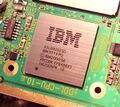 IBM PowerPC "Gekko" processor
 -
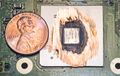 IBM PowerPC "Gekko" processor (180 nm) shaved down to show the silicon die
 -
 ATi "Flipper" processor
 -
 ATi "Flipper" (180 nm) shaved down to show the silicon die
 -
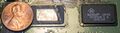 One of the two 1T-SRAM RAM modules shaved down to expose the die
 -
 GameCube Game Disc

--(Gamecube-GPU).jpg)


| Details | Ref. | |
|---|---|---|
| CPU |
|
[144][145] |
| GPU |
|
[144][145][150] |
| System memory |
|
[145][151][150] |
| Audio |
|
[144][151] |
| Video modes |
|
[144] |
| Connectivity |
| |
| Storage |
|
[144][151][153] |
| Other |
|
[151] |
Games
In its lifespan from 2001 to 2007, Nintendo licensed over 600 GameCube games.[154][155] Nintendo bolstered the console's popularity[156] by creating new franchises, such as Pikmin and Animal Crossing, which actually began as a Japanese exclusive on N64, and renewing some that had skipped the Nintendo 64, such as with Metroid Prime. Longer standing franchises include the critically acclaimed Software:The Legend of Zelda: The Wind Waker and Super Mario Sunshine, as well as Software:Mario Kart: Double Dash. Other Nintendo games are successors to Nintendo 64 games, such as the GameCube's best-selling game, Super Smash Bros. Melee, at more than 7 million copies worldwide, F-Zero GX; Software:Mario Golf: Toadstool Tour; Mario Party 4, 5, 6, and 7; Mario Power Tennis; and Software:Paper Mario: The Thousand-Year Door. Though committed to its software library, Nintendo was still criticized for not releasing enough launch window games and by the release of Luigi's Mansion instead of a 3D Mario game.
Nintendo had struggled with its family-friendly image during the late 1990s and most of the 2000s. However, during this period, it released more video games for a mature audience with mostly successful results.[157][158][159][160] While the video game industry was focusing on more mature audiences and online connections, Nintendo regained older players who had gravitated to the PlayStation 2 and Xbox during the early 2000s.[161][162] Some games aimed at older audiences were critically and financially successful—more than on Dreamcast, and less than on PlayStation 2 and Xbox.[61] Such examples include Software:The Legend of Zelda: Twilight Princess,[163][164] Super Smash Bros. Melee,[165][166] Resident Evil 4,[167][168][169][170] Software:Metal Gear Solid: The Twin Snakes,[171][172] Killer7,[173] Star Wars Rogue Squadron II: Rogue Leader,[174] Final Fantasy Crystal Chronicles,[175][176] Resident Evil (2002),[177] Metroid Prime,[178] Metroid Prime II: Echoes,[179] Soul Calibur II,[61] Resident Evil Zero,[180] F-Zero GX,[181] Star Fox Adventures,[61] and Star Fox Assault.[182] One of the most well-known GameCube games for mature audiences is Eternal Darkness: Sanity's Requiem, which underperformed financially, but garnered critical acclaim and is now regarded as a cult classic.[183][184][185][186]
The GameCube is Nintendo's first home console with a system menu, activated by powering on without a valid game disc or by holding down the A button while one is loaded.[187]
Third-party support

Early in Nintendo's history, the company had achieved considerable success with third-party developer support on the Nintendo Entertainment System and Super NES. Competition from the Sega Genesis and Sony PlayStation in the 1990s changed the market's landscape and reduced Nintendo's ability to obtain exclusive, third-party support on the Nintendo 64. The Nintendo 64 Game Pak cartridge format increased the cost to manufacture software, as opposed to the cheaper, higher-capacity optical discs on PlayStation.[188]
With the GameCube, Nintendo intended to reverse the trend as evidenced by the number of third-party games available at launch. The new optical disc format increased game storage capacity significantly and reduced production costs. Successful exclusives include Software:Star Wars Rogue Squadron II: Rogue Leader from Factor 5, Resident Evil 4 from Capcom, and Software:Metal Gear Solid: The Twin Snakes from Konami. Sega discontinued its Dreamcast console to become a third-party developer, porting Dreamcast games such as Crazy Taxi and Sonic Adventure 2, and developing new franchises, such as Super Monkey Ball. Longtime Nintendo partner Rare, which had developed GoldenEye 007, Perfect Dark, Banjo-Kazooie, Conker's Bad Fur Day, and the Donkey Kong Country series, released Star Fox Adventures for GameCube, its final Nintendo game before acquisition by Microsoft in 2002. Several third-party developers were contracted to work on new games for Nintendo franchises, including Software:Star Fox: Assault (which became a Player's Choice re-release[189]), Donkey Konga by Namco, and Wario World from Treasure.[154] Capcom had announced 5 games for the system dubbed the Capcom Five in November 2002,[190] Viewtiful Joe and Resident Evil 4 were later ported to other systems.
Third-party GameCube support was some of the most extensive of any Nintendo console predating the Wii.[191][192][193][194] Some third-party developers, such as Midway,[195] Namco,[196] Activision,[197] Konami,[198][199] Ubisoft,[200] THQ,[201] Disney Interactive Studios,[202] Humongous Entertainment, Electronic Arts,[203][204][205][206][207] and EA Sports,[208][209] continued to release GameCube games into 2007. One of the biggest third-party GameCube developers was Sega, which had quit the console hardware market to become a third-party game developer after the failure of the Dreamcast. It partnered with long-time rival Nintendo, and with Microsoft and Sony, to recuperate profits lost from the Dreamcast.[210][211][212] Sega was a successful third-party developer since the early 2000s, mostly those for the family market,[213] such as Super Monkey Ball,[214][215][216] Phantasy Star Online, Sonic Adventure, Sonic Adventure 2: Battle,[217][218][219][220][221] and Sonic Heroes.[222][223][224][225][226][227]
Online gaming

Nintendo's GameCube did not put heavy focus on online games earlier in the console's life. Only eight GameCube games support network connectivity, five with Internet support and three with local area network (LAN) support.[228][229] The only Internet capable games released in western territories are three role-playing games (RPGs) in Sega's Phantasy Star series: Phantasy Star Online Episode I & II, Phantasy Star Online Episode I & II Plus, and Phantasy Star Online Episode III: C.A.R.D. Revolution.[228] The official servers were decommissioned in 2007, but players can still connect to fan maintained private servers.[230] Japan received two additional games with Internet capabilities, a cooperative RPG, Homeland and a baseball game with downloadable content, Jikkyō Powerful Pro Yakyū 10.[228][229] Lastly, three racing games have LAN multiplayer modes: 1080° Avalanche, Kirby Air Ride, and Software:Mario Kart: Double Dash. Those can be forced over the Internet with third-party PC software capable of tunneling the GameCube's network traffic.[231][232]
Online play requires an official broadband or modem adapter because the GameCube lacks out of the box network capabilities. Nintendo never commissioned any Internet services for GameCube but allowed other publishers to manage custom online experiences.[233]
Emulation
On June 5, 2025, several GameCube games were re-released on the Nintendo Classics Service as part of the "Expansion Pack" tier of Nintendo Switch Online exclusively for the Nintendo Switch 2.[234]
Reception
The GameCube received generally positive reviews following its launch. PC Magazine praised the overall hardware design and quality of games available at launch.[235] CNET gave an average review rating, noting that though the console lacks a few features offered by its competition, it is relatively inexpensive, has a great controller design, and launched a decent lineup of games.[236] In later reviews, criticism mounted against the console often centering on its overall look and feel, describing it as "toy-ish".[237][238] With poor sales figures and the associated financial harm to Nintendo, a Time International article called the GameCube an "unmitigated disaster".[62]
Retrospectively, Joystiq compared the GameCube's launch window to its successor, the Wii, noting that the GameCube's "lack of games" resulted in a subpar launch, and the console's limited selection of online games damaged its market share in the long run.[239] Time International concluded that the system had low sales figures, because it lacked "technical innovations".[240]
Sales
In Japan, between 280,000 and 300,000 GameCube consoles were sold during the first three days of its sale, out of an initial shipment of 450,000 units.[241] During its launch weekend, $100 million worth of GameCube products were sold in North America.[242] The console was sold out in several stores, faster than initial sales of both of its competitors, the Xbox and the PlayStation 2.[243][244] Nintendo reported that the most popular launch game is Luigi's Mansion, with more sales at its launch than Super Mario 64 had.[245] Other popular games include Software:Star Wars Rogue Squadron II: Rogue Leader and Software:Wave Race: Blue Storm.[242] By early December 2001, 600,000 units had been sold in the US.[246]
Nintendo predicted 50 million GameCube units by 2005,[247] but only sold 22 million GameCube units worldwide during its lifespan,[248][249] placing it slightly behind the Xbox's 24 million[250] (though it did manage to outsell the Xbox in Japan),[251] and well behind the PlayStation 2's 155 million.[252] Ars Technica articles from 2006 showed and a 2020 book state that Nintendo officially sold 24 million GameCube consoles worldwide,[253][254][255] and one article from Seeking Alpha states that the GameCube sold 26 million consoles worldwide.[256] Its sales exceeded that of the Xbox 360 in Japan.[257][258][259][260] The GameCube's predecessor, the Nintendo 64, also outperformed it at nearly 33 million units.[261] It also exceeded the Dreamcast, which yielded 9.13 million units.[262] In September 2009, IGN ranked the GameCube 16th in its list of best gaming consoles of all time, placing it behind all three of its sixth-generation competitors: the PlayStation 2 (3rd), the Dreamcast (8th), and the Xbox (11th).[237] As of March 31, 2003, 9.55 million GameCube units had been sold worldwide, behind Nintendo's initial goal of 10 million consoles.[263] Many of Nintendo's own first-party games, such as Super Smash Bros. Melee,[264][265][266] Pokémon Colosseum,[267][268][269] and Software:Mario Kart: Double Dash,[270] had strong sales, though this did not typically benefit third-party developers or directly drive sales of their games.[271] However, at the same time, these first-party games, and second-party and third-party games, elevated the GameCube.[lower-alpha 15]
Sales of many cross-platform games—such as sports franchises released by Electronic Arts—were far below their PlayStation 2 and Xbox counterparts, eventually prompting some developers to scale back or completely cease support for the GameCube. Exceptions include Sega's family friendly Sonic Adventure 2 and Super Monkey Ball,[276] which reportedly yielded more sales on GameCube than most of the company's games on the PlayStation 2 and Xbox.[18][277][278][279] In June 2003, Acclaim Entertainment CEO Rod Cousens said that the company would no longer support the GameCube, and criticized it as a system "that don't deliver profits". Acclaim would later rescind his claims, by saying the company would elevate support for the system.[280] This decision was made unclear after the company filed for bankruptcy in August 2004. In September 2003, Eidos Interactive announced to end support for the GameCube, as the publisher was losing money from developing for Nintendo's console. This led to several games in development being canceled for the system.[281] Eidos's CEO Mike McGravey would say that the GameCube was a "declining business". However, after the company's purchase by the SCi Entertainment Group in 2005, Eidos resumed development for the system and released Software:Lego Star Wars: The Video Game[282] and Software:Tomb Raider: Legend.
In March 2003, British retailer Dixons removed all GameCube consoles, accessories and games from its stores.[283] That same month, another British retailer Argos, cut the price of the GameCube in their stores to £78.99, which was more than £50 cheaper than Nintendo's SRP for the console at the time.[284] However, in October of that year, they did eventually restock their supply of consoles after a price drop was ordered which caused the console sales to outpace the PlayStation 2 for a week.[285][286]
With sales sagging and millions of unsold consoles in stock, Nintendo halted GameCube production for the first nine months of 2003 to reduce surplus units.[62] Sales rebounded slightly after a price drop to US$99.99 on September 24, 2003[287] and the release of The Legend of Zelda: Collector's Edition bundle. A demo disc, the GameCube Preview Disc, was also released in a bundle in 2003.[288] Beginning with this period, GameCube sales continued to be steady, particularly in Japan, but the GameCube remained in third place in worldwide sales during the sixth-generation era because of weaker sales performance elsewhere, though its fortunes would change for the better in America and Europe.[289]
Iwata forecasted to investors that the company would sell 50 million GameCube units worldwide by March 2005, but by the end of 2006, it had only sold 21.74 million—fewer than half.[18] However, it had the highest attach rate of any Nintendo console at 9.59 and was profitable,[290][291][292] even more than Xbox with higher sales rates.[293][294]
Legacy
Many games that debuted on the GameCube, including the Pikmin series, Chibi-Robo!, Metroid Prime, and Luigi's Mansion became popular and profitable Nintendo franchises or subseries.[lower-alpha 16]
GameCube controllers have limited support on Wii U and Switch, to play Super Smash Bros. for Wii U, and Super Smash Bros. Ultimate respectively, via a USB adapter.[301][302] While on the Wii U the controller was only allowed to be used in Super Smash Bros., the Nintendo Switch recognizes it as a Pro Controller. Thus, the GameCube Controller can be used in any game where the Pro Controller is recognized. However, due to the GameCube controller lacking motion controls and some buttons, it may not be fully playable in some Switch games.
Regarding concerns about the correlation between violence and video games, a 2009 study by Iowa State University found that certain games like Super Mario Sunshine and Chibi-Robo!, which were GameCube exclusives, would help players learn positive skills about helping others, empathy, and cooperation.[303][304][305] The game Super Monkey Ball, which was a GameCube exclusive, could help surgeons perform laparoscopic surgery better than surgeons who do not play video games.[306][307][308][309]
GamesRadar+ ranked it 11th on their list of The 20 best video game consoles and hardware of all time in 2021.[310] Den of Geek placed it at number 12 on their list of The 25 Best Video Game Consoles Ever, Ranked, in 2023.[311]
See also
- Dolphin (emulator)
- GameCube accessories
Notes
- ↑ 1.0 1.1 1.2 via Game Boy Player add-on
- ↑ NTSC consoles only, requires third-party cable/adapter and the use of the Digital AV port, which was removed from later models after DOL-001
- ↑ NTSC consoles only
- ↑ PAL consoles only
- ↑ NTSC consoles only, requires the use of the Digital AV port, which was removed from later models after DOL-001
- ↑ NTSC consoles only, requires the use of the Digital AV port, which was removed from later models after DOL-001
- ↑ NTSC consoles only, requires third-party cable/adapter and the use of the Digital AV port, which was removed from later models after DOL-001
- ↑ 16 MB max. capacity
- ↑ As of March 10, 2008[10]
- ↑ Abbreviated as both NGC and GC in Japan, and as GCN in North America and Europe
- ↑ Sales figures differ, as some sources show the GameCube sold 24 million units worldwide.[11][12]
- ↑ Attributed to multiple references:[49][50][51][52][53][54][55][56][57]
- ↑ Attributed to multiple references:[68][69][70][71][72][73][74][75][76]
- ↑ Attributed to multiple references:[87][96][97][98][99]
- ↑ Attributed to multiple references:[268][270][272][273][274][275]
- ↑ Attributed to multiple references:[295][296][297][298][299][300]
References
- ↑ IGN Staff (2001-05-21). "Nintendo Reveals GameCube Pricing" (in en). https://www.ign.com/articles/2001/05/21/nintendo-reveals-gamecube-pricing.
- ↑ 2.0 2.1 Morris, Chris (May 21, 2001). "GameCube to Sell for $199". Money.CNN.com (Press release). New York City. Archived from the original on June 23, 2018. Retrieved September 21, 2018.
- ↑ Gieselmann, Hartmut (April 22, 2002). "Nintendo senkt Preis für GameCube". https://www.heise.de/newsticker/meldung/Nintendo-senkt-Preis-fuer-GameCube-62429.html.
- ↑ 4.0 4.1 ニンテンドーゲームキューブ取扱説明書. Nintendo. 2001. p. 36.
- ↑ 5.0 5.1 Becker, David (November 29, 2001). "Nintendo Reports Record GameCube Launch". http://news.cnet.com/2100-1040-276374.html.
- ↑ Williams, Martyn (August 24, 2001). "Nintendo Unveils GameCube Launch Plans". CNN. http://edition.cnn.com/2001/TECH/fun.games/08/24/gamecube.release.idg/.
- ↑ "GameCube Price Dropped". BBC News. April 22, 2002. https://news.bbc.co.uk/2/hi/entertainment/1943247.stm.
- ↑ Cameron, Nadia (May 20, 2002). "GameCube Launch Rounds Out Console Troika". https://www.pcworld.idg.com.au/article/22321/gamecube_launch_rounds_console_troika/.
- ↑ "Nintendo Jumps Online". June 17, 2012. https://www.ign.com/articles/2002/05/13/nintendo-jumps-online.
- ↑ "At Long Last, Nintendo Proclaims: Let the Brawls Begin on Wii!" (Press release). Redmond, Washington: Nintendo. March 10, 2008. Archived from the original on March 13, 2008. Retrieved March 11, 2008.
The previous installment in the series, Super Smash Bros. Melee, is the best-selling game for Nintendo GameCube with 7.09 million copies sold worldwide.
- ↑ Reimer, Jeremy (October 1, 2006). "How the Wii Was Born". https://arstechnica.com/gadgets/2006/10/wii-2/.
- ↑ Reimer, Jeremy (May 1, 2006). "Gamecube Price Drop Imminent?". https://arstechnica.com/uncategorized/2006/05/6710-2/.
- ↑ 13.0 13.1 13.2 13.3 Buchner, Greg (October 30, 2001). "ATI Discusses GameCube Graphics" (Interview). IGN. Archived from the original on June 19, 2022. Retrieved June 25, 2014.
- ↑ 14.0 14.1 14.2 "Nintendo Press Conference Transcript". May 14, 1999. https://www.ign.com/articles/1999/05/14/nintendo-press-conference-transcript.
- ↑ 15.0 15.1 15.2 Parker, Sam (June 6, 2001). "Nintendo Tweaks GameCube's Specs". ZDnet. https://www.zdnet.com/article/nintendo-tweaks-gamecubes-specs/.
- ↑ 16.0 16.1 "It's Alive!". March 13, 1999. https://www.ign.com/articles/1999/03/13/its-alive-3.
- ↑ "Make Way for the New". IGN. August 21, 2000. https://www.ign.com/articles/2000/06/13/make-way-for-the-new-2.
- ↑ 18.0 18.1 18.2 18.3 18.4 18.5 Rogers, Emily (January 7, 2014). "A Dolphin's Tale: The Story of GameCube". Dromble Media. http://www.dromble.com/2014/01/07/dolphin-tale-story-of-gamecube/.
- ↑ "Say Hello to Project Dolphin". May 4, 1999. https://www.ign.com/articles/1999/05/05/say-hello-to-project-dolphin.
- ↑ "ATI Snags Dolphin Graphics Chip Designer". February 16, 2000. https://www.ign.com/articles/2000/02/17/ati-snags-dolphin-graphics-chip-designer.
- ↑ Satterfield, Shane (August 24, 2000). "Nintendo's GameCube Unveiled". http://www.gamespot.com/articles/nintendos-gamecube-unveiled/1100-2619269/.
- ↑ "First Quarter Financial Results Briefing Q & A". Nintendo Co., Ltd.. July 31, 2009. https://www.nintendo.co.jp/ir/en/library/events/090731qa/index.html.
- ↑ IGN Staff (December 13, 2000). "The Name Game". https://www.ign.com/articles/2000/12/13/the-name-game.
- ↑ "Nintendo – Customer Service". Nintendo of America. https://www.nintendo.com/consumer/systems/nintendogamecube/trouble_sound.jsp.
- ↑ 25.0 25.1 Fielder, Lauren (May 16, 2001). "E3 2001: Nintendo Unleashes GameCube Software, a New Miyamoto Game, and More". http://www.gamespot.com/news/e3-2001-nintendo-unleashes-gamecube-software-a-new-miyamoto-game-and-more-2761390.
- ↑ Hinkle, David (November 19, 2007). "Year One: GameCube vs. Wii". Joystiq. http://www.joystiq.com/2007/11/19/year-one-gamecube-vs-wii/.
- ↑ George, Richard; Thomas, Lucas M. (May 9, 2011). "Nintendo's History at E3: 2001". https://www.ign.com/articles/2011/05/10/nintendos-history-at-e3-2001?page=2.
- ↑ "Factor 5 Worked with GameCube Motion Controller". Aussie Nintendo. July 28, 2007. http://www.aussie-nintendo.com/?v=news&p=15571.
- ↑ Thomas, Lucas M. (November 11, 2011). "Before the GameCube Arrived". https://www.ign.com/articles/2011/11/12/before-the-gamecube-arrived?page=1.
- ↑ Schneider, Peer (June 2, 2004). "The Legend of Zelda: Four Swords Adventures". https://www.ign.com/articles/2004/06/02/the-legend-of-zelda-four-swords-adventures.
- ↑ East, Thomas (May 29, 2012). "Classic E3 Moments: Nintendo Reveal GameCube in 2001". Official Nintendo Magazine UK. http://www.officialnintendomagazine.co.uk/38372/classic-e3-moments-nintendo-reveal-gamecube-in-2001/.
- ↑ Trammel, David (September 3, 2001). "GameCube Slogan Revealed!". Nintendo World Report. http://www.nintendoworldreport.com/news/6408.
- ↑ "Kirby Air Ride". GameTrailers. http://www.gametrailers.com/video/tv-spot-kirby-air/1831.
- ↑ Chmielewski, Dawn (October 9, 2001). "Nintendo's GameCube Debuts". p. 24. https://www.newspapers.com/clip/97798350/york-daily-record/.
- ↑ McFerran, Damien (September 3, 2020). "Turns Out Nintendo Was Thinking About a Switch-Style Device Back in the GameCube Era". https://www.nintendolife.com/news/2020/09/turns_out_nintendo_was_thinking_about_a_switch-style_device_back_in_the_gamecube_era.
- ↑ Fischer, Tyler (September 2, 2020). "Nintendo Leak Reveals Portable GameCube Console". https://comicbook.com/gaming/news/nintendo-gamecube-console-portable-leak/.
- ↑ Phillips, Tom (September 4, 2020). "Latest Nintendo Leaks Suggest Company Mulled Portable GameCube". https://www.eurogamer.net/articles/2020-09-04-latest-nintendo-leaks-suggest-company-mulled-portable-gamecube.
- ↑ "GameCube Launches in Japan". BBC News. September 14, 2001. https://news.bbc.co.uk/1/hi/entertainment/1543848.stm.
- ↑ Sato, Yukiyoshi Ike (September 13, 2001). "Nintendo GameCube Launches in Japan". http://www.gamespot.com/news/nintendo-gamecube-launches-in-japan-2812298.
- ↑ Becker, David (August 23, 2001). "Nintendo Delays U.S. Launch of GameCube". http://news.cnet.com/Nintendo-delays-U.S.-launch-of-GameCube/2100-1040_3-272053.html.
- ↑ "GameCube Gets Midnight Launch". BBC News. May 2, 2002. https://news.bbc.co.uk/2/hi/entertainment/1963749.stm.
- ↑ Eggebrecht, Julian (April 22, 2002). "Factor 5 on Dolby Pro Logic II". IGN (Interview). Archived from the original on November 16, 2014. Retrieved June 24, 2014.
- ↑ Becker, David (October 29, 2002). "Xbox, GameCube Scrap for Second Place" (in en). https://www.cnet.com/culture/xbox-gamecube-scrap-for-second-place/.
- ↑ "Why Did Sony Dominate? : The 6th Generation Video Game War". https://www.lunduniversity.lu.se/lup/publication/1316917.
- ↑ "Console Wars". The Economist. ISSN 0013-0613. https://www.economist.com/business/2007/03/22/console-wars.
- ↑ "Chart". The Economist. http://www.economist.com/images/20050806/CSF279.gif.
- ↑ Huffstutter, P.J. (April 8, 2003). "Nintendo Sees Profit Slump on Weak GameCube Sales" (in en-US). https://www.latimes.com/archives/la-xpm-2003-apr-08-fi-nintendo8-story.html.
- ↑ Kent, Steven (September 27, 2003). "Nintendo Stands by GameCube--For Now". https://www.chicagotribune.com/news/ct-xpm-2003-09-27-0309270110-story.html.
- ↑ Morris, Chris (November 16, 2001). "Nintendo Launches GameCube Console System". https://money.cnn.com/2001/11/16/technology/gamecube/index.htm.
- ↑ Kent, Steven (April 11, 2001). "Nintendo's GameCube May Top PlayStation 2, Xbox". https://archive.seattletimes.com/archive/?date=20010411&slug=gamecube11.
- ↑ "Four Ways for Nintendo to Get Back in the Game". September 5, 2002. https://money.cnn.com/2002/09/05/commentary/game_over/column_gaming/index.htm.
- ↑ Becker, David (January 2, 2002). "Nintendo: GameCube to Out-Entertain Rivals" (in en). https://www.cnet.com/culture/nintendo-gamecube-to-out-entertain-rivals/.
- ↑ McFerran, Damien (December 7, 2020). "Nintendo's Focus on Younger Players Is a Positive, Not a Negative" (in en-GB). https://www.nintendolife.com/news/2020/12/talking_point_nintendos_focus_on_younger_players_is_a_positive_not_a_negative.
- ↑ Boxer, Steven (June 14, 2001). "Cult Following for Nintendo". https://www.telegraph.co.uk/technology/reviews/4764196/Cult-following-for-Nintendo.html.
- ↑ Ryan, Jeff (2013). Super Mario: How Nintendo Conquered America. Portfolio. ISBN 978-1-59184-563-8. OCLC 821701726.
- ↑ "GameCube". November 16, 2003. https://www.sunjournal.com/2003/11/16/gamecube/.
- ↑ Rivera, Nimo (July 4, 2004). "Which Console Should You Get?" (in en-US). https://www.sandiegouniontribune.com/sdut-which-console-should-you-get-2004jul04-story.html.
- ↑ Chu, Showwei (October 30, 2002). "Nintendo Targeting New Video Games at Young Adults" (in en-CA). The Globe and Mail. https://www.theglobeandmail.com/report-on-business/nintendo-targeting-new-video-games-at-young-adults/article25424723/.
- ↑ Chimelewski, Dawn (October 15, 2001). "Adults Courted As GameCube's Newest Audience". https://www.chicagotribune.com/news/ct-xpm-2001-10-15-0110150197-story.html.
- ↑ Rodriguez, Steven (February 2, 2007). "The Greatest GameCube Games Finale". http://www.nintendoworldreport.com/feature/12801/nintendo-world-reports-greatest-gamecube-games-the-greatest-gamecube-games-finale.
- ↑ 61.0 61.1 61.2 61.3 "Next Generation – Interactive Entertainment Today, Video Game and Industry News – Home of Edge Online :: THE TOP 100 GAMES OF THE 21st CENTURY". October 28, 2007. http://www.next-gen.biz/index2.php?option=com_content&task=view&id=3537&Itemid=2&pop=1&page=1.
- ↑ 62.0 62.1 62.2 Frederick, Jim; Toko, Sekiguchi (December 8, 2003). "The Console Wars: Game On". Time International (Business Source Complete) (49): 56–59. https://time.com/archive/6646123/the-console-wars-game-on/. Retrieved November 17, 2025.
- ↑ IGN Staff (April 7, 2003). "GameCube Benchmark Unmet" (in en). https://www.ign.com/articles/2003/04/07/gamecube-benchmark-unmet.
- ↑ Pham, Alex (September 25, 2003). "Nintendo Struggles for Victory of Old" (in en-US). https://www.latimes.com/archives/la-xpm-2003-sep-25-fi-nintendo25-story.html.
- ↑ Metts, Jonathan (March 19, 2003). "GameCube Sales Double in February". http://www.nintendoworldreport.com/news/8412/gamecube-sales-double-in-february.
- ↑ Calvert, Justin (November 4, 2003). "GameCube Market Share Up 18 Points" (in en-US). https://www.gamespot.com/articles/gamecube-market-share-up-18-points/1100-6078111/.
- ↑ I. G. N. Staff (January 15, 2004). "GameCube Sales Update" (in en). https://www.ign.com/articles/2004/01/15/gamecube-sales-update.
- ↑ Fahey, Rob (November 5, 2003). "GameCube's Market Share Doubles in the USA" (in en). https://www.gamesindustry.biz/gamecubes-market-share-doubles-in-the-usa.
- ↑ Hong, Quang (January 15, 2004). "Nintendo Reports Successful Holiday Season" (in en). https://www.gamedeveloper.com/pc/nintendo-reports-successful-holiday-season.
- ↑ "GameCube Outsells PS2 in US After Price Cut" (in en). October 9, 2003. https://www.theregister.com/2003/10/09/gamecube_outsells_ps2_in_us/.
- ↑ Burnes, Andrew (November 4, 2003). "Nintendo on U.S. GameCube Sales" (in en). https://www.ign.com/articles/2003/11/04/nintendo-on-us-gamecube-sales.
- ↑ Jenkins, David (December 2, 2003). "GameCube Tops US Consoles Sales" (in en). https://www.gamedeveloper.com/pc/gamecube-tops-us-consoles-sales.
- ↑ Fahey, Rob (October 9, 2003). "GameCube Outsells PS2 in the USA Following Pricecut" (in en). https://www.gamesindustry.biz/gamecube-outsells-ps2-in-the-usa-following-pricecut.
- ↑ Burnes, Andrew (October 3, 2003). "GameCube North American Sales Figures Revealed" (in en). https://www.ign.com/articles/2003/10/03/gamecube-north-american-sales-figures-revealed.
- ↑ Dvorak, Phred (November 5, 2003). "Nintendo's GameCube Sales Surge in U.S. After Price Cut" (in en-US). The Wall Street Journal. ISSN 0099-9660. https://www.wsj.com/articles/SB106788619028502300.
- ↑ Cox, Matt (November 4, 2003). "GameCube market share doubles" (in en). http://www.lawrence.com/news/2003/nov/04/gamecube_market/.
- ↑ Feldman, Curt (January 21, 2004). "Console game sales grow 5 percent in '03 - GameSpot". https://www.gamespot.com/articles/console-game-sales-grow-5-percent-in-03/1100-6086799.
- ↑ Jenkins, David (October 2, 2003). "GameCube Sales Quadruple In US" (in en). https://www.gamedeveloper.com/pc/gamecube-sales-quadruple-in-us.
- ↑ "Nintendo: GameCube sales quadrupled in past week" (in en). October 3, 2003. https://www.itweb.co.za/content/4r1lyMRobKOqpmda.
- ↑ IGN Staff (November 4, 2003). "GameCube Market Share Doubles" (in en). https://www.ign.com/articles/2003/11/04/gamecube-market-share-doubles.
- ↑ Jenkins, David (November 5, 2003). "GameCube Market Share Doubles In US" (in en). https://www.gamedeveloper.com/pc/gamecube-market-share-doubles-in-us.
- ↑ Becker, David (September 24, 2003). "Nintendo cuts GameCube price" (in en). https://www.cnet.com/tech/gaming/nintendo-cuts-gamecube-price/.
- ↑ Tran, Khanh T. L. (November 29, 2001). "Nintendo's New GameCube Sells Well, But Lower-Priced Game Boy Soars" (in en-US). The Wall Street Journal. ISSN 0099-9660. https://www.wsj.com/articles/SB1006998117720785680.
- ↑ Skolnick, Evan (September 30, 2005). "Microsoft versus Nintendo: A Marketing Battle". https://onlyagame.typepad.com/only_a_game/2005/09/microsoft_versu.html.
- ↑ Good, Dan (2020). The Microsoft Story: How the Tech Giant Rebooted Its Culture, Upgraded Its Strategy, and Found Success in the Cloud. HarperCollins. pp. 110–111.
- ↑ Jenkins, David (June 14, 2004). "GameCube Market Share Doubles In Europe". https://www.gamedeveloper.com/pc/gamecube-market-share-doubles-in-europe.
- ↑ 87.0 87.1 Fahey, Rob (June 14, 2004). "GameCube market share doubles in Europe". https://www.gamesindustry.biz/articles/gamecube-market-share-doubles-in-europe.
- ↑ Burnes, Andrew (October 3, 2003). "Nintendo Europe Slashes GameCube Price". https://www.ign.com/articles/2003/10/03/nintendo-europe-slashes-gamecube-price.
- ↑ "Colosseum Selling UK GameCubes – Press Release". May 27, 2004. http://www.nintendoworldreport.com/pr/9614/colosseum-selling-uk-gamecubes.
- ↑ "No Fears For Resident Evil 4 As It Sells Over 200,000 Copies On Nintendo GameCube Across Europe!". April 25, 2005. https://www.gamesindustry.biz/articles/no-fears-for-resident-evil-4-as-it-sells-over-200000-copies-on-nintendo-gamecube-across-europe.
- ↑ Jenkins, David (October 21, 2003). "GameCube Sales Beat Xbox In UK". https://www.gamedeveloper.com/pc/gamecube-sales-beat-xbox-in-uk.
- ↑ Yeung, Karlie (October 21, 2003). "GameCube Sales Jump in Europe – News". http://www.nintendoworldreport.com/news/9070/gamecube-sales-jump-in-europe.
- ↑ "GameCube, Xbox scramble in Europe". February 6, 2003. https://www.cnet.com/culture/gamecube-xbox-scramble-in-europe/.
- ↑ Fahey, Rob (November 11, 2003). "GameCube claims second place in Europe, but UK sales fall". https://www.gamesindustry.biz/articles/gamecube-claims-second-place-in-europe-but-uk-sales-fall.
- ↑ Ekman, Daniel (April 30, 2002). "GCN in Europe". https://www.ign.com/articles/2002/04/30/gcn-in-europe.
- ↑ Calvert, Justin (October 13, 2003). "GameCube Selling Well in UK". https://www.gamespot.com/articles/gamecube-selling-well-in-uk/1100-6076721/.
- ↑ "News: German GameCube Sales Figures | N-Europe.com". May 27, 2002. https://www.n-europe.com/news/news-german-gamecube-sales-figures/.
- ↑ IGN Staff (August 19, 2004). "GameCube Sales Climbing". https://www.ign.com/articles/2004/08/19/gamecube-sales-climbing.
- ↑ Satterfield, Shane (2002). "GameCube sells 50,000 units in Germany – GameSpot". https://www.gamespot.com/articles/gamecube-sells-50000-units-in-germany/1100-2864279/.
- ↑ Fahey, Rob (January 20, 2004). "GameCube approaches 3 million units in Europe". https://www.gamesindustry.biz/articles/gamecube-approaches-3-million-units-in-europe.
- ↑ Thorsen, Tor (February 22, 2007). "Nintendo Officially Pulls Plug on GameCube?" (in en-US). https://www.gamespot.com/articles/nintendo-officially-pulls-plug-on-gamecube/1100-6236024/.
- ↑ "Nintendo Confirms the GameCube Is Officially Dead". February 22, 2007. http://spong.com/article/11856/Nintendo-Confirms-The-GameCube-Is-Officially-Dead.
- ↑ "Nintendo Ends GameCube Support". February 22, 2007. http://www.mcvuk.com/news/read/nintendo-ends-gamecube-support.
- ↑ Webster, Hilton (2024-10-29). "How Many Games Were Made For The GameCube?" (in en). https://www.thegamer.com/how-many-games-made-released-gamecube/.
- ↑ Hatfield, Daemon (2007-01-23). "Paper Mario Unfolding in April?" (in en). https://www.ign.com/articles/2007/01/23/paper-mario-unfolding-in-april.
- ↑ Casamassina, Matt (2006-11-18). "The Legend of Zelda: Twilight Princess Review" (in en). https://www.ign.com/articles/2006/11/18/the-legend-of-zelda-twilight-princess-review-2.
- ↑ "Gaming Intelligence Agency – Interview with Greg Buchner". http://thegia.com/archive/features/f010606.html.
- ↑ 108.0 108.1 Hackman, Mark (June 12, 2001). "Nintendo GameCube Unwrapped". ExtremeTech. http://www.extremetech.com/extreme/49118-nintendo-gamecube-unwrapped.
- ↑ "Technical Details". Nintendo of Europe. https://www.nintendo.co.uk/Corporate/Nintendo-History/Nintendo-GameCube/Technical-Details/Technical-Details-627134.html.
- ↑ Shimpi, Anand Lal (December 7, 2001). "Hardware Behind the Consoles – Part II: Nintendo's GameCube". AnandTech. http://www.anandtech.com/show/858.
- ↑ "GameCube 101: Graphics". January 16, 2001. https://www.ign.com/articles/2001/01/17/gamecube-101-graphics.
- ↑ Gray, Douglas F. (June 14, 2001). "GameCube Uncovered – IBM, ATI Inside". PC World. http://www.pcworld.idg.com.au/article/28028/gamecube_uncovered_-_ibm_ati_inside/. Retrieved July 9, 2013.
- ↑ Bonsor, Kevin (December 4, 2000). "How GameCube Works". HowStuffWorks. http://electronics.howstuffworks.com/gamecube2.htm.
- ↑ "GameCube: A Digital Wonder". August 23, 2000. https://www.ign.com/articles/2000/08/24/gamecube-a-digital-wonder.
- ↑ "Matsushita Allies with Nintendo on Next-Generation Game Console". May 12, 1999. http://www.eetimes.com/document.asp?doc_id=1139403.
- ↑ "Spaceworld 2001: Spicing GameCube Up". August 22, 2001. https://www.ign.com/articles/2001/08/22/spaceworld-2001-spicing-gamecube-up.
- ↑ Berghammer, Billy (July 24, 2002). "Nintendo Announces Platinum GameCube". Nintendo World Report. http://www.nintendoworldreport.com/news/7586.
- ↑ "Spice Up Your Life". December 3, 2001. https://www.ign.com/articles/2001/12/04/spice-up-your-life.
- ↑ "Iwata Asks: Nintendo 3DS". https://iwataasks.nintendo.com/interviews/3ds/how-nintendo-3ds-made/0/2/. "Iwata: To go back a little further, the Nintendo GameCube system actually had 3D-compatible circuitry built-in [...] Itoi: Nintendo GameCube did? And all the Nintendo GameCube systems around the world? Iwata: Yeah. If you fit it with a certain accessory, it could display 3D images."
- ↑ Serrels, Mark (January 7, 2011). "The GameCube and the Game Boy Advance Were 3D Compatible!". http://www.kotaku.com.au/2011/01/the-gamecube-and-the-game-boy-advance-were-3d-compatible/.
- ↑ "Iwata Asks". http://iwataasks.nintendo.com/interviews/#/3ds/how-nintendo-3ds-made/0/2.
- ↑ Taljonick, Ryan (April 3, 2013). "The 100 Best Easter Eggs of All Time". Games Radar. https://www.gamesradar.com/100-best-easter-eggs-all-time/. Retrieved July 16, 2013.
- ↑ "Nintendo GameCube Memory Card 1019". Nintendo. https://www.nintendo.com/consumer/memorycard1019.jsp.
- ↑ Plunkett, Luke (June 28, 2011). "The Evolution of the PlayStation Control Pad". Kotaku. https://kotaku.com/the-evolution-of-the-playstation-control-pad-5816069.
- ↑ Satterfield, Shane (November 16, 2001). "What's Inside the GameCube?". ZDNet. https://www.zdnet.com/article/whats-inside-the-gamecube/.
- ↑ England, Kyle (April 5, 2012). "The Legend of the Gamepad: A Brief History of Nintendo Consoles Told with Buttons and Joysticks.". Nintendojo. http://www.nintendojo.com/features/editorials/the-legend-of-the-gamepad.
- ↑ "GCN Controller: See It in Action". July 27, 2001. https://www.ign.com/articles/2001/07/27/gcn-controller-see-it-in-action.
- ↑ Graziano, Claudia (December 3, 1998). "'Nintendo Thumb' Points to RSI". Wired. https://www.wired.com/culture/lifestyle/news/1998/12/16579. Retrieved July 15, 2013.
- ↑ Powers, Rick (October 6, 2001). "GameCube Controller". Nintendo World Report. http://www.nintendoworldreport.com/impressions/2727.
- ↑ Wiley, M. (June 11, 2002). "Nintendo WaveBird Review". https://www.ign.com/articles/2002/06/11/nintendo-wavebird-review.
- ↑ "Nintendo GameCube Game Boy Player". November 18, 2001. https://www.ign.com/articles/2002/11/18/nintendo-gamecube-game-boy-player.
- ↑ Humphries, Matthew (August 17, 2011). "Nintendo's New Wii Drops GameCube Compatibility, Bundles More Games". Geek.com. http://www.geek.com/games/nintendos-new-wii-console-drops-gamecube-compatibility-bundles-more-games-1413513/.
- ↑ Plunkett, Luke (December 13, 2012). "Tearing Open the New Wii Reveals Some Crazy Nintendo Decisions". Kotaku. https://kotaku.com/tearing-open-the-new-wii-reveals-some-crazy-nintendo-de-5968014.
- ↑ 134.0 134.1 Lake, Max (October 19, 2001). "Q for Christmas in Japan". Nintendo World Report. Reuters. https://www.nintendoworldreport.com/news/6618/q-for-christmas-in-japan.
- ↑ 135.0 135.1 Mirabella III, Fran (April 9, 2002). "Panasonic Q Review". https://www.ign.com/articles/2002/04/09/panasonic-q-review.
- ↑ 136.0 136.1 "2001年12月14日、DVD再生に対応したゲームキューブ互換機「Q」(SL-GC10)が発売されました: 今日は何の日?" (in ja). Engadget JP (Verizon Media). December 14, 2019. https://japanese.engadget.com/jp-2019-12-13-2001-12-14-dvd-q-sl-gc10.html.
- ↑ Cole, Michael (December 17, 2003). "Panasonic Q Discontinued – News". http://www.nintendoworldreport.com/news/9283/panasonic-q-discontinued.
- ↑ "松下、ゲームキューブのソフトがプレイできるDVDプレーヤー"Q"を発表" (in ja). ASCII. October 19, 2001. https://ascii.jp/elem/000/000/326/326847/.
- ↑ "パナソニック製ゲームキューブ互換機「Q」、11月下旬に4万円以下で発売か" (in ja). Game Watch (Impress Corporation). October 11, 2001. https://game.watch.impress.co.jp/docs/20011011/q.htm.
- ↑ "Nintendo's GameCube Component FAQ page". Nintendo. https://www.nintendo.com/consumer/systems/nintendogamecube/component_faq.jsp.
- ↑ 141.0 141.1 141.2 "DCTP - Nintendo's Gamecube Technical Overview". http://www.segatech.com/gamecube/overview/.
- ↑ "Console Specs". https://www.angelfire.com/electronic2/mariotan/.
- ↑ IGN Staff (November 4, 2000). "Gamecube Versus PlayStation 2". IGN. http://ign.com/articles/2000/11/04/gamecube-versus-playstation-2.
- ↑ 144.0 144.1 144.2 144.3 144.4 144.5 144.6 Shimpi, Anand Lal (December 7, 2001). "Hardware Behind the Consoles - Part II: Nintendo's GameCube". AnandTech. http://www.anandtech.com/show/858.
- ↑ 145.0 145.1 145.2 "Game Consoles: A Look Ahead". Ace's Hardware. December 14, 2003. http://www.aceshardware.com/read.jsp?id=60000288.
- ↑ 146.0 146.1 146.2 146.3 Graphics Processor Specifications, IGN, 2001
- ↑ IGN Staff (January 17, 2001). "GameCube 101: Graphics". IGN. http://ign.com/articles/2001/01/17/gamecube-101-graphics.
- ↑ "X-ing Things Out". January 9, 2001. https://www.ign.com/articles/2001/01/09/x-ing-things-out.
- ↑ Engel, Thomas (October 2002). "Shader Integration: Merging Shading Technologies on the Nintendo GameCube". Game Developer. https://www.gamedeveloper.com/programming/shader-integration-merging-shading-technologies-on-the-nintendo-gamecube. Retrieved June 5, 2024.
- ↑ 150.0 150.1 GameCube clears path for game developers, EE Times, 5/16/2001
- ↑ 151.0 151.1 151.2 151.3 "GCN Technical Specifications". Nintendo. http://register.nintendo.com/techspecgcn.
- ↑ "| Nintendo - Customer Service - Memory Card 1019 |". https://www.nintendo.com/consumer/memorycard1019.jsp.
- ↑ "Nintendo GameCube Accessories". Nintendo. https://www.nintendo.co.uk/NOE/en_GB/systems/accessories_1222.html. (dead)
- ↑ 154.0 154.1 Reece, Mark (November 18, 2011). "Feature: Remembering the GameCube". http://www.nintendolife.com/news/2011/11/feature_remembering_the_gamecube.
- ↑ Hinkle, David (November 19, 2007). "Year One: GameCube vs. Wii". https://www.engadget.com/2007/11/19/year-one-gamecube-vs-wii/.
- ↑ Metts, Jonathan (February 27, 2003). "AIAS Winners from D.I.C.E.! - News". http://www.nintendoworldreport.com/news/8337/aias-winners-from-dice.
- ↑ Chmielewski, Dawn C. (October 15, 2001). "Adults courted as GameCube's newest audience". https://www.chicagotribune.com/news/ct-xpm-2001-10-15-0110150197-story.html.
- ↑ "Four ways for Nintendo to get back in the game – Sep. 5, 2002". https://money.cnn.com/2002/09/05/commentary/game_over/column_gaming/index.htm.
- ↑ "Cult following for Nintendo". June 14, 2001. https://www.telegraph.co.uk/technology/reviews/4764196/Cult-following-for-Nintendo.html.
- ↑ Kasavin, Greg (June 2, 2003). "Nintendo E3 2003 Press Conference Report – GameSpot". https://www.gamespot.com/articles/nintendo-e3-2003-press-conference-report/1100-6027510/.
- ↑ Ashcraft, Brian (December 14, 2012). "Why Resident Evil 4 Became a Nintendo Exclusive" (in en-us). https://kotaku.com/why-resident-evil-4-became-a-nintendo-exclusive-5968398.
- ↑ Reed, Kristan (November 1, 2004). "Resident Evil 4 coming to PS2 'end of 2005'" (in en-gb). Eurogamer.net. https://www.eurogamer.net/news-011104-re4onps2.
- ↑ "The Legend of Zelda: A Sales History" (in en). June 21, 2012. https://www.zeldadungeon.net/the-legend-of-zelda-a-sales-history/.
- ↑ Sweeny, Aric (September 9, 2017). "Japan: 'Breath of the Wild' Sales Top 'Twilight Princess'" (in en-US). http://www.nintendo.destructoid.com/japan-breath-wild-sales-top-twilight-princess/.
- ↑ IGN Staff (January 17, 2002). "Super Smash Bros. "Million" in Japan" (in en). https://www.ign.com/articles/2002/01/17/super-smash-bros-million-in-japan.
- ↑ Dingo, Star. "CNN.com – Sci-Tech – Review: 'Super Smash Brothers Melee' for GameCube – May 30, 2001". https://www.cnn.com/2001/TECH/fun.games/05/30/smash.brothers.idg/index.html.
- ↑ "Why Resident Evil 4 Became a Nintendo Exclusive" (in en-us). December 14, 2012. https://kotaku.com/why-resident-evil-4-became-a-nintendo-exclusive-5968398.
- ↑ "No Fears For Resident Evil 4 As It Sells Over 200,000 Copies On Nintendo GameCube Across Europe!" (in en). April 25, 2005. https://www.gamesindustry.biz/no-fears-for-resident-evil-4-as-it-sells-over-200000-copies-on-nintendo-gamecube-across-europe.
- ↑ Orry, Tom (June 8, 2005). "Resident Evil 4 tops 500,000 sales in North America" (in en-US). https://www.videogamer.com/news/resident-evil-4-tops-500-000-sales-in-north-america/.
- ↑ Surette, Tim (June 7, 2005). "Resident Evil 4 sells half a million" (in en-US). https://www.gamespot.com/articles/resident-evil-4-sells-half-a-million/1100-6127089/.
- ↑ Thompson, Scott (November 10, 2011). "Observing the Course and Wake of the Capcom Five – Feature". http://www.nintendoworldreport.com/feature/28394/observing-the-course-and-wake-of-the-capcom-five.
- ↑ Rodriguez, Steven (March 18, 2004). "Metal Gear Solid: The Twin Snakes Review – Review". http://www.nintendoworldreport.com/review/4218/metal-gear-solid-the-twin-snakes-gamecube.
- ↑ "Resident Evil 4 coming to PS2 'end of 2005'" (in en-gb). Eurogamer.net. November 1, 2004. https://www.eurogamer.net/news-011104-re4onps2.
- ↑ "IGN: Star Wars Rogue Leader is No.1 on the GCN". June 14, 2006. http://games.ign.com/articles/358/358808p1.html.
- ↑ "「小さな王様と約束の国 ファイナルファンタジー・クリスタルクロニクル」がWiiウェアのダウンロード専用コンテンツとして登場 - ファミ通.com". https://www.famitsu.com/game/news/1211082_1124.html.
- ↑ "GFK Chart-Track". April 24, 2018. https://www.chart-track.co.uk/index.jsp?c=p/software/uk/archive/index_test.jsp&ct=110009&arch=t&lyr=2004&year=2004&week=11.
- ↑ Roper, Chris (May 23, 2008). "Capcom Releases Lifetime Sales Numbers" (in en). https://www.ign.com/articles/2008/05/23/capcom-releases-lifetime-sales-numbers.
- ↑ "The Magic Box – US Platinum Chart Games.". April 21, 2007. http://www.the-magicbox.com/Chart-USPlatinum.shtml.
- ↑ Casamassina, Matt (August 29, 2009). "A Space Bounty Hunter in Texas" (in en). https://www.ign.com/articles/2009/08/29/a-space-bounty-hunter-in-texas.
- ↑ "Platinum Titles |Product Data | CAPCOM" (in en-US). https://www.capcom.co.jp/ir/english/business/million.html.
- ↑ Nathan Brown (December 28, 2018). "From Shenmue to Yakuza, Toshihiro Nagoshi looks back on an illustrious career of Japanese game development" (in en). https://www.gamesradar.com/from-shenmue-to-yakuza-toshihiro-nagoshi-looks-back-on-an-illustrious-career-of-japanese-game-development/.
- ↑ "Series Analysis: Star Fox" (in en-US). April 23, 2016. https://sourcegaming.info/2016/04/23/series-analysis-star-fox/.
- ↑ Stone, Sam (October 17, 2021). "The Scariest Nintendo Game of All Time Is on the GameCube" (in en-US). https://www.cbr.com/scariest-nintendo-game-eternal-darkness-gamecube/.
- ↑ Churchill, James (October 28, 2015). "The Making Of Eternal Darkness: Sanity's Requiem" (in en-GB). https://www.nintendolife.com/news/2015/10/feature_the_making_of_eternal_darkness_sanitys_requiem.
- ↑ Sall, Matt (June 27, 2022). "GameCube's 'Eternal Darkness' was a Masterpiece Of Creativity" (in en). https://www.belloflostsouls.net/2022/06/eternal-darkness-was-a-masterpiece-of-creativity.html.
- ↑ Haines, Rob (March 9, 2014). "Eternal Darkness: Sanity's Requiem retrospective" (in en-gb). Eurogamer.net. https://www.eurogamer.net/eternal-darkness-sanitys-requiem-retrospective.
- ↑ "Nintendo GameCube Instruction Booklet". Nintendo of America. p. 15. https://www.nintendo.com/consumer/downloads/gcn101_manual_english.pdf.
- ↑ East, Tom (November 4, 2009). "History of Nintendo: GameCube". Official Nintendo Magazine UK. http://www.officialnintendomagazine.co.uk/12990/features/history-of-nintendo-gamecube/?page=1.
- ↑ "Star Fox Assault". Nintendo. https://www.nintendo.com/gamemini?gameid=0b746eac-10e2-4bf6-8a49-9d3441139961&.
- ↑ "カプコン、「biohazard4」など個性の強い大人向け作品を一挙に5タイトル発表". https://game.watch.impress.co.jp/docs/20021114/capcom.htm.
- ↑ "Peter Main talks GameCube! - News". http://www.nintendoworldreport.com/news/6360/peter-main-talks-gamecube.
- ↑ "GC(ニンテンドー ゲームキューブ)歴代米国売上ランキング". February 11, 2005. http://www5e.biglobe.ne.jp/~hokora/gcranka.html.
- ↑ Bramwell, Tom (January 4, 2002). "First quarter for GameCube" (in en-gb). Eurogamer.net. https://www.eurogamer.net/article-31578.
- ↑ "Nintendo GameCube, Xbox, Playstation 2, Video Game Comparison". https://www.gamecubicle.com/system-gamecube-comparison.htm.
- ↑ IGN Staff (September 6, 2001). "Midway's Full GameCube Lineup" (in en). https://www.ign.com/articles/2001/09/06/midways-full-gamecube-lineup.
- ↑ Metts, Jonathan (March 27, 2001). "Namco Likes Nintendo – News". http://www.nintendoworldreport.com/news/5718/namco-likes-nintendo.
- ↑ "Activision: Pulling the Joystick into High Gear" (in en). Bloomberg.com. March 13, 2001. https://www.bloomberg.com/news/articles/2001-03-12/activision-pulling-the-joystick-into-high-gear.
- ↑ Lake, Max (June 1, 2001). "Konami on X-Box & GameCube at E3 – News". http://www.nintendoworldreport.com/news/6032/konami-on-x-box-n-gamecube-at-e3.
- ↑ "Konami swallows gaming industry" (in en-gb). Eurogamer.net. May 22, 2002. https://www.eurogamer.net/article-46014.
- ↑ "Surf's Up Official Press Release". Ubisoft. March 19, 2007. http://www.ubi.com/ENCA/News/Info.aspx?nId=4469.
- ↑ "Ratatouille Official Press Release". THQ. November 6, 2006. http://investor.thq.com/phoenix.zhtml?c=96376&p=irol-newsArticle&ID=927018&highlight=.
- ↑ "Disney Showcases E3 Lineup". Nintendo World Report. August 2, 2007. http://www.nintendoworldreport.com/pr/13940.
- ↑ Bramwell, Tom (May 10, 2001). "EA announces GameCube titles" (in en-gb). Eurogamer.net. https://www.eurogamer.net/article-30610.
- ↑ "Nintendo Teams Up With Electronic Arts" (in en-US). The Wall Street Journal. March 7, 2003. ISSN 0099-9660. https://www.wsj.com/articles/SB104706206680368100.
- ↑ Arts, Electronic (May 13, 2003). "2003 Games At The Electronic Entertainment Expo | Scoop News" (in en). https://www.scoop.co.nz/stories/SC0305/S00040/2003-games-at-the-electronic-entertainment-expo.htm.
- ↑ "A Boy's-Eye Look at the Consoles" (in en). Bloomberg.com. December 13, 2001. https://www.bloomberg.com/news/articles/2001-12-12/a-boys-eye-look-at-the-consoles.
- ↑ Kasavin, Greg (June 2, 2003). "Nintendo E3 2003 Press Conference Report – GameSpot". https://www.gamespot.com/articles/nintendo-e3-2003-press-conference-report/1100-6027510/.
- ↑ "Madden NFL 08 Official Press Release". Electronic Arts. April 18, 2007. http://www.ea.com/article.jsp?id=madden08pressrelease.
- ↑ Developer, Game (May 9, 2001). "EA To Bring Madden, Others To Gamecube" (in en). https://www.gamedeveloper.com/pc/ea-to-bring-madden-others-to-gamecube.
- ↑ Buchanan, Levi (March 5, 2002). "Teaming up with Nintendo, the ship comes in for Sega". https://www.chicagotribune.com/news/ct-xpm-2002-03-05-0203050005-story.html.
- ↑ sonic_hedgehogs (August 11, 2003). "Sonic DX Sales Help SEGA Profit" (in en-GB). https://www.sonicstadium.org/2003/08/sonic-dx-sales-help-sega-profit/.
- ↑ Legend, Hero of (May 14, 2015). "Update: The Spin: A look into Sonic's history with Nintendo" (in en-GB). https://www.sonicstadium.org/2015/05/the-spin-a-look-into-sonics-history-with-nintendo/.
- ↑ Dreadknux (October 15, 2001). "Yuji Naka: Sonic Titles to Appeal to Younger Audience" (in en-GB). https://www.sonicstadium.org/2001/10/yuji-naka-sonic-titles-to-appeal-to-younger-audience/.
- ↑ Welsh, Oli (November 26, 2020). "The best launch titles ever: Super Monkey Ball on GameCube" (in en-gb). Eurogamer.net. https://www.eurogamer.net/the-best-launch-titles-ever-super-monkey-ball-on-gamecube.
- ↑ Craddock, Ryan (May 13, 2019). "Super Monkey Ball Creator Has No Idea Why The Game Was So Popular" (in en-GB). https://www.nintendolife.com/news/2019/05/super_monkey_ball_creator_has_no_idea_why_the_game_was_so_popular.
- ↑ IGN Staff (October 19, 2001). "Super Monkey Ball" (in en). https://www.ign.com/articles/2001/10/19/super-monkey-ball-4.
- ↑ Dreadknux (February 28, 2002). "Sonic Adventure 2 Battle Tops Gamecube Sales Chart in US" (in en-GB). https://www.sonicstadium.org/2002/02/sonic-adventure-2-battle-tops-gamecube-sales-chart-in-us/.
- ↑ sonic_hedgehogs (July 3, 2002). "US Sales: Sonic Advance and SA2 Battle Rank High on Chart" (in en-GB). https://www.sonicstadium.org/2002/07/us-sales-sonic-advance-and-sa2-battle-rank-high-on-chart/.
- ↑ Dreadknux (October 6, 2002). "Report: Sonic Tops SEGA's Third-Party Game Sales in 2002" (in en-GB). https://www.sonicstadium.org/2002/10/report-sonic-tops-segas-third-party-game-sales-in-2002/.
- ↑ Dreadknux (November 24, 2002). "Sonic Adventure 2 Battle is One of the Best-Selling Gamecube Games Ever" (in en-GB). https://www.sonicstadium.org/2002/11/sonic-adventure-2-battle-is-one-of-the-best-selling-gamecube-games-ever/.
- ↑ sonic_hedgehogs (February 15, 2002). "Sonic Adventure 2 Battle Rides High on Amazon Sales Chart" (in en-GB). https://www.sonicstadium.org/2002/02/sonic-adventure-2-battle-rides-high-on-amazon-sales-chart/.
- ↑ Johnson, Faith (July 30, 2022). "SEGA's Astonishing GameCube Rebound Following Defeat In The Console Wars". https://www.nintendolife.com/features/segas-astonishing-gamecube-rebound-following-defeat-in-the-console-wars.
- ↑ Lab, Jesse (April 24, 2022). "20 Years Later, Sonic Adventure 2: Battle Might Be the Series's Most Important Game". https://www.escapistmagazine.com/20-years-later-sonic-adventure-2-battle-might-be-the-seriess-most-important-game/.
- ↑ Wen, Alan (July 1, 2022). "Sonic Adventure is still the gold standard for 3D Sonic games". https://www.vg247.com/sonic-advenutre-gold-standard-3d.
- ↑ Torres, Ricardo (May 12, 2003). "Sonic Adventure DX Preview". https://www.gamespot.com/articles/sonic-adventure-dx-preview/1100-6026338/.
- ↑ GameSpot Staff (July 1, 2002). "New Sonic games bound for GameCube, GBA". https://www.gamespot.com/articles/new-sonic-games-bound-for-gamecube-gba/1100-2872973/.
- ↑ IGN staff (February 25, 2002). "Sonic Nabs Strong Sales" (in en). https://www.ign.com/articles/2002/02/25/sonic-nabs-strong-sales.
- ↑ 228.0 228.1 228.2 Bivens, Danny (October 31, 2001). "GameCube Broadband/Modem Adapter – Feature". http://www.nintendoworldreport.com/feature/27672/nintendos-expansion-ports-gamecube-broadbandmodem-adapter.
- ↑ 229.0 229.1 "ダウンロード". November 19, 2005. http://www.konami.jp:80/gs/game/pawa/10_gc/.
- ↑ "| Nintendo – Customer Service | Nintendo GameCube – Online/LAN". https://www.nintendo.com/consumer/systems/nintendogamecube/lan_online.jsp.
- ↑ "| Nintendo – Customer Service | Nintendo GameCube – Connecting over a LAN". https://www.nintendo.com/consumer/systems/nintendogamecube/lan_index.jsp.
- ↑ Thorsen, Tor (October 28, 2003). "DIY Developers Bring GameCube Online". https://www.gamespot.com/articles/diy-developers-bring-gamecube-online/1100-6077489/.
- ↑ "Nintendo Jumps Online". May 13, 2002. https://www.ign.com/articles/2002/05/13/nintendo-jumps-online.
- ↑ "What's new with Nintendo Switch Online on Nintendo Switch 2?" (in en-US). https://www.nintendo.com/us/whatsnew/whats-new-with-nintendo-switch-online-on-nintendo-switch-2/?srsltid=AfmBOor5XKQECwK6475YbGFAK57GEiHkfVNJMYBHnIwhn3JzEnYNSvVN.
- ↑ Ryan, Michael E. (November 15, 2001). "Nintendo GameCube: Review". https://www.pcmag.com/article2/0,2817,7344,00.asp.
- ↑ "Nintendo GameCube". November 18, 2001. http://reviews.cnet.com/consoles/nintendo-gamecube-black/4505-10109_7-8688672.html.
- ↑ 237.0 237.1 "Nintendo GameCube Is Number 16". IGN Entertainment. https://www.ign.com/top-25-consoles/16.html.
- ↑ "Xbox Vs. GameCube Vs. PlayStation 2: Torture-Testing All the Video Game Consoles--in One Room, at One Time". December 7, 2004. http://www.popularmechanics.com/technology/gadgets/1278831.
- ↑ Hinkle, David (November 19, 2007). "Year One: GameCube vs. Wii". Joystiq. http://www.joystiq.com/2007/11/19/year-one-gamecube-vs-wii/.
- ↑ McCracken, Harry. "Play Hard. (Cover Story)." Time International (Atlantic Edition) 180.23 (2012): 48-49. Business Source Complete.
- ↑ Ahmed, Shahmed (May 17, 2006). "Japanese GameCube Sales Figures". GameSpot. https://www.gamespot.com/articles/japanese-gamecube-sales-figures/1100-2812925/.
- ↑ 242.0 242.1 "GameCube Sales Hit $100m". November 21, 2001. https://news.bbc.co.uk/2/hi/entertainment/1666671.stm.
- ↑ "GameCube Sales Brisk". November 29, 2001. https://money.cnn.com/2001/11/29/technology/nintendo/.
- ↑ Saddoris, Chad (2001-12-05). "Nintendo's GAMECUBE a holiday hit" (in en). https://www.chron.com/neighborhood/article/Nintendo-s-GAMECUBE-a-holiday-hit-9942088.php.
- ↑ Ando, Mariko (November 29, 2001). "GameCube Sales Surpasses Xbox, PS2". MarketWatch. https://www.marketwatch.com/story/nintendo-claims-gamecube-sales-outpaces-xbox-ps2.
- ↑ Smith, Tony (December 4, 2001). "Nintendo GameCube Sales on Target to Beat Initial Forecast". https://www.theregister.co.uk/2001/12/04/nintendo_gamecube_sales_on_target/.
- ↑ "Nintendo Targets 50 Million GameCubes – News". http://www.nintendoworldreport.com/news/7448/nintendo-targets-50-million-gamecubes.
- ↑ "Consolidated Sales Transition by Region". Nintendo. June 2011. https://www.nintendo.co.jp/ir/library/historical_data/pdf/consolidated_sales_e1106.pdf.
- ↑ "Nintendo GameCube". March 27, 2014. https://www.ign.com/wikis/history-of-video-game-consoles/Nintendo_GameCube.
- ↑ Dyer, Mitch (November 15, 2011). "Ten Incredible Gifts Xbox Gave Modern Gaming". https://www.ign.com/articles/2011/11/15/ten-incredible-gifts-xbox-gave-modern-gaming?page=2.
- ↑ "Why Xbox Failed in Japan". Eurogamer.net. November 17, 2013. https://www.eurogamer.net/why-xbox-failed-in-japan.
- ↑ Moriarty, Colin (February 16, 2013). "Sony's Documentary on PlayStation 2's Retail Dominance". https://www.ign.com/articles/2013/02/17/sonys-documentary-on-playstation-2s-retail-dominance.
- ↑ Reimer, Jeremy (October 1, 2006). "How the Wii Was Born". https://arstechnica.com/gadgets/2006/10/wii-2/.
- ↑ Reimer, Jeremy (May 1, 2006). "Gamecube Price Drop Imminent?". https://arstechnica.com/uncategorized/2006/05/6710-2/.
- ↑ Pellegrin-Boucher, Estelle; Roy, Pierre (2020). "1". Innovation in the Cultural and Creative Industries. John Wiley & Sons. pp. 13. ISBN 9781786303790. https://books.google.com/books?id=KvK-DwAAQBAJ. Retrieved August 22, 2024.
- ↑ Sakazaki, Lloyd (December 11, 2006). "Seventh Generation Gaming Consoles: Thinking Outside the Box". https://seekingalpha.com/article/22075-seventh-generation-gaming-consoles-thinking-outside-the-box.
- ↑ Casamassina, Matt (September 9, 2006). "GCN Outsells 360 in Japan". https://www.ign.com/articles/2006/09/09/gcn-outsells-360-in-japan.
- ↑ "Xbox 360 losing to GameCube in Japan". September 11, 2006. https://www.videogamer.com/news/xbox-360-losing-to-gamecube-in-japan/.
- ↑ "Japanese GameCube sales figures". https://www.gamespot.com/articles/japanese-gamecube-sales-figures/1100-2812925/.
- ↑ Moriarty, Colin (April 1, 2013). "Why Did Xbox 360 Fail in Japan?". https://www.ign.com/articles/2013/04/01/why-did-xbox-360-fail-in-japan.
- ↑ Buchanan, Levi (September 29, 2008). "Nintendo 64 Week: Day One". https://www.ign.com/articles/2008/09/29/nintendo-64-week-day-one.
- ↑ Zackariasson, Peter; Wilson, Timothy L.; Ernkvist, Mirko (2012). "Console Hardware: The Development of Nintendo Wii". The Video Game Industry: Formation, Present State, and Future. Routledge. p. 158. ISBN 978-1-138-80383-1.
- ↑ "Profit Decline at Nintendo Blamed on GameCube Sales". seattlepi. May 22, 2003. http://www.seattlepi.com/business/amp/Profit-decline-at-Nintendo-blamed-on-GameCube-1115364.php.
- ↑ IGN Staff (January 17, 2002). "Super Smash Bros. "Million" in Japan". https://www.ign.com/articles/2002/01/17/super-smash-bros-million-in-japan.
- ↑ IGN Staff (November 30, 2001). "Smash Bros. Melee Hot in Japan". https://www.ign.com/articles/2001/11/30/smash-bros-melee-hot-in-japan.
- ↑ "A Smashing Debut! - News". http://www.nintendoworldreport.com/news/6760/a-smashing-debut.
- ↑ "Pokemon Colosseum Already Racking Up Sales – News". http://www.nintendoworldreport.com/news/9386/pokemon-colosseum-already-racking-up-sales.
- ↑ 268.0 268.1 "GameCube Market Share Doubles in Europe". June 14, 2004. https://www.gamesindustry.biz/articles/gamecube-market-share-doubles-in-europe.
- ↑ "UK Charts: Euro 2004 Goes Top as Pokemon Outsells Ninja Gaiden". May 18, 2004. https://www.gamesindustry.biz/articles/uk-charts-euro-2004-goes-top-as-pokemon-outsells-ninja-gaiden.
- ↑ 270.0 270.1 "Japan Charts: GameCube Surges as Mario Kart Takes the Top Spot". November 14, 2003. https://www.gamesindustry.biz/articles/japan-charts-gamecube-surges-as-mario-kart-takes-the-top-spot.
- ↑ "GameCube Sales Brisk – Nov. 29, 2001". https://money.cnn.com/2001/11/29/technology/nintendo/.
- ↑ Fahey, Rob (November 5, 2003). "GameCube's Market Share Doubles in the USA". https://www.gamesindustry.biz/articles/gamecubes-market-share-doubles-in-the-usa.
- ↑ "GameCube Approaches 3 Million Units in Europe". January 20, 2004. https://www.gamesindustry.biz/articles/gamecube-approaches-3-million-units-in-europe.
- ↑ "UK Cube Sales Rise Dramatically". October 21, 2003. https://www.gamesindustry.biz/articles/uk-cube-sales-rise-dramatically.
- ↑ "The Nintendo Switch Has Officially Surpassed the GameCube In Lifetime Sales". October 30, 2018. https://www.goliath.com/gaming/the-nintendo-switch-has-officially-surpassed-the-gamecube-in-lifetime-sales/.
- ↑ "Super Monkey Ball Creator Is Still Surprised the Series Took Off". May 13, 2019. https://www.destructoid.com/super-monkey-ball-creator-is-still-surprised-the-series-took-off/.
- ↑ Dubin, Jayson (May 4, 2012). "Sonic Adventure 2 Battle #1 Selling Title on GameCube 1st Week Out". https://www.gamezone.com/news/sonic_adventure_2_battle_1_selling_title_on_gamecube_1st_week_out/.
- ↑ Dreadknux (March 28, 2002). "Sonic Adventure 2 Battle Leads US GameCube Chart for Second Month Running". https://www.sonicstadium.org/2002/03/sonic-adventure-2-battle-leads-us-gamecube-chart-for-second-month-running/.
- ↑ IGN Staff (February 25, 2002). "Sonic Nabs Strong Sales". https://www.ign.com/articles/2002/02/25/sonic-nabs-strong-sales.
- ↑ "Acclaim to Pull GameCube Support". June 17, 2012. https://www.ign.com/articles/2003/06/23/acclaim-to-pull-gamecube-support.
- ↑ "Eidos to Pull GCN Support". September 5, 2003. http://cube.ign.com/articles/436/436915p1.html.
- ↑ "Eidos Brings "The Force" to the Nintendo GameCube with LEGO Star Wars: The Video Game". October 26, 2005. https://www.gamesindustry.biz/articles/eidos-brings-the-force-to-the-nintendo-gamecuber-with-lego-star-wars-the-video-game.
- ↑ Humphries, Matthew (March 12, 2003). "Major UK Retailer Dixons Dumps GameCube – Geek.com". Geek.com. https://www.geek.com/games/major-uk-retailer-dixons-dumps-gamecube-553046/.
- ↑ "Argos to Drop GameCube". Eurogamer.net. March 18, 2003. https://www.eurogamer.net/articles/article_47584.
- ↑ gamesindustry.biz. "Argos Re-Stocks GameCube After Price Cut". https://www.technewsmax.com/2003/10/13/argos_restocks_gamecube_after_price/.
- ↑ Fahey, Rob (October 10, 2003). "Argos Re-Introduces GameCube Following Price Cut". https://www.gamesindustry.biz/articles/argos-re-introduces-gamecube-following-price-cut.
- ↑ "Nintendo GameCube Price Drops to $99!". Business Wire (Press release). Nintendo. September 24, 2003. Archived from the original on August 5, 2011. Retrieved July 13, 2007.
- ↑ "Nintendo GameCube Preview Disc". https://www.ign.com/games/nintendo-gamecube-preview-disc/gcn-567300.
- ↑ Gilbert, Henry (August 1, 2013). "The Wii U Is the GameCube (but Not the Virtual Boy)". GamesRadar. https://www.gamesradar.com/wii-u-gamecube-not-virtual-boy/.
- ↑ Sirani, Jordan (November 8, 2021). "Where Switch, PS5 Rank Among the Best-Selling Video Game Consoles of All Time". https://www.ign.com/articles/best-selling-video-game-consoles.
- ↑ Moriarty, Colin (January 29, 2014). "These Are Nintendo's Lifetime Hardware and Software Numbers". https://www.ign.com/articles/2014/01/29/these-are-nintendos-lifetime-hardware-and-software-numbers.
- ↑ "What Is The Best Nintendo System Ever?". March 18, 2022. https://www.vdgms.com/opinion/what-is-the-best-nintendo-system-ever.
- ↑ Carter, David (2010). Money Games: Profiting from the Convergence of Sports and Entertainment. Stanford University Press. pp. 46–47. ISBN 978-0-8047-7679-0. OCLC 1198931987. https://books.google.com/books?id=9OTnuMeqRoAC. Retrieved 2025-11-17.
- ↑ Rabowsky, Brent (2010). Interactive Entertainment: A Videogame Industry Guide. Radiosity Press. pp. 28. ISBN 978-0-9842984-0-2. OCLC 780282928.
- ↑ Vuckovic, Daniel (May 21, 2012). "The GameCube's Legacy to Nintendo and Gaming". http://www.vooks.net/the-gamecubes-legacy-to-nintendo-and-gaming/.
- ↑ "Pikmin Turns Twenty: History and Evolution of the Franchise". October 28, 2021. https://techgameworld.com/pikmin-turns-twenty-history-and-evolution-of-the-franchise/.
- ↑ "Pikmin Review: A Look at Pikmin and Pikmin 2 for GameCube". December 1, 2008. https://www.gameyum.com/gamecube-games/17736-capsule-reviews-pikmin-and-pikmin-2-gamecube/.
- ↑ Pereira, Joseph Pereira (January 25, 2002). "Unorthodox Nintendo Game Faces Steep Learning Curve". The Wall Street Journal. ISSN 0099-9660. https://www.wsj.com/articles/SB1011911582774440280.
- ↑ "Metroid Prime Retrospective – Feature". http://www.nintendoworldreport.com/feature/19255/metroid-prime-retrospective.
- ↑ "How Luigi's Mansion Went from an Underwhelming Launch Title to a Beloved Classic". October 17, 2018. https://www.gamerevolution.com/features/445173-luigis-mansion-became-beloved-classic.
- ↑ Perlmutter, Zachary (May 20, 2019). "How Nintendo Kept the GameCube Controller in Constant Circulation". https://www.nintendoenthusiast.com/2019/05/20/nintendo-gamecube-controller-constant-circulation/.
- ↑ Carusi, Veronica (March 11, 2019). "Check Out These New Luigi and Peach GameCube Controllers from PDP". https://www.nintendoenthusiast.com/2019/03/11/check-out-these-new-luigi-and-peach-gamecube-controllers-from-pdp/.
- ↑ "Good game?". The Economist. ISSN 0013-0613. https://www.economist.com/science-and-technology/2009/05/28/good-game.
- ↑ "Iowa State study finds video games can teach helpful behavior, too". www.news.iastate.edu (Press release). Iowa State University. April 1, 2009. Archived from the original on December 14, 2024. Retrieved November 17, 2025.
- ↑ Jacobs, Tom (March 27, 2009). Video Games Can Encourage Positive Behavior, Too. https://psmag.com/economics/video-games-can-encourage-positive-behavior-too-3851. Retrieved March 12, 2023.
- ↑ Rosser, James C.; Gentile, Douglas A.; Hanigan, Kevin; Danner, Omar K. (2012). "The Effect of Video Game "Warm-up" on Performance of Laparoscopic Surgery Tasks". Journal of the Society of Laparoendoscopic Surgeons 16 (1): 3–9. doi:10.4293/108680812x13291597715664. ISSN 1086-8089. PMID 22906322. PMC 3407453. http://dx.doi.org/10.4293/108680812x13291597715664.
- ↑ "Super Monkey Ball proves effective warm-up for surgeons" (in en-US). October 19, 2013. https://www.destructoid.com/super-monkey-ball-proves-effective-warm-up-for-surgeons/.
- ↑ Marriott, Michel (February 24, 2005). "We Have to Operate, but Let's Play First" (in en-US). The New York Times. ISSN 0362-4331. https://www.nytimes.com/2005/02/24/technology/circuits/we-have-to-operate-but-lets-play-first.html.
- ↑ "'Super Monkey Ball' could help train surgeons" (in en). May 24, 2006. https://www.nbcnews.com/id/wbna12955998.
- ↑ West, Josh (November 23, 2021). "The 20 best video game consoles and hardware of all time". https://www.gamesradar.com/best-video-game-consoles-hardware-of-all-time/.
- ↑ Byrd, Matthew (July 8, 2023). "The 25 Best Video Game Consoles Ever, Ranked". https://www.denofgeek.com/games/best-video-game-consoles-ever-ranked/.
External links

 |  |


