Software:International Superstar Soccer 64
| International Superstar Soccer 64 | |
|---|---|
 European Nintendo 64 cover art | |
| Developer(s) | Konami Computer Entertainment Osaka |
| Publisher(s) | Konami |
| Composer(s) | Tsutomu Ogura Harumi Ueko |
| Series | International Superstar Soccer |
| Platform(s) | Nintendo 64 |
| Release | BR - 1998 |
| Genre(s) | Sports |
| Mode(s) | Single-player, Multiplayer |
International Superstar Soccer 64 (officially abbreviated as ISS 64, originally released in Japan as Script error: The function "nihongo_foot" does not exist. and then later adapted as Script error: The function "nihongo_foot" does not exist.) is a video game developed by Konami Computer Entertainment Osaka in the International Superstar Soccer series by Konami. Its team lineup follows the Super NES version of International Superstar Soccer Deluxe, only with South Africa replacing Morocco.
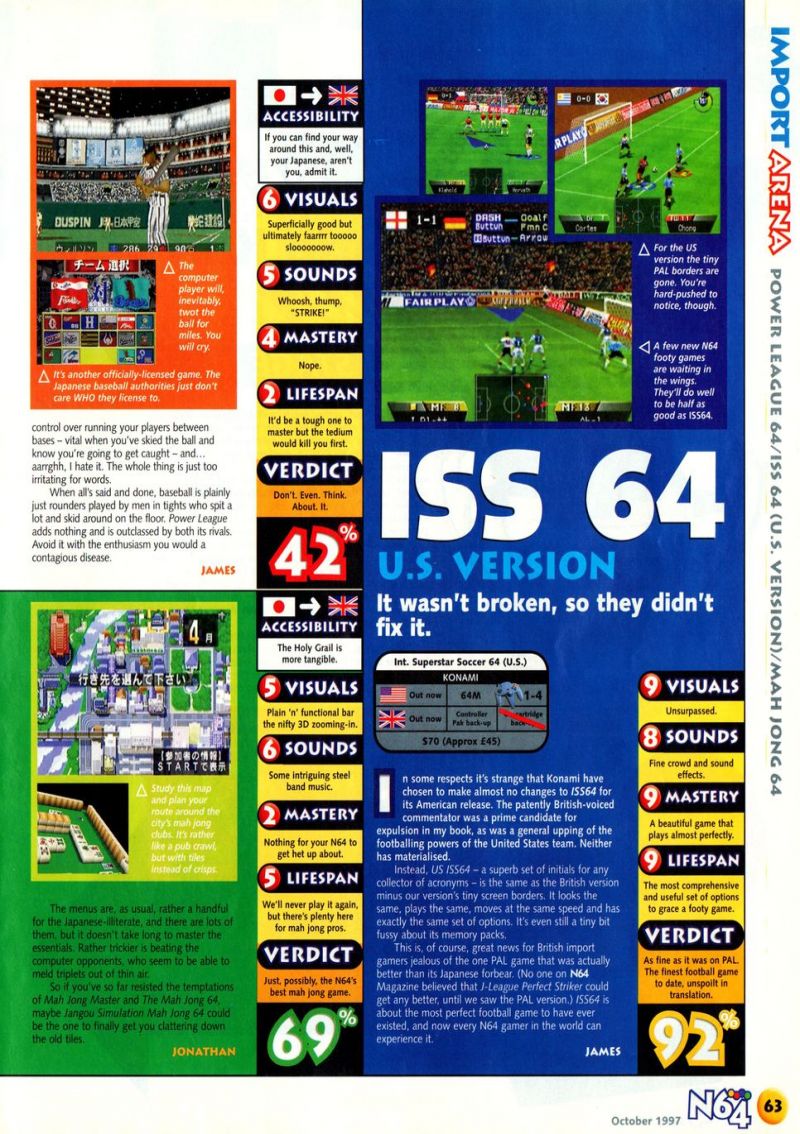
International Superstar Soccer 64 was met with critical acclaim, and often called one of the best of the Nintendo 64's third-party releases.
Gameplay

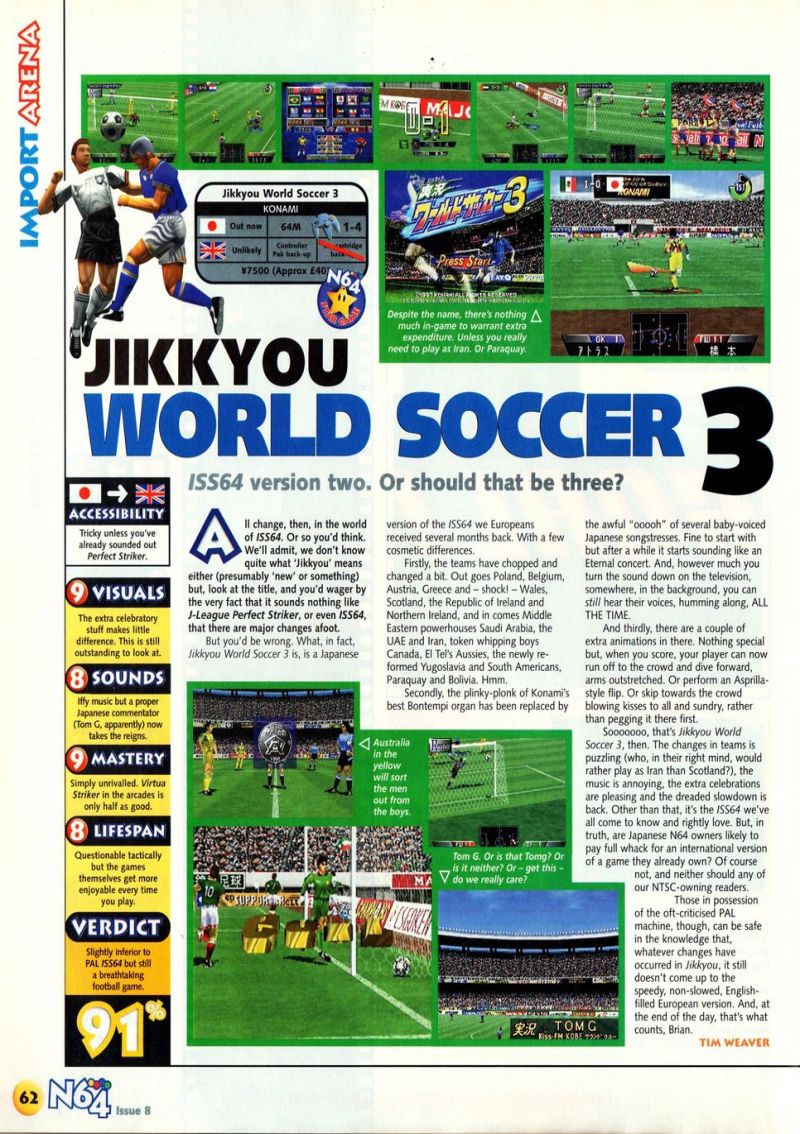
The game is similar to the PlayStation version (including the same player names, with the exception of Japan, England and a handful of American players), but with some teams having a more inaccurate home or away kit. The USA, for example, uses their 1994 World Cup Adidas "stripes" kit as their home kit and their then-current Nike home kit as their away kit. Gameplay is similar to that of the Super NES predecessor, International Superstar Soccer Deluxe, upgraded for the Nintendo 64 with 3D animation. While it keeps largely the same team squads (with the teams now sporting near-authentic kits), South Africa debuted in this game as a selectable side, replacing Morocco. However, the Japanese version has teams that are not present in the Western versions: Bolivia, Yugoslavia, Iran, Australia, Canada and Saudi Arabia. In addition, in ISS 64, Turkey is still incorrectly billed as an Asian team rather than European, unlike in Jikkyō World Soccer 3.
There are six game modes, including single match, league battle and penalty shoot-out.[2] The player can assign a team member to cover a specific member of the opposing team.[2] The International Cup has the player competing against a range of teams from around the world in a round-robin tournament, while the World League is a series of 70 matches against every one of other teams in the game.
The player can also contest a penalty shoot-out competition with up to 4 players or attempt to complete certain scenarios. These matches are set up with a specific goal—for example, scoring a goal within a given time limit or stopping the opposing team from scoring.
Teams
 Germany
 France
 Italy
Italy Switzerland
 Norway
 Denmark
 Sweden
 Spain
Spain Portugal
 Netherlands
 England
 Russia
 Croatia
 Romania
 Bulgaria
 Czech Republic
 Japan
Japan South Korea
 Turkey
 Cameroon
 Nigeria
 South Africa
 Brazil
 Argentina
 Colombia
 Mexico
 Uruguay
 United States
USA/European version exclusive


Japanese version exclusive


Reception
| Reception | ||||||||||||||||||||||||||||||
|---|---|---|---|---|---|---|---|---|---|---|---|---|---|---|---|---|---|---|---|---|---|---|---|---|---|---|---|---|---|---|
| ||||||||||||||||||||||||||||||


The game was a commercial success, selling over 1 million units in Europe.[20]
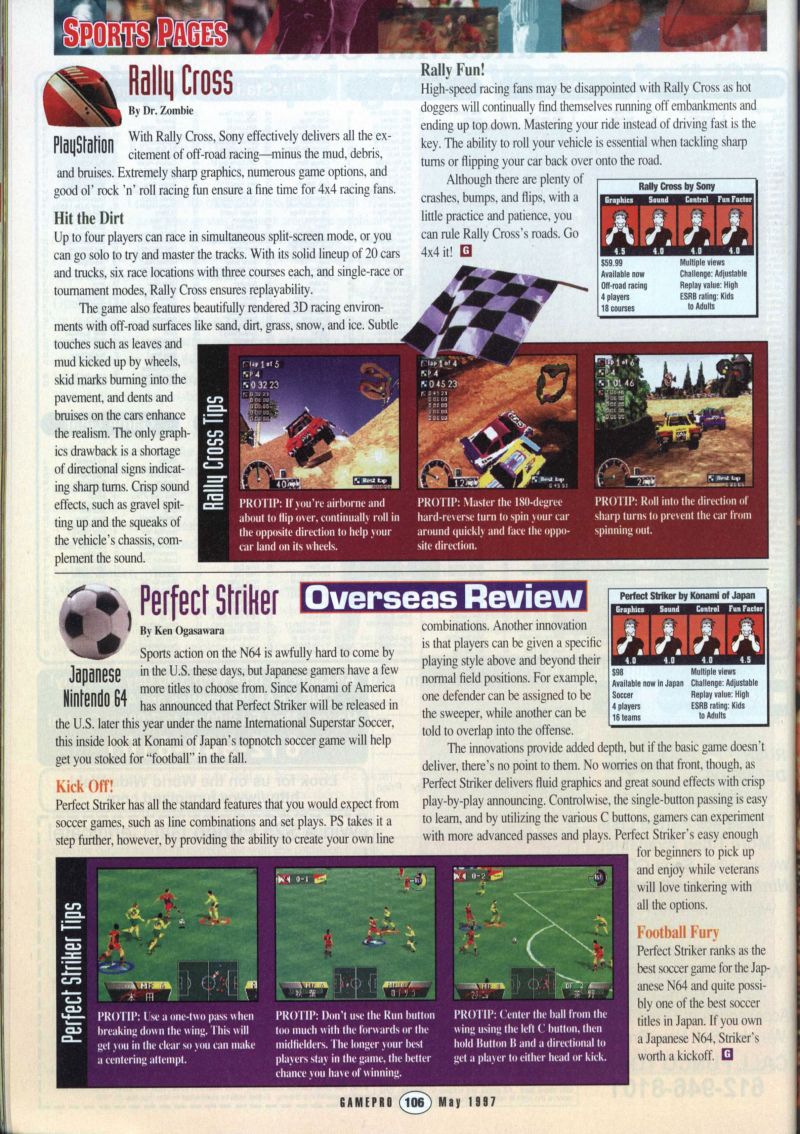
The game met with critical acclaim in Japan.[21] In an interview around the time of the game's release in the region, Shigeru Miyamoto said that "Konami's soccer game may be better than [Nintendo's N64] games. It looks really good."[22] Edge said that the Japanese import was "the most versatile and entertaining football game seen on any platform, and forms a strong addition to Nintendo's 64bit [sic] portfolio."[5] GamePro said that Striker "ranks as the best soccer game for the Japanese N64 and quite possibly one of the best soccer titles in Japan. If you own a Japanese N64, Striker's worth a kick-off."[23][lower-alpha 2] Next Generation said that the same Japanese import "goes farther than most titles in presenting a fantastic look and feel. Just make sure you have a few friends around to play it, otherwise you'll tire from 10-3 wins real quick."[18] Famitsu gave it a score of 32 out of 40 for Perfect Striker,[7] and 31 out of 40 for World Soccer 3.[8]
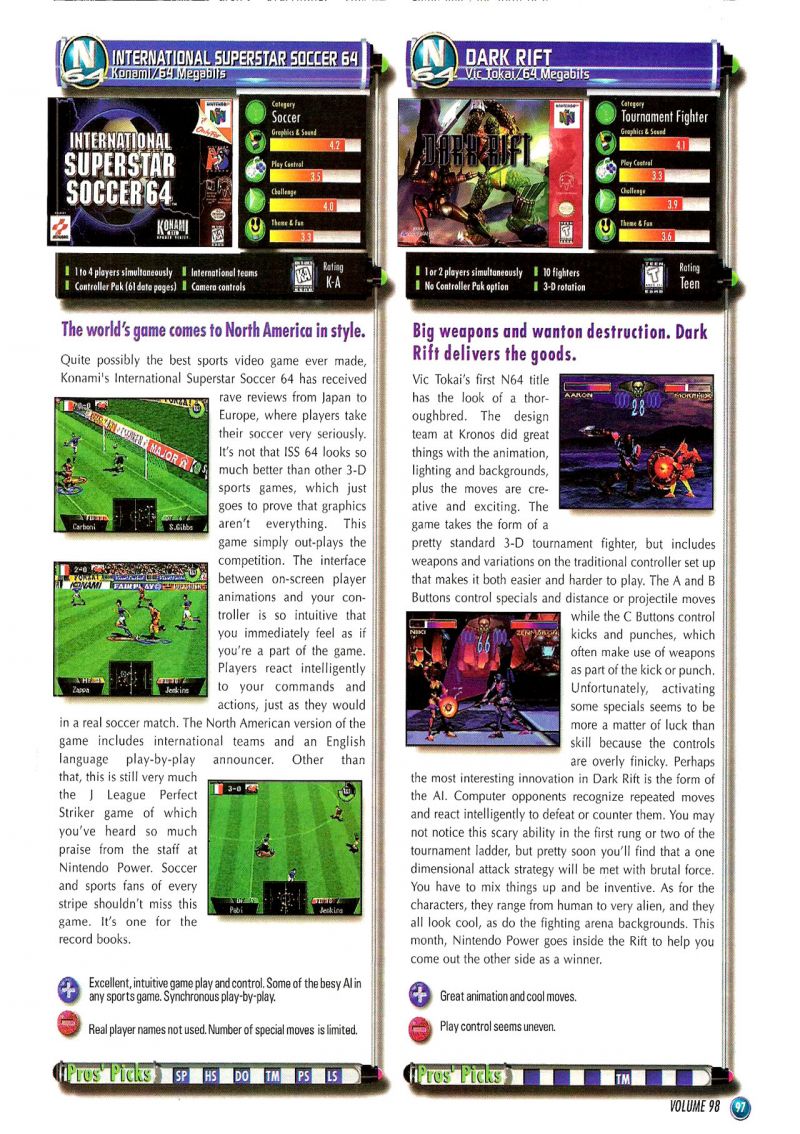
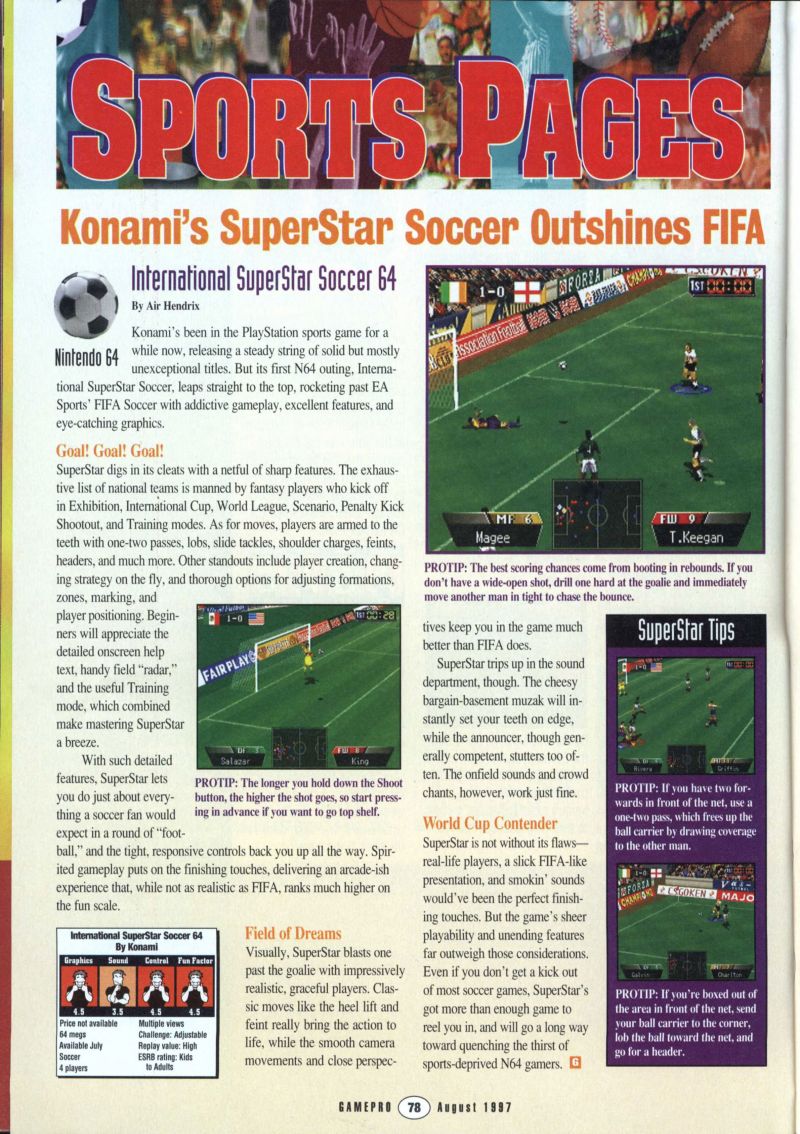
The North American version received favorable reviews, according to the review aggregation website GameRankings. Game Informer gave it universal acclaim, and Nintendo Power gave it a favorable review, over one month before the game was released Stateside.[9][19] Several critics noted that the A.I. in the game was dramatically improved from the Japanese version.[lower-alpha 3] Most said International Superstar Soccer 64 was better than the Nintendo 64's previous soccer game, FIFA Soccer 64,[lower-alpha 4] and Kraig Kujawa of Electronic Gaming Monthly went so far as to call it "without a doubt, the best soccer game on the market".[6] GamePro was one of the few to voice criticisms with the game, specifically the music and the use of fictional players, but called it "an arcade-ish experience that, while not as realistic as FIFA, ranks much higher on the fun scale."[27]
The most often cited strengths of the game included a variety of gameplay modes;[lower-alpha 5] the wide range of moves that the players can execute;[lower-alpha 6] the graceful, lifelike player animations;[lower-alpha 7] and the controls, particularly the tight responsiveness and strong implementation of the Nintendo 64 controller's analog joystick.[lower-alpha 8] However, most critics found it difficult to cover all of the game's positive elements. For example, Next Generation commented, "Details like refs of varying skill, different weather conditions, real stadiums, and attitude give even more depth to a game that gets just about everything right."[17] Peer Schneider of IGN (then known as N64.com) gave strong praise to International Superstar Soccer 64's multiplayer modes.[25] He later published a longer review which covered a few criticisms, such as the lack of a FIFA license, but also commented more extensively on the game's strong attention to detail, and reemphasized that "As far as multiplayer games go, ISS64 has replaced Mario Kart 64, Star Fox 64 and Wayne Gretzky as the ultimate gameplay experience."[24] Glenn Rubenstein of GameSpot said that it "offers just about everything FIFA 64 did. It just does it slightly better."[26]
Just a few months after the game's North American release, Electronic Gaming Monthly ranked it the 24th best console video game of all time, commenting that "The gameplay is awesome, appealing to both hardcore and casual fans of the sport. The graphics are the best of any sports game, as the attention to detail in the player animations is amazing. ... No soccer game comes close to this one."[28] In its 1997 Editors' Choice Awards, Electronic Gaming Monthly also named International Superstar Soccer 64 "Sports Game of the Year" and a runner-up for "Nintendo 64 Game of the Year" (behind GoldenEye 007).[29] Official Nintendo Magazine ranked it the 81st best game available on Nintendo platforms.[30] The game won the award for "Console Sports Game of the Year" at the Academy of Interactive Arts & Sciences' inaugural Interactive Achievement Awards.[31]
Legacy
The intro of a Peruvian bootleg version of the game intended for the Brazilian market, entitled Mundial Ronaldinho Soccer 64, became a popular Internet meme in 2020.[32] The bootleg, made by Peruvian scene organization Twin Eagles Group,[33][34] changed the announcer's language to Portuguese (although the commentator actually speaks a mix of Peruvian Spanish and Portuguese; see Portuñol).[32] Named after Ronaldo Nazário (who was known as "Ronaldinho" in his early international career and should not be confused with Ronaldinho, who in Brazil was given the demonym "Gaúcho" to differentiate from Ronaldo), the title screen uses poorly-edited photos of him.[32] It replaces the fictional names of the players with real-life counterparts (with Ronaldo's name overwriting that of in-game striker Allejo), albeit with errors on some, such as Alan Shearer's name being misspelled as "Schearer".[33]
Notes
- ↑ In GameFan's viewpoint of the game, one critic gave it a score of 95, and the other 97.
- ↑ GamePro gave the Japanese import three 4/5 scores for graphics, sound, and control, and 4.5/5 for fun factor.
- ↑ [24][17][25]
- ↑ [26][17][25][27]
- ↑ [6][26][25][27]
- ↑ [26][24][17][27]
- ↑ [6][26][24][17][25][27]
- ↑ [6][26][24][17][25][27]
References
- ↑ Smith, Erica (August 22, 1997). "On the Shelves This Week". CNET. http://www.gamecenter.com/News/Item/0,3,0-1073,00.html.
- ↑ 2.0 2.1 "NG Alphas: J-League Perfect Striker". Next Generation (Imagine Media) (26): 104. February 1997. https://archive.org/details/NEXT_Generation_26/page/n107/mode/2up. Retrieved October 31, 2020.
- ↑ "International Superstar Soccer 64 for Nintendo 64". CBS Interactive. https://www.gamerankings.com/n64/197641-international-superstar-soccer-64/index.html.
- ↑ Lombardi, Doug (September 25, 1997). "International Superstar Soccer 64". CNET. http://gamecenter.com/Consoles/Nintendo/Isoccer/.
- ↑ 5.0 5.1 Edge staff (February 1997). "J-League Perfect Striker [sic"]. Edge (Future Publishing) (42): 80–81. https://archive.org/details/edgeuk042/page/n67/mode/2up. Retrieved November 1, 2020.
- ↑ 6.0 6.1 6.2 6.3 6.4 EGM staff (July 1997). "Team EGM Sports: International Superstar Soccer 64". Electronic Gaming Monthly (Ziff Davis) (96): 114.
- ↑ 7.0 7.1 "実況Jリーグ パーフェクトストライカー [NINTENDO64"] (in ja). Famitsu (Enterbrain). https://www.famitsu.com/cominy/?m=pc&a=page_h_title&title_id=14491&redirect=no. Retrieved October 31, 2020.
- ↑ 8.0 8.1 "実況ワールドサッカー3 [NINTENDO64"] (in ja). Famitsu (Ziff Davis). https://www.famitsu.com/cominy/?m=pc&a=page_h_title&title_id=14505&redirect=no. Retrieved October 31, 2020.
- ↑ 9.0 9.1 McNamara, Andy; Storm, Jon; Anderson, Paul (July 1997). "International Superstar Soccer [64"]. Game Informer (FuncoLand) (51). http://www.gameinformer.com/july97/soccer.html. Retrieved November 1, 2020.
- ↑ Joe Kidd; Jacques Strap (July 1997). "International Superstar Soccer 64 [game misidentified as "International Superstar Soccer Pro for Sony PlayStation""]. GameFan (Metropolis Media) 5 (7): 86. https://archive.org/details/Gamefan_Vol_5_Issue_07/page/n87/mode/2up. Retrieved July 19, 2021.
- ↑ Colin (September 1997). "International Superstar Soccer 64 Review". CraveOnline. https://www.gamerevolution.com/review/32562-international-su-review.
- ↑ Toose, Dan (September 1997). "International Superstar Soccer 64". Hyper (Next Media Pty Ltd) (47): 46–47. https://retrocdn.net/images/e/ed/Hyper_AU_047.pdf. Retrieved July 19, 2021.
- ↑ Weaver, Tim (June 1997). "International Superstar Soccer 64 (PAL)". N64 Magazine (Future Publishing) (3): 30–36.
- ↑ Ashton, James (October 1997). "ISS 64 (US Version)". N64 Magazine (Future Publishing) (7): 63. http://www.nintendo64ever.com/scans/mags/Scan-Magazine-478-63.jpg. Retrieved November 1, 2020.
- ↑ Weaver, Tim (November 1997). "Jikkyou World Soccer 3". N64 Magazine (Future Publishing) (8): 62. http://www.nintendo64ever.com/scans/mags/Scan-Magazine-479-62.jpg. Retrieved November 1, 2020.
- ↑ Weaver, Tim (April 1997). "J-League Perfect Striker [sic]". N64 Magazine (Future Publishing) (1): 78–80.
- ↑ 17.0 17.1 17.2 17.3 17.4 17.5 17.6 "GOOOALLL! (International Superstar Soccer Review)". Next Generation (Imagine Media) (32): 113. August 1997. https://archive.org/details/NEXT_Generation_32/page/n113/mode/2up. Retrieved October 31, 2020.
- ↑ 18.0 18.1 "J-League Perfect Striker [sic (Japan)"]. Next Generation (Imagine Media) (30): 112. June 1997. https://archive.org/details/NEXT_Generation_30/page/n113/mode/2up. Retrieved October 31, 2020.
- ↑ 19.0 19.1 "International Superstar Soccer 64". Nintendo Power (Nintendo of America) 98: 97. July 1997. http://www.nintendo64ever.com/scans/mags/Scan-Magazine-440-97.jpg. Retrieved November 1, 2020.
- ↑ Schneider, Peer (5 November 1998). "International Superstar Soccer '98 Review". https://www.ign.com/articles/1998/11/05/international-superstar-soccer-98.
- ↑ "Preview: International Superstar Soccer". Electronic Gaming Monthly (Ziff Davis) (104): 112. May 1997.
- ↑ Ogasawara, Ken (March 1997). "Nintendo 64: An Expert's View". GamePro (IDG) (102): 41. https://archive.org/details/GamePro_Issue_092_March_1997/page/n42.
- ↑ Ogasawara, Ken (May 1997). "[Jikkyou J.League Perfect Striker"]. GamePro (IDG) (104): 106. http://www.nintendo64ever.com/scans/mags/Scan-Magazine-1850-106.jpg. Retrieved November 1, 2020.
- ↑ 24.0 24.1 24.2 24.3 24.4 Cite error: Invalid
<ref>tag; no text was provided for refs namedSchneider - ↑ 25.0 25.1 25.2 25.3 25.4 25.5 "International Superstar Soccer 64 Review". Independent. September 3, 1997. http://www.n64.com/thin/reviews/1996.html.
- ↑ 26.0 26.1 26.2 26.3 26.4 26.5 Cite error: Invalid
<ref>tag; no text was provided for refs namedGSrev - ↑ 27.0 27.1 27.2 27.3 27.4 27.5 Air Hendrix (August 1997). "Konami's SuperStar Soccer Outshines FIFA". GamePro (IDG) (107): 78. http://www.nintendo64ever.com/scans/mags/Scan-Magazine-1853-78.jpg. Retrieved October 31, 2020.
- ↑ EGM staff (November 1997). "100 Best Games of All Time". Electronic Gaming Monthly (Ziff Davis) (100): 146. Note: Contrary to the title, the intro to the article (on page 100) explicitly states that the list covers console video games only, meaning PC games and arcade games were not eligible.
- ↑ "Editors' Choice Awards". Electronic Gaming Monthly (Ziff Davis) (104): 87–88. March 1998.
- ↑ East, Tom (February 17, 2009). "Nintendo Feature: 100 Best Nintendo Games: Part One". Future plc. http://www.officialnintendomagazine.co.uk/7188/features/100-best-nintendo-games-part-one/.
- ↑ "The Award - Winners". http://www.interactive.org/html/award/awardwin98.htm.
- ↑ 32.0 32.1 32.2 Cardozo, Daniel (May 18, 2020). "De onde surgiu o meme Ronaldinho Soccer 64" (in Portuguese). Rush Arena. https://rusharena.com.br/de-onde-surgiu-o-meme-ronaldinho-soccer-64/.
- ↑ 33.0 33.1 Azevedo, Rafael Luis (November 12, 2018). "O cara que produziu os games piratas de 'International Superstar Soccer'" (in Portuguese). Vice. https://www.vice.com/pt/article/o-cara-que-produziu-os-games-piratas-de-international-superstar-soccer/.
- ↑ "Ronaldinho Soccer 64 Details - LaunchBox Games Database". https://gamesdb.launchbox-app.com/games/details/117831-ronaldinho-soccer-64.
External links
- MobyGames is a commercial database website that catalogs information on video games and the people and companies behind them via crowdsourcing. This includes over 300,000 games for hundreds of platforms.[1] Founded in 1999, ownership of the site has changed hands several times. It has been owned by Atari SA since 2022.
Features
Edits and submissions to the site (including screenshots, box art, developer information, game summaries, and more) go through a verification process of fact-checking by volunteer "approvers".[2] This approval process after submission can range from minutes to days or months.[3] The most commonly used sources are the video game's website, packaging, and credit screens. There is a published standard for game information and copy-editing.[4] A ranking system allows users to earn points for contributing accurate information.[5]
Registered users can rate and review games. Users can create private or public "have" and "want" lists, which can generate a list of games available for trade with other registered users. The site contains an integrated forum. Each listed game can have its own sub-forum.
History

MobyGames was founded on March 1, 1999, by Jim Leonard and Brian Hirt, and joined by David Berk 18 months later, the three of which had been friends since high school.[6][7] Leonard had the idea of sharing information about computer games with a larger audience. The database began with information about games for IBM PC compatibles, relying on the founders' personal collections. Eventually, the site was opened up to allow general users to contribute information.[5] In a 2003 interview, Berk emphasized MobyGames' dedication to taking video games more seriously than broader society and to preserving games for their important cultural influence.[5]
In mid-2010, MobyGames was purchased by GameFly for an undisclosed amount.[8] This was announced to the community post factum , and the site's interface was given an unpopular redesign.[7] A few major contributors left, refusing to do volunteer work for a commercial website.{{Citation needed|date=June 2025} On December 18, 2013, MobyGames was acquired by Jeremiah Freyholtz, owner of Blue Flame Labs (a San Francisco-based game and web development company) and VGBoxArt (a site for fan-made video game box art).[9] Blue Flame Labs reverted MobyGames' interface to its pre-overhaul look and feel,[10] and for the next eight years, the site was run by Freyholtz and Independent Games Festival organizer Simon Carless.[7]
On November 24, 2021, Atari SA announced a potential deal with Blue Flame Labs to purchase MobyGames for $1.5 million.[11] The purchase was completed on 8 March 2022, with Freyholtz remaining as general manager.[12][13][14] Over the next year, the financial boost given by Atari led to a rework of the site being built from scratch with a new backend codebase, as well as updates improving the mobile and desktop user interface.[1] This was accomplished by investing in full-time development of the site instead of its previously part-time development.[15]
In 2024, MobyGames began offering a paid "Pro" membership option for the site to generate additional revenue.[16] Previously, the site had generated income exclusively through banner ads and (from March 2014 onward) a small number of patrons via the Patreon website.[17]
On February 13, 2025, Freyholtz stepped down as the site lead to move onto new projects, leaving operations to Tracy Poff, a veteran coder on the site, and Atari staff.[18]
See also
- IGDB – game database used by Twitch for its search and discovery functions
References
- ↑ 1.0 1.1 Sheehan, Gavin (2023-02-22). "Atari Relaunches The Fully Rebuilt & Optimized MobyGames Website". https://bleedingcool.com/games/atari-relaunches-the-fully-rebuilt-optimized-mobygames-website/.
- ↑ Litchfield, Ted (2021-11-26). "Zombie company Atari to devour MobyGames". https://www.pcgamer.com/zombie-company-atari-to-devour-mobygames/.
- ↑ "MobyGames FAQ: Emails Answered § When will my submission be approved?". Blue Flame Labs. 30 March 2014. http://www.mobygames.com/info/faq7#g1.
- ↑ "The MobyGames Standards and Practices". Blue Flame Labs. 6 January 2016. http://www.mobygames.com/info/standards.
- ↑ 5.0 5.1 5.2 Miller, Stanley A. (2003-04-22). "People's choice awards honor favorite Web sites". Milwaukee Journal Sentinel.
- ↑ "20 Years of MobyGames" (in en). 2019-02-28. https://trixter.oldskool.org/2019/02/28/20-years-of-mobygames/.
- ↑ 7.0 7.1 7.2 Plunkett, Luke (2022-03-10). "Atari Buys MobyGames For $1.5 Million". https://kotaku.com/mobygames-retro-credits-database-imdb-atari-freyholtz-b-1848638521.
- ↑ "Report: MobyGames Acquired By GameFly Media". Gamasutra. 2011-02-07. https://www.gamedeveloper.com/game-platforms/report-mobygames-acquired-by-gamefly-media.
- ↑ Corriea, Alexa Ray (December 31, 2013). "MobyGames purchased from GameFly, improvements planned". http://www.polygon.com/2013/12/31/5261414/mobygames-purchased-from-gamefly-improvements-planned.
- ↑ Wawro, Alex (31 December 2013). "Game dev database MobyGames getting some TLC under new owner". Gamasutra. https://www.gamedeveloper.com/business/game-dev-database-mobygames-getting-some-tlc-under-new-owner.
- ↑ "Atari invests in Anstream, may buy MobyGames". November 24, 2021. https://www.gamesindustry.biz/articles/2021-11-24-atari-invests-in-anstream-may-buy-mobygames.
- ↑ Rousseau, Jeffrey (2022-03-09). "Atari purchases Moby Games". https://www.gamesindustry.biz/atari-purchases-moby-games.
- ↑ "Atari Completes MobyGames Acquisition, Details Plans for the Site's Continued Support". March 8, 2022. https://www.atari.com/atari-completes-mobygames-acquisition-details-plans-for-the-sites-continued-support/.
- ↑ "Atari has acquired game database MobyGames for $1.5 million" (in en-GB). 2022-03-09. https://www.videogameschronicle.com/news/atari-has-acquired-game-database-mobygames-for-1-5-million/.
- ↑ Stanton, Rich (2022-03-10). "Atari buys videogame database MobyGames for $1.5 million". https://www.pcgamer.com/atari-buys-videogame-database-mobygames-for-dollar15-million/.
- ↑ Harris, John (2024-03-09). "MobyGames Offering “Pro” Membership". https://setsideb.com/mobygames-offering-pro-membership/.
- ↑ "MobyGames on Patreon". http://www.patreon.com/mobygames.
- ↑ "An update on MobyGames leadership". 2025-02-13. https://www.mobygames.com/forum/3/thread/269628/an-update-on-mobygames-leadership/#post-269628.
 |
Wikidata has the property:
|

External links
- No URL found. Please specify a URL here or add one to Wikidata.

 |  |
Warning: Default sort key "International Superstar Soccer 64" overrides earlier default sort key "Mobygames".
| |