Software:Magical Tetris Challenge
| Magical Tetris Challenge | |
|---|---|
 Arcade flyer | |
| Developer(s) | Capcom |
| Publisher(s) | Capcom[lower-alpha 1] |
| Director(s) | Hidemaro Fujibayashi |
| Designer(s) | Hidemaro Fujibayashi |
| Composer(s) | Masato Kouda (Consoles) Harumi Fujita (GBC) |
| Series | Tetris |
| Platform(s) | Arcade, Nintendo 64, PlayStation, Game Boy Color |
| Release | Arcade
PlayStation Game Boy Color |
| Genre(s) | Puzzle |
| Mode(s) | Single-player, multiplayer |
Magical Tetris Challenge[lower-alpha 2] is a 1998 puzzle video game developed and published by Capcom for arcades. It was ported to the Nintendo 64, Game Boy Color and PlayStation. It is a version of Tetris (Russian: Тетрис[lower-alpha 3]) featuring Disney characters. It is one of the few Nintendo 64 games to be entirely in 2D, in addition to being Capcom's first game for the console. The Japanese arcade cabinet and cover art was done by Kenichi Sudo,[1] while the North American cover art was done by Robert Griggs.[2]
Console version
This version is played as one of four characters: Mickey Mouse, Minnie Mouse, Donald Duck, or Goofy, Three game modes are available: Magical Tetris, Updown Tetris, and an Endless mode. Magical and Updown Tetris can be played under Story Mode or in Versus Multiplayer.
Magical Tetris
In Magical Tetris, the player is pitted against an opponent, which is either the A.I. in Story or Endless Modes or another player in Versus Mode. Players control the standard seven Tetris pieces, race to make lines (and consecutive line clears, called combos), and attack the other player. The attacked player receives a set of "magical" pieces, which range from pentomino pieces to square blocks and even very large (up to 5x5-block sized) pieces. Players can also counter one another by making multiple lines to send the pieces back to their opponent. Because of the pentomino pieces, it is possible for a player to clear five lines at once (called a Pentris) using a 5-block straight piece.
Updown and Classic Tetris
Updown Tetris can be considered as an extension of Classic Tetris; Updown Tetris is available in Story and Versus Modes, whereas Classic Tetris takes up what would be the Endless mode. The magical pieces are absent from this mode, and attacking the other player sends a number of lines to the other player; the lines rise from the bottom as filled lines with a one-block gap in a predetermined column and could be used as further lines to attack the opponent.
Common elements
During Magical and Updown Tetris, making lines and combos fills a special meter alongside the board called the Magic Meter, with the fill line initially set to the fourth row; when a player's meter is filled, all of the blocks drop, filling any gaps, and one predetermined column drops out; all the blocks above the meter are wiped clean, the meter resets, and play continues. The meter's fill level may or may not rise depending on the difficulty. If it does rise, it moves up two lines which makes it harder to fill and less effective. The meter can be reduced by two lines (to a minimum of two) by scoring an "All Clear" of completely clearing the board of pieces. In this way, the player is left with filled columns and one empty column, allowing either a Tetris or Pentris to be made easily using a straight piece.
Pieces spawn from the top one row at a time; column grids and a "ghost" piece are provided to aid the players in positioning and dropping pieces. Play stops when a piece entering the grid has to overlap a piece in the board. Players are scored according to the number of combos and counters they make in addition to any other points earned.
Story Mode
Players can choose to be one of four characters (Mickey, Donald, Goofy, or Minnie) to play out the story; each character has a different storyline. It can be played under Magical or Updown Tetris. The last three stages pit the player's character against a Weasel and the Big Bad Wolf before facing the game's main antagonist, Pete.
Game Boy Color
The Game Boy Color version is vastly different from the console versions. Magical and Updown Tetris are present in the game, plus new gameplay styles were added. All four characters are playable, alongside Pete, who is unlocked in Quest Mode, which replaces the console version's Story Mode. Due to limitations of the Game Boy's screen, the player can't see the adversary's gameplay and it is represented with a flashing laser on the left side of the screen, which height represents how tall the adversary's tetris pieces are stacked, and like it, reaching the top of the screen calls for a game over. This version also has the special meter, but only for some Tetris variants.
The Game Boy Color version uses chiptune renditions of music tracks from the console version, and new tracks. Unlike the console versions, each track is used as the theme song for a Tetris variant rather than for a Disney character.
Quest Mode
This mode's main goal consists of a coin rally where the player has the goal of collecting coins that can be gathered by winning a match of Tetris; these are in the possession of certain characters or buildings, and each character has its unique way of playing Tetris. Once the player has all the coins that are needed to win the rally, he must get to the rally station before another player comes in with the coins collected. After beating Quest Mode four times, Pete can be unlocked as a playable character for all game modes. Tetris variants can also be unlocked to be played in single player mode by beating Quest Mode and waiting until the credits end, Updown and Standard Tetris are the only variants available in the start when playing single player.[3]
Signal Tetris
In Signal Tetris, clearing a line will cause the floor blocks below the clearing standard seven Tetris pieces will change color. The objective is to get the floor blocks to match the colors of the line of blocks under the floor. As a result, the player has to be careful about the positioning Tetrominos when clearing lines. Easy and Normal use just red and blue for the floor blocks, but the Expert difficulty adds the color yellow.
Towering Tetris
Towering Tetris starts you with a pile of random garbage blocks that raises throughout the game. The objective is clear the garbage blocks faster than they can raise until you reach the bottom of the pile and clear the keyhole block on the bottom line. In addition to the standard pieces, this mode also features a special 1*2 Piece that shoots an endless supply of 1*1 blocks when you press A or B and then disappears when it locks into place.
Target Tetris
In this puzzle mode, you are given a preset sequence of Tetrominos with which you must clear all of the Target Blocks (represented by Acorns, Lightning Bolts, or Flames depending on mode) on the screen. Each difficulty level has its own set of puzzles, with over a hundred total puzzles.
Reception
| Reception | |||||||||||||||||||||||||||||||||||||||||||||||||||||||
|---|---|---|---|---|---|---|---|---|---|---|---|---|---|---|---|---|---|---|---|---|---|---|---|---|---|---|---|---|---|---|---|---|---|---|---|---|---|---|---|---|---|---|---|---|---|---|---|---|---|---|---|---|---|---|---|
| |||||||||||||||||||||||||||||||||||||||||||||||||||||||
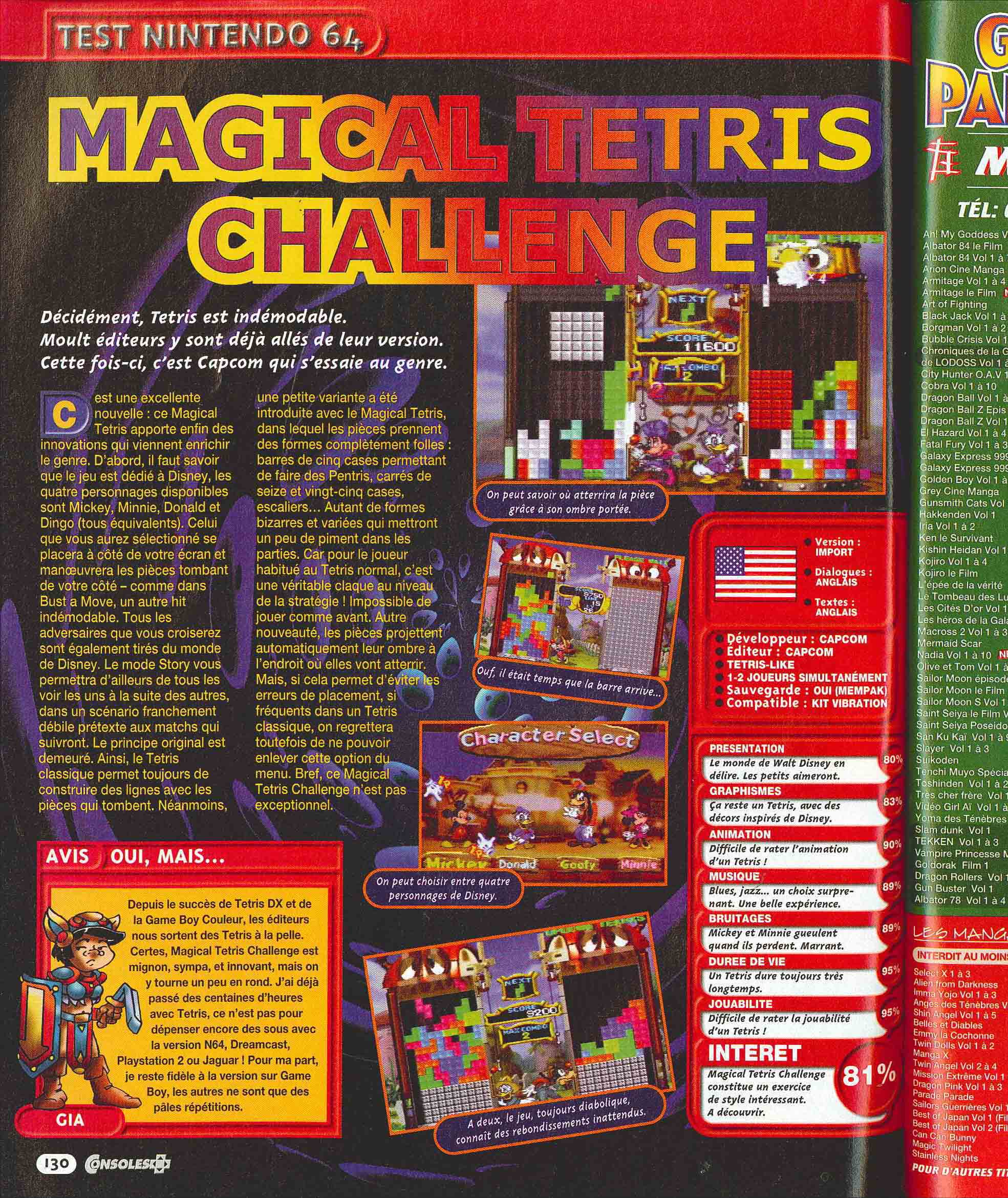
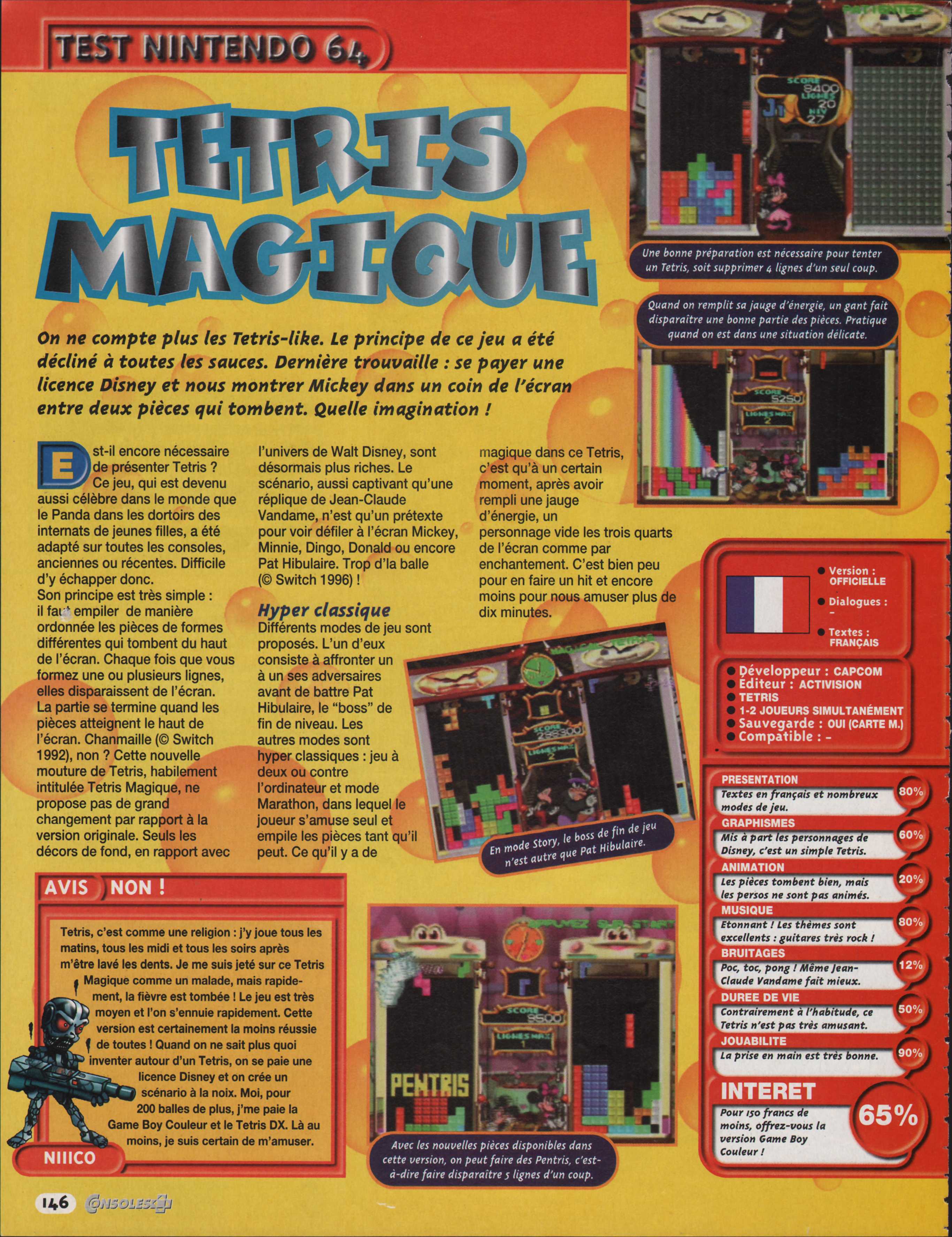
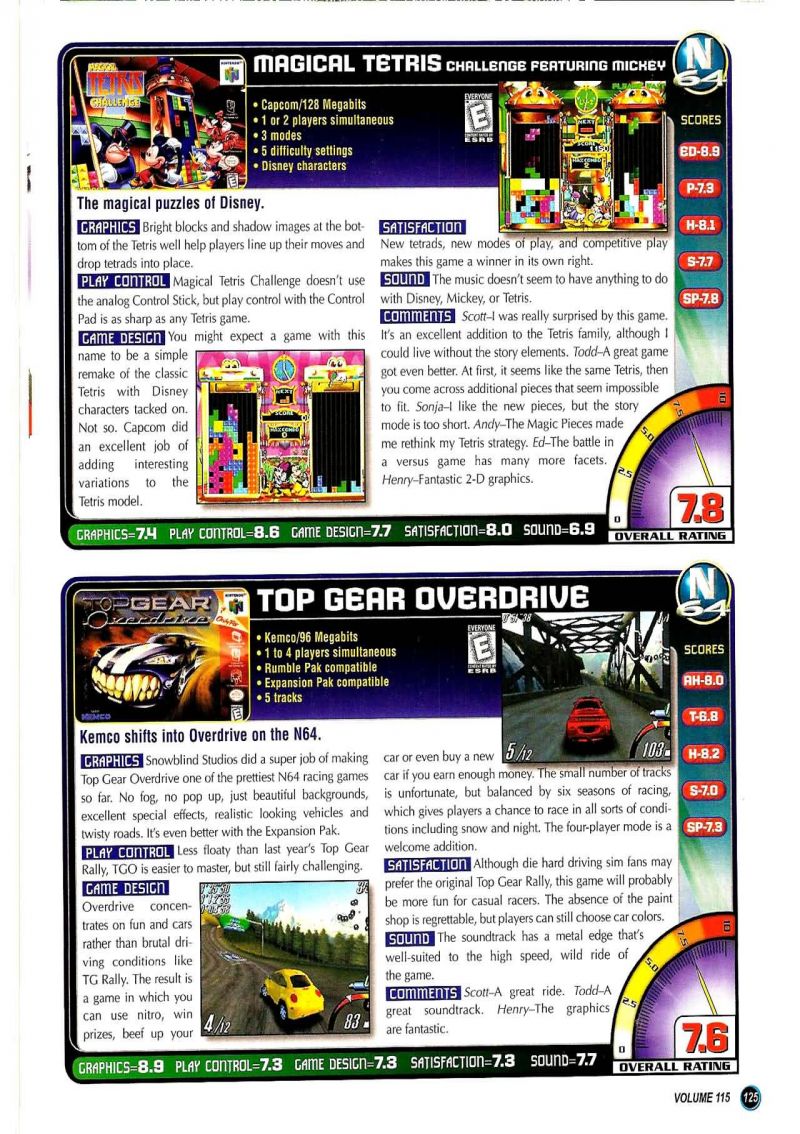
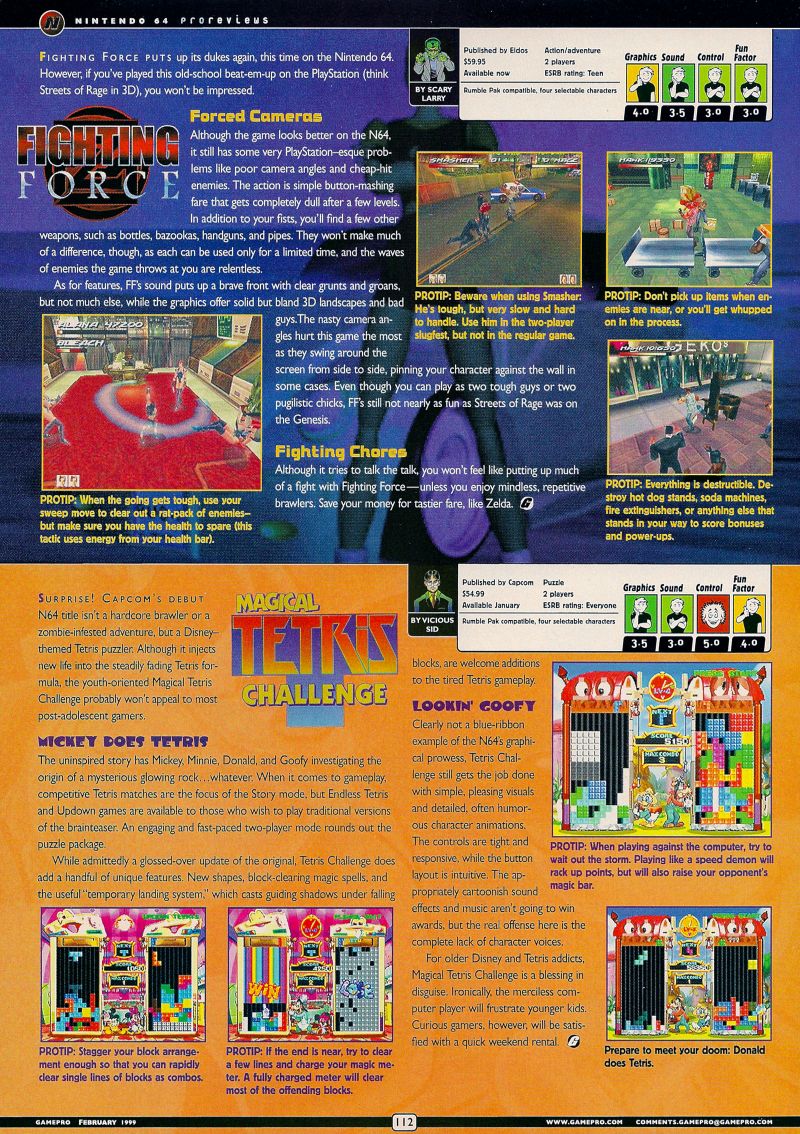
The Game Boy Color version received "favorable" reviews, and the Nintendo 64 version received "average" reviews, according to the review aggregation website GameRankings.[4][5] In Japan, Famitsu gave the PlayStation version a score of 27 out of 40,[11] and later gave the GBC version a score of 26 out of 40.[10] Nintendo Power gave the Japanese Nintendo 64 version a favorable review over a month before the game was released in North America,[20] and GameSpot gave it a mixed review, about two months prior to its North American release date.[14] GamePro said of the Nintendo 64 version, "For older Disney and Tetris addicts, Magical Tetris Challenge is a blessing in disguise. Ironically, the merciless computer player will frustrate younger kids. Curious gamers, however, will be satisfied with a quick weekend rental."[21][lower-alpha 5]
Notes
- ↑ Published in Europe by Sony Computer Entertainment (PlayStation) and Activision (Nintendo 64 and Game Boy Color)
- ↑ Known in Japan as Magical Tetris Challenge Featuring Mickey (Japanese: マジカルテトリスチャレンジ featuring ミッキー, Hepburn: Majikaru Tetorisu Charenji Fīcharingu Mikkī)
- ↑ Pronounced ru or ru
- ↑ In Electronic Gaming Monthly's review of the Nintendo 64 version, two critics gave it each a score of 7.5/10, one gave it 7/10, and the other gave it 8/10.
- ↑ GamePro gave the Nintendo 64 version 3.5/5 for graphics, 3/5 for sound, 5/5 for control, and 4/5 for fun factor.
References
- ↑ "VGDensetsu on Twitter: "The Japanese version was illustrated by Kenichi SUDO / 須藤健一."". Twitter. https://twitter.com/VGDensetsu/status/1837941306758185140.
- ↑ "Robert Griggs (RobertGriggsArt) on Twitter: "Going through some old files and came across the original pencils for the cover of this Capcom USA Nintendo 64 Mickey "Magical Tetris Challenge" game. Didn't realize I had it. So many forgotten drawings."". Twitter. https://twitter.com/robertgriggsart/status/1837612957599256771.
- ↑ "Magical Tetris Challenge Cheats, Codes, and Secrets for Game Boy Color". Red Ventures. https://gamefaqs.gamespot.com/gbc/197843-magical-tetris-challenge/cheats. Retrieved September 20, 2018.
- ↑ 4.0 4.1 "Magical Tetris Challenge for Game Boy Color". CBS Interactive. Archived from the original on May 5, 2019. https://web.archive.org/web/20190505221119/https://www.gamerankings.com/gbc/197843-magical-tetris-challenge/index.html. Retrieved August 18, 2022.
- ↑ 5.0 5.1 "Magical Tetris Challenge for Nintendo 64". CBS Interactive. Archived from the original on May 5, 2019. https://web.archive.org/web/20190505234647/https://www.gamerankings.com/n64/197844-magical-tetris-challenge/index.html. Retrieved August 18, 2022.
- ↑ Broderick, Glenn (January 15, 1999). "Magical Tetris Challenge (N64)". CNET. Archived from the original on August 23, 2000. https://web.archive.org/web/20000823162906/http://gamecenter.com/Consoles/Nintendo/Magictet/. Retrieved August 18, 2022.
- ↑ Gia (March 1999). "Magical Tetris Challenge (N64) [US Import"] (in fr). Consoles + (86): 130. http://download.abandonware.org/magazines/Consoles%20Plus/consoleplus_numero086/Consoles%2B_N86-Page%200130.jpg. Retrieved August 18, 2022.
- ↑ Niiico (October 1999). "Tetris Magique (N64)" (in fr). Consoles + (93): 146. http://download.abandonware.org/magazines/Consoles%20Plus/consoleplus_numero093/Consoles%2B%20093%20-%20Page%20146%20%281999-10%29.jpg. Retrieved August 18, 2022.
- ↑ Hsu, Dan; Ricciardi, John; Smith, Shawn; Boyer, Crispin (February 1999). "Magical Tetris Challenge (N64)". Electronic Gaming Monthly (Ziff Davis) (115): 167. https://archive.org/details/ElectronicGamingMonthly_201902/Electronic%20Gaming%20Monthly%20Issue%20115%20%28February%201999%29/page/n181/mode/2up. Retrieved December 26, 2021.
- ↑ 10.0 10.1 "テトリスアドベンチャー すすめミッキーとなかまたち [ゲームボーイ"] (in ja). Famitsu (Enterbrain). https://www.famitsu.com/cominy/?m=pc&a=page_h_title&title_id=21223. Retrieved September 18, 2018.
- ↑ 11.0 11.1 "マジカル テトリス チャレンジ featuring ミッキー [PS"] (in ja). Famitsu (Enterbrain). https://www.famitsu.com/cominy/?m=pc&a=page_h_title&title_id=18692. Retrieved September 18, 2018.
- ↑ McNamara, Andy; Storm, Jon; Anderson, Paul (January 1999). "Magical Tetris Challenge - Nintendo 64". Game Informer (FuncoLand) (69). https://www.gameinformer.com/reviews/review_detail.cfm?ITEM_ID=3064. Retrieved September 20, 2018.
- ↑ Provo, Frank (March 14, 2000). "Magical Tetris Challenge Review (GBC)". Red Ventures. https://www.gamespot.com/reviews/magical-tetris-challenge-review/1900-2537181/. Retrieved September 20, 2018.
- ↑ 14.0 14.1 Fielder, Lauren (November 18, 1998). "Magical Tetris Challenge Review [Import (N64)"]. Red Ventures. https://www.gamespot.com/reviews/magical-tetris-challenge-review/1900-2544706/. Retrieved September 20, 2018.
- ↑ Harris, Craig (February 28, 2000). "Magical Tetris Challenge (GBC)". Ziff Davis. https://www.ign.com/articles/2000/02/29/magical-tetris-challenge. Retrieved September 20, 2018.
- ↑ Casamassina, Matt (January 15, 1999). "Magical Tetris Challenge (N64)". Ziff Davis. https://www.ign.com/articles/1999/01/16/magical-tetris-challenge-4. Retrieved September 20, 2018.
- ↑ Pseudo supprimé (January 31, 2000). "Test: Defi au Tetris Magique (PS1)" (in fr). Webedia. Archived from the original on December 27, 2021. https://web.archive.org/web/20211227162519/https://www.jeuxvideo.com/articles/0000/00000500_test.htm. Retrieved December 26, 2021.
- ↑ Bickham, Jes (November 1999). "Magical Tetris Challenge". N64 Magazine (Future Publishing) (34): 64. https://archive.org/details/n64magazineukcollection/N64%20Magazine%2034%20-%20november%201999%20%28UK%29%20%28preliminary%20version%29/page/n63/mode/2up. Retrieved December 26, 2021.
- ↑ "Magical Tetris Challenge (GBC)". Nintendo Power (Nintendo of America) 130. March 2000.
- ↑ 20.0 20.1 "Magical Tetris Challenge Featuring Mickey (N64)". Nintendo Power (Nintendo of America) 115: 125. December 1998. https://www.nintendo64ever.com/scans/mags/Scan-Magazine-357-125.jpg. Retrieved September 20, 2018.
- ↑ Vicious Sid (February 1999). "Magical Tetris Challenge (N64)". GamePro (IDG Entertainment) (125): 112. Archived from the original on February 14, 2005. https://web.archive.org/web/20050214065532/http://www.gamepro.com/nintendo/n64/games/reviews/113.shtml. Retrieved September 20, 2018.
External links
- Magical Tetris Challenge at the Killer List of Videogames
- MobyGames is a commercial database website that catalogs information on video games and the people and companies behind them via crowdsourcing. This includes over 300,000 games for hundreds of platforms.[1] Founded in 1999, ownership of the site has changed hands several times. It has been owned by Atari SA since 2022.
Features
Edits and submissions to the site (including screenshots, box art, developer information, game summaries, and more) go through a verification process of fact-checking by volunteer "approvers".[2] This approval process after submission can range from minutes to days or months.[3] The most commonly used sources are the video game's website, packaging, and credit screens. There is a published standard for game information and copy-editing.[4] A ranking system allows users to earn points for contributing accurate information.[5]
Registered users can rate and review games. Users can create private or public "have" and "want" lists, which can generate a list of games available for trade with other registered users. The site contains an integrated forum. Each listed game can have its own sub-forum.
History

MobyGames was founded on March 1, 1999, by Jim Leonard and Brian Hirt, and joined by David Berk 18 months later, the three of which had been friends since high school.[6][7] Leonard had the idea of sharing information about computer games with a larger audience. The database began with information about games for IBM PC compatibles, relying on the founders' personal collections. Eventually, the site was opened up to allow general users to contribute information.[5] In a 2003 interview, Berk emphasized MobyGames' dedication to taking video games more seriously than broader society and to preserving games for their important cultural influence.[5]
In mid-2010, MobyGames was purchased by GameFly for an undisclosed amount.[8] This was announced to the community post factum , and the site's interface was given an unpopular redesign.[7] A few major contributors left, refusing to do volunteer work for a commercial website.{{Citation needed|date=June 2025} On December 18, 2013, MobyGames was acquired by Jeremiah Freyholtz, owner of Blue Flame Labs (a San Francisco-based game and web development company) and VGBoxArt (a site for fan-made video game box art).[9] Blue Flame Labs reverted MobyGames' interface to its pre-overhaul look and feel,[10] and for the next eight years, the site was run by Freyholtz and Independent Games Festival organizer Simon Carless.[7]
On November 24, 2021, Atari SA announced a potential deal with Blue Flame Labs to purchase MobyGames for $1.5 million.[11] The purchase was completed on 8 March 2022, with Freyholtz remaining as general manager.[12][13][14] Over the next year, the financial boost given by Atari led to a rework of the site being built from scratch with a new backend codebase, as well as updates improving the mobile and desktop user interface.[1] This was accomplished by investing in full-time development of the site instead of its previously part-time development.[15]
In 2024, MobyGames began offering a paid "Pro" membership option for the site to generate additional revenue.[16] Previously, the site had generated income exclusively through banner ads and (from March 2014 onward) a small number of patrons via the Patreon website.[17]
On February 13, 2025, Freyholtz stepped down as the site lead to move onto new projects, leaving operations to Tracy Poff, a veteran coder on the site, and Atari staff.[18]
See also
- IGDB – game database used by Twitch for its search and discovery functions
References
- ↑ 1.0 1.1 Sheehan, Gavin (2023-02-22). "Atari Relaunches The Fully Rebuilt & Optimized MobyGames Website". https://bleedingcool.com/games/atari-relaunches-the-fully-rebuilt-optimized-mobygames-website/.
- ↑ Litchfield, Ted (2021-11-26). "Zombie company Atari to devour MobyGames". https://www.pcgamer.com/zombie-company-atari-to-devour-mobygames/.
- ↑ "MobyGames FAQ: Emails Answered § When will my submission be approved?". Blue Flame Labs. 30 March 2014. http://www.mobygames.com/info/faq7#g1.
- ↑ "The MobyGames Standards and Practices". Blue Flame Labs. 6 January 2016. http://www.mobygames.com/info/standards.
- ↑ 5.0 5.1 5.2 Miller, Stanley A. (2003-04-22). "People's choice awards honor favorite Web sites". Milwaukee Journal Sentinel.
- ↑ "20 Years of MobyGames" (in en). 2019-02-28. https://trixter.oldskool.org/2019/02/28/20-years-of-mobygames/.
- ↑ 7.0 7.1 7.2 Plunkett, Luke (2022-03-10). "Atari Buys MobyGames For $1.5 Million". https://kotaku.com/mobygames-retro-credits-database-imdb-atari-freyholtz-b-1848638521.
- ↑ "Report: MobyGames Acquired By GameFly Media". Gamasutra. 2011-02-07. https://www.gamedeveloper.com/game-platforms/report-mobygames-acquired-by-gamefly-media.
- ↑ Corriea, Alexa Ray (December 31, 2013). "MobyGames purchased from GameFly, improvements planned". http://www.polygon.com/2013/12/31/5261414/mobygames-purchased-from-gamefly-improvements-planned.
- ↑ Wawro, Alex (31 December 2013). "Game dev database MobyGames getting some TLC under new owner". Gamasutra. https://www.gamedeveloper.com/business/game-dev-database-mobygames-getting-some-tlc-under-new-owner.
- ↑ "Atari invests in Anstream, may buy MobyGames". November 24, 2021. https://www.gamesindustry.biz/articles/2021-11-24-atari-invests-in-anstream-may-buy-mobygames.
- ↑ Rousseau, Jeffrey (2022-03-09). "Atari purchases Moby Games". https://www.gamesindustry.biz/atari-purchases-moby-games.
- ↑ "Atari Completes MobyGames Acquisition, Details Plans for the Site's Continued Support". March 8, 2022. https://www.atari.com/atari-completes-mobygames-acquisition-details-plans-for-the-sites-continued-support/.
- ↑ "Atari has acquired game database MobyGames for $1.5 million" (in en-GB). 2022-03-09. https://www.videogameschronicle.com/news/atari-has-acquired-game-database-mobygames-for-1-5-million/.
- ↑ Stanton, Rich (2022-03-10). "Atari buys videogame database MobyGames for $1.5 million". https://www.pcgamer.com/atari-buys-videogame-database-mobygames-for-dollar15-million/.
- ↑ Harris, John (2024-03-09). "MobyGames Offering “Pro” Membership". https://setsideb.com/mobygames-offering-pro-membership/.
- ↑ "MobyGames on Patreon". http://www.patreon.com/mobygames.
- ↑ "An update on MobyGames leadership". 2025-02-13. https://www.mobygames.com/forum/3/thread/269628/an-update-on-mobygames-leadership/#post-269628.
 |
Wikidata has the property:
|

External links
- No URL found. Please specify a URL here or add one to Wikidata.
 |  |
- MobyGames is a commercial database website that catalogs information on video games and the people and companies behind them via crowdsourcing. This includes over 300,000 games for hundreds of platforms.[1] Founded in 1999, ownership of the site has changed hands several times. It has been owned by Atari SA since 2022.
Features
Edits and submissions to the site (including screenshots, box art, developer information, game summaries, and more) go through a verification process of fact-checking by volunteer "approvers".[2] This approval process after submission can range from minutes to days or months.[3] The most commonly used sources are the video game's website, packaging, and credit screens. There is a published standard for game information and copy-editing.[4] A ranking system allows users to earn points for contributing accurate information.[5]
Registered users can rate and review games. Users can create private or public "have" and "want" lists, which can generate a list of games available for trade with other registered users. The site contains an integrated forum. Each listed game can have its own sub-forum.
History
MobyGames was founded on March 1, 1999, by Jim Leonard and Brian Hirt, and joined by David Berk 18 months later, the three of which had been friends since high school.[6][7] Leonard had the idea of sharing information about computer games with a larger audience. The database began with information about games for IBM PC compatibles, relying on the founders' personal collections. Eventually, the site was opened up to allow general users to contribute information.[5] In a 2003 interview, Berk emphasized MobyGames' dedication to taking video games more seriously than broader society and to preserving games for their important cultural influence.[5]
In mid-2010, MobyGames was purchased by GameFly for an undisclosed amount.[8] This was announced to the community post factum , and the site's interface was given an unpopular redesign.[7] A few major contributors left, refusing to do volunteer work for a commercial website.{{Citation needed|date=June 2025} On December 18, 2013, MobyGames was acquired by Jeremiah Freyholtz, owner of Blue Flame Labs (a San Francisco-based game and web development company) and VGBoxArt (a site for fan-made video game box art).[9] Blue Flame Labs reverted MobyGames' interface to its pre-overhaul look and feel,[10] and for the next eight years, the site was run by Freyholtz and Independent Games Festival organizer Simon Carless.[7]
On November 24, 2021, Atari SA announced a potential deal with Blue Flame Labs to purchase MobyGames for $1.5 million.[11] The purchase was completed on 8 March 2022, with Freyholtz remaining as general manager.[12][13][14] Over the next year, the financial boost given by Atari led to a rework of the site being built from scratch with a new backend codebase, as well as updates improving the mobile and desktop user interface.[1] This was accomplished by investing in full-time development of the site instead of its previously part-time development.[15]
In 2024, MobyGames began offering a paid "Pro" membership option for the site to generate additional revenue.[16] Previously, the site had generated income exclusively through banner ads and (from March 2014 onward) a small number of patrons via the Patreon website.[17]
On February 13, 2025, Freyholtz stepped down as the site lead to move onto new projects, leaving operations to Tracy Poff, a veteran coder on the site, and Atari staff.[18]
See also
- IGDB – game database used by Twitch for its search and discovery functions
References
- ↑ 1.0 1.1 Sheehan, Gavin (2023-02-22). "Atari Relaunches The Fully Rebuilt & Optimized MobyGames Website". https://bleedingcool.com/games/atari-relaunches-the-fully-rebuilt-optimized-mobygames-website/.
- ↑ Litchfield, Ted (2021-11-26). "Zombie company Atari to devour MobyGames". https://www.pcgamer.com/zombie-company-atari-to-devour-mobygames/.
- ↑ "MobyGames FAQ: Emails Answered § When will my submission be approved?". Blue Flame Labs. 30 March 2014. http://www.mobygames.com/info/faq7#g1.
- ↑ "The MobyGames Standards and Practices". Blue Flame Labs. 6 January 2016. http://www.mobygames.com/info/standards.
- ↑ 5.0 5.1 5.2 Miller, Stanley A. (2003-04-22). "People's choice awards honor favorite Web sites". Milwaukee Journal Sentinel.
- ↑ "20 Years of MobyGames" (in en). 2019-02-28. https://trixter.oldskool.org/2019/02/28/20-years-of-mobygames/.
- ↑ 7.0 7.1 7.2 Plunkett, Luke (2022-03-10). "Atari Buys MobyGames For $1.5 Million". https://kotaku.com/mobygames-retro-credits-database-imdb-atari-freyholtz-b-1848638521.
- ↑ "Report: MobyGames Acquired By GameFly Media". Gamasutra. 2011-02-07. https://www.gamedeveloper.com/game-platforms/report-mobygames-acquired-by-gamefly-media.
- ↑ Corriea, Alexa Ray (December 31, 2013). "MobyGames purchased from GameFly, improvements planned". http://www.polygon.com/2013/12/31/5261414/mobygames-purchased-from-gamefly-improvements-planned.
- ↑ Wawro, Alex (31 December 2013). "Game dev database MobyGames getting some TLC under new owner". Gamasutra. https://www.gamedeveloper.com/business/game-dev-database-mobygames-getting-some-tlc-under-new-owner.
- ↑ "Atari invests in Anstream, may buy MobyGames". November 24, 2021. https://www.gamesindustry.biz/articles/2021-11-24-atari-invests-in-anstream-may-buy-mobygames.
- ↑ Rousseau, Jeffrey (2022-03-09). "Atari purchases Moby Games". https://www.gamesindustry.biz/atari-purchases-moby-games.
- ↑ "Atari Completes MobyGames Acquisition, Details Plans for the Site's Continued Support". March 8, 2022. https://www.atari.com/atari-completes-mobygames-acquisition-details-plans-for-the-sites-continued-support/.
- ↑ "Atari has acquired game database MobyGames for $1.5 million" (in en-GB). 2022-03-09. https://www.videogameschronicle.com/news/atari-has-acquired-game-database-mobygames-for-1-5-million/.
- ↑ Stanton, Rich (2022-03-10). "Atari buys videogame database MobyGames for $1.5 million". https://www.pcgamer.com/atari-buys-videogame-database-mobygames-for-dollar15-million/.
- ↑ Harris, John (2024-03-09). "MobyGames Offering “Pro” Membership". https://setsideb.com/mobygames-offering-pro-membership/.
- ↑ "MobyGames on Patreon". http://www.patreon.com/mobygames.
- ↑ "An update on MobyGames leadership". 2025-02-13. https://www.mobygames.com/forum/3/thread/269628/an-update-on-mobygames-leadership/#post-269628.
|
Wikidata has the property:
|
External links
- No URL found. Please specify a URL here or add one to Wikidata.
| Corporations |
|  | ||||
|---|---|---|---|---|---|---|
| Arcades games and amusements |
| |||||
| Software and utilities | ||||||
| Video game consoles |
| |||||
| Personal computers |
| |||||
| Peripherals |
| |||||
| Other | ||||||
| |
Template:Mickey Mouse games Template:Donald Duck games Template:Goofy games
| |