Software:The Terminator: Future Shock
| The Terminator: Future Shock | |
|---|---|
 North American cover art with the T-800 Terminator cyborg. | |
| Developer(s) | Bethesda Softworks |
| Publisher(s) | Bethesda Softworks |
| Director(s) | Kaare Siesing |
| Producer(s) | Todd Howard |
| Designer(s) |
|
| Programmer(s) |
|
| Writer(s) |
|
| Composer(s) | Andy Warr |
| Engine | XnGine |
| Platform(s) | MS-DOS |
| Release | December 1995[1] |
| Genre(s) | First-person shooter |
| Mode(s) | Single-player |
The Terminator: Future Shock is a first-person shooter video game for MS-DOS developed by Bethesda Softworks and released in 1995. It is based on the Terminator franchise. The game received generally positive reviews, and a sequel, Skynet, was released in 1996.
Gameplay

Future Shock is a first-person shooter in which the player navigates 3D levels in a post-apocalyptic world while fighting enemy robots with a wide variety of guns and grenades. Each level requires the player to accomplish a number of objectives before progressing. Levels include harsh terrain, as many areas contain radiation that is lethal to the player character. The terrain is navigated in three ways: on foot, in a jeep with a mounted cannon, or in an aerial combat robot, referred to as an HK fighter.
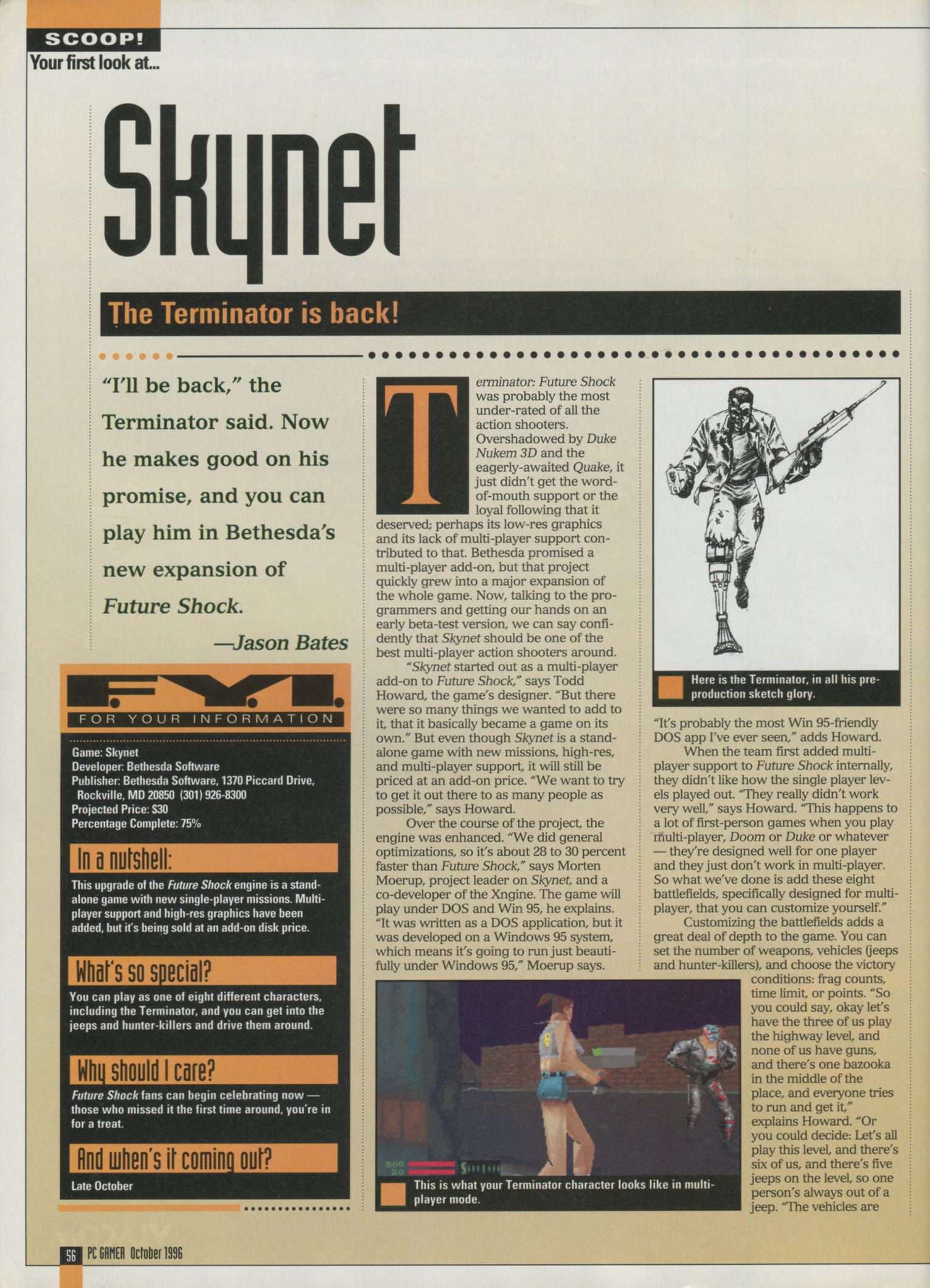
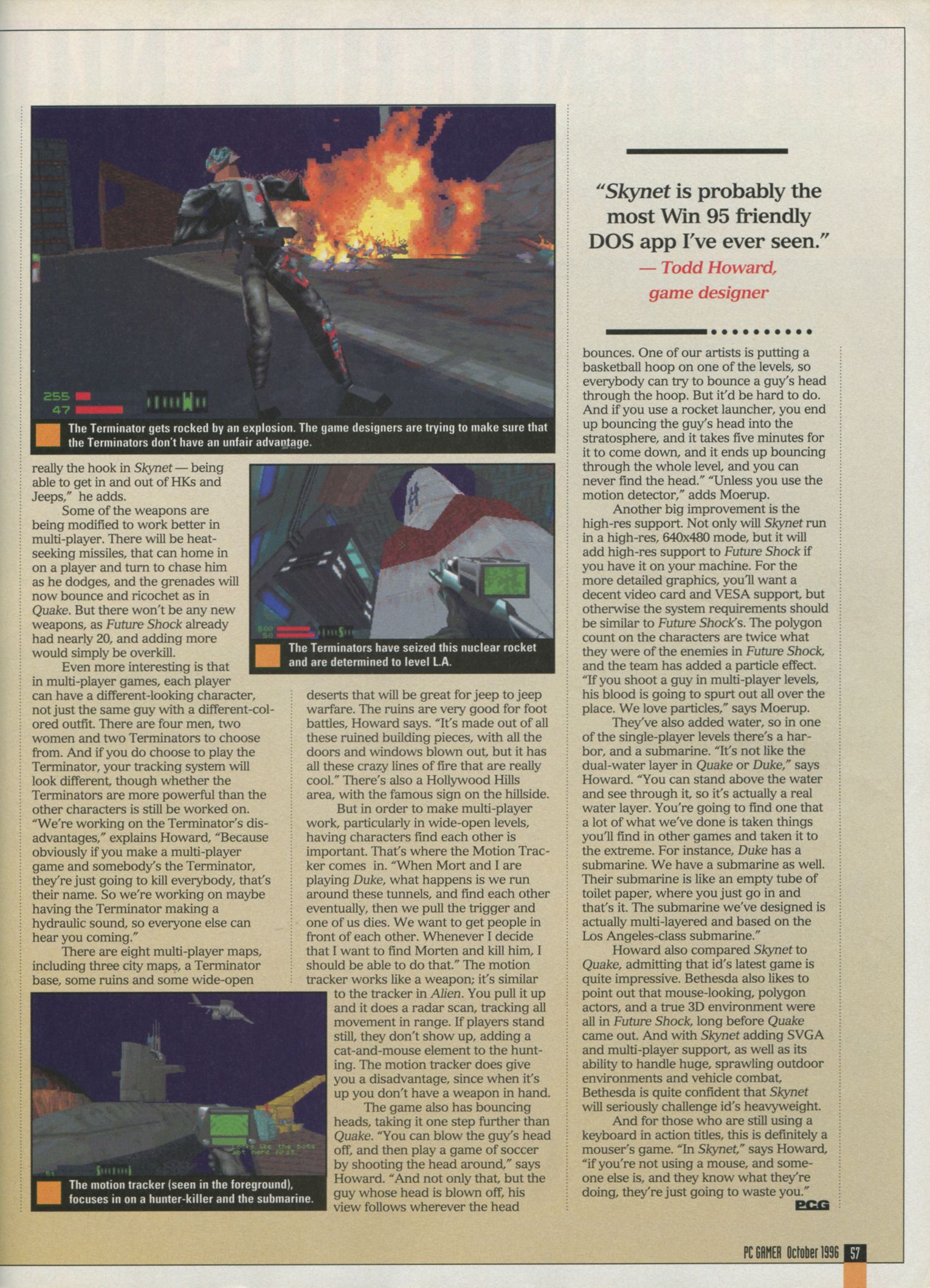
Future Shock is single-player only.[2] A multiplayer deathmatch mode was added to the sequel, Skynet.
Plot
Set in a post-apocalyptic future, The Terminator: Future Shock begins in 2015 with the player character escaping from an extermination camp with the help of the Human Resistance. After escaping, the character is introduced to John Connor, the leader of the Human Resistance, as well as a young Kyle Reese and begins aiding the resistance effort with missions. After several missions, T-800 model Terminators infiltrate the Human Resistance headquarters, causing its leadership to establish a new headquarters elsewhere. The player character later witnesses enemies appearing out of nowhere, eventually learning that Skynet has perfected time displacement. As a result of the successful resistance missions, Skynet from the future begins manipulating time by strategically placing its forces to thwart successful resistance maneuvers. The Human Resistance learns that Skynet is using time displacement to transmit information to itself in 1995 in an attempt to increase the speed at which it will become sentient. The player character is sent on a mission to stop Skynet as the resistance HQ is besieged and Kyle Reese and Connor himself are seriously wounded.
Development
Bethesda Softworks developed the game using its XnGine 3D graphics engine, which the company had invested over $3 million into developing. Todd Howard produced the title.[1][3] The XnGine engine incorporated technology advances to portray more realism in games, such as quicker action, unrestricted viewing angles, and freedom of movement. Its proprietary technology integrates 360-degree rotation with fully textured polygons, SVGA/VGA graphics and specialized video effects. XnGine can generate weather effects, such as snow, sleet and fog; realistic shading; and textured, contoured terrain.[4] Howard described the engine as a true 3D engine capable of real-time phong shading, which helps simulate area lighting effects from sources of light in the environment.[3] Future Shock was one of the first games in the first-person shooter genre to feature true, fully texture-mapped 3D environments and enemies, and pioneered the use of mouse-look control.[5][6] It was developed by a team of eight or ten people.[7]
The game was originally scheduled to release in August 1995.[8] However, a game demo was released in November 1995 and the full game was not released until December.[1] A network, multi-layer module was planned for release in February 1996[1] but ultimately was not. Virgin Interactive Entertainment distributed the game in the UK, Germany, Australia, Scandinavia, Spain, and Italy.[9]
Reception
| Reception | ||||||||||||||||||||
|---|---|---|---|---|---|---|---|---|---|---|---|---|---|---|---|---|---|---|---|---|
| ||||||||||||||||||||
The Terminator: Future Shock received generally favorable reviews from gaming publications. In the United Kingdom, the game ranked 5th in the best-sellers CD-ROMs for PCs during the week of February 25, 1996 according to the European Leisure Software Publishers Association.[18]
Tal Blevins of GameSpot praised several aspects of the game. He described the game environment as "well thought-out", the control system as "smooth", and the audio-visuals as "superb", noting the family movie soundtrack.[10] Phil Bedard of Computer Games Magazine compared the game to Doom, "but with some things thrown in that make it different". Bedard praised the music and stereo sound effects but wished that the game supported a higher resolution. He criticized the character controls, calling them difficult, as well as the occasional gameplay lag caused by a large number of game objects and the lack of network play.[12]
A reviewer for Next Generation praised the game's immersion into the film's post-apocalypse world and noted that the freedom of exploration and destruction sets it apart from other first-person shooters. However, he called it "more frustrating than fun", noting that the freedom of movement necessitates complex controls, which the reviewer described as difficult and cumbersome. He further wrote that the dark color palette makes it challenging to see enemies.[13] A Maximum reviewer called it "a slick, professional blaster that sets new standards in the movie to game license wars". He commented that the game's only weakness is the lack of multiplayer and cited multiple positives: the "tangible and involving" environments, the varied mission objectives, the player controlled vehicles, the story line, the mouse look control, and the variety of weapons.[16]
T. Liam McDonald of PC Gamer called it a "damned fine game in many ways", praising the graphics and sound effects, but he was critical of the awkward controls and the difficulty in aiming, as well as the lack of multiplayer.[15] Simon Cox, writing for the UK-based PC Gamer, praised Future Shock as a scary game and "one of the most atmospheric and believable shoot-'em-ups ever". However, he also considered the controls difficult to use at first.[14] Roy Bassave of Knight Ridder said that the game is the most sophisticated 3D game yet.[19]
In retrospect over a decade later, Todd Howard described the game as a forgotten title.[20]
References
- ↑ 1.0 1.1 1.2 1.3 "Terminator: Future Shock Demo Creates Website Gridlock for Bethesda; Top Internet Games Site Dubs it "Most Popular Game of the Season". November 20, 1995. https://go.gale.com/ps/i.do?p=GPS&u=wikipedia&id=GALE%7CA17769672&v=2.1&it=r&sid=bookmark-GPS&asid=3beba313. Retrieved July 15, 2024.
- ↑ Bates, Jason (October 1996). "Skynet". p. 56. Archived from the original on March 22, 2016. https://web.archive.org/web/20160322223355/http://scans.roushimsx.com/PCGamer_1996_10_pg056.jpg. Retrieved November 10, 2023.
- ↑ 3.0 3.1 White, Rod (February 27, 1996). "An Interview with Todd Howard, Producer of Terminator: Future Shock". http://www.pcme.com/intrview.htm. Retrieved August 31, 2023. "Disable JavaScript to avoid being redirected&access the Interview"
- ↑ "The Terminator: Future Shock". February 3, 1996. p. 92. Archived from the original on November 19, 2023. https://web.archive.org/web/20231119115017/https://www.newspapers.com/article/the-miami-herald/132888984/. Retrieved July 15, 2024.
- ↑ "The Genesis of a Genre". November 2004. p. 47. https://archive.org/details/atomic-046/page/46/mode/2up. Retrieved February 10, 2026.
- ↑ Staff (October 1996). "Skynet: The Terminator is Back". PC Gamer (Future plc) 3 (10): 57. ISSN 1080-4471. Archived from the original. Error: If you specify
|archiveurl=, you must also specify|archivedate=. https://web.archive.org/web/20160322191936/http://scans.roushimsx.com/PCGamer_1996_10_pg057.jpg. Retrieved November 10, 2023. - ↑ MacDonald, Keza (November 30, 2020). "To say, I saved the world – that's the magic of games': Bethesda's Todd Howard". Archived from the original on November 30, 2020. https://web.archive.org/web/20201130110422/https://www.theguardian.com/games/2020/nov/30/todd-howard-bethesda-starfield-future-games-interview. Retrieved January 22, 2026.
- ↑ Perkins, Lee (July 20, 1995). "ACE in hand for SkyNet beaters". p. 54. Archived from the original on July 15, 2024. https://web.archive.org/web/20240715082651/https://www.newspapers.com/article/the-age/151365586/. Retrieved July 15, 2024.
- ↑ "The Terminator: Future Shock". Archived from the original on January 31, 1998. https://web.archive.org/web/19980131114802/http://www.vie.co.uk/products/term_fs/term_fs.htm. Retrieved June 17, 2025.
- ↑ 10.0 10.1 Blevins, Tal (May 28, 1996). "The Terminator: Future Shock Review". Archived from the original. Error: If you specify
|archiveurl=, you must also specify|archivedate=. https://web.archive.org/web/20141220073539/http://www.gamespot.com/reviews/terminator-future-shock-review/1900-2533376/. - ↑ Olafson, Peter (March 1996). "The Terminator: Future Shock Review". pp. 150,154. Archived from the original. Error: If you specify
|archiveurl=, you must also specify|archivedate=. https://web.archive.org/web/20130511185928/http://www.cgwmuseum.org/galleries/issues/cgw_140.pdf. - ↑ 12.0 12.1 Bedard, Phil (December 17, 1997). "Terminator: Future Shock review". Computer Games Magazine. http://www.cdmag.com/articles/018/151/terminatorfs_review.html.
- ↑ 13.0 13.1 "Terminator: Future Shock". Next Generation (Imagine Media) (16): 95. April 1996. https://archive.org/details/NEXT_Generation_16/page/n97/mode/2up.
- ↑ 14.0 14.1 Cox, Simon. "The Terminator: Future Shock". http://www.pcgamer.co.uk/games/gamefile_review_page.asp?item_id=1240.
- ↑ 15.0 15.1 McDonald, T. Liam (April 1995). "Terminator: Future Shock". Archived from the original. Error: If you specify
|archiveurl=, you must also specify|archivedate=. https://web.archive.org/web/20000226134638/http://www.pcgamer.com/reviews/1037.html. - ↑ 16.0 16.1 "Maximum Reviews: Terminator: Future Shock". Maximum: The Video Game Magazine (Emap International Limited) (5): 161. April 1996.
- ↑ Wildgoose, David (May 1996). "The Terminator: Future Shock". PC PowerPlay (1): 52–53. https://archive.org/details/PCPowerplay-001-1996-05/page/n51/mode/2up.
- ↑ "Best-sellers CD-ROms for PCs". February 25, 1996. p. 45. Archived from the original. Error: If you specify
|archiveurl=, you must also specify|archivedate=. https://web.archive.org/web/20250608144902/https://www.newspapers.com/article/the-observer/174077537/. - ↑ Bassave, Roy (February 8, 1996). "Video game of the Week". p. 32. Archived from the original. Error: If you specify
|archiveurl=, you must also specify|archivedate=. https://web.archive.org/web/20231110153957/https://www.newspapers.com/article/the-anniston-star/134948635/. - ↑ Peckham, Matt (December 4, 2015). "How Fallout 4 Mastermind Todd Howard Builds His Epic Dream Worlds". Archived from the original. Error: If you specify
|archiveurl=, you must also specify|archivedate=. https://web.archive.org/web/20151205114818/https://www.wired.com/2015/12/todd-howard-profile/.
External links
- Official website (archived)
- MobyGames is a commercial database website that catalogs information on video games and the people and companies behind them via crowdsourcing. This includes over 300,000 games for hundreds of platforms.[1] Founded in 1999, ownership of the site has changed hands several times. It has been owned by Atari SA since 2022.
Features
Edits and submissions to the site (including screenshots, box art, developer information, game summaries, and more) go through a verification process of fact-checking by volunteer "approvers".[2] This approval process after submission can range from minutes to days or months.[3] The most commonly used sources are the video game's website, packaging, and credit screens. There is a published standard for game information and copy-editing.[4] A ranking system allows users to earn points for contributing accurate information.[5]
Registered users can rate and review games. Users can create private or public "have" and "want" lists, which can generate a list of games available for trade with other registered users. The site contains an integrated forum. Each listed game can have its own sub-forum.
History

MobyGames was founded on March 1, 1999, by Jim Leonard and Brian Hirt, and joined by David Berk 18 months later, the three of which had been friends since high school.[6][7] Leonard had the idea of sharing information about computer games with a larger audience. The database began with information about games for IBM PC compatibles, relying on the founders' personal collections. Eventually, the site was opened up to allow general users to contribute information.[5] In a 2003 interview, Berk emphasized MobyGames' dedication to taking video games more seriously than broader society and to preserving games for their important cultural influence.[5]
In mid-2010, MobyGames was purchased by GameFly for an undisclosed amount.[8] This was announced to the community post factum , and the site's interface was given an unpopular redesign.[7] A few major contributors left, refusing to do volunteer work for a commercial website.{{Citation needed|date=June 2025} On December 18, 2013, MobyGames was acquired by Jeremiah Freyholtz, owner of Blue Flame Labs (a San Francisco-based game and web development company) and VGBoxArt (a site for fan-made video game box art).[9] Blue Flame Labs reverted MobyGames' interface to its pre-overhaul look and feel,[10] and for the next eight years, the site was run by Freyholtz and Independent Games Festival organizer Simon Carless.[7]
On November 24, 2021, Atari SA announced a potential deal with Blue Flame Labs to purchase MobyGames for $1.5 million.[11] The purchase was completed on 8 March 2022, with Freyholtz remaining as general manager.[12][13][14] Over the next year, the financial boost given by Atari led to a rework of the site being built from scratch with a new backend codebase, as well as updates improving the mobile and desktop user interface.[1] This was accomplished by investing in full-time development of the site instead of its previously part-time development.[15]
In 2024, MobyGames began offering a paid "Pro" membership option for the site to generate additional revenue.[16] Previously, the site had generated income exclusively through banner ads and (from March 2014 onward) a small number of patrons via the Patreon website.[17]
On February 13, 2025, Freyholtz stepped down as the site lead to move onto new projects, leaving operations to Tracy Poff, a veteran coder on the site, and Atari staff.[18]
See also
- IGDB – game database used by Twitch for its search and discovery functions
References
- ↑ 1.0 1.1 Sheehan, Gavin (2023-02-22). "Atari Relaunches The Fully Rebuilt & Optimized MobyGames Website". https://bleedingcool.com/games/atari-relaunches-the-fully-rebuilt-optimized-mobygames-website/.
- ↑ Litchfield, Ted (2021-11-26). "Zombie company Atari to devour MobyGames". https://www.pcgamer.com/zombie-company-atari-to-devour-mobygames/.
- ↑ "MobyGames FAQ: Emails Answered § When will my submission be approved?". Blue Flame Labs. 30 March 2014. http://www.mobygames.com/info/faq7#g1.
- ↑ "The MobyGames Standards and Practices". Blue Flame Labs. 6 January 2016. http://www.mobygames.com/info/standards.
- ↑ 5.0 5.1 5.2 Miller, Stanley A. (2003-04-22). "People's choice awards honor favorite Web sites". Milwaukee Journal Sentinel.
- ↑ "20 Years of MobyGames" (in en). 2019-02-28. https://trixter.oldskool.org/2019/02/28/20-years-of-mobygames/.
- ↑ 7.0 7.1 7.2 Plunkett, Luke (2022-03-10). "Atari Buys MobyGames For $1.5 Million". https://kotaku.com/mobygames-retro-credits-database-imdb-atari-freyholtz-b-1848638521.
- ↑ "Report: MobyGames Acquired By GameFly Media". Gamasutra. 2011-02-07. https://www.gamedeveloper.com/game-platforms/report-mobygames-acquired-by-gamefly-media.
- ↑ Corriea, Alexa Ray (December 31, 2013). "MobyGames purchased from GameFly, improvements planned". http://www.polygon.com/2013/12/31/5261414/mobygames-purchased-from-gamefly-improvements-planned.
- ↑ Wawro, Alex (31 December 2013). "Game dev database MobyGames getting some TLC under new owner". Gamasutra. https://www.gamedeveloper.com/business/game-dev-database-mobygames-getting-some-tlc-under-new-owner.
- ↑ "Atari invests in Anstream, may buy MobyGames". November 24, 2021. https://www.gamesindustry.biz/articles/2021-11-24-atari-invests-in-anstream-may-buy-mobygames.
- ↑ Rousseau, Jeffrey (2022-03-09). "Atari purchases Moby Games". https://www.gamesindustry.biz/atari-purchases-moby-games.
- ↑ "Atari Completes MobyGames Acquisition, Details Plans for the Site's Continued Support". March 8, 2022. https://www.atari.com/atari-completes-mobygames-acquisition-details-plans-for-the-sites-continued-support/.
- ↑ "Atari has acquired game database MobyGames for $1.5 million" (in en-GB). 2022-03-09. https://www.videogameschronicle.com/news/atari-has-acquired-game-database-mobygames-for-1-5-million/.
- ↑ Stanton, Rich (2022-03-10). "Atari buys videogame database MobyGames for $1.5 million". https://www.pcgamer.com/atari-buys-videogame-database-mobygames-for-dollar15-million/.
- ↑ Harris, John (2024-03-09). "MobyGames Offering “Pro” Membership". https://setsideb.com/mobygames-offering-pro-membership/.
- ↑ "MobyGames on Patreon". http://www.patreon.com/mobygames.
- ↑ "An update on MobyGames leadership". 2025-02-13. https://www.mobygames.com/forum/3/thread/269628/an-update-on-mobygames-leadership/#post-269628.
 |
Wikidata has the property:
|

External links
- No URL found. Please specify a URL here or add one to Wikidata.

 |  |
- The Terminator: Future Shock can be played for free in the browser at the Internet Archive
| Films | |||||
|---|---|---|---|---|---|
| Television series | |||||
| Characters |
| ||||
| Soundtracks | |||||
| Video games | |||||
| Attractions | |||||
| Other |
| ||||
| Related | |||||

Warning: Default sort key "Terminator: Future Shock, The" overrides earlier default sort key "Mobygames".
| |