Biology:Amur lemming
| Amur lemming | |
|---|---|
Scientific classification 
| |
| Kingdom: | Animalia |
| Phylum: | Chordata |
| Class: | Mammalia |
| Order: | Rodentia |
| Family: | Cricetidae |
| Subfamily: | Arvicolinae |
| Genus: | Lemmus |
| Species: | L. amurensis
|
| Binomial name | |
| Lemmus amurensis Vinogradov, 1924
| |

| |
| Distribution of the Amur lemming[2] | |
The Amur lemming (Lemmus amurensis) or Amur brown lemming is a species of true lemming found near the Amur River in Siberia.
Morphology
The Amur lemming is rusty brown with a underbelly. A thin, dark dorsal stripe runs the length of the body.[3] It often has a thicker black stripe running across the dorsal neck, however this may be less pronounced in some individuals.[4] The Amur lemming is typically smaller than other true lemmings, though individual size varies based on locality and season of birth.[4]
Distribution and ecology
The Amur lemming lives further south than its congeners. Specimens have been collected from the Amur region and from southern Yakutia.[3] The Amur lemming inhabits marshes, shrublands, tundra, and larch forests. It feeds on mosses (particularly Dicranum, Drepanocladus, and Hyloomnium mosses), heathers, cotton, grasses, and insects.[5]
Reproduction
Females can birth 2-4 litters per year with 3-9 young in each litter. Females produces fewer pups per little during their first breeding season.[5]
Description and taxonomy
The Amur lemming was described based on a specimen collected in the Amur region in 1914; the site at which it was trapped has since been flooded by the creation of the Zeya Dam.[4]
Lemmus amurencis can produce fertile hybrids with both the Norway lemming (Lemmus lemmus) and the West Siberian lemming (Lemmus sibiricus).[4]
Conservation status
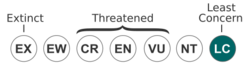
The IUCN Red List lists L. amurencis as a species of least concern.[5] Abramson et. al. (2018) dispute this status; they argue that the population has been overestimated based on phylogenetic data. The authors also report failed trapping attempts in regions once inhabited by the Amur lemming which suggest that the some populations are in decline.[4]
References
- ↑ Cassola, F. (2016). "Lemmus amurensis". IUCN Red List of Threatened Species 2016. doi:10.2305/IUCN.UK.2016-3.RLTS.T11480A22335890.en. https://www.iucnredlist.org/species/11480/22335890. Retrieved 18 April 2024.
- ↑ Spitsyn, Vitaly M.; Bolotov, Ivan N.; Kondakov, Alexander V.; Klass, Anna L.; Mizin, Ivan A.; Tomilova, Alena A.; Zubrii, Natalia A.; Gofarov, Mikhail Y. (2021-03-17). "A new Norwegian Lemming subspecies from Novaya Zemlya, Arctic Russia". Ecologica Montenegrina 40: 93–117. doi:10.37828/em.2021.40.8. ISSN 2336-9744. https://www.biotaxa.org/em/article/view/em.2021.40.8. Retrieved 2022-09-05.
- ↑ 3.0 3.1 Fredga, Karl; Fedorov, Vadim; Jarrell, Gordon; Jonsson, Lars (May 1999). "Genetic diversity in Arctic Lemmings". Ambio 28 (3). https://www.researchgate.net/profile/Vadim-Fedorov-2/publication/247440304_Genetic_diversity_in_Arctic_lemmings/links/5811111b08aee15d49150440/Genetic-diversity-in-Arctic-lemmings.pdf.
- ↑ 4.0 4.1 4.2 4.3 4.4 Abramson, N I; Petrova, T V (2018-01-19). "Genetic analysis of type material of the Amur lemming resolves nomenclature issues and creates challenges for the taxonomy of true lemmings (Lemmus, Rodentia: Cricetidae) in the eastern Palearctic". Zoological Journal of the Linnean Society 182 (2): 465–477. doi:10.1093/zoolinnean/zlx044. ISSN 0024-4082. https://doi.org/10.1093/zoolinnean/zlx044.
- ↑ 5.0 5.1 5.2 Francesca Cassola (Global Mammal Assessment) (2016-08-08). "IUCN Red List of Threatened Species: Lemmus amurensis". IUCN Red List of Threatened Species. https://www.iucnredlist.org/species/11480/115102341.
Wikidata ☰ Q1766211 entry
 |  |


