Biology:Tundra vole
| Tundra vole | |
|---|---|
_(9-4-08)_gambell,_ak_-2_(2834490753).jpg)
| |
| Tundra vole in Alaska | |
Scientific classification 
| |
| Kingdom: | Animalia |
| Phylum: | Chordata |
| Class: | Mammalia |
| Order: | Rodentia |
| Family: | Cricetidae |
| Subfamily: | Arvicolinae |
| Genus: | Alexandromys |
| Species: | A. oeconomus
|
| Binomial name | |
| Alexandromys oeconomus (Pallas, 1776)
| |

| |
| Synonyms[1] | |
| |
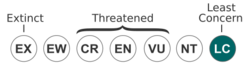
The tundra vole (Alexandromys oeconomus) or root vole is a medium-sized vole found in Northern and Central Europe, Asia, and northwestern North America, including Alaska and northwestern Canada.[2] In the western part of the Netherlands, the tundra vole is a relict from the ice age and has developed into the subspecies A. o. arenicola.
Description
The tundra vole has short ears and a short tail. Its fur is yellowish brown with paler sides and white underparts. It is typically about 18 cm (7.1 in) long with a 4 cm (1.6 in) tail and a weight of about 50 grams (1.8 oz).
The tundra vole displays sexual dimorphism, with males being noticeably larger than the females as adults.[3]
Habitat
The tundra vole is found in damp tundra or moist meadows, usually near water.[citation needed]
Behaviour and diet
This species makes runways through the surface growth in warm weather and tunnels through the snow in winter. It feeds on grasses, sedges and seeds. It is active year-round. It also digs burrows where it stores seeds and roots, especially licorice root, for the winter.[citation needed] A dental mesowear analysis of the tundra vole compared to the common vole found that the former consumed more abrasive foods overall.[4]
Breeding
Female voles have three to six litters of three to nine young in a shallow burrow. The tundra vole has its highest fecundity during May and June, but can prolong its mating season all the way until winter.[5]
Subspecies
Subspecies are as follows:[6]
- A. o. amakensis - Amak Island tundra vole - Alaska, United States
- A. o. arenicola - Dutch tundra vole - Netherlands
- A. o. elymocetes - Montague Island tundra vole - Alaska, United States
- A. o. finmarchicus - Norwegian tundra vole - Norway
- A. o. innuitus - St. Lawrence Island tundra vole - Alaska, United States
- A. o. medius - Norwegian tundra vole - Norway
- A. o. mehelyi - Central European tundra vole - Austria, Hungary and Slovakia
- A. o. oeconomus - nominate subspecies - widespread
- A. o. popofensis - Shumagin Islands tundra vole - Alaska, United States
- A. o. punakensis - Punuk Islands tundra vole - Alaska, United States
- A. o. sitkensis - Alexander Archipelago tundra vole - Alaska, United States
- A. o. unalascensis - Unalaska Island tundra vole - Alaska, United States
Genetic variability
The large number of subspecies of A. oeconomus is due to the changing environment that they have had to endure since the glacier/ice-age, as well as the isolation of populations.[7] Human interaction also greatly affects the environment of this species.[8] As a result, voles have lost genetic diversity as seen through a lessened heterozygous population for certain genes within separated populations.[7] Roads and structures do not necessarily limit species interaction, but it is the distances created between other communities of voles that limit gene flow.[8]
References
- ↑ 1.0 1.1 Linzey, A.V.; Shar, S.; Lkhagvasuren, D.; Juškaitis, R.; Sheftel, B.; Meinig, H.; Amori, G.; Henttonen, H. (2016). "Microtus oeconomus". IUCN Red List of Threatened Species 2016. doi:10.2305/IUCN.UK.2016-3.RLTS.T13451A22347188.en. https://www.iucnredlist.org/species/13451/22347188. Retrieved 19 February 2022.
- ↑ "Alexandromys oeconomus (Pallas, 1776)". American Society of Mammalogists. https://mammaldiversity.org/species-account/species-id=1002035.
- ↑ Balčiauskas, L.; Balčiauskienė, L. (2024). "Sexual Body Size Dimorphism in Small Mammals: A Case Study from Lithuania". Biology 13 (12): 1032. doi:10.3390/biology13121032. PMID 39765699.
- ↑ Kropacheva, Yuliya E.; Zykov, Sergey V.; Zolotareva, Natalya V.; Podgaevskaya, Elena N.; Lipikhina, Yuliya A. (13 March 2025). "Dental macro- and mesowear in two vole species under spatial and temporal dynamics of feeding conditions: implications for paleodiet reconstruction" (in en). Historical Biology: 1–20. doi:10.1080/08912963.2025.2474622. ISSN 0891-2963. https://www.tandfonline.com/doi/full/10.1080/08912963.2025.2474622#abstract. Retrieved 3 September 2025.
- ↑ Starikov, V.P.; Kravchenko, V.N.; Volodina, O.Y. (2023). "Breeding and Population Structure of the Root Vole Alexandromys oeconomus Pallas, 1776 (Cricetidae, Rodentia) in the Southern Trans-Ural Region". Biol Bull Russ Acad Sci 50 (10): 2782–2790. doi:10.1134/S1062359023100266. Bibcode: 2023BioBu..50.2782S.
- ↑ Witte van den Bosch, R. and Bekker, D. (2009). Verdwijnt de oer-Hollandse lemming? Geschiedenis en toekomst van de noordse woelmuis. Zoogdier 20-4: p.p 3-7. (in Dutch)
- ↑ 7.0 7.1 Kelemen, K. A.; Urzi, F.; Buzan, E.; Horváth, G. F.; Tulis, F.; Baláž, I. (2021). "Genetic variability and conservation of the endangered Pannonian root vole in fragmented habitats of an agricultural landscape". Nature Conservation 43: 167–191. doi:10.3897/natureconservation.43.58798.
- ↑ 8.0 8.1 Prakas, P.; Butkauskas, D.; Balčiauskienė, L.; Balčiauskas, L. (2024). "Low Genetic Variability of the Tundra Vole in Lithuania". Animals 14 (2): 270. doi:10.3390/ani14020270. PMID 38254439.
Wikidata ☰ Q703702 entry
 |  |


