Biology:Endling
An endling is the last known individual of a species or subspecies. Once the endling dies, the species becomes extinct. The word was coined in correspondence in the scientific journal Nature.
Usage
The 4 April 1996 issue of Nature published a correspondence in which commentators suggested that a new word, endling, be adopted to denote the last individual of a species.[1][2] The 23 May issue of Nature published several counter-suggestions, including ender, terminarch, and relict.[1][3]
The word endling appeared on the walls of the National Museum of Australia in Tangled Destinies, a 2001 exhibition by Matt Kirchman and Scott Guerin, about the relationship between Australian peoples and their land. In the exhibition, the definition, as it appeared in Nature, was printed in large letters on the wall above two specimens of the extinct Tasmanian tiger: "Endling (n.) The last surviving individual of a species of animal or plant". A printed description of this exhibition offered a similar definition, omitting reference to plants: "An endling is the name given to an animal that is the last of its species."[4][5]
In The Flight of the Emu: A Hundred Years of Australian Ornithology 1901-2001, author Libby Robin stated that "the very last individual of a species" is "what scientists refer to as an 'endling'".[6]
In 2011, the word was used in the Earth Island Journal, in an essay by Eric Freedman entitled "Extinction Is Forever: A Quest for the Last Known Survivors". Freedman defined endling as "the last known specimen of her species."[7] In "The Sense of an Endling", author Helen Lewis describes the notion of an endling as poignant, and the word as "wonderfully Tolkien-esque".[8] Author Eric Freedman describes endling as "a word with finality", stating, "It is deep-to-the-bone chilling to know the exact date a species disappeared from Earth. It is even more ghastly to look upon the place where it happened and know that nobody knew or cared at the time what had transpired and why."[9]
The word was also used as the title of a 2022 video game, Endling: Extinction Is Forever, which portrays the survival story of the last fox family in a world affected by environmental destruction.[10] Endling is also the title of a 2025 novel by Ukrainian-Canadian author Maria Reva, which juxtaposes a Ukrainian woman's quest to keep endangered land snails alive with Russia's 2022 invasion of Ukraine[11].
Notable endlings

This is not a comprehensive list of contemporary extinction, but a list of high-profile, widely publicised examples of when the last individual of a species was known.
Birds

- Martha, the last known passenger pigeon (Ectopistes migratorius), died at the Cincinnati Zoo at 1 PM on 1 September 1914, marking the extinction of the species.[12][13]
- Incas, the last known Carolina parakeet (Conuropsis carolinensis), died, also at the Cincinnati Zoo (and in the same cage as Martha), on 21 February 1918.[13][14] He died within one year of his mate, Lady Jane.[15]
- Booming Ben, a solitary heath hen (Tympanuchus cupido cupido), was last seen 11 March 1932 on Martha's Vineyard, Massachusetts.[16]
- Orange Band, the last known dusky seaside sparrow (Ammospiza maritima nigrescens), died on 17 June 1987 at the Discovery Island zoological park at Walt Disney World Resort, marking the extinction of the subspecies.[17]
- The last known Kauaʻi ʻōʻō (Moho braccatus) was recorded singing a mating call on Kauai in 1987 by David Boynton. The bird is believed to have been killed by Hurricane Iniki in 1992, and the death of this individual also marked the extinction of the entire Mohoidae family.[18][19]
Mammals
- In 1627, the last aurochs (Bos primigenius), an ancestor of bovine and cattle, died in a forest near what is now Jaktorów in modern-day Poland.[20]

A quagga mare at the London Zoo in 1870. This is the only specimen photographed alive. - The quagga (Equus quagga quagga) became extinct in the wild in the late 1870s due to hunting for meat and skins, and the subspecies' endling died in captivity on 12 August 1883 at the Artis in Amsterdam.[21]
- The final tarpan (Equus ferus ferus) died in captivity in the Russian Empire in 1903.[22]
- On 7 September 1936, the last known captive thylacine (Thylacinus cynocephalus), also called Tasmanian tiger, died in Hobart Zoo, following persecution of the species through hunting and trapping. Information published about this individual has been conflicted throughout the decades following its death.[23] Frank Darby, who falsely claimed to have worked at the Hobart Zoo, invented the myth this thylacine was named "Benjamin", and the claim was rapidly circulated by media and persists to the present--even being repeated on Wikipedia itself.[24] Other areas of contention include where this thylacine was captured and by whom, whether it was neglected in its zoo enclosure and even whether it was the last known surviving thylacine.[23] Researchers Robert Paddle and Kathryn Medlock argue that the endling was female and died of neglect. Gareth Linnard says that the specimen was not called Benjamin, but was male and died of old age, having been well-treated due to its valued status in the zoo's collection.[23] Regardless of its sex, the thylacine at Hobart Zoo is the last reputably-verified specimen of not only its species and genus, but also the entire family Thylacinidae. However, scientist Barry Brook and his colleagues argue that the weight of evidence supports the thylacine probably persisting in the wild for several decades following the 1936 death of the Hobart Zoo animal.[25]
- The last known Mexican grizzly bear (Ursus arctos horribilis), also called oso plateado (silver bear) in Spanish, was shot in 1976 in Sonora, Mexico.[26]


- Celia, the last Pyrenean ibex (Capra pyrenaica pyrenaica), was found crushed by a tree on 6 January 2000 in the Spanish Pyrenees, after hunting and competition from livestock reduced the population to one individual.[27]
- The final Vietnamese Javan rhinoceros (Rhinoceros sondaicus annamiticus), was shot by a poacher at the Cát Tiên National Park in 2010, after habitat loss, poaching, and the Vietnam War reduced the population to one individual.[28]
Reptiles and amphibians
.jpg)
- On 24 June 2012, Lonesome George, the last known Pinta Island tortoise (Chelonoidis niger abingdonii), died in his habitat in the Galápagos Islands.[29]
- On 26 September 2016, Toughie, the last known Rabbs' fringe-limbed treefrog (Ecnomiohyla rabborum), died in the Atlanta Botanical Garden.[30]
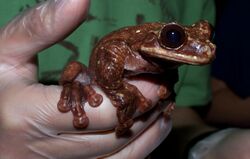
'Toughie', the last known Rabb's fringe-limbed treefrog - After being considered possibly extinct for 113 years, a Fernandina Island Galápagos tortoise named Fernanda was found in 2019 for the Animal Planet series, Extinct or Alive. However, she is the only living individual known, making Fernanda an endling.[31]

Invertebrates
- Turgi was the last Partula clarkei, a Polynesian tree snail, who died on 31 January 1996 in the London Zoo.[32]
- A tank in the Bristol Zoo was the last refuge of Partula faba, a land snail from Ra'iātea in French Polynesia. The population dropped from 38 in 2012[33] to one in 2015.[34] The last individual died on 21 February 2016.[34]
- George was the last known individual of the Oahu tree snail species Achatinella apexfulva. He died on January 1, 2019, in captivity near Kailua, Hawaii.[35]
Plants
- The Curepipe Botanic Gardens in Mauritius have housed the last specimen of the palm Hyophorbe amaricaulis since the 1950s.[36]
- Only one living specimen of the tree species Madhuca diplostemon is known to exist.[37]
- Some ancient seeds, dated to between 993-1202 AD, were found in an archaeological excavation in the Judean desert in 1986–87. In 2009, a specimen of an unknown species of Commiphora, informally named "Sheba", was successfully sprouted from one of these seeds. In 2024, it was tentatively identified as tsori or Judean balsam, on the basis of taxonomy and resin properties matching ancient descriptions.[38]
See also
References
- ↑ 1.0 1.1 Jorgensen, Dolly (13 April 2013). "Naming and claiming the last". http://dolly.jorgensenweb.net/nordicnature/?p=450.
- ↑ Robert M. Webster; Bruce Erickson (4 April 1996). "The last word?". Nature 380 (386): 386. doi:10.1038/380386c0. PMID 8602235. Bibcode: 1996Natur.380..386W.
- ↑ Elaine Andrews (4 April 1996). "The last word". Nature 381 (272): 272. doi:10.1038/381272d0. Bibcode: 1996Natur.381..272A.
- ↑ "Tangled Destinies". National Museum of Australia. 2002. http://www.nma.gov.au/__data/assets/pdf_file/0020/19514/tangled_destinies_bw.pdf.
- ↑ Smith, Mike (2001). "The Endling exhibition, Tangled Destinies gallery, National Museum of Australia, Canberra, 2001". National Museum of Australia. http://environmentalhistory-au-nz.org/links/publications/reviews/pdfs/robin-rev1.pdf.
- ↑ Robin, Libby (2002). The Flight of the Emu: A Hundred Years of Australian Ornithology 1901-2001. Melbourne University Press. p. 260. ISBN 978-0-522-84987-5.
- ↑ Freedman, Eric (2011). "Extinction is Forever: A Quest for the Last Known Survivors". Earth Island Journal. http://www.earthisland.org/journal/index.php/eij/article/extinction_is_forever.
- ↑ Lewis, Helen (27 June 2012). "The Sense of an Endling". http://www.newstatesman.com/sci-tech/sci-tech/2012/06/sense-endling.
- ↑ Freedman, Eric (5 July 2008). "Cut from history: An abandoned Tasmanian zoo tells the haunting tale of an ending". EJ Magazine. http://www.ejmagazine.com/2002a/history.html.
- ↑ Hayhoe, Benjamin (2022-07-19). "‘Endling: Extinction is Forever’ review: a powerful environmental message". https://www.nme.com/reviews/game-reviews/endling-extinction-is-forever-review-3272436.
- ↑ Powers, John (2025-06-23). "'Endling' is a shape-shifting debut that takes on heavy themes with humor". NPR. https://www.npr.org/2025/06/23/nx-s1-5440259/endling-review-maria-reva-ukraine.
- ↑ "Endangered Species Handbook". Animal Welfare Institute. 1983. http://www.endangeredspecieshandbook.org/dinos_eastern.php.
- ↑ 13.0 13.1 Blythe, Anne (27 August 2012). "Extinct Carolina Parakeet still fascinates". News Observer. http://www.newsobserver.com/2012/08/27/2299018/a-talkative-bird-gone-without.html.
- ↑ "The last Carolina Parakeet". John James Audubon Center. December 22, 2015. http://johnjames.audubon.org/last-carolina-parakeet.
- ↑ Snyder, Noel (June 2004). The Carolina Parakeet: Glimpses of a Vanished Bird. Princeton University Press.
- ↑ "Heath Hen (Extinct)". BeautyOfBirds (formerly Avian Web). http://www.beautyofbirds.com/heathhen.html.
- ↑ "Last of dusky sparrows dies". The New York Times. Associated Press. 17 June 1987. https://www.nytimes.com/1987/06/17/us/last-of-dusky-sparrows-dies.html.
- ↑ "Kauai Oo (Moho braccatus) - BirdLife species factsheet". https://datazone.birdlife.org/species/factsheet/kauai-oo-moho-braccatus/text.
- ↑ Recording Of The Last Kauai 'o'o Bird, https://archive.org/details/recording-of-the-last-kauai-oo-bird, retrieved 2024-09-11
- ↑ Rokosz, M. (1995). "History of the Aurochs (Bos taurus primigenius) in Poland". Animal Genetics Resources Information 16: 5–12. doi:10.1017/S1014233900004582. http://agtr.ilri.cgiar.org/agtrweb/Documents/Library/docs/agri16_95.pdf.
- ↑ Van Bruggen, A.C. (1959). "Illustrated notes on some extinct South African ungulates". South African Journal of Science 55 (8): 197–200. https://journals.co.za/doi/pdf/10.10520/AJA00382353_1382. Retrieved 31 July 2022.
- ↑ Bunzel-Drüke, Finck, Kämmer, Luick, Reisinger, Riecken, Riedl, Scharf & Zimball: "Wilde Weiden: Praxisleitfaden für Ganzjahresbeweidung in Naturschutz und Landschaftsentwicklung
- ↑ 23.0 23.1 23.2 Linnard, Gareth; Sleightholme, Stephen R. (31 October 2023). "An exploration of the evidence surrounding the identity of the last captive Thylacine". Australian Zoologist 43 (2): 287–338. doi:10.7882/AZ.2023.034.
- ↑ Dunlevie, James (5 December 2022). "Stop calling the last thylacine Benjamin, Tasmanian tiger researcher says". ABC News. https://www.abc.net.au/news/2022-12-06/benjamin-thylacine-tasmanian-tiger-naming-myth-persists/101734442.
- ↑ Brook, Barry W.; Sleightholme, Stephen R.; Campbell, Cameron R.; Jarić, Ivan; Buettel, Jessie C. (15 June 2023). "Resolving when (and where) the Thylacine went extinct". Science of the Total Environment 877. doi:10.1016/j.scitotenv.2023.162878. PMID 36934937.
- ↑ Gallo-Reynoso, Juan-Pablo (June 1, 2008). "Probable occurrence of a brown bear (Ursus arctos) in Sonora, Mexico, in 1976". The Southwestern Naturalist 53 (2): 256–260. doi:10.1894/0038-4909(2008)53[256:pooabb2.0.co;2]. http://wildsonora.com/sites/default/files/reports/probable-occurrence-of-a-brown-bear-ursus-arctos-in-sonora-mexico-in-1976.pdf. Retrieved September 11, 2024.
- ↑ Richard Gray and Roger Dobson (31 January 2009). "Extinct ibex is resurrected by cloning". The Telegraph. https://www.telegraph.co.uk/science/science-news/4409958/Extinct-ibex-is-resurrected-by-cloning.html.
- ↑ Gersmann, Hanna (2011-10-25). "Javan rhino driven to extinction in Vietnam, conservationists say". The Guardian. ISSN 0261-3077. https://www.theguardian.com/environment/2011/oct/25/javan-rhino-extinct-vietnam.
- ↑ Valencia, Alexandra; Garcia, Eduardo (24 June 2012). "Lonesome George, last-of-his-kind Galapagos tortoise, dies". Reuters. http://www.trust.org/alertnet/news/lonesome-george-last-of-his-kind-galapagos-tortoise-dies.
- ↑ Bo Emerson (28 September 2016). "Rare frog goes extinct, despite Atlanta's rescue efforts". The Atlanta Journal-Constitution. http://www.accessatlanta.com/news/news/rare-frog-goes-extinct-despite-atlantas-rescue-eff/nsgkt/.
- ↑ "Tortoise thought to be extinct for 113 years has been rediscovered on the Galapagos". 2019-02-20. https://www.foxnews.com/science/tortoise-thought-to-be-extinct-for-113-years-has-been-rediscovered-on-the-galapagos.
- ↑ "Tiny Tree Snail Finally Creeps To Extinction". Chicago Tribune. 1 February 1996. http://www.chicagotribune.com/1996/02/01/tiny-tree-snail-finally-creeps-to-extinction/.
- ↑ Five of the world's 10 most at-risk species at Bristol Zoo
- ↑ 34.0 34.1 "Captain Cook's bean snail Partula faba". http://islandbiodiversity.com/faba.htm.
- ↑ Yong, Ed (July 2019). "The Last of Its Kind". The Atlantic. https://www.theatlantic.com/magazine/archive/2019/07/extinction-endling-care/590617/. Retrieved 28 June 2019.
- ↑ Bachraz, V.; Strahm, W. (2000). "Hyophorbe amaricaulis". IUCN Red List of Threatened Species 2000. doi:10.2305/IUCN.UK.2000.RLTS.T38578A10125958.en. https://www.iucnredlist.org/species/38578/10125958. Retrieved 11 November 2021.
- ↑ Rajwi, Tiki (2020-10-03). "Extinct tree found after 180 years in Kollam grove". The Hindu. ISSN 0971-751X. https://www.thehindu.com/news/national/kerala/extinct-tree-found-after-180-years-in-kollam-grove/article32760018.ece.
- ↑ Sallon, Sarah; Solowey, Elaine; Gostel, Morgan R.; Egli, Markus; Flematti, Gavin R.; Bohman, Björn; Schaeffer, Philippe; Adam, Pierre et al. (2024-09-10). "Characterization and analysis of a Commiphora species germinated from an ancient seed suggests a possible connection to a species mentioned in the Bible". Communications Biology 7 (1): 1109. doi:10.1038/s42003-024-06721-5. ISSN 2399-3642. PMID 39256474.
External links
- What Do You Call the Last of a Species? by Michelle Nijhuis for The New Yorker
- Cut from history by Eric Freedman for Knight Center for Environmental Journalism
- Bringing Them Back to Life by Carl Zimmer for National Geographic Magazine.
| Phenomena |  | ||||
|---|---|---|---|---|---|
| Models | |||||
| Causes | |||||
| Theories and concepts | |||||
| Extinction events |
| ||||
| Extinct species | |||||
| Organizations | |||||
| See also | |||||


 |  |


