Earth:Early Earth


Early Earth, also known as Proto-Earth, is loosely defined as Earth in the first one billion years — or gigayear (109 y or Ga) — of its geological history,[1] from its initial formation in the young Solar System at about 4.55 billion years ago (Gya), to the end of the Eoarchean era at approximately 3.5 Gya.[2] On the geologic time scale, this comprises all of the Hadean eon and approximately one-third of the Archean eon, starting with the formation of the Earth about 4.6 Gya,[3] and ended at the start of the Paleoarchean era 3.6 Gya.
This period of Earth's history involved the planet's formation from the solar nebula via a process known as accretion, and transition of the Earth's atmosphere from a hydrogen/helium-predominant primary atmosphere collected from the protoplanetary disk to a reductant secondary atmosphere rich in nitrogen, methane and CO
2. This time period included intense impact events as the young Proto-Earth, a protoplanet of about 0.63 Earth masses,[4] began clearing the neighborhood, including the early Moon-forming collision with Theia — a Mars-sized co-orbital planet likely perturbed from the L4 Lagrange point[5] — around 0.032 Ga after formation of the Solar System,[6] which resulted in a series of magma oceans and episodes of core formation.[7] After formation of the core, meteorites or comets from the Outer Solar System might have delivered water and other volatile compounds to the Earth's mantle, crust and ancient atmosphere in an intense "late veneer" bombardment.[8] As the Earth's planetary surface eventually cooled and formed a stable but evolving crust during the end-Hadean, most of the water vapor condensed out of the atmosphere and precipitated into a superocean that covered nearly all of the Earth's surface,[9][10] transforming the initially lava planet Earth of the Hadean into an ocean planet at the early Archean, where the earliest known life forms appeared soon afterwards.
Although little crustal material from this period survives, the oldest dated rock is a zircon mineral of 4.404 ± 0.008 Gya enclosed in a metamorphosed sandstone conglomerate in the Jack Hills of the Narryer Gneiss terrane of Western Australia.[11] The earliest supracrustals (such as the Isua greenstone belt) date from the latter half of this period, about 3.8 Gya, around the same time as peak Late Heavy Bombardment.
History
According to evidence from radiometric dating and other sources, Earth formed about 4.54 billion years ago.[12][13][14] The current dominant theory of planet formation suggests that planets such as Earth form in about 50 to 100 million years but more recently proposed alternative processes and timescales have stimulated ongoing debate in the planetary science community.[15] For example, in June 2023, one team of scientists reported evidence that Earth may have formed in just three million years.[16][15] Nonetheless, within the first billion years of the formation of Earth,[17][18][19][20] life appeared in its oceans and began to affect its atmosphere and surface, promoting the proliferation of aerobic as well as anaerobic organisms. Since then, the combination of Earth's distance from the Sun, its physical properties and its geological history have allowed life to emerge, develop photosynthesis, and, later, evolve further and thrive. The earliest life on Earth arose at least 3.5 billion years ago.[21][22][23] Earlier possible evidence of life includes graphite, which may have a biogenic origin, in 3.7-billion-year-old metasedimentary rocks discovered in southwestern Greenland[24] and 4.1-billion-year-old zircon grains in Western Australia.[25][26]
In November 2020, an international team of scientists reported studies suggesting that the primeval atmosphere of the early Earth was very different from the conditions used in the Miller–Urey studies considering the origin of life on Earth.[27]
-
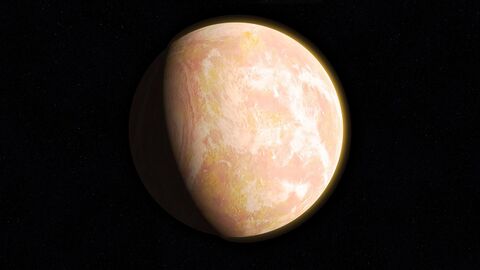
 Artist impression of the Early Earth as a lava planet during the Hadean eon
 -


See also
- Astronomy:Chronology of the universe – History and future of the universe
- Biology:History of life
- Earth:Future of Earth – Long-term extrapolated geological and biological changes of planet Earth
- Earth:Geological history of Earth
- Earth:History of Earth
- Biology:Timeline of the evolutionary history of life – Major events during the development of life
- Earth:Timeline of natural history – None
References
- ↑ Rankama, Kalervo (May 1967). "Megayear and Gigayear: Two Units of Geological Time" (in en). Nature 214 (5088): 634. doi:10.1038/214634a0. ISSN 1476-4687. Bibcode: 1967Natur.214..634R.
- ↑ Vaclav Cilek, ed (2009). "Early Earth". Earth System: History and Natural Variability Volume I. Eolss Publishers. p. 98. ISBN 978-1-84826-104-4. https://www.eolss.net/ebooklib/bookinfo/earth-system-history-natural-variability.aspx.
- ↑ "International Chronostratigraphic Chart 2015". ICS. http://www.stratigraphy.org/ICSchart/ChronostratChart2015-01.pdf.
- ↑ Lammer, Helmut; Brasser, Ramon; Johansen, Anders; Scherf, Manuel; Leitzinger, Martin (2020-12-22). "Formation of Venus, Earth and Mars: Constrained by Isotopes". Space Science Reviews (Springer Nature) 217 (1). doi:10.1007/s11214-020-00778-4. https://link.springer.com/article/10.1007/s11214-020-00778-4. Retrieved 2025-08-24.
- ↑ Belbruno, Edward; Gott, J. Richard III (March 2005). "Where Did The Moon Come From?". The Astronomical Journal (IOP Publishing, American Astronomical Society) 129 (3): 1724–1745. doi:10.1086/427539. https://iopscience.iop.org/article/10.1086/427539/fulltext/. Retrieved 2025-08-10.
- ↑ Yu, Gang; Jacobsen, Stein B. (2011-10-17). "Fast accretion of the Earth with a late Moon-forming giant impact". PNAS (National Academy of Sciences) 108 (43): 17604–17609. doi:10.1073/pnas.1108544108. PMID 22006299.
- ↑ Carlson, Richard W.; Garnero, Edward; Harrison, T. Mark; Li, Jie; Manga, Michael; McDonough, William F.; Mukhopadhyay, Sujoy; Romanowicz, Barbara et al. (2014-01-01). "How Did Early Earth Become Our Modern World?". Annual Review of Earth and Planetary Sciences 42 (1): 151–178. doi:10.1146/annurev-earth-060313-055016. Bibcode: 2014AREPS..42..151C.
- ↑ Drake, Michael J.; Righter, Kevin (2002-03-07). "Determining the composition of the Earth" (in en). Nature 416 (6876): 39–44. doi:10.1038/416039a. ISSN 0028-0836. PMID 11882886. Bibcode: 2002Natur.416...39D.
- ↑ Dong, Junjie; Fischer, Rebecca A.; Stixrude, Lars P.; Lithgow-Bertelloni, Carolina R. (2021-03-09). "Constraining the Volume of Earth's Early Oceans With a Temperature-Dependent Mantle Water Storage Capacity Model". AGU Advances (American Geophysical Union) 2 (1). doi:10.1029/2020AV000323. https://agupubs.onlinelibrary.wiley.com/doi/full/10.1029/2020AV000323. Retrieved 2025-08-24.
- ↑ Korenaga, Jun (2018-10-01). "Crustal evolution and mantle dynamics through Earth history". Philosophical Transactions of the Royal Society A: Mathematical, Physical and Engineering Sciences (Royal Society) 376 (2132). doi:10.1098/rsta.2017.0408. ISSN 1364-503X. PMID 30275159.
- ↑ Wilde, Simon A.; Valley, John W.; Peck, William H.; Graham, Colin M. (2001-01-11). "Evidence from detrital zircons for the existence of continental crust and oceans on the Earth 4.4 Gyr ago : Abstract: Nature". Nature 409 (6817): 175–178. doi:10.1038/35051550. ISSN 0028-0836. PMID 11196637. Bibcode: 2001Natur.409..175W.
- ↑ "Age of the Earth". U.S. Geological Survey. 1997. http://pubs.usgs.gov/gip/geotime/age.html.
- ↑ Dalrymple, G. Brent (2001). "The age of the Earth in the twentieth century: a problem (mostly) solved". Special Publications, Geological Society of London 190 (1): 205–221. doi:10.1144/GSL.SP.2001.190.01.14. Bibcode: 2001GSLSP.190..205D.
- ↑ Manhesa, Gérard; Allègre, Claude J.; Dupréa, Bernard; Hamelin, Bruno (1980). "Lead isotope study of basic-ultrabasic layered complexes: Speculations about the age of the earth and primitive mantle characteristics". Earth and Planetary Science Letters 47 (3): 370–382. doi:10.1016/0012-821X(80)90024-2. Bibcode: 1980E&PSL..47..370M.
- ↑ 15.0 15.1 Onyett, Isaac J. (14 June 2023). "Silicon isotope constraints on terrestrial planet accretion". Nature 619 (7970): 539–544. doi:10.1038/s41586-023-06135-z. PMID 37316662. Bibcode: 2023Natur.619..539O.
- ↑ Patel, Kasha (16 June 2023). "Scientists have a controversial theory for how — and how fast — Earth formed". The Washington Post. https://www.washingtonpost.com/climate-environment/2023/06/16/earth-formation-pebble-accretion-theory/.
- ↑ Dalrymple, G.B. (1991). The Age of the Earth. California: Stanford University Press. ISBN 978-0-8047-1569-0.
- ↑ Newman, William L. (2007-07-09). "Age of the Earth". Publications Services, USGS. http://pubs.usgs.gov/gip/geotime/age.html.
- ↑ Dalrymple, G. Brent (2001). "The age of the Earth in the twentieth century: a problem (mostly) solved". Geological Society, London, Special Publications 190 (1): 205–21. doi:10.1144/GSL.SP.2001.190.01.14. Bibcode: 2001GSLSP.190..205D. http://sp.lyellcollection.org/cgi/content/abstract/190/1/205. Retrieved 2007-09-20.
- ↑ Stassen, Chris (2005-09-10). "The Age of the Earth". TalkOrigins Archive. http://www.talkorigins.org/faqs/faq-age-of-earth.html.
- ↑ Schopf, JW, Kudryavtsev, AB, Czaja, AD, and Tripathi, AB. (2007). Evidence of Archean life: Stromatolites and microfossils. Precambrian Research 158:141–155.
- ↑ Schopf, JW (2006). Fossil evidence of Archaean life. Philos Trans R Soc Lond B Biol Sci 29;361(1470) 869-85.
- ↑ Hamilton Raven, Peter; Brooks Johnson, George (2002). Biology. McGraw-Hill Education. p. 68. ISBN 978-0-07-112261-0. https://archive.org/details/biologyrave00rave. Retrieved 7 July 2013.
- ↑ Ohtomo, Yoko; Kakegawa, Takeshi; Ishida, Akizumi et al. (January 2014). "Evidence for biogenic graphite in early Archaean Isua metasedimentary rocks". Nature Geoscience 7 (1): 25–28. doi:10.1038/ngeo2025. ISSN 1752-0894. Bibcode: 2014NatGe...7...25O.
- ↑ Borenstein, Seth (19 October 2015). "Hints of life on what was thought to be desolate early Earth". Excite. Associated Press (Yonkers, NY: Mindspark Interactive Network). http://apnews.excite.com/article/20151019/us-sci--earliest_life-a400435d0d.html.
- ↑ Bell, Elizabeth A.; Boehnike, Patrick; Harrison, T. Mark et al. (19 October 2015). "Potentially biogenic carbon preserved in a 4.1 billion-year-old zircon". Proc. Natl. Acad. Sci. U.S.A. 112 (47): 14518–21. doi:10.1073/pnas.1517557112. ISSN 1091-6490. PMID 26483481. PMC 4664351. Bibcode: 2015PNAS..11214518B. http://www.pnas.org/content/early/2015/10/14/1517557112.full.pdf. Retrieved 2015-10-20. Early edition, published online before print.
- ↑ Zurich, Eth (29 November 2020). "Uncovering Mysteries of Earth's Primeval Atmosphere 4.5 Billion Years Ago and the Emergence of Life". https://scitechdaily.com/uncovering-mysteries-of-earths-primeval-atmosphere-4-5-billion-years-ago-and-the-emergence-of-life/.
- ↑ Arney, G. N.; Meadows, V. S.; Domagal-Goldman, S. D.; Claire, M.; Schwieterman, E. (2014). "The Pale Orange Dot: Spectral Effects of a Hazy Early Earth". AGU Fall Meeting Abstracts 2014. Bibcode: 2014AGUFMPP53A1202A. https://ui.adsabs.harvard.edu/abs/2014AGUFMPP53A1202A/abstract.
- ↑ "NASA Team Looks to Ancient Earth First to Study Hazy Exoplanets - NASA". 8 February 2017. https://www.nasa.gov/centers-and-facilities/goddard/nasa-team-looks-to-ancient-earth-first-to-study-hazy-exoplanets/.
External links
- Earth – Speed through space – about 1 million miles an hour – NASA and (WP discussion)


zh-yue:早期地球
 |  |


