Software:G.A.S.P!! Fighters' NEXTream
| G.A.S.P. Fighters' NEXTream | |
|---|---|
 European Nintendo 64 cover art | |
| Developer(s) | Konami Computer Entertainment Osaka |
| Publisher(s) | Konami |
| Platform(s) | Nintendo 64 |
| Release | |
| Genre(s) | Fighting |
| Mode(s) | Single player, multiplayer |
G.A.S.P!! Fighters' NEXTream (ガスプ!! ファイターズ ネクストリーム, Generation of Arts, Speed and Power) is a fighting video game for the Nintendo 64 released in 1998. The story follows a series of fighters that have each received a mysterious letter to compete in a legendary contest, and about a champion that has disappeared. The North American versions are known as Deadly Arts.[1] The story and the player profiles do not appear in the instructions for the North American version. Except for the title, it is basically the same as the Japan and Europe versions, with slightly changed voice messages, and different character nameplates.
Gameplay
The player can choose from one of the eight fighters in a match or "Duel". After beating the other seven characters and an identical version of themselves, there are two other opponents: Gouriki, a character wearing a cat mask and rope-like fairy wings, and Ohgami Reiji, the final boss that wears a large straw hat covering his eyes, and business suit. Reiji while fighting can change into one of two other characters: Hikari, an all-white humanoid with a third eye in his forehead, and Yami, a grey-skinned man with purple beard and long sideburns. The difficulty of the opponents can be changed from very easy up to expert, while the rounds and how long they last can also be manipulated. There is a Versus mode, for teaming up or one on one, as well as a create your own fighter option. Unlike most 3D fighting games, players receive points for how well they do, and the combination of moves they use. While creating their own characters, players can choose which type of body, height and such, then practice with the new characters in the training area to gain more moves. The player's game progress, scores, and created player can be saved onto Memory Paks, allowing the player to continue to try to improve their skills or challenge friends when playing on their Nintendo 64 console.[2] There are 12 arenas in all, nine of which are available at the beginning of play and three unlockable ones. The two main boss characters also become playable after unlocking them. With Reiji, the two creatures can also be transformed into and used while playing.
Development
The game was first unveiled at the September 1997 Tokyo Game Show.[3]
Initially the game was to be released under the title G.A.S.P.!!: Fighters' NEXTream in all regions, but in early 1998 Konami decided to rename it Deadly Arts for the North American release.[4]
Reception
| Reception | ||||||||||||||||||||||||||||||||
|---|---|---|---|---|---|---|---|---|---|---|---|---|---|---|---|---|---|---|---|---|---|---|---|---|---|---|---|---|---|---|---|---|
| ||||||||||||||||||||||||||||||||


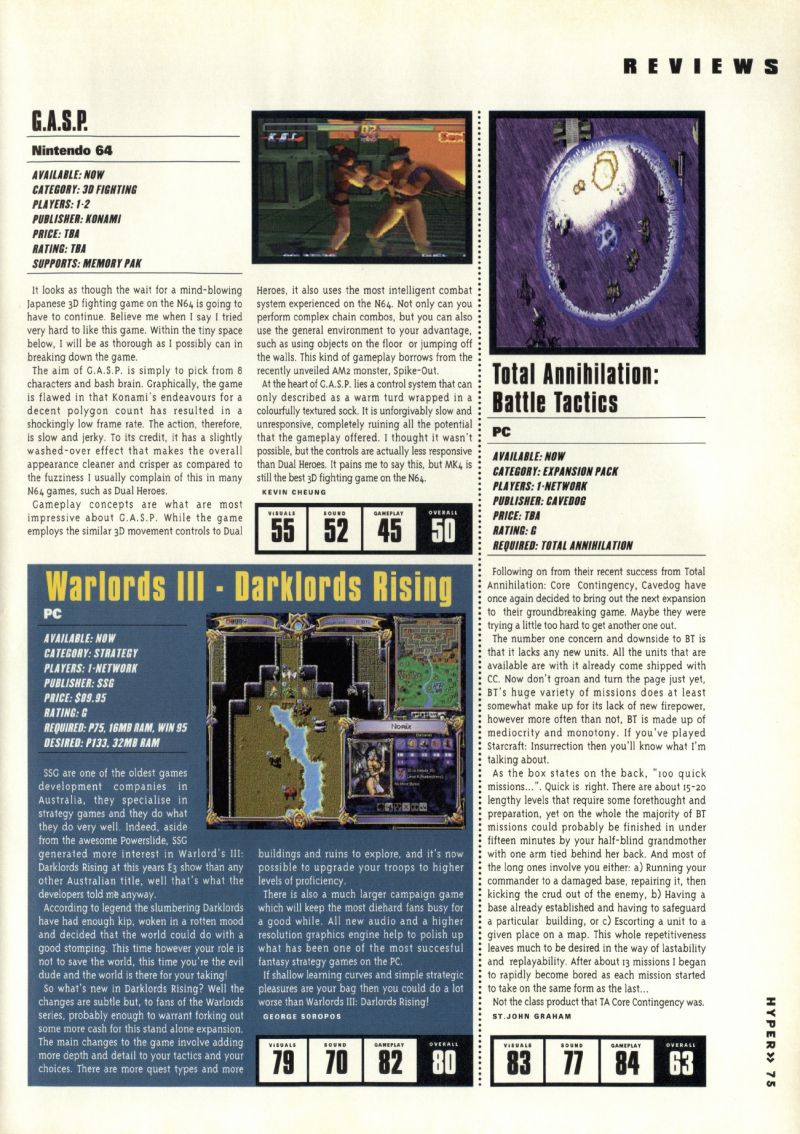
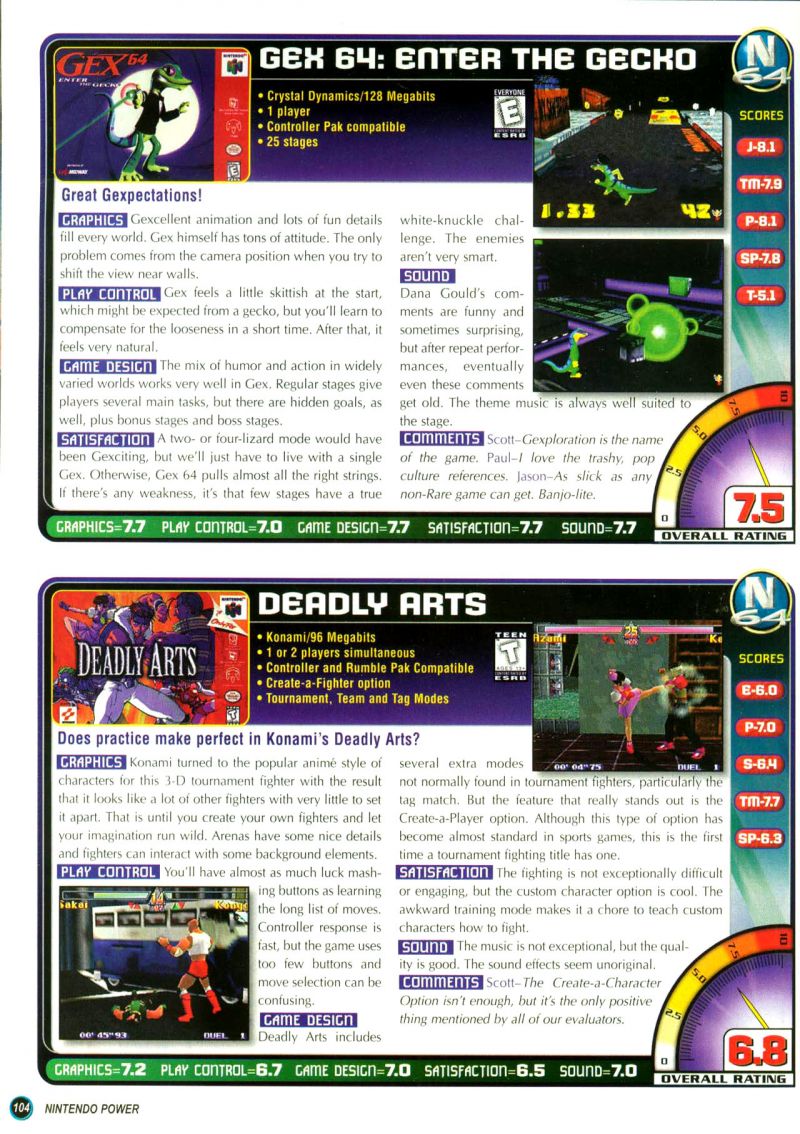
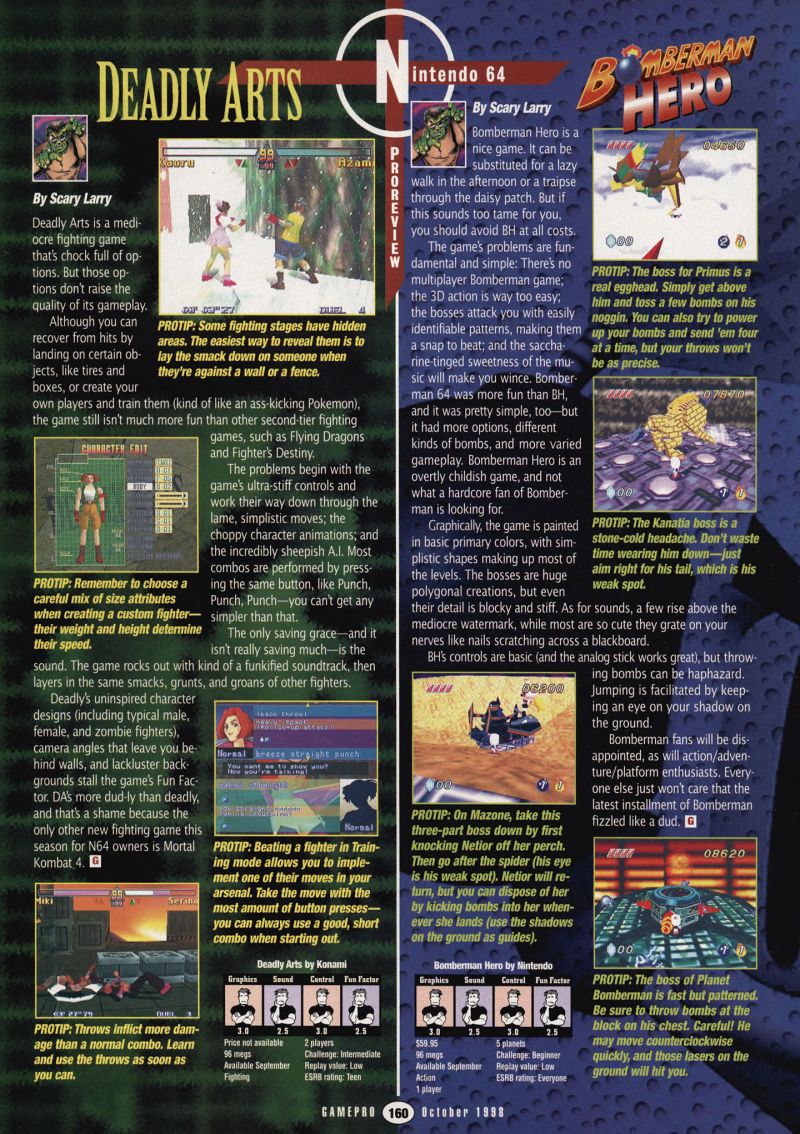
The game received unfavorable reviews according to the review aggregation website GameRankings.[5] Matt Casamassina of IGN noted the "stale, sub-first-generation graphics, terrible control and detestable framerates."[13] Jeff Gerstmann, writing for GameSpot, was similarly critical, concluding that the game was too basic and uninteresting.[11] Next Generation said that the game was "not only a crappy fighting game but a sad excuse for a game in general. Bad graphics, bad control, and utterly generic designs all add up to an experience you'll want to miss at all costs."[16] In Japan, Famitsu gave it a score of 19 out of 40.[9] GamePro said that the game was "more dud-ly than deadly, and that's a shame because the only other new fighting game this season for N64 owners is Mortal Kombat 4."[18][lower-alpha 2]
Notes
References
- ↑ 1.0 1.1 IGN staff (September 29, 1998). "Deadly Arts Out in the US". Ziff Davis. Archived from the original on June 27, 2023. https://web.archive.org/web/20230627054255/https://www.ign.com/articles/1998/09/30/deadly-arts-out-in-the-us. Retrieved August 27, 2023.
- ↑ "Previews: G.A.S.P.!! Fighters' NEXTream". Electronic Gaming Monthly (Ziff Davis) (102): 46. January 1998. Archived from the original on July 3, 2023. https://web.archive.org/web/20230703235249/https://retrocdn.net/images/8/8a/EGM_US_102.pdf. Retrieved August 27, 2023.
- ↑ "Tokyo Catches Gaming Hysteria". Next Generation (Imagine Media) (35): 18. November 1997. https://archive.org/details/NEXT_Generation_35/page/n19/mode/2up. Retrieved October 2, 2020.
- ↑ "Nintendo 64 Preview Gallery". Electronic Gaming Monthly (Ziff Davis) (106): 38. May 1998. Archived from the original on July 1, 2023. https://web.archive.org/web/20230701200259/https://retrocdn.net/images/f/f0/EGM_US_106.pdf. Retrieved August 27, 2023.
- ↑ 5.0 5.1 "Deadly Arts for Nintendo 64". CBS Interactive. Archived from the original on May 5, 2019. https://web.archive.org/web/20190505145010/https://www.gamerankings.com/n64/197070-deadly-arts/index.html. Retrieved October 2, 2020.
- ↑ Gia (September 1998). "G.A.S.P!! Fighters NEXTream [sic]" (in fr). Consoles + (80): 124–25.
- ↑ Edge staff (June 1998). "G.A.S.P! Fighters NEXTream [sic [Import]"]. Edge (Future Publishing) (59): 95. Archived from the original on July 3, 2023. https://web.archive.org/web/20230703200410/https://retrocdn.net/images/7/77/Edge_UK_059.pdf. Retrieved August 27, 2023.
- ↑ Williams, Ken "Sushi-X"; Hsu, Dan; Ricciardi, John; Boyer, Crispin (October 1998). "Deadly Arts". Electronic Gaming Monthly (Ziff Davis) (111): 257. Archived from the original on July 5, 2023. https://web.archive.org/web/20230705190235/https://retrocdn.net/images/1/1d/EGM_US_111.pdf. Retrieved August 26, 2023.
- ↑ 9.0 9.1 "G.A.S.P!! 〜Fighter's NEXTream〜 [sic [NINTENDO64]"] (in ja). Famitsu (Enterbrain). Archived from the original on June 27, 2023. https://web.archive.org/web/20230627055757/https://www.famitsu.com/cominy/?m=pc&a=page_h_title&title_id=14525&redirect=no. Retrieved August 27, 2023.
- ↑ "Deadly Arts". Game Informer (FuncoLand) (65). September 2000.
- ↑ 11.0 11.1 Gerstmann, Jeff (November 5, 1998). "Deadly Arts Review". Fandom. Archived from the original on January 27, 2005. https://web.archive.org/web/20050127163903/http://www.gamespot.com/n64/action/deadlyarts/review.html. Retrieved August 27, 2023.
- ↑ Cheung, Kevin (October 1998). "G.A.S.P. [sic"]. Hyper (Next Media Pty Ltd) (60): 75. Archived from the original on June 27, 2023. https://web.archive.org/web/20230627054337/https://www.nintendo64ever.com/scans/mags/Scan-Magazine-690-71.jpg. Retrieved August 27, 2023.
- ↑ 13.0 13.1 Casamassina, Matt (October 19, 1998). "Deadly Arts". Ziff Davis. Archived from the original on August 19, 2023. https://web.archive.org/web/20230819051044/https://www.ign.com/articles/1998/10/20/deadly-arts. Retrieved August 27, 2023.
- ↑ Kitts, Martin (May 1998). "G.A.S.P! Fighters NEXTream [sic] [Import]". N64 Magazine (Future Publishing) (15): 58–61.
- ↑ "G.A.S.P! Fighters NEXTream [sic]". N64 Magazine (Future Publishing) (22). December 1998.
- ↑ 16.0 16.1 "Deadly Arts". Next Generation (Imagine Media) (49): 109. January 1999. https://archive.org/details/NEXT_Generation_49/page/n109/mode/2up. Retrieved October 2, 2020.
- ↑ "Deadly Arts". Nintendo Power (Nintendo of America) 112: 104. September 1998. Archived from the original on July 6, 2023. https://web.archive.org/web/20230706021353/https://www.nintendo64ever.com/scans/mags/Scan-Magazine-354-104.jpg. Retrieved August 27, 2023.
- ↑ Scary Larry (October 1998). "Deadly Arts". GamePro (IDG) (121): 160. Archived from the original on June 27, 2023. https://web.archive.org/web/20230627054330/https://www.nintendo64ever.com/scans/mags/Scan-Magazine-1862-160.jpg. Retrieved August 27, 2023.
External links
- MobyGames is a commercial database website that catalogs information on video games and the people and companies behind them via crowdsourcing. This includes over 300,000 games for hundreds of platforms.[1] Founded in 1999, ownership of the site has changed hands several times. It has been owned by Atari SA since 2022.
Features
Edits and submissions to the site (including screenshots, box art, developer information, game summaries, and more) go through a verification process of fact-checking by volunteer "approvers".[2] This lengthy approval process after submission can range from minutes to days or months.[3] The most commonly used sources are the video game's website, packaging, and credit screens. There is a published standard for game information and copy-editing.[4] A ranking system allows users to earn points for contributing accurate information.[5]
Registered users can rate and review games. Users can create private or public "have" and "want" lists, which can generate a list of games available for trade with other registered users. The site contains an integrated forum. Each listed game can have its own sub-forum.
History

MobyGames was founded on March 1, 1999, by Jim Leonard and Brian Hirt, and joined by David Berk 18 months later, the three of which had been friends since high school.[6][7] Leonard had the idea of sharing information about computer games with a larger audience. The database began with information about games for IBM PC compatibles, relying on the founders' personal collections. Eventually, the site was opened up to allow general users to contribute information.[5] In a 2003 interview, Berk emphasized MobyGames' dedication to taking video games more seriously than broader society and to preserving games for their important cultural influence.[5]
In mid-2010, MobyGames was purchased by GameFly for an undisclosed amount.[8] This was announced to the community post factum , and the site's interface was given an unpopular redesign.[7] A few major contributors left, refusing to do volunteer work for a commercial website.{{Citation needed|date=June 2025} On December 18, 2013, MobyGames was acquired by Jeremiah Freyholtz, owner of Blue Flame Labs (a San Francisco-based game and web development company) and VGBoxArt (a site for fan-made video game box art).[9] Blue Flame Labs reverted MobyGames' interface to its pre-overhaul look and feel,[10] and for the next eight years, the site was run by Freyholtz and Independent Games Festival organizer Simon Carless.[7]
On November 24, 2021, Atari SA announced a potential deal with Blue Flame Labs to purchase MobyGames for $1.5 million.[11] The purchase was completed on 8 March 2022, with Freyholtz remaining as general manager.[12][13][14] Over the next year, the financial boost given by Atari led to a rework of the site being built from scratch with a new backend codebase, as well as updates improving the mobile and desktop user interface.[1] This was accomplished by investing in full-time development of the site instead of its previously part-time development.[15]
In 2024, MobyGames began offering a paid "Pro" membership option for the site to generate additional revenue.[16] Previously, the site had generated income exclusively through banner ads and (from March 2014 onward) a small number of patrons via the Patreon website.[17]
See also
- IGDB – game database used by Twitch for its search and discovery functions
References
- ↑ 1.0 1.1 Sheehan, Gavin (2023-02-22). "Atari Relaunches The Fully Rebuilt & Optimized MobyGames Website". https://bleedingcool.com/games/atari-relaunches-the-fully-rebuilt-optimized-mobygames-website/.
- ↑ Litchfield, Ted (2021-11-26). "Zombie company Atari to devour MobyGames". https://www.pcgamer.com/zombie-company-atari-to-devour-mobygames/.
- ↑ "MobyGames FAQ: Emails Answered § When will my submission be approved?". Blue Flame Labs. 30 March 2014. http://www.mobygames.com/info/faq7#g1.
- ↑ "The MobyGames Standards and Practices". Blue Flame Labs. 6 January 2016. http://www.mobygames.com/info/standards.
- ↑ 5.0 5.1 5.2 Miller, Stanley A. (2003-04-22). "People's choice awards honor favorite Web sites". Milwaukee Journal Sentinel.
- ↑ "20 Years of MobyGames" (in en). 2019-02-28. https://trixter.oldskool.org/2019/02/28/20-years-of-mobygames/.
- ↑ 7.0 7.1 7.2 Plunkett, Luke (2022-03-10). "Atari Buys MobyGames For $1.5 Million". https://kotaku.com/mobygames-retro-credits-database-imdb-atari-freyholtz-b-1848638521.
- ↑ "Report: MobyGames Acquired By GameFly Media". Gamasutra. 2011-02-07. https://www.gamedeveloper.com/game-platforms/report-mobygames-acquired-by-gamefly-media.
- ↑ Corriea, Alexa Ray (December 31, 2013). "MobyGames purchased from GameFly, improvements planned". http://www.polygon.com/2013/12/31/5261414/mobygames-purchased-from-gamefly-improvements-planned.
- ↑ Wawro, Alex (31 December 2013). "Game dev database MobyGames getting some TLC under new owner". Gamasutra. https://www.gamedeveloper.com/business/game-dev-database-mobygames-getting-some-tlc-under-new-owner.
- ↑ "Atari invests in Anstream, may buy MobyGames". November 24, 2021. https://www.gamesindustry.biz/articles/2021-11-24-atari-invests-in-anstream-may-buy-mobygames.
- ↑ Rousseau, Jeffrey (2022-03-09). "Atari purchases Moby Games". https://www.gamesindustry.biz/atari-purchases-moby-games.
- ↑ "Atari Completes MobyGames Acquisition, Details Plans for the Site's Continued Support". March 8, 2022. https://www.atari.com/atari-completes-mobygames-acquisition-details-plans-for-the-sites-continued-support/.
- ↑ "Atari has acquired game database MobyGames for $1.5 million" (in en-GB). 2022-03-09. https://www.videogameschronicle.com/news/atari-has-acquired-game-database-mobygames-for-1-5-million/.
- ↑ Stanton, Rich (2022-03-10). "Atari buys videogame database MobyGames for $1.5 million". https://www.pcgamer.com/atari-buys-videogame-database-mobygames-for-dollar15-million/.
- ↑ Harris, John (2024-03-09). "MobyGames Offering “Pro” Membership". https://setsideb.com/mobygames-offering-pro-membership/.
- ↑ "MobyGames on Patreon". http://www.patreon.com/mobygames.
 |
Wikidata has the property:
|

External links
- No URL found. Please specify a URL here or add one to Wikidata.
 |  |
Warning: Default sort key "G.A.S.P!! Fighters' Nextream" overrides earlier default sort key "Mobygames".
| |