Software:Ikari Warriors
| Ikari Warriors | |
|---|---|
 North American arcade flyer | |
| Developer(s) | SNK |
| Publisher(s) | |
| Director(s) | Koji Obada[3] |
| Designer(s) | Koji Obada[3] |
| Programmer(s) | Daimajin |
| Artist(s) | Tama Keiko Iju |
| Platform(s) |
|
| Release | |
| Genre(s) | Run and gun |
| Mode(s) | Single-player, multiplayer |
Ikari Warriors, known as Script error: The function "nihongo_foot" does not exist. in Japan, is a 1986 run and gun video game developed and published by SNK for arcades. It was released in North America by Tradewest. Amongst the numerous Commando clones on the market, Ikari Warriors was distinguished by its unique control style with rotary joysticks and a two-player cooperative mode.[13] The rotary joystick controls were in turn based on SNK's earlier TNK III (1985). Ikari was originally intended to be an official licensed adaptation of the film Rambo: First Blood Part II (1985), but SNK were initially unable to acquire the rights to the film.
The game was a major commercial success in arcades. It was Japan's second highest-grossing table arcade in 1986, and London's third highest-grossing arcade game that year. It was also a major breakthrough US release for SNK, ranking among America's top five highest-grossing dedicated arcade games for two years in a row, in 1986 and 1987.
Gameplay
The player takes the role of commandos named Colonel Ralf Jones (red) and Second Lieutenant Clark Still (blue), who must try to reach the village of Ikari to free a captive high-ranking officer named Colonel Cook. Enemy units attempting to kill the player include tanks, enemy soldiers and helicopters. A number of power-ups along the way help the player achieve victory.
Players must proceed from the bottom of the screen upwards, towards the village of Ikari. Trying to prevent them from reaching the village are enemy soldiers and other units. Along the way, players may commandeer enemy tanks and helicopters (NES version) to help fight their way through the enemy personnel. The tanks are immune to enemy bullets, but have a limited supply of fuel and will sustain damage when it runs out or the tank is caught in an explosion, taking the player with it unless he can exit the tank and get clear before it blows up. The helicopters have two different weapons, a spread gun and a cannon, and may fly over water.
Rotating the joystick changes the direction the character faced independent of the direction the character was moving, as controlled by pushing the joystick. This gives the player freedom to attack or walk in eight different directions. No shot is fired from directly in front of the player; the warrior uses the machine gun in his right hand, and throws grenades with his left. If a player character takes too long moving up screen, the computer starts using "call for fire". A red spot appears below him, which is tracking fire to speed up the game.
Hardware
Ikari Warriors uses SNK's model LS-30 joysticks, which contain a 12-way rotary switch box. The joysticks can be rotated in addition to being pushed in eight directions. The less successful TNK III, released in 1985 and also from SNK, is the first to have used such joysticks.[14][15][16][17] There are also two buttons: one for the standard gun and another for lobbing grenades.
Ikari Warriors printed circuit boards (PCBs) were manufactured in two different versions: SNK pinout and JAMMA pinout. Most SNK-pinout units were put into Ikari Warriors cabinets, while most JAMMA-pinout units were supplied as conversion kits. The SNK-pinout boards have a 22/44-pin edge connectors. The JAMMA-pinout PCBs have a 28/56-pin edge connectors. Both types consist of a stack of three boards, with interconnects.
Development
The game was developed by SNK, where it was designed and directed by Koji Obada. He had previously designed SNK's TNK III (1985), known as T.A.N.K. in Japan and Europe, a vertical tank shooter inspired by Taito's Front Line (1982) that used rotary joystick controls. The same year, Capcom's vertical run-and-gun shooter Commando (1985), known as Senjō no Ōkami ("Wolf of the Battlefield") in Japan, had become a major global arcade hit. Ikari combined the run-and-gun shooter gameplay of Commando with the rotary joysticks and tank vehicles of T.A.N.K.[3]
The game was also inspired by the action film Rambo: First Blood Part II (1985), released as Rambo: Ikari no Dasshutsu ("Rambo: The Furious Escape") in Japan. Obada had originally intended the game to be an official licensed adaptation of Rambo, but SNK were initially unable to acquire the rights to the film. This resulted in the game's title being shortened to Ikari, referencing part of the film's Japanese title. After the game made its North American debut at an arcade game expo, they got in touch with the film's star Sylvester Stallone, who was friends with SNK's president, about acquiring the rights to the film, but it was too late by that point, as the game had already become popularly known by its Japanese title Ikari among arcade players in Japan and North America, leading to the game being officially released as Ikari Warriors in North America.[3]
Regional differences
In addition to changing the names of the main characters from Ralf and Clark to Paul and Vince, the military commander the player rescues at the end of the game is named General Kawasaki in the Japanese version (named after SNK's founder Eikichi Kawasaki) and Colonel Cook in the US/Euro version (named after Tradewest's founder Leland Cook). General Kawasaki's name was unchanged in the NES version. The enemies in the game were actually Neo-Nazis, as evidenced by the presence of a swastika at the middle of the final room.
Versions

Ikari Warriors was initially converted to the Apple II, Commodore 64 and IBM PC by Quicksilver Software and published by Data East USA in the US in 1986.[18] Elite Systems acquired the licence for Europe releasing the Amstrad CPC version in late 1986.[8] A version for the ZX Spectrum by David Perry was scheduled for November 1986[19] but was never released.
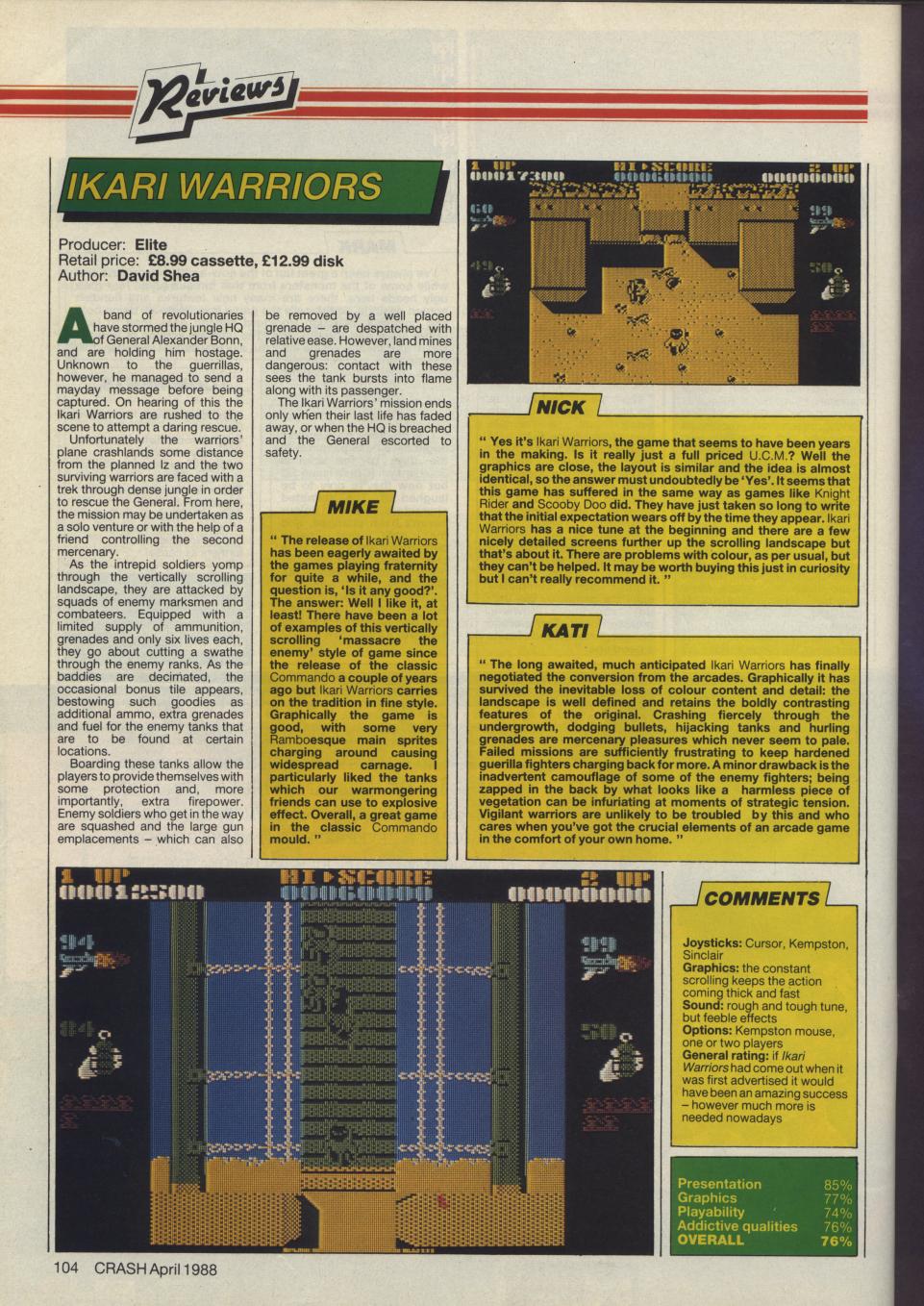
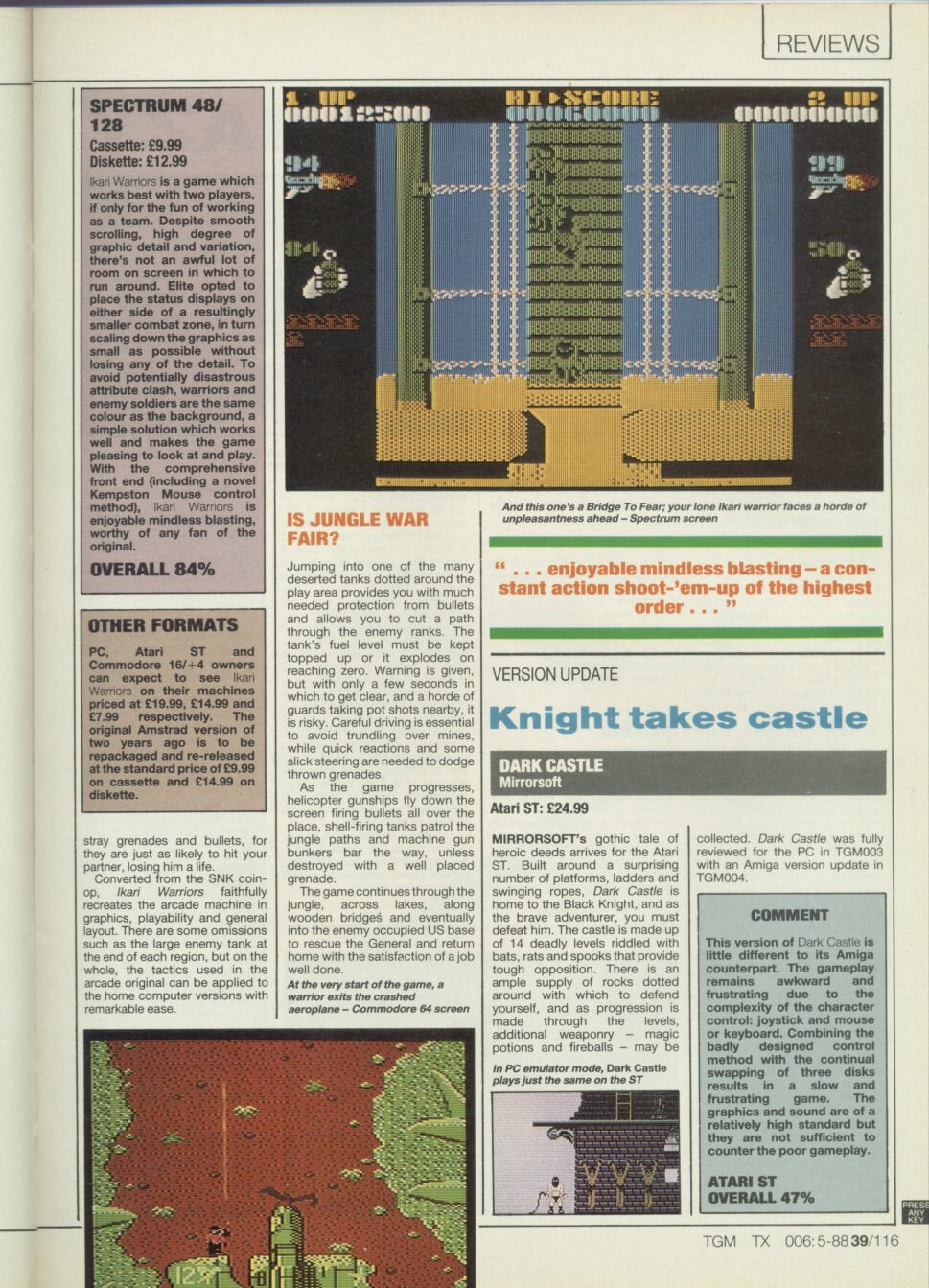
In 1988 Elite published a second Commodore 64 conversion (by John Twiddy, programmer of The Last Ninja), a new ZX Spectrum conversion (by David Shea, author of the Amstrad version) along with versions for the Commodore 16, Amiga and Atari ST.[18]
SNK released their own conversion for the MSX in 1987. The NES version was developed by Micronics. Atari Corporation released conversions for the Atari 2600 and Atari 7800 in 1990 as one of the final published games for those systems during their initial eras.
Hamster Corporation released the arcade version as part of their Arcade Archives series for the Nintendo Switch and PlayStation 4 in 2019.[20] The game was also included on the SNK 40th Anniversary Collection.
Reception
| Reviews (home conversions) | |||||||||||||||||||||||||||||||||||||||||||||||||||||||||||||||||||||||
|---|---|---|---|---|---|---|---|---|---|---|---|---|---|---|---|---|---|---|---|---|---|---|---|---|---|---|---|---|---|---|---|---|---|---|---|---|---|---|---|---|---|---|---|---|---|---|---|---|---|---|---|---|---|---|---|---|---|---|---|---|---|---|---|---|---|---|---|---|---|---|---|
| |||||||||||||||||||||||||||||||||||||||||||||||||||||||||||||||||||||||
In Japan, Game Machine listed Ikari as the most successful table arcade cabinet of March 1986.[29] It remained at the top of the magazine's table arcade cabinet charts through April[30][31] and early May,[32] before returning to the top in June 1986.[33] It went on to become Japan's second highest-grossing table arcade game of 1986.[34][35] In the United Kingdom, it was one of the top three highest-grossing arcade games of 1986 in London, appearing at number-three on the annual 1986 Electrocoin chart.[36]
In North America, Ikari Warriors was the second top-grossing arcade game on the monthly Play Meter charts in July 1986.[37] It went on to be one of the top five highest-grossing dedicated arcade games of 1986 according to AMOA,[38] and the year's eight highest arcade video game according to RePlay.[39] It was also among the top five dedicated arcade games of 1987.[40]
In 1996, Next Generation listed the arcade version of Ikari Warriors as number 61 on their "Top 100 Games of All Time", lauding the innovative joysticks, play balance, and power-ups which offer an invigorating boost to the player character's capabilities without taking away the game's challenge.[13]
Conversions
Computer and Video Games enthusiastically reviewed the "classy" Amstrad personal computer conversion, calling the graphics "simply brilliant" and the gameplay "awesomely addictive". They said that players "won't see better ... probably for quite a while" because "the Amstrad graphics are as close as dammit to the arcade machine and the playability goes off the C+VG scale".[8]
The IBM PC version of the game received 4 out of 5 stars in Dragon.[23]
Legacy
Ikari Warriors spawned the sequels Victory Road (1986) and Software:Ikari III: The Rescue (1989).
SNK released an Ikari Warriors clone in 1987 called Guerrilla War (known as Guevara in Japan). The game features communist fighters Che Guevara and Fidel Castro as its heroes.
Sylvester Stallone, whose role as John Rambo had an influence on the game, owned an Ikari Warriors arcade cabinet in the 1980s. The future mixed martial arts (MMA) champion Kazushi Sakuraba (later famous for defeating the Gracie family of Brazilian jiu-jitsu fighters) was also a fan of Ikari in his high school years.[3]
The characters Ralf and Clark appeared again as playable characters in Metal Slug 6 and 7, as well as in The King of Fighters series. Their names were used for two minor unrelated characters in Crystalis, and they were featured as cameos in Super Smash Bros. Ultimate as background characters in the King Of Fighters Stadium stage.
See also
- Front Line, a 1982 arcade game with similar gameplay, including a rotary knob and drivable tanks
- Time Soldiers, a 1987 arcade shooter with similar gameplay, released by SNK
Notes
References
- ↑ 1.0 1.1 "Overseas Readers Column: SNK Unveiled Video "Ikari" With Its Anger". Game Machine (Amusement Press, Inc.) (279): 22. 15 March 1986. https://onitama.tv/gamemachine/pdf/19860315p.pdf#page=12.
- ↑ "Video Game Flyers: Ikari Warriors, SNK (Spain)". https://flyers.arcade-museum.com/?page=flyer&db=videodb&id=4523&image=1.
- ↑ 3.0 3.1 3.2 3.3 3.4 "「怒」を作った男". Continue. March 2001. http://shmuplations.com/snkgoldenage/.
- ↑ 4.0 4.1 Akagi, Masumi (13 October 2006) (in ja). アーケードTVゲームリスト国内•海外編(1971-2005). Japan: Amusement News Agency. pp. 19, 134. ISBN 978-4990251215. https://archive.org/details/ArcadeGameList1971-2005/page/n19.
- ↑ "怒(いかり) まとめ [アーケード] / ファミ通.com". February 22, 2014. http://www.famitsu.com/cominy/?m=pc&a=page_h_title&title_id=25452.
- ↑ "NES Games". Nintendo of America. https://www.nintendo.com/consumer/downloads/nes_games.pdf.
- ↑ 7.0 7.1 Famitsu staff (November 14, 1986). "新作ゲームクロスレビュー" (in ja). Famicom Tsūshin (ASCII Corporation) (11): 9. http://www.famitsu.com/cominy/?m=pc&a=page_h_title&title_id=19723. Retrieved June 23, 2022.
- ↑ 8.0 8.1 8.2 8.3 Tim Metcalfe (January 1987). "Ikari Warriors (Amstrad review)". Computer and Video Games (EMAP) (63): 19. https://spectrumcomputing.co.uk/page.php?issue_id=1514&page=19. Retrieved 7 May 2021.
- ↑ "怒(いかり) まとめ [MSX] / ファミ通.com". February 22, 2014. http://www.famitsu.com/cominy/?m=pc&a=page_h_title&title_id=23053.
- ↑ "Availability Update". Computer Entertainer 6 (11): p. 14. February 1988. https://archive.gamehistory.org/item/c09394af-6249-46ab-ac73-256346227e2f.
- ↑ "Availability Update". Computer Entertainer 7 (6): p. 14. September 1988. https://archive.gamehistory.org/item/a0358c56-b638-4760-b363-343c0e92f4d9.
- ↑ "Short step to 7800 and 2600 games". Computer Entertainer 9 (4): p. 13. July 1990. https://archive.gamehistory.org/item/3783dc2d-0ea2-40f6-a9da-04743a333c10.
- ↑ 13.0 13.1 "Top 100 Games of All Time". Next Generation (Imagine Media) (21): 48. September 1996.
- ↑ "Transfer lever as well as turret turning knob". SNK T.A.N.K flyer, 1985.
- ↑ "This arcade game was the first SNK game to use the special rotary joystick.". Vintagearcade.net. http://vintagearcade.net/ClassicArcadeGames/1_video_games/TNK3.php.
- ↑ [1]
- ↑ "Escher's Mame Rotary Joystick Fix Mame Version .63 Updated from v.59 to work with v.63 by Jake Stookey". Mame.hower.us. January 23, 2003. http://mame.hower.us/rotary/.
- ↑ 18.0 18.1 Martyn Carroll (25 February 2016). "The History of Ikari Warriors". Retro Gamer (Imagine Publishing) (152): 34.
- ↑ "Elite's Autumn Extravaganza". Crash (Newsfield) (33): 137. October 1986. https://spectrumcomputing.co.uk/page.php?issue_id=1000&page=137. Retrieved 7 May 2021.
- ↑ Calvert, Darren (2019-03-14). "Nintendo Download: 14th March (North America)" (in en-GB). https://www.nintendolife.com/news/2019/03/nintendo_download_14th_march_north_america.
- ↑ "Archive - Magazine viewer". World of Spectrum. http://wos.meulie.net/pub/sinclair/magazines/Crash/Issue51/Pages/Crash5100104.jpg.
- ↑ "Computer and Video Games Magazine Issue 101". https://archive.org/stream/computer-video-games-magazine-101/CVG101_Apr_1990#page/n61/mode/2up.
- ↑ 23.0 23.1 Lesser, Hartley; Lesser, Patricia; Lesser, Kirk (February 1989). "The Role of Computers". Dragon (142): 42–51. https://fapestniegd.xen.prgmr.com/dragon/Drmg142.pdf#page=44.
- ↑ "Archive - Magazine viewer". World of Spectrum. http://wos.meulie.net/pub/sinclair/magazines/SinclairUser/Issue073/Pages/SinclairUser07300105.jpg.
- ↑ "Ikari Warriors". Ysrnry.co.uk. http://www.ysrnry.co.uk/articles/ikariwarriors.htm.
- ↑ Atari ST User, Vol. 3, No. 4 (June 1988), pages 44-45
- ↑ "Critically Speaking...Nintendo Compatible". Computer Entertainer 6 (3): p. 13. June 1987. https://archive.gamehistory.org/item/223b8697-9fc7-471f-8603-20725c45c99a.
- ↑ "Archive - Magazine viewer". World of Spectrum. https://wos.meulie.net/pub/sinclair/magazines/TheGamesMachine/Issue06/Pages/TheGamesMachine0600039.jpg.
- ↑ "Game Machine's Best Hit Games 25 - テーブル型TVゲーム機 (Table Videos)". Game Machine (Amusement Press, Inc.) (280): 21. 15 March 1986.
- ↑ "Best Hit Games 25". Game Machine (Amusement Press, Inc.) (280): 21. 1 April 1986. https://onitama.tv/gamemachine/pdf/19860401p.pdf#page=11.
- ↑ "Best Hit Games 25". Game Machine (Amusement Press, Inc.) (281): 21. 15 April 1986. https://onitama.tv/gamemachine/pdf/19860415p.pdf#page=11.
- ↑ "Best Hit Games 25". Game Machine (Amusement Press, Inc.) (282): 19. 1 May 1986. https://onitama.tv/gamemachine/pdf/19860501p.pdf#page=10.
- ↑ "Best Hit Games 25". Game Machine (Amusement Press, Inc.) (281): 21. 15 April 1986. https://onitama.tv/gamemachine/pdf/19860415p.pdf#page=11.
- ↑ "Game Machine's Best Hit Games 25: '86 上半期". Game Machine (Amusement Press, Inc.) (288): 28. 15 July 1986. https://onitama.tv/gamemachine/pdf/19860715p.pdf#page=15.
- ↑ "Game Machine's Best Hit Games 25: '86 下半期". Game Machine (Amusement Press, Inc.) (300): 16. 15 January 1987. https://onitama.tv/gamemachine/pdf/19870115p.pdf#page=9.
- ↑ "1986 Top Ten Coin-Ops". Sinclair User (59 (February 1987)): 96. 18 January 1987. https://archive.org/details/sinclair-user-magazine-059/page/n94/mode/1up.
- ↑ "National Play Meter". Play Meter 12 (12): 74–5. July 15, 1986. https://archive.org/details/play-meter-volume-12-number-12-july-15th-1986-600dpi/Play%20Meter%20-%20Volume%2012%2C%20Number%2012%20-%20July%2015th%201986%20%28Compressed%29/page/74.
- ↑ "Coin Machine: AMOA Announces Awards Nominations". Cash Box: 38. August 23, 1986. https://worldradiohistory.com/Archive-All-Music/Cash-Box/80s/1986/CB-1986-08-23.pdf#page=38.
- ↑ "Top 20 of 1986". Top Score (Amusement Players Association): p. 3. July–August 1987. http://www.videoparadise-sanjose.com/ts-3.htm.
- ↑ "Nominees Announced For AMOA's JB, Games, & Vending Promo Awards". Cash Box: 37. October 3, 1987. https://worldradiohistory.com/Archive-All-Music/Cash-Box/80s/1987/CB-1987-10-03.pdf#page=37.
External links
- Ikari Warriors at the Killer List of Videogames
- MobyGames is a commercial database website that catalogs information on video games and the people and companies behind them via crowdsourcing. This includes over 300,000 games for hundreds of platforms.[1] Founded in 1999, ownership of the site has changed hands several times. It has been owned by Atari SA since 2022.
Features
Edits and submissions to the site (including screenshots, box art, developer information, game summaries, and more) go through a verification process of fact-checking by volunteer "approvers".[2] This approval process after submission can range from minutes to days or months.[3] The most commonly used sources are the video game's website, packaging, and credit screens. There is a published standard for game information and copy-editing.[4] A ranking system allows users to earn points for contributing accurate information.[5]
Registered users can rate and review games. Users can create private or public "have" and "want" lists, which can generate a list of games available for trade with other registered users. The site contains an integrated forum. Each listed game can have its own sub-forum.
History

MobyGames was founded on March 1, 1999, by Jim Leonard and Brian Hirt, and joined by David Berk 18 months later, the three of which had been friends since high school.[6][7] Leonard had the idea of sharing information about computer games with a larger audience. The database began with information about games for IBM PC compatibles, relying on the founders' personal collections. Eventually, the site was opened up to allow general users to contribute information.[5] In a 2003 interview, Berk emphasized MobyGames' dedication to taking video games more seriously than broader society and to preserving games for their important cultural influence.[5]
In mid-2010, MobyGames was purchased by GameFly for an undisclosed amount.[8] This was announced to the community post factum , and the site's interface was given an unpopular redesign.[7] A few major contributors left, refusing to do volunteer work for a commercial website.{{Citation needed|date=June 2025} On December 18, 2013, MobyGames was acquired by Jeremiah Freyholtz, owner of Blue Flame Labs (a San Francisco-based game and web development company) and VGBoxArt (a site for fan-made video game box art).[9] Blue Flame Labs reverted MobyGames' interface to its pre-overhaul look and feel,[10] and for the next eight years, the site was run by Freyholtz and Independent Games Festival organizer Simon Carless.[7]
On November 24, 2021, Atari SA announced a potential deal with Blue Flame Labs to purchase MobyGames for $1.5 million.[11] The purchase was completed on 8 March 2022, with Freyholtz remaining as general manager.[12][13][14] Over the next year, the financial boost given by Atari led to a rework of the site being built from scratch with a new backend codebase, as well as updates improving the mobile and desktop user interface.[1] This was accomplished by investing in full-time development of the site instead of its previously part-time development.[15]
In 2024, MobyGames began offering a paid "Pro" membership option for the site to generate additional revenue.[16] Previously, the site had generated income exclusively through banner ads and (from March 2014 onward) a small number of patrons via the Patreon website.[17]
On February 13, 2025, Freyholtz stepped down as the site lead to move onto new projects, leaving operations to Tracy Poff, a veteran coder on the site, and Atari staff.[18]
See also
- IGDB – game database used by Twitch for its search and discovery functions
References
- ↑ 1.0 1.1 Sheehan, Gavin (2023-02-22). "Atari Relaunches The Fully Rebuilt & Optimized MobyGames Website". https://bleedingcool.com/games/atari-relaunches-the-fully-rebuilt-optimized-mobygames-website/.
- ↑ Litchfield, Ted (2021-11-26). "Zombie company Atari to devour MobyGames". https://www.pcgamer.com/zombie-company-atari-to-devour-mobygames/.
- ↑ "MobyGames FAQ: Emails Answered § When will my submission be approved?". Blue Flame Labs. 30 March 2014. http://www.mobygames.com/info/faq7#g1.
- ↑ "The MobyGames Standards and Practices". Blue Flame Labs. 6 January 2016. http://www.mobygames.com/info/standards.
- ↑ 5.0 5.1 5.2 Miller, Stanley A. (2003-04-22). "People's choice awards honor favorite Web sites". Milwaukee Journal Sentinel.
- ↑ "20 Years of MobyGames" (in en). 2019-02-28. https://trixter.oldskool.org/2019/02/28/20-years-of-mobygames/.
- ↑ 7.0 7.1 7.2 Plunkett, Luke (2022-03-10). "Atari Buys MobyGames For $1.5 Million". https://kotaku.com/mobygames-retro-credits-database-imdb-atari-freyholtz-b-1848638521.
- ↑ "Report: MobyGames Acquired By GameFly Media". Gamasutra. 2011-02-07. https://www.gamedeveloper.com/game-platforms/report-mobygames-acquired-by-gamefly-media.
- ↑ Corriea, Alexa Ray (December 31, 2013). "MobyGames purchased from GameFly, improvements planned". http://www.polygon.com/2013/12/31/5261414/mobygames-purchased-from-gamefly-improvements-planned.
- ↑ Wawro, Alex (31 December 2013). "Game dev database MobyGames getting some TLC under new owner". Gamasutra. https://www.gamedeveloper.com/business/game-dev-database-mobygames-getting-some-tlc-under-new-owner.
- ↑ "Atari invests in Anstream, may buy MobyGames". November 24, 2021. https://www.gamesindustry.biz/articles/2021-11-24-atari-invests-in-anstream-may-buy-mobygames.
- ↑ Rousseau, Jeffrey (2022-03-09). "Atari purchases Moby Games". https://www.gamesindustry.biz/atari-purchases-moby-games.
- ↑ "Atari Completes MobyGames Acquisition, Details Plans for the Site's Continued Support". March 8, 2022. https://www.atari.com/atari-completes-mobygames-acquisition-details-plans-for-the-sites-continued-support/.
- ↑ "Atari has acquired game database MobyGames for $1.5 million" (in en-GB). 2022-03-09. https://www.videogameschronicle.com/news/atari-has-acquired-game-database-mobygames-for-1-5-million/.
- ↑ Stanton, Rich (2022-03-10). "Atari buys videogame database MobyGames for $1.5 million". https://www.pcgamer.com/atari-buys-videogame-database-mobygames-for-dollar15-million/.
- ↑ Harris, John (2024-03-09). "MobyGames Offering “Pro” Membership". https://setsideb.com/mobygames-offering-pro-membership/.
- ↑ "MobyGames on Patreon". http://www.patreon.com/mobygames.
- ↑ "An update on MobyGames leadership". 2025-02-13. https://www.mobygames.com/forum/3/thread/269628/an-update-on-mobygames-leadership/#post-269628.
 |
Wikidata has the property:
|

External links
- No URL found. Please specify a URL here or add one to Wikidata.
 |  |
- Ikari Warriors at SpectrumComputing.co.uk
| |