Unsolved:Lick Object of 1921
| Discovery | |
|---|---|
| Discovered by | William W. Campbell |
| Discovery date | 7 August 1921 |
| Orbital characteristics A | |
| Perihelion | ~0.25 AU |
The Lick Object of 1921 is an unidentified astronomical object that was observed from the Lick Observatory in August 1921. Although follow-up observations were not successfully conducted, it is hypothesized that this object is highly likely a non-periodic comet.[1]
Observational history
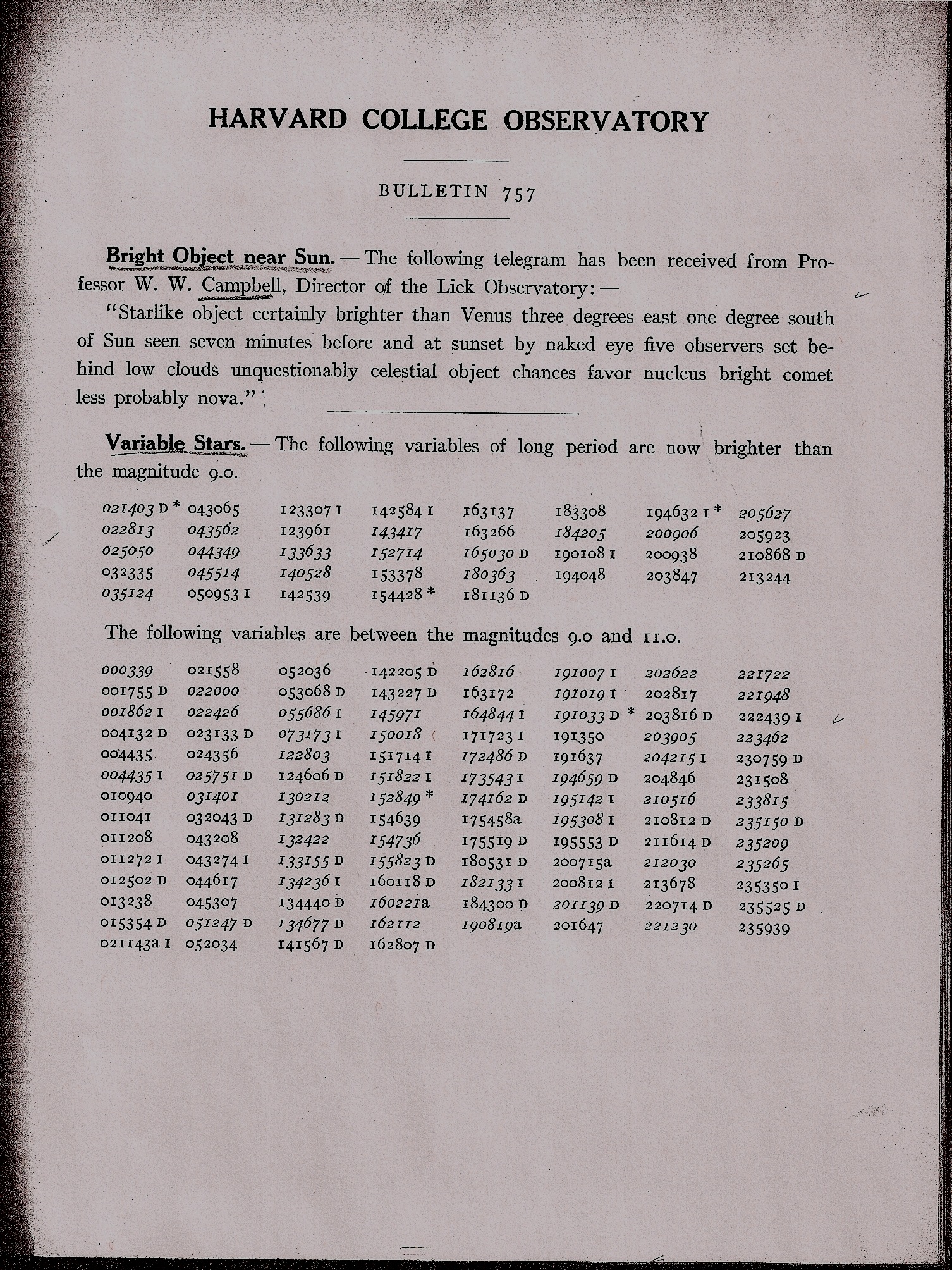
William Wallace Campbell reported the sighting of a star-like object about three degrees from the Sun on the evening of 7 August 1921.[2][3] Observers noted that the object was as bright as Venus, reaching an apparent magnitude of –2 at its maximum.[4] A possibility that it was a nova explosion was ruled out due to its high relative position (about 40 degrees) to the Galactic plane.[lower-alpha 1]
Zdenek Sekanina and Rainer Kracht published a study in 2016 where they concluded that the Lick object is highly likely a fragment of the same parent body as the comet C/1847 C1 (Hind).[1] Their findings suggested that the Lick Object and C/1847 C1 splitted from a parent body sometime during their perihelion on the 7th millennium BC at a relative velocity of ~1.0–1.5 m/s (3.3–4.9 ft/s).[1]
References
Notes
Citations
- ↑ 1.0 1.1 1.2 Z. Sekanina; R. Kracht (2016). "Pairs and Groups of Genetically Related Long-Period Comets and Probable Identity of the Mysterious Lick Object of 1921". The Astrophysical Journal 823 (1). doi:10.3847/0004-637X/823/1/2. https://iopscience.iop.org/article/10.3847/0004-637X/823/1/2/pdf.
- ↑ 2.0 2.1 W. W. Campbell. "Observations of an Unidentified Object Seen Near the Sun on Sunday, August 7, 1921". Publications of the Astronomical Society of the Pacific 33 (195): 258–260. https://www.jstor.org/stable/pdf/40668524.pdf.
- ↑ S. I. Bailey (9 August 1921). "Bright Object near Sun". Harvard College Observatory Bulletin 757. http://tamkin2.eps.harvard.edu/IAUCs/HCOB757a.jpg.
- ↑ J. A. Pearce (1921). "The Unidentified Bright Object Seen Near the Sun, August 7, 1921". Journal of the Royal Astronomical Society of Canada 15: 364–367. Bibcode: 1921JRASC..15..364P. https://ui.adsabs.harvard.edu/link_gateway/1921JRASC..15..364P/ADS_PDF.


 |  |